Inevitably, the 'Pléiadisation' of Pierre Drieu la Rochelle (1893–1945) last year (2012) brought shocked objections. How could it not? A fascist's writings allowed into the esteemed Pléiade? Fascist Drieu certainly was (specifically from 1934), although he saved his friend Jean Paulhan from the Gestapo, and also saved such writers as Sartre. Drieu's life in any case can't be reduced to simplistic condemnations: he was riddled with contradictions. What would have become of him if he'd gone into hiding after the liberation of Paris (as for instance André Malraux suggested) and not killed himself?
31 October 2013
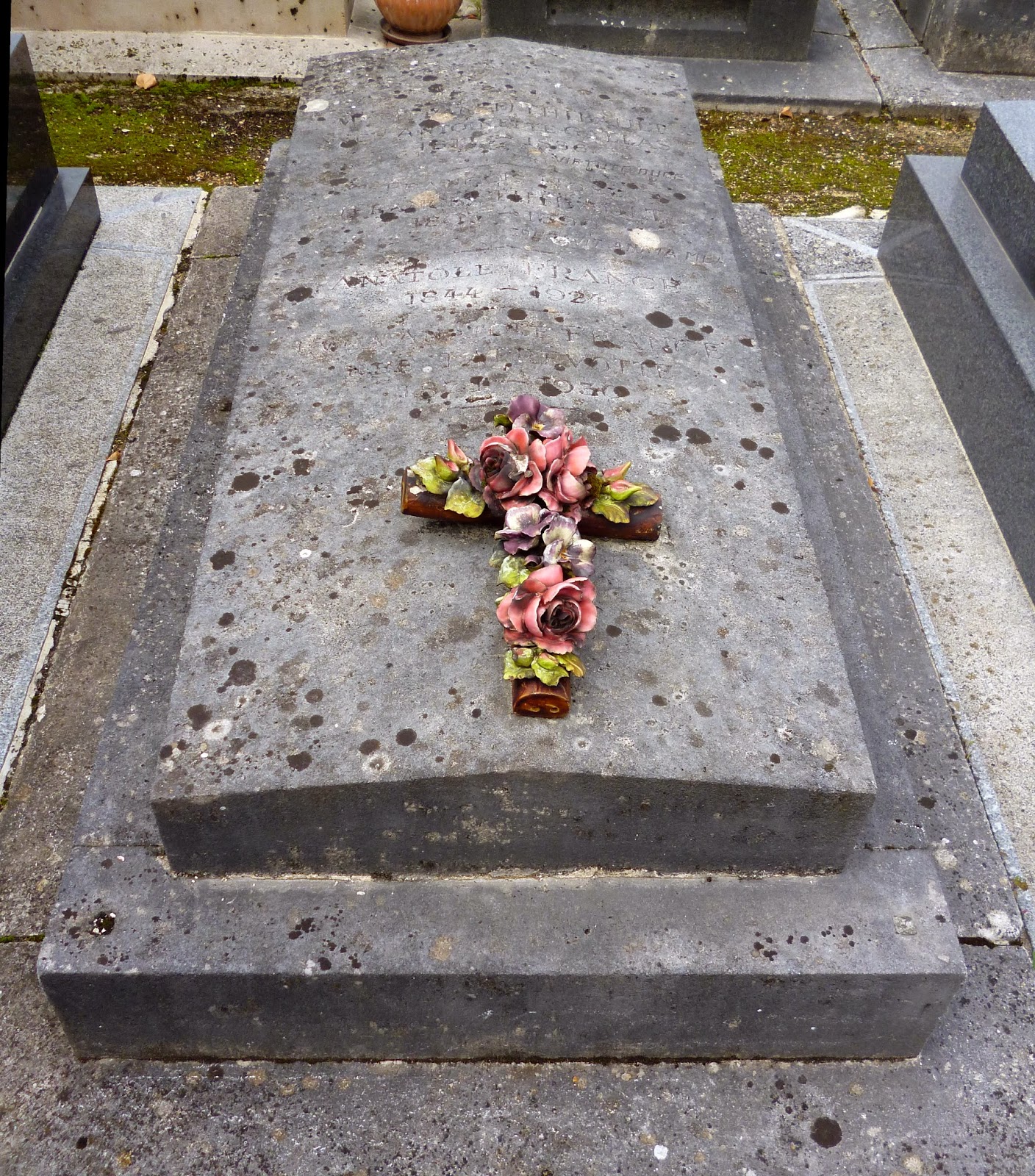
Anatole France: Le Cimetière ancien de Neuilly-sur-Seine #2
Libellés :
France (Anatole),
Hauts-de-Seine (92),
Neuilly-sur-Seine (92)
This time I had no trouble finding the grave of Anatole France (1844–1924), François Anatole Thibault's pseudonym. He was one of the greatest writers and literary critics of the late 19th and early 20th centuries, and in 1921 he was awarded the Noble Prize for Literature. He was also involved in many of the social and political concerns of his time – he was a Dreyfusard, for instance.
A great number of Anatole France's books are freely available online, in French and in English, via Project Gutenberg. I provide a link to them below, as well as to my original post of other graves in this cemetery:
Charles de Bernard: Le Cimetière ancien de Neuilly-sur-Seine #1
'ICI
REPOSE
CHARLES DE BERNARD
du Grail.
NÉ À BESANÇON (DOUBS)
LE 24 FÉVRIER, 1804.
DÉDÉDÉ À SABLONVILLE, CN DE NEUILLY*,
LE 6 MARS 1850.
LE 24 FÉVRIER, 1804.
DÉDÉDÉ À SABLONVILLE, CN DE NEUILLY*,
LE 6 MARS 1850.
ÉCRIVAIN DISTINGUÉ.
MODESTE DANS LE SUCCÈS.
SIMPLE DANS SES HABITUDES.
COEUR NOBLE ET DÉVOUÉ.
IL A VÉCUT POUR SA FEMME
ET SES ENFANS
DONT IL FIT LE BONHEUR.
PRIEZ POUR LUI.'
MODESTE DANS LE SUCCÈS.
SIMPLE DANS SES HABITUDES.
COEUR NOBLE ET DÉVOUÉ.
IL A VÉCUT POUR SA FEMME
ET SES ENFANS
DONT IL FIT LE BONHEUR.
PRIEZ POUR LUI.'
'DISTINGUISHED WRITER.
MODEST IN HIS SUCCESS.
SIMPLE IN HIS WAYS.
A NOBLE AND DEVOTED HEART.
HE LOVED HIS WIFE
AND CHILDREN
WHOM HE FILLED WITH HAPPINESS.
PRAY FOR HIM.'
Charles de Bernard was a novelist and short story writer who was very popular in the 1840s. He was a friend of Balzac and was translated into English and appreciated both in Great Britain and the USA.
Time has not been kind to his memory. Writing in the late 1870s, Henry James considered him a second-rate French author largely of only historical interest. He is almost forgotten today.
*Sablonville (literally 'Sandtown') was a village in the commune of Neuilly-sur-Seine. Today the nearby métro station Les Sablons (Jardin d'Acclimatation) remembers the Plaine des Sablons, where sand was extracted for building purposes.
Below is a link to a novel by Bernard, plus a link to an earlier post I made on other graves in this cemetery:
–––––––––––––––––––––––––––––––––––
Charles de Bernard: Le Noeud gordien (1938)
Cimetière ancien de Neuilly-sur-Seine
Charles de Bernard: Le Noeud gordien (1938)
Cimetière ancien de Neuilly-sur-Seine
30 October 2013
Eça de Queiroz in Neuilly-sur-Seine, Hauts-de-Seine (92)
Libellés :
Eça de Queiroz,
France,
Hauts-de-Seine (92),
Île-de-France,
Neuilly-sur-Seine (92)
I'll try to keep these posts (photos shot in a month in the Paris area mid-September to mid-October) in date order, although I may fail because of tricky ones I have to research too much. This was the first day and the clouds appearing to predict rain held off most of the time – in fact almost all of the time it was superb summer weather until the last few days.
OK, here goes, and the first writer mentioned isn't even French.
Eça de Queiroz – also (particularly in modern Portuguese) written Eça de Queirós – is noted for his naturalist novels and for introducing naturalism into Portuguese literature. He is sometimes called the Portuguese Zola, although Flaubert was probably a bigger influence on him, and Zola himself even rated him above Flaubert.
SCULPTURE DE ANTÓNIO TEIXEIRA LOPES
SELON UNE ÉTUDE DE 1903
OFFERTE PAR LA MAIRIE DE LISBONNE
EN PARTENARIAT AVEC
L'AMBASSADE DU PORTUGAL À PARIS
2004'
OK, here goes, and the first writer mentioned isn't even French.
'EÇA DE QUEIROZ
ÉCRIVAIN ET DIPLOMATE
1845–1900'
ÉCRIVAIN ET DIPLOMATE
1845–1900'
I chose not to crop the photo as I love the memory of the Grande Arche de La Défense relatively close behind me as I capture this in the central reservation on avenue Charles de Gaulle in Neuilly-sur-Seine, the bust obscuring a distant Arc de triomphe.
'EÇA DE QUEIROZ, CONSUL DU PORTUGAL
À PARIS, EST MORT À NEUILLY-SUR-SEINE
LE 16 AOÛT 1900
À PARIS, EST MORT À NEUILLY-SUR-SEINE
LE 16 AOÛT 1900
SCULPTURE DE ANTÓNIO TEIXEIRA LOPES
SELON UNE ÉTUDE DE 1903
OFFERTE PAR LA MAIRIE DE LISBONNE
EN PARTENARIAT AVEC
L'AMBASSADE DU PORTUGAL À PARIS
2004'
Eça de Queiroz first worked as the Portuguese consul in Paris in 1888. Although he died in Neuilly, he was buried in Portugal.
Samuel Rogers in Hornsey
Libellés :
Haringey,
Hornsey,
London,
Rogers (Samuel)
The tomb of the poet Samuel Rogers (1763–1855), where he joined his brother Henry and his sister Sarah in the churchyard at St Mary's, Hornsey. The inscription on the tomb notes that he was the author of 'The Pleasures of Memory'.
Below is a link to an online book of his poems:
–––––––––––––––––––––––––––––––––––
The Poems of Samuel Rogers, with a Memoir (1850)
Alexander Pope in Chiswick
Libellés :
Chiswick,
London,
Pope (Alexander),
Richmond upon Thames
'ALEXANDER
POPE
1688–1744
Poet
lived in this row,
Mawson's Buildings
1716–1719'
The building the plaque is on is now a pub, although for some reason I shot it at a very bad angle.
And the pub has two names – the Mawson Arms and the Fox and Hounds, as there were once two pubs on the site. The above plaque says that Pope lived here with his parents from 1716 to 1719, although Pope's father died in 1717.
–––––––––––––––––––––––––––––––––––
Alexander Pope's Grotto in Twickenham
Alexander Pope in St Marys Church, Twickenham
Alexander Pope in Stanton Harcourt, Oxfordshire
Anthony Beckles Willson: Mr Pope & others at Cross DeepAlexander Pope's Grotto in Twickenham
Alexander Pope in St Marys Church, Twickenham
Alexander Pope in Stanton Harcourt, Oxfordshire
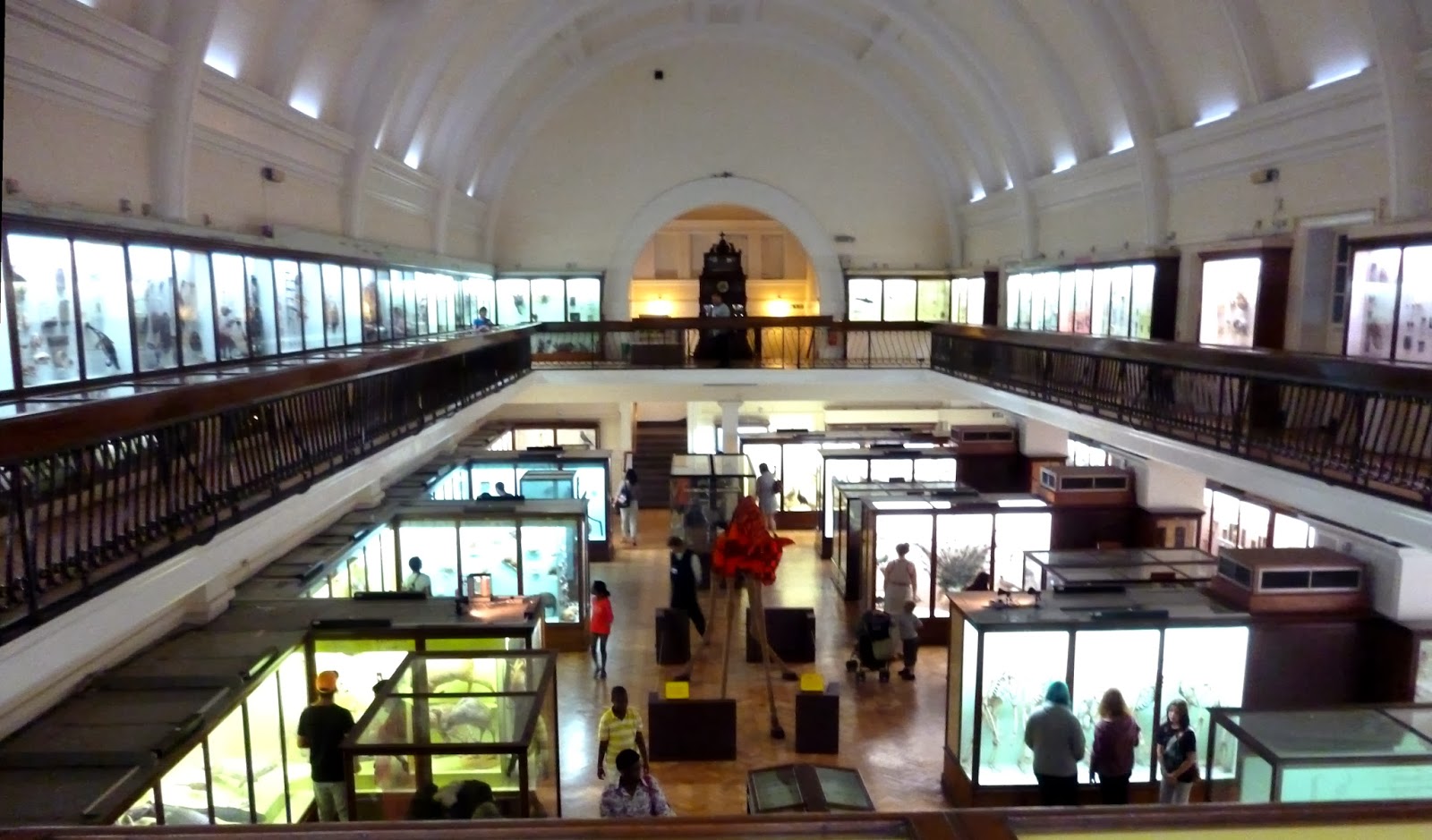
The Horniman Museum, Forest Hill, Lewisham
Libellés :
Forest Hill,
Horniman (Annie),
Horniman (Frederick John),
Lewisham,
London,
Manchester School
'THE
HORNIMAN
MUSEUM
AND GARDENS
WERE GIVEN TO
THE PEOPLE OF LONDON
IN 1901 BY
FREDERICK JOHN
HORNIMAN
WHO LIVED NEAR
THIS SITE'
HORNIMAN
MUSEUM
AND GARDENS
WERE GIVEN TO
THE PEOPLE OF LONDON
IN 1901 BY
FREDERICK JOHN
HORNIMAN
WHO LIVED NEAR
THIS SITE'
Frederick John Horniman (1835–1906) inherited his father John Horniman's firm, which towards the end of the 19th century was the largest tea business in the world. Frederick travelled the world collecting various specimens of natural history or cultural objects, his stated purpose being to 'bring the world to Forest Hill'.
The mosaic is Humanity in the House of Circumstance, designed by Robert Anning Bell. From the left, the figures represent Art, Poetry, Music, and Endurance; the central figure represents Humanity, with Love on the left and Hope on the right; then come Charity, Wisdom, Meditation (seated), and Resignation. The door on the left represents Birth, the door on the right Death.
Just an indication of the size of the place.
The Conservatory.
(As a point of interest, Annie Horniman (1860–1937), the daughter of Frederick and Rebekah (née Elmslie) Horniman, founded the Gaiety Theatre in Manchester, noted for what became known as the Manchester School of playwrights (e.g. Harold Brighouse, Stanley Houghton, Allan Monkhouse, etc).)
29 October 2013
Highgate Cemetery (West) #4: Frederick Tennyson
Libellés :
Highgate,
London,
Tennyson (Alfred Lord),
Tennyson (Frederick)
'SACRED TO THE MEMORY OF
FREDERICK TENNYSON,
POET AND SCHOLAR,
BORN AT LOUTH, LINCOLNSHIRE,
JUNE 15th 1807,
DIED AT KENSINGTON, LONDON,
FEBRUARY 26 th 1898,
IN HIS 91st YEAR.
ERECTED BY HIS ELDEST SON
JULIUS GEORGE TENNYSON,
IN TOKEN OF AFFECTION.'
FREDERICK TENNYSON,
POET AND SCHOLAR,
BORN AT LOUTH, LINCOLNSHIRE,
JUNE 15th 1807,
DIED AT KENSINGTON, LONDON,
FEBRUARY 26 th 1898,
IN HIS 91st YEAR.
ERECTED BY HIS ELDEST SON
JULIUS GEORGE TENNYSON,
IN TOKEN OF AFFECTION.'
Frederick Tennyson was an elder brother of Alfred who was temporarily expelled from Cambridge University for refusing to accept punishment for not attending chapel. He lived in Florence for twenty years and was heavily influenced by Swedenborg.
Highgate Cemetery (West) #2: Ellen Wood
Libellés :
Highgate,
London,
Wood (Ellen)
Ellen Wood (1814–87), who used to write under the self-effacing name of Mrs Henry Wood, is best known for her novel East Lynne (1861). She lived with her husband and family in France for twenty years, returning on the failure of her husband's business. In London, she supported her family on the profits of her many novels.
Below is a link to many of her works:
–––––––––––––––––––––––––––––––––––
Ellen Wood novels
Below is a link to many of her works:
–––––––––––––––––––––––––––––––––––
Ellen Wood novels
Highgate Cemetery (West) #1: Radclyffe Hall
Libellés :
Batten (Mabel),
Hall (Radclyffe),
Highgate,
London,
Troubridge (Una)
Unfortunately, admission to West Cemetery is by guided tour only, which means that you're at the mercy of the guide, and that (at least on the occasion when I went this August) could well mean that you'll be subjected to the predictable: the 'menagerist' George Wombwell, the boxer Tom Sayers, etc. If the guide isn't interested in literature, as ours obviously wasn't – then there'll not even be a mention of Christina Rossetti, let alone Radclyffe Hall or Ellen Wood. Which isn't good enough for me, so it was fortunate that I'd done some online research before, and had worked out that we'd be passing by the last two authors at least. In the end, I was surprised to find the number of graves I did find – but in spite of, rather than because of – the guide.
Radclyffe Hall (1880–1943) is probably most well known for her 'lesbian' novel The Well of Loneliness (1928), which was the subject of a court case. She lived with the singer Mabel Veronica Batten from her husband's death until Batten's own death in 1916.
Batten's cousin Una Troubridge (1887–1963) was a sculptor and translator (notably of Colette) who lived with Hall from 1917.
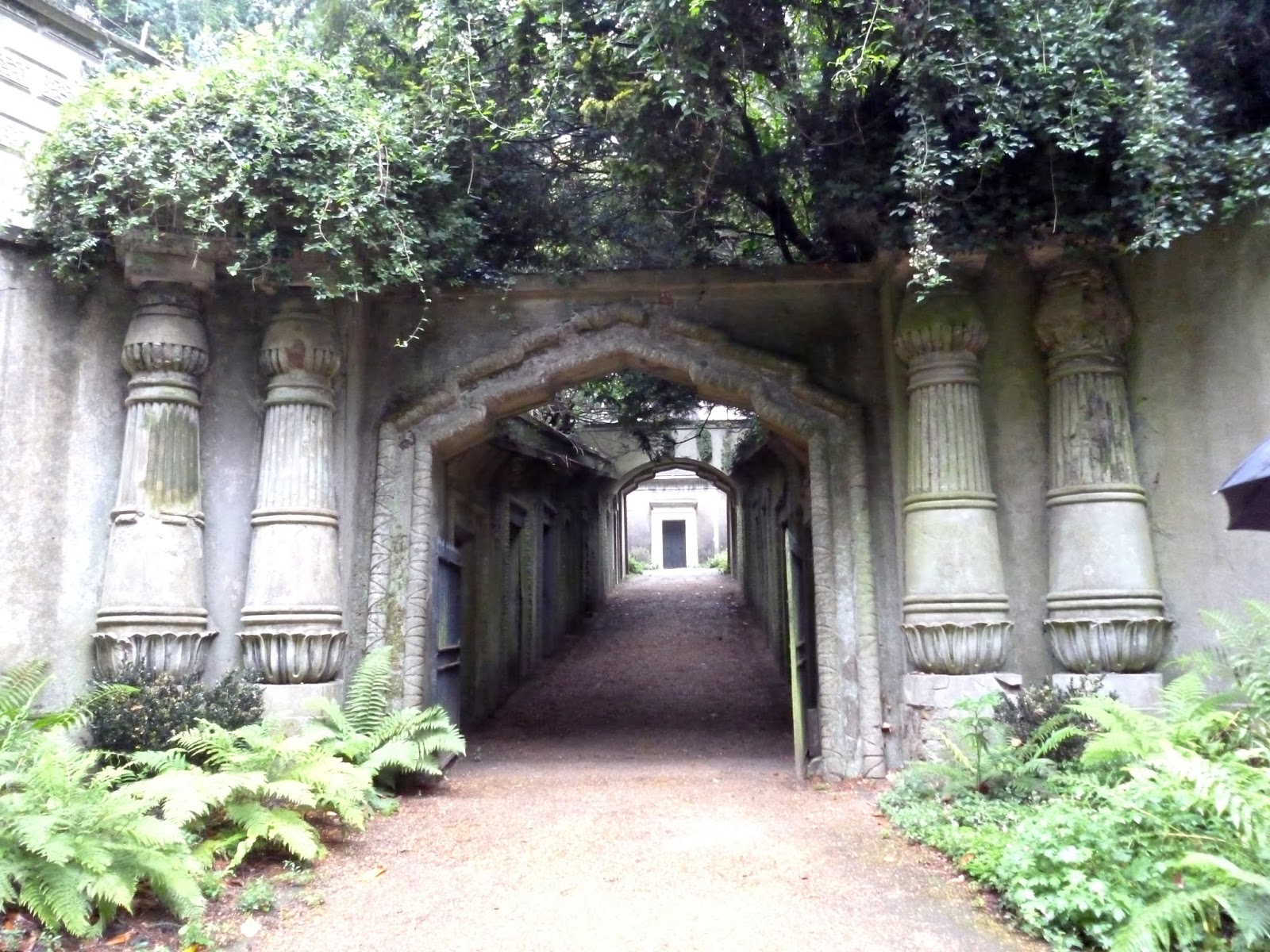
The Egyptian Avenue, leading on to the Circle of Lebanon.
'RADCLYFFE HALL
1943
...AND, IF GOD CHOOSE,
I SHALL BUT LOVE THEE BETTER
AFTER DEATH.
UNA.'
Pierre Petit: Molinier, une vie d'enfer (1992)
Libellés :
Breton (André),
French Art,
Molinier (Pierre),
Petit (Pierre)
'Ci-gît
Pierre MOLINIER
né le 13 avril 1900 mort vers 1950
ce fut un homme sans moralité
il s'en fit gloire et honneur
Inutile
de
P.P.L'
Pierre MOLINIER
né le 13 avril 1900 mort vers 1950
ce fut un homme sans moralité
il s'en fit gloire et honneur
Inutile
de
P.P.L'
26 October 2013
Frédéric Beigbeder: Premier bilan après l'apocalypse (2011)
Libellés :
Beigbeder (Frédéric),
French Literature
Before Premier bilan après l'apocalypse exploded on my consciousness, I'd only read two of Frédéric Beigbeder's novels: Mémoires d'un Jeune Homme Dérangé (1990) and 99 Francs (2000), both of which I've commented on before on this blog, and both of which I link below.
But Premier bilan is quite something else, and it's difficult to express how much I enjoyed this outrageously self-opinionated, repetitive, wholly original, quirky, bizarre, immensely informative, infuriating, moving, contemptible, cliquish, and quite brilliant book written with both deep sincerity and tongue firmly in cheek.
Beigbeder obviously has deep concerns for the future of the book: not so much that it will be consumed in the flames of a Ray Bradbury-style dystopian Fahrenheit 451, but that we shall move into a paperless society in which print be only be in the form of the virtual word, with no sense of touch or smell, etc, and whose technology may even destroy our literary heritage.
So, here are one hundred books from the (essentially late half of the) 20th century (and just a few more immediately before and after that century) that Beigbeder believes must be saved. As Beigbeder is French it is unsurprising that more than 50% of these books are in that language, and as he has connections with the USA it is unsurprising that more than 25% of the books are of American origin. But barely 10% of the books are by female authors, which would appear to suggest an unfortunate male bias. (Maybe he can be excused just this once.)
It would be churlish (even ignorant) of me to even attempt to mention (in mock anger) the number and quality of the writers Beigbeder has excluded here: this is an idiosyncratic list, a list of those books he loves and considers worthy of survival, and not a list of those works he personally thinks are, er, great works in themselves (if that has any meaning).
But the strength of this book is that it is idiosyncratic, even a little insane – Beigbeder, for instance, includes in his hundred books an album by French rock band Téléphone and contrives to make his number 69 by the very sexually-oriented San-Antonio (OK, Frédéric Dard), the book of choice (En avant la moujik!) being published in the 'année érotique' of 1969. Furthermore, as I'm far from being a fan of much of what passes for good contemporary English literature (by which I mean that produced by English nationals), I am very pleased to find that only five of the 100 entries are by English writers, and that two of those entries are books by J. G. Ballard, whom Beigbeder rates higher than the usual tedious suspects he dismissively mentions: David Lodge, Ian McEwan, Jonathan Coe, and Julian Barnes.1
I am delighted to note that Beigbeder includes the glorious Jean Rhys, who was born in Dominica to a Welsh father and a white Creole mother of Scottish ancestry; the fact that the chosen book isn't the usual (and atypical of Rhys's better work) Wide Sargasso Sea but Good Morning, Midnight (1939) shows that he knows what he's talking about. But then, going for lesser known works (which are often better in quality and/or are far more interesting) is Beigbeder's forte.
Premier bilan is no conventional trip through the memory lane of its writer, but a genuine attempt to pinpoint some of missing elements in the conventional lists of 'best' books. As such, it often mentions obscure works, even, perhaps, a few that are almost impossible to find without spending far more than idle curiosity would allow for (such as Alain Pacadis's Un jeune homme chic (1978)). But others are much more accessible (at least for buying online but not necessarily from the point of view of readability), such as Rose poussière (1972) by Jean-Jacques Schuhl. And then there are Les Couleurs de l'infamie by Albert Cossery, Brèves de comptoir by Jean-Marie Gourio and Autoportrait by Edouard Levé.
This is a book I shall consult again and again, just dipping into it, discovering (I'm sure) much more each time.
But Premier bilan is quite something else, and it's difficult to express how much I enjoyed this outrageously self-opinionated, repetitive, wholly original, quirky, bizarre, immensely informative, infuriating, moving, contemptible, cliquish, and quite brilliant book written with both deep sincerity and tongue firmly in cheek.
Beigbeder obviously has deep concerns for the future of the book: not so much that it will be consumed in the flames of a Ray Bradbury-style dystopian Fahrenheit 451, but that we shall move into a paperless society in which print be only be in the form of the virtual word, with no sense of touch or smell, etc, and whose technology may even destroy our literary heritage.
So, here are one hundred books from the (essentially late half of the) 20th century (and just a few more immediately before and after that century) that Beigbeder believes must be saved. As Beigbeder is French it is unsurprising that more than 50% of these books are in that language, and as he has connections with the USA it is unsurprising that more than 25% of the books are of American origin. But barely 10% of the books are by female authors, which would appear to suggest an unfortunate male bias. (Maybe he can be excused just this once.)
It would be churlish (even ignorant) of me to even attempt to mention (in mock anger) the number and quality of the writers Beigbeder has excluded here: this is an idiosyncratic list, a list of those books he loves and considers worthy of survival, and not a list of those works he personally thinks are, er, great works in themselves (if that has any meaning).
But the strength of this book is that it is idiosyncratic, even a little insane – Beigbeder, for instance, includes in his hundred books an album by French rock band Téléphone and contrives to make his number 69 by the very sexually-oriented San-Antonio (OK, Frédéric Dard), the book of choice (En avant la moujik!) being published in the 'année érotique' of 1969. Furthermore, as I'm far from being a fan of much of what passes for good contemporary English literature (by which I mean that produced by English nationals), I am very pleased to find that only five of the 100 entries are by English writers, and that two of those entries are books by J. G. Ballard, whom Beigbeder rates higher than the usual tedious suspects he dismissively mentions: David Lodge, Ian McEwan, Jonathan Coe, and Julian Barnes.1
I am delighted to note that Beigbeder includes the glorious Jean Rhys, who was born in Dominica to a Welsh father and a white Creole mother of Scottish ancestry; the fact that the chosen book isn't the usual (and atypical of Rhys's better work) Wide Sargasso Sea but Good Morning, Midnight (1939) shows that he knows what he's talking about. But then, going for lesser known works (which are often better in quality and/or are far more interesting) is Beigbeder's forte.
Premier bilan is no conventional trip through the memory lane of its writer, but a genuine attempt to pinpoint some of missing elements in the conventional lists of 'best' books. As such, it often mentions obscure works, even, perhaps, a few that are almost impossible to find without spending far more than idle curiosity would allow for (such as Alain Pacadis's Un jeune homme chic (1978)). But others are much more accessible (at least for buying online but not necessarily from the point of view of readability), such as Rose poussière (1972) by Jean-Jacques Schuhl. And then there are Les Couleurs de l'infamie by Albert Cossery, Brèves de comptoir by Jean-Marie Gourio and Autoportrait by Edouard Levé.
This is a book I shall consult again and again, just dipping into it, discovering (I'm sure) much more each time.
Premier bilan is an infuriating delight – wouldn't anyone be infuriated by someone trying to convince you that writers such as Bret Easton Ellis or Jay McInerney are way up there among the best in the world? – but it's the way that he says it. And he says things so well (if in a slightly exaggerated fashion). (Smiley definitely required there.)
I'll translate a few gems:
'As with all of [Cossery's] books, he praises laziness, condemns the rich with their possessions, and only respects beggars, outsiders, the poor. For him, these are the only free humans. [...] [L]et's stop classing the unemployed as handicapped when they are gods!'
'...celebrity, the new opium of the people...'
'[Ned Roram's] most beautiful sentences are those which we don't completely understand but feel deeply: they are addressed to the soul more than the head.'
'The film Breakfast at Tiffanys was absolutely charming but all the same it was an act of high treason. [Blake Edwards] turned a satire that could have been called 'The Fall of an Escort Girl' into a romantic moral comedy.'
'[Guillaume] Dustan cleverly synthesises the four most modern strands of contemporary literature: new realism (Houellebecq / Ravelec / Despentes), autofiction (Donner / Angot / Doubrovsky), experimental 'dandy rock' writing (Schuhl / Pacadis / Adrien), and gay porn (Renaud Camus / Hervé Guilbert / Vincent Borel).'
'When I was an adolescent – I still am, but no matter...' (Beigbeder was 48 when this book was published.)
Beigbeder knows a great deal about literature, he loves it, he's immensely pretentious (that's one of his great strengths: he's a joker), he's still way too laddish, he'll never grow up (also one of his greatest strengths), but after reading Premier bilan I wanted to ring him up and talk about this book (that's a reference to something he says) because I loved it, because of its brilliance and because of its superb arrogance. Beigbeder has a self-deprecation which, paradoxically, can only come from conviction of his great worth. No, of course I don't take this book seriously: it's too vital for that.
Another translation of mine from this book:
'I'm frightened of LSD (I've often been offered it but never wanted to try it). I don't sleep with minors (that's bad). But I love it when books allow me to know things I don't have a knowledge of.'
That, of course, is what reading should be all about. This is a human, wonderful – and wonderfully annoying – book. It easily makes my one hundred, all-time list.
–––––––––––––––––––––––––––––––––––
1 In Coe's defence, he wrote a brilliant biography of B. S. Johnson; Barnes's interest in Félix Fénéon and Alphonse Daudet are to be commended; Lodge is very good when talking about modernism; but McEwan, er... but then isn't he a friend of the dreadful Martin Amis?2
2 I noticed Philippe Djian (Beigbeder's number 18 with Maudit ménage and 95 with Clémence Picot) says (with apparent glee) in a magazine somewhere that the semi-colon is dead; oh no it's not.
My other Beigbeder posts:
–––––––––––––––––––––––––––––––––––
Frédéric Beigbeder: Mémoires d'un Jeune Homme Dérangé
Frédéric Beigbeder: 99 Francs
Frédéric Beigbeder: Un roman français
Frédéric Beigbeder: L'Amour dure trois ans | Love Lasts Three Years
Frédéric Beigbeder: Vacances dans le coma
24 October 2013
The Geffrye: Museum of the Home, Shoreditch, London
Libellés :
Geffrye (Robert),
Geffrye Museum,
Hackney,
London,
Shoreditch
The Geffrye Museum on Kingsland Road, Shoreditch, was established in 1914, originally being almshouses built in 1714.
Sir Robert Geffrye, the founder of the almshouses and Master of the Ironmongers' Company.
Up to fifty elderly poor people lived around this front garden area.
A partial view of the inside of the chapel.
On the other side, the reading room overlooks the back garden.
But the essential part of the museum is its display of home interiors, of which I found that the most recent ones were the easiest to photograph. They all represent middle-class homes. The room above is a reconstruction of an Edwardian (1900–14) drawing room in a semi-detached house. Electricity would have been a feature.
A 1930s living-cum-dining room in a London flat, which would have had running hot water, central heating, and wide windows.
A living-cum-dining room typical of an early 1960s house. The focal point of the room moves from the fireplace to the television.
Finally, from the 1990s, commercial premises converted into living space. Bare floorboards, minimal furniture.
The back garden.
An outside view of the reading room.
There is also a tiny cemetery which includes the founder's tomb.
23 October 2013
Sou Fujimoto and the Serpentine Gallery Pavilion 2013
Libellés :
Fujimoto (Sou),
Kensington Gardens,
Serpentine Gallery
The 2013 Serpentine Gallery Pavilion (open 1 June 2013 to 20 October 2013) was designed by the youngest person to accept the commission, 41-year-old Japanese architect Sou Fujimoto. The complex network of white steel poles in front of the gallery blend with the surrounding environment to create a dream-like effect that I find quite mesmerising. I'll let the images speak for themselves.
Subscribe to:
Posts (Atom)