12 April 2012

Edward Thomas in Steep, Hampshire

Edward Thomas (1878–1917) moved from Kent to Steep, Hampshire, with his family in 1906, and this is where he became a poet.

The Red House on Cockshott Lane was the Thomas family's second home in Steep, and as the above plaque on the house records, he lived here from 1909 to 1913.

2 Yew Tree Cottages, which is set back a little from Church Road and reached by a short passage, was Thomas's last home in Steep, and from this building he enlisted in The Artists' Rifles in 1915.

A similar plaque to the one in Cockshott Lane is also fixed to the wall here.

Thomas frequently took walks around the countryside, and Shoulder of Mutton Hill was one of his preferred spots.

This view gives another indication of the hilly countryside around the village, and shows the rear of Thomas's memorial stone, made in 1937, in the foreground.

'THIS HILLSIDE
IS DEDICATED TO THE MEMORY OF
EDWARD THOMAS
P O E T
Born in Lambeth 3rd March 1878.
Killed in the Battle of Arras 9th April 1917.

AND  I ROSE  UP  AND KNEW
THAT  I  WAS  TIRED
AND  CONTINUED  MY  JOURNEY'

In 1978, to commemorate the centenary of Edward Thomas's birth, Laurence Whistler designed and engraved two windows for the south wall of the Church of All Saints, Steep. Seven years previously, Whistler had engraved a window remembering the lives of Edward and Helen Thomas in Eastbury, Wiltshire, where Thomas's widow moved to and where she lived until her death in 1966. She had written two books, As It Was and World without End, about her life with her husband. Helen's friend, the artist Joy Finzi, assisted in the commissioning and installation of the Eastbury window.

The left window at Steep (shown above) shows a road across hills, with Thomas's jacket (taken from an original) in the foreground, along with his pipe and stick.

The above image shows a copy of the right window: the window itself was smashed by vandals in 1910. It showed Thomas's poem 'The New House':

The New House

Now first, as I shut the door,
I was alone
In the new house; and the wind
Began to moan.

Old at once was the house,
And I was old;
My ears were teased with the dread
Of what was foretold,

Nights of storm, days of mist, without end;
Sad days when the sun
Shone in vain: old griefs and griefs
Not yet begun.

All was foretold me; naught
Could I foresee;
But I learnt how the wind would sound
After these things should be.

At the top of the engraving, behind the title, the house is depicted enshrouded in mist. Below it are a series of doors opening and shutting, the final one opening out onto a battlefield in Flanders. The explanatory notes 'Memorial Windows to Edward Thomas' conclude by saying that from the final door 'something rises that turns into the sun, and then the door-latch he has just closed behind him, in the poem'.

Many thanks to the churchwarden for bringing this picture out to show us.
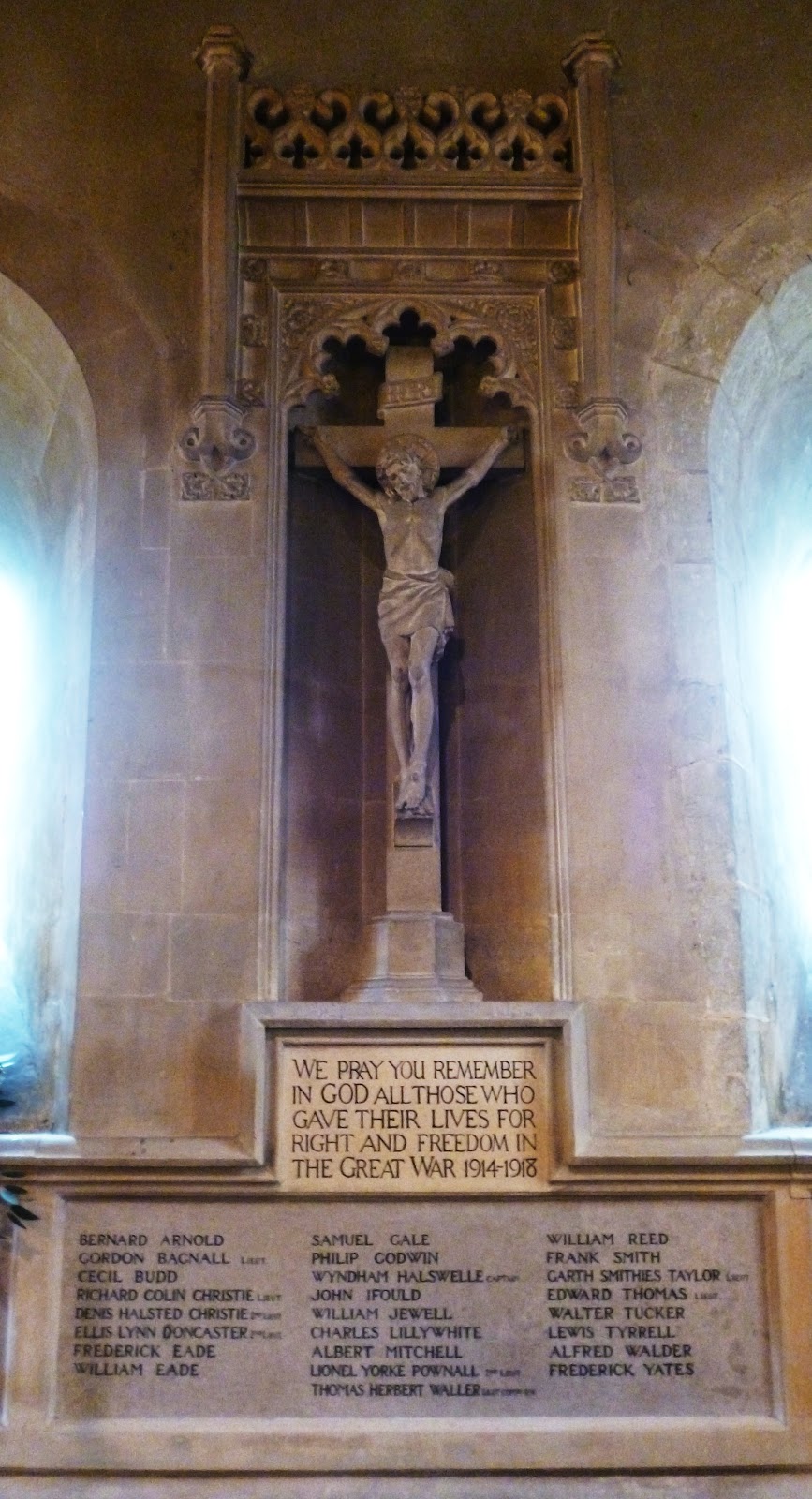
On the opposite wall is this monument to the war dead in the parish.

And Edward Thomas's name is of course among them.

A very short distance away, on the corner of Mill Lane and Church Road, is another war monument.

It's the kind of thing you may sometimes miss if you don't occasionally step out from the car.

I give three links below, all concerning Matthew Hollis's Edward Thomas simply because Hollis is the most recent of Thomas's biographers. All come from the Guardian, the first two being video clips and the last an article on Thomas's relationship with Robert Frost and Hollis's (possibly none too original) take on the vexed reasons for Thomas's enlisting.

Unfortunately the White Horse Inn eluded me.
–––––––––––––––––––––––––––––––––––––––––––––––––
Matthew Hollis showing Sarah Crown Edward Thomas landmarks in Steep (10-minute video)

Matthew Hollis reading from his book Now All Roads Lead to France: The Last Years of Edward Thomas (4-minute video)

Edward Thomas, Robert Frost and the road to war, by Matthew Hollis

11 April 2012

Harry Crews (1935–2012)

Hopelessly late as usual, I only learned a few hours ago of the death of the amazing Southern writer Harry Crews, who was a hellraiser of the first water. These are some of the things that have been said about him since his death:

New York Times.
LA Times.
Tampa Bay Times.

Interesting clips on Youtube:

Harry Crews on Dennis Miller.
Harry Crews talking as opposed to performing.

Jane Austen in Chawton and Alton, Hampshire

Jane Austen (1775–1817) was born in the rectory at Steventon, Hampshire, where her father George was its incumbent. George died in 1805, after the Austens had moved to Bath, and in 1809 Jane, her mother Cassandra, her sister Cassandra Elizabeth, and Martha Lloyd moved to Chawton, where Jane would stay until a short time before her death in Winchester in 1817. It was in Chawton that Jane either wrote or revised her novels, and from where she became known as a novelist four of her six novels were published in her lifetime – Sense and Sensibility (1811), Pride and Prejudice (1813), Mansfield Park (1814) and Emma (1816), and the remaining completed two, Northanger Abbey and Persuasion, were published posthumously in 1818.

Now known as 'Jane Austen's House Museum', this late 15th or early 16th century property was a farm house until 1769, when it was bought by Thomas Knight to become part of his estate and was a pub called the New Inn until it became home to the manager of the estate. Jane's brother Edward had been adopted by the childless Knight family (and he changed his name to Knight), and as he had inherited the property he let the women live rent free here until Jane's sister Cassandra's death in 1845, after which it was divided into three cottages for farm workers.

'JANE AUSTEN'S HOME
GIVEN BY
THOMAS EDWARD CARPENTER, J.P. OF MILL HILL
IN MEMORY OF HIS SON
LIEUT. PHILIP JOHN CARPENTER,
EAST SURREY REGT.
KILLED IN ACTION, LAKE TRASIMENE, 1944

OPENED 1959 BY THE DUKE OF WELLINGTON, K. G.,
PRESIDENT OF THE JANE AUSTEN SOCIETY,
FOUNDED 1940 BY DOROTHY DARNELL, OF ALTON.'

'JANE AUSTEN
LIVED HERE FROM 1809–1817
AND HENCE ALL OF HER WORKS
WERE SENT INTO THE WORLD.
HER ADMIRERS IN THIS COUNTRY
AND IN AMERICA HAVE UNITED
TO ERECT THIS TABLET

SUCH ART AS HERS
CAN NEVER GROW OLD'
The Bakehouse.
 
This was separate from house itself, and baking, the washing of clothes, and salting of pigs would have been carried out here.

This donkey carriage belonged to the Austen women. Jane and Cassandra walked for a few hours each afternoon, but the carriage was used for shopping trips to nearby Alton.

The Austens paid a cook, and the housekeeping would have largely been the responsibility of Cassandra and Martha Lloyd.

Unfortunately, in the house itself photography is not allowed.

At the entrance, we were asked if we wanted a 'short guide' for £1, so I took a leaflet from the plastic tray marked 'Short Guides £1' and bought it. It wasn't a guide at all and was obviously a hell of a rip-off, but when I later spotted one free in Alton, I realized they'd placed free leaflets in the wrong holder. Plus, the ten-minute video on the half hour didn't happen. Let's be polite and say there is room for improvements.
––––––––––––––––––––––––––––––––––––––––––––––

Once belonging to the Knight family and therefore passing into the inheritance of Edward, this is now Chawton House Library – see the link at the bottom of this post.

At the parish church, it's easy to find the graves.

And the matching tombstones stand side by side.

'IN
MEMORY OF
CASSANDRA AUSTEN
WHO DIED THE 18TH. DAY
OF JANUARY 1827,
AGED 87 YEARS.'

'IN
MEMORY OF
CASSANDRA ELIZABETH
AUSTEN,
WHO DIED THE 22ND. DAY
OF MARCH 1845
AGED 72 YEARS.'

'IN MEMORY OF
CASSANDRA AUSTEN,
DAUGHTER OF THE LATE
REVEREND THOMAS LEIGH
RECTOR OF HARPSDEN OXFORDSHIRE,
AND RELICT OF THE LATE
REVEREND GEORGE AUSTEN,
RECTOR OF STEVENTON HANTS,

SHE DIED THE 18TH DAY OF JANUARY 1827,
AGED 87 YEARS.

LEAVING FOUR SONS
AND ONE DAUGHTER SURVIVING NAMELY
EDWARD KNIGHT,
OF CHAWTON HOUSE IN THIS PARISH,
HENRY THOMAS AUSTEN,
FRANCIS WILLIAM AUSTEN,
CHARLES JOHN AUSTEN, AND
CASSANDRA ELIZABETH AUSTEN
WHO HAVE INSCRIBED THIS TABLET
TO THE MEMORY OF
AN AFFECTIONATE AND BELOVED PARENT.'

 'IN MEMORY OF
CASSANDRA ELIZABETH
AUSTEN
DAUGHTER OF THE LATE
REVEREND GEORGE AUSTEN
RECTOR OF SCREVETON
IN THIS COUNTY
DIED 22ND MARCH 1845 AGED 72'.

The plaque marking 200 years since Jane Austen's arrival in Chawton.

1 High Street, Alton, where Jane Austen dined with Rebecca Parker Terry following the death of her friend's father William.

4 High Street, the home of Jane Austen's doctor William Curtis.

 
'Site of Austen, Gray and Vincent
– the bank of Henry Austen
(brother of Jane Austen)

1806–1811'

–––––––––––––––––––––––––––––––––––––––––––

Caroline Glyn in Chawton, Hampshire, and Her Great-grandmother Elinor

A plaque on the north wall of St Nicholas Church, Chawton, Hampshire, is dedicated to Caroline Glyn:

'In Loving Memory of
CAROLINE GLYN, Novelist.
Lived and wrote in this Village.
Died 15th May 1981.
Aged 33 years.
A Member of Poor Clares at the
Convent of St Mary, Stroud.
New South Wales, Australia.'

Her first novel, Don't Knock the Corners Off, was published in 1963 when she was 15, and is concerned with the loss of the self in the process of conformity in the education system. It was followed by Love and Joy in the Mabellon (1965) – about café life among the young in Paris – then The Unicorn Girl (1966), Heights and Depths (1968), The Tree (1969), The Tower and the Rising Tide (1971), and The Peacemaker: A Novel (1973). In Him Was Life (c. 1976) has a Foreword by the Bishop of Lincoln. The last published work in her lifetime was The Mountain at the End of Night: Stories of Dream and Vision (1977), and posthumously two books of poetry were published: Poems from the Dark (1982), and Chawton and Other Poems (2000). The books of poems were published by Outpost Publications (a vanity publisher) and Feather Books (which was run by John Waddinton-Feather of Shrewsbury) respectively, two small businesses which also published Caroline's mother Susan Glyn's poetry.

Caroline's parents led an itinerant life, and her father was Geoffrey Leo Davson, a second baronet who changed his name by deed poll to Anthony Glyn, who was also a writer. His parents were Edward Rae Davson and Margot (née Glyn), who was the daughter of Clayton Louis Glyn and Elinor Glyn (1864–1943), his grandmother being a scriptwriter and novelist, particularly infamous for the novel Three Weeks (1907), the sexual content of which caused a scandal at the time. Elinor's husband lived way beyond his means (hiring Brighton public baths for two days for his knee-length red-haired bride to swim naked in, for instance), and she later became the sole family earner.

Caroline led an altogether more restrained life, and a congenital illness led to her death in a convent at 33. A link at the bottom of the page is to an article on Caroline by Robert Temple, probably the only boyfriend she had before becoming a nun.

Grandson Anthony Glyn's Elinor Glyn: A Biography (London: Hutchinson, 1955), with 1927 artwork here by Philip Alexius de László.

Joan Hardwick's Addicted to Romance: The Life and Adventures of Elinor Glyn (London: Deutsch, 1994) is also well worth reading.
 
Addendum 1: I've just Googled "Caroline Glyn" and discovered that her
novel Don't Knock the Corners Off * (and no other) was translated into French by Francine Le Masson in 1964 as A bas l'école!, which translates literally as 'Down with School!', although this doesn't come anywhere near the subtlety of the English title.

Addendum 2: It's just struck me that 'Don't knock the corners off' is surely a reference to the French word écorner, but with a different meaning.
 
––––––––––––––––––––––––––––––––––––––––––––––––
Professor Robert Temple on Caroline Glyn, with links to US Life article and two of Glyn's dustjackets with blurbs.

Sir Anthony Glyn's obituary in the Independent.

9 April 2012

Edmund Spenser in Alton, Hampshire


'HERE LIVED
EDMUND SPENSER
POET – 1590'
 
I chanced upon this building in Amery Street after visiting the exhibition at the Allen Gallery on Church Street, Alton, which at the moment contains a number of exhibits based on Flora Thompson's literature, mainly on Sue Scullard's wood engravings inspired by Thompson, of which more in another post.

Addendum: Jane Hurst of Alton has kindly sent me an attachment containing her research on the above plaque and Edmund Spenser's supposed relation to 1 Amery Street, which I précis below with my comment.

What the 'evidence' of Spenser's living here amounts to is that John Aubrey (1626–97) mentions in Brief Lives that the poet Samuel Woodford told him that Spenser once lived in the Alton area. That's all: no place is specified, and no date given. To find the next reference to Spenser here, we have to fast forward to the mid-19th century, when the Rev. George Gilfillan (1813–78) becomes a little more specific and writes that Spenser once spent some time in Alton. It's around the turn of the 19th century that William Curtis, writing in a book on the history of Alton, says that 'it appears' that Spenser lived in Alton, and he 'suppos[es]' that it was at 1 Amery Street.

In the 1930s the house was going to be demolished but its 'literary association' saved it. I'm pleased that it did as this is quite an attractive building. Spenserian scholar Douglas Hamer (1897-1981) of Sheffield University once said that the plaque's removal would be 'to the credit of Alton'. I disagree: whilst it seems clear that the plaque's existence is due to a series of historical distortions, it's nevertheless a fact that this myth is a part of Alton's history.

8 April 2012

Fanny Adams in Alton, Hampshire

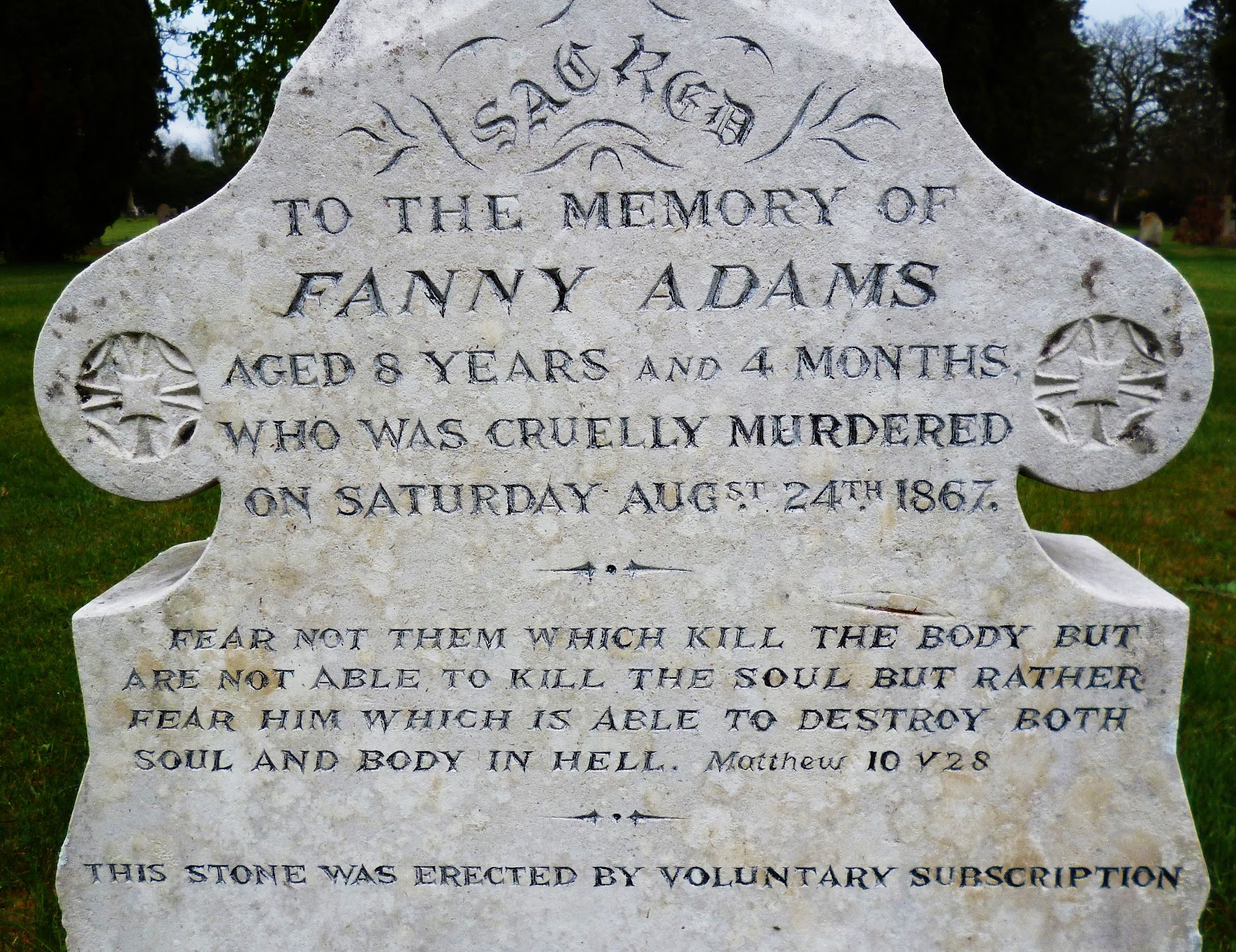
The grave of Fanny Adams is in Alton Cemetery, Hampshire.

'SACRED
TO THE MEMORY OF
FANNY ADAMS
AGED 8 YEARS AND 4 MONTHS,
WHO WAS CRUELLY MURDERED
ON SATURDAY AUGST. 24TH. 1867.
–––––––––––––––––––
FEAR NOT THEM WHICH KILL THE BODY BUT
ARE NOT ABLE TO KILL THE SOUL BUT RATHER
FEAR HIM WHICH IS ABLE TO DESTROY BOTH
SOUL AND BODY AND HELL. Matthew 10 V 28
–––––––––––––––––––
THIS STONE WAS ERECTED BY VOLUNTARY SUBSCRIPTION'

Fanny Adams (1859–1867) was murdered on 24 August 1867 by solicitor's clerk Frederick Baker at the age of eight years and four months. Her head and legs had been severed and her eyes gouged out. Although there was a history of mental illness in Baker's family, including himself, Baker was hanged outside Winchester prison on 24 December 1867.

The expression 'Fanny Adams' was adopted by sailors discontented with their rations to mean meat of no worth. By extension, 'sweet FA' has come to be a euphemism for something of no value, in other words 'fuck all'.

ADDENDUM: Very oddly, there's a French expression 'faire Fanny', which some sources say comes from the 19th century too, when a twenty-year-old called Fanny from the Croix-Rousse region of Lyon used to console players scoring 'nul points' at pétanque (or boules) by taking them aside and showing them her arse. Some, of course, might see this as an insult, and other stories take it as exactly that. And then, there's an expression called 'embrasser Fanny', when 'Fanny' kissed the losers, although this expression is said to originate from different eastern areas of France. It seems an odd coincidence that 'Fanny' is used to mean zero in both France and England and in such unrelated circumstances, but now how did the American 'Fanny' (in the sense of 'ass' meaning 'arse' or, er, posterior), come into being, and apparently have no relationship with the young French girl(s)? Weird.

7 April 2012

H. G. Wells in Petersfield, Hampshire: Petersfield Plaques #1

The Drum, Chapel Street.


'This
17th century
building was first
identified as an inn in 1714.
when Chapel Street was an
important highway. In the early
20th century it was popular
with cyclists. H. G. Wells
regularly dined and
wrote here'.


The leaflet 'Petersfield Blue Plaque Trail' (2008) adds that there's a stream called the Drum which runs at the side of the pub.

5 April 2012

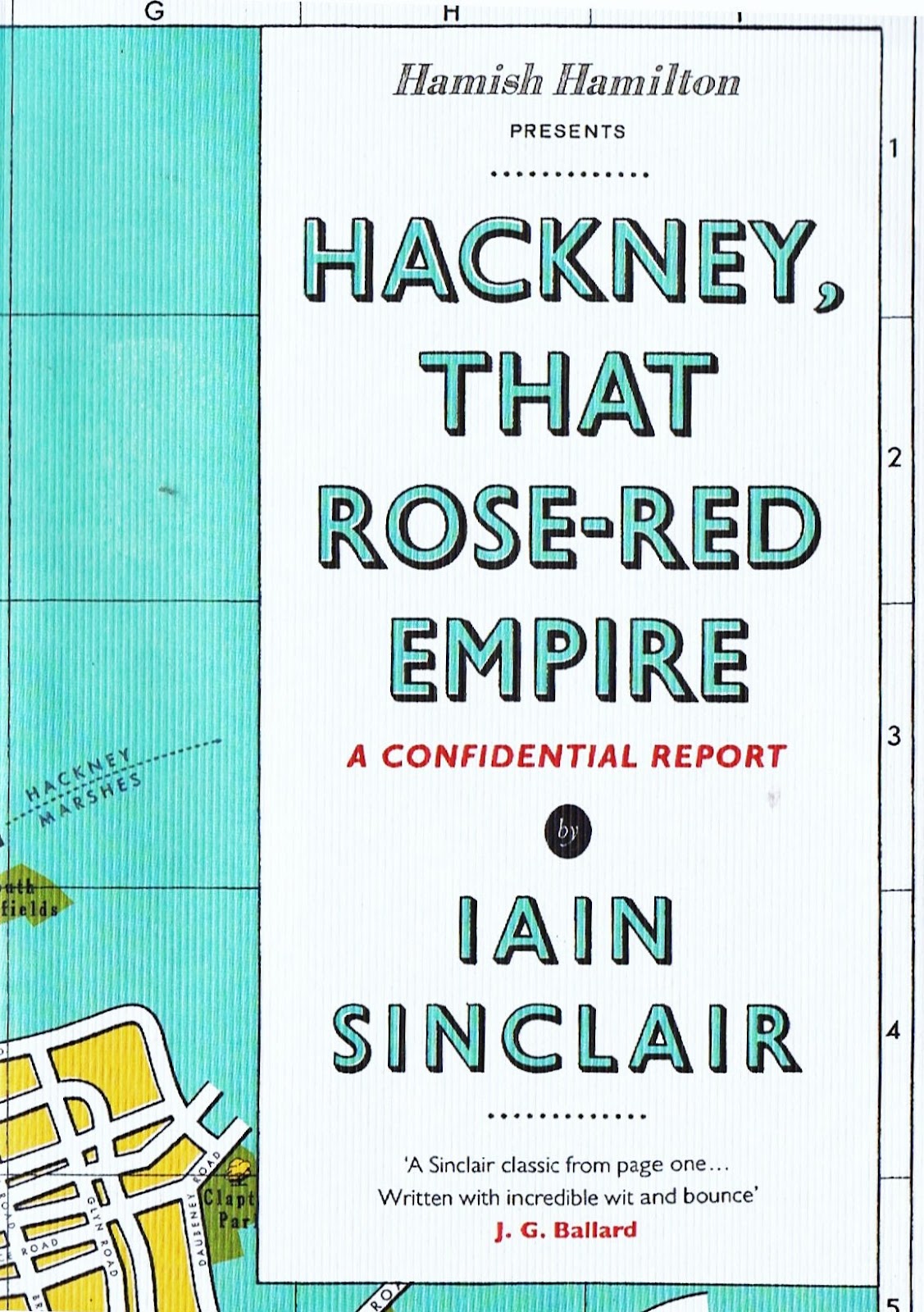
Iain Sinclair: Hackney, That Rose-Red Empire: A Confidential Report (2009)

Hackney, That Rose-Red Empire is a book that is mainly concerned with the last forty years in the borough of Hackney, London, this being the time Iain Sinclair has lived in Albion Drive, Haggeston. He records (though not chronologically) the often hidden or forgotten history of Hackney, particularly celebrating its eccentrics and its alternative lifestylers at the same time – in a wider and a quieter context – as he sets his sights on corruption at high as well as lower levels within (and by extension without) the borough. It is chaotic and digressive, but highly readable. Sinclair describes the book as 'built around absence, holes in the narrative, faked resolution'.

Many of the pages of this 'documentary fiction' are taken up with interviews Sinclair has had with people who live or have lived in the borough. These include: Chris Petit, with whom Sinclair has worked on films; Stewart Home, ranting; Home's friend Mark Pawson talking about his experiences renting a room at the Mole Man's house in Mortimer Street; Swanny the drug-taking doctor; Will Self on a Hackney hike with him; Marina Warner on Jean-Luc Godard's Sympathy for the Devil; Sheila Rowbotham partly on Godard's Brish Sounds, but mainly about living in Hackney around that time; the late David Widgery's wife Juliet Ash on Hackney in the past; and Ken Worpole (of Dockers and Detectives fame), who makes the (for me at least) astonishing revelation that Simon Blumenfeld wasn't Jewish.

At one point the narrator asks 'did those feet?', but no, there's no evidence of William Blake (who is obviously lurking – probably both consciously and unconsciously – in the name of Sinclair's Albion Drive) walking upon Hackney's land, although Blake's friend and devotee, wood engraver Edward Calvert (1799–1883), lived in the future borough and was buried in Abney Park Cemetery in Stoke Newington – although Sinclair failed to find the grave.

A number of times, in passing, there's mention of the insufferable Tony Blair, sometimes mentioned with his almost equally insufferable wife: I appreciated Sinclair's accurate description of Blair's 'gerbil grin that doesn't synchronize with panic in fearful eyes', and was amused to learn that Denis Healey had equated his 'personal charisma' with 'bullshit'. And often, there's comment on the horror that Sinclair, in an interview, described as 'apocalytically catastrophic', and that Will Self contemptuously describes here as New Labour's 'New Jerusalem': the Olympic Games, the government 'vanity project' that has been so destructive of a large area around Hackney Wick and Stratford.

On a lighter note, it's refreshing to find a number of obscure books mentioned, by no means all of which I was already aware, but after a little Googling these look very promising and I include them here as much as an aide-mémoire as anything else: H. Kaner's self-published People of the Twilight (1946), R. C. Hutchinson's Elephant and Castle (1945), Roland Camberton's Rain on the Pavements (1951), Alexander Baron's The Lowlife (1963), Nigel Fountain's Days Like these (1985), and Derek Raymond's How the Dead Live (1986).

At 580 pages, Hackney, That Rose-Red Empire is very long, but doesn't feel it: exhilaratingly digressive, it is a joy to read.


–––––––––––––––––––––––––––––––––––
Iain Sinclair: Ghost Milk: Calling Time on the Grand Project

1 April 2012

The Gentle Author: Spitalfields Life: In the Midst of Life I Woke to Find Myself Living in an Old House beside Brick Lane in the East End of London (2012)

In a blog post below I briefly mentioned the recent publication of The Gentle Author's book Spitalfields Life, but I've now had time to read a great number of its many features, and can say that this is a whopping Christmas cake of a book that deals with an area largely left out of the guide books to London. This isn't a guide book as such, but a celebration of the diversity of the Spitalfields community which covers many different aspects of life there. Mercifully, Jack the Ripper is left to the tourists to find out about elsewhere, but then that's in Whitechapel, and anyway this is a very long way from the done-to-death conventional features of guide books – almost all of this is new material culled from people living in Spitalfields, and is about those people.

And The Gentle Author doesn't adhere strictly to geographical boundaries, as his (or her) Spitalfields includes parts of Bethnal Green, Whitechapel, the City, Shoreditch, and I was also pleased to learn of the grave of William Shakespeare's brother Edmund in Southwark Cathedral.*

These are some of the articles I really enjoyed in the book:

– Brazilian Robson Cezar, who collects bottle tops from local pubs to make artistic creations with, a very notable one being the fascia of the Bell pub on the corner of Middlesex Street and New Goulston Street.

– 16-year-old rapper Yasin Ahmed, also known as King Sour DA MC.

– Sandra Esqulant, landlady of the Golden Heart on Commercial Street, who was caught one night hoolahooping in the road and captured by (sometimes candid) photographer Phil Maxwell.

– Carrom Paul, who is introducing many people to the joys of the board game carrom.

– Belgian artist Roa, who has huge paintings on street walls, such as a squirrel at the corner of Club Row and Redchurch Street, and a crane on the corner of Hanbury Street and Brick Lane. A link to a number of his animal paintings elsewhere: ROA, l'homme et l'animal.

– The delightful Mr Pussy, The Gentle Author's cat.

– Stanley Rondeau, a volunteer at Nicholas Hawksmoor's Christ Church, who has traced his Huguenot family tree and written a booklet about it.

– London's Next Top Tranny contest, consisting of drag performances held at Bethnal Green Men's Social Club. (Interesting to learn that Hessel Street is named after Phoebe Hessel, who dressed as a man in order to join the army and be with her partner.)

– Aldgate pump on the corner of Fenchurch Street and Leadenham Street, which once caused hundreds of deaths through people drinking water polluted by human remains in cemeteries. The Gentle Author notes that Dickens gave a passing mention to it in The Uncommercial Traveller.

– The lovingly kept and still-functioning 1899 toilets under John Wesley's Chapel on City Road.


– Paper bag seller Paul Gardner, whose family has had a business in the same building since 1870. The Gentle Author claims you can't say you've been to Spitalfields without shaking his hand.

– Dennis Severs' House at 18 Folgate Street. The American Severs moved in here in 1979 and created a time capsule in each of the ten rooms, which have been furnished in styles of the 18th and 19th centuries, complete with smells. This is now a museum.


I think my only criticism is that there's not an Index – there are a few pages entitled 'Index', but in reality this merely amounts to another Table of Contents, this time divided into subject areas as in The Gentle Author's 'Spitalfields Life' blog.

The attractiveness of the book is enhanced by the illustrations of Mark Hearld, Lucinda Rogers, and Rob Ryan. Included at the back are two suggested routes for tours around Spitalfields.

*The Gentle Author's latest blog post (1 April) is about Charles Dickens in Shadwell and Limehouse.

–––––––––––––––––––––––––––––––––––––––––––––––––––––

'Spitalfields Life' blog.

66,000 Miles Per Hour: The Gentle Author of Spitalfields Life.

30 March 2012

T. W. Robertson, Playwright

The playwright Thomas William Robertson (1829– 71) – who was usually known as 'T. W. Robertson', sometimes as 'Tom Robertson' – was born in Newark-on-Trent, Nottinghamshire, where his father William was an actor on the 'Lincoln circuit'.

Robertson moved to London in 1849, where he lived as a journalist, writer, stage manager and actor. He was a friend of the Manchester playwright H. J. Byron, with whom he had collaborated, and Robertson's play Society (1865) was put on at the Prince of Wales Theatre, London, which was managed by Marie Wilton and Byron. He wrote a number of plays after this, but died just a little more than five years later.
William Tydeman's Plays by Tom Robertson (Cambridge: Cambridge University Press, 1982) contains, along with a brief critical sketch, four plays: Society, Ours (1866), Caste (1867), and School (1869). Tydeman is very sceptical of the many claims that have been made about Robertson being a great innovator of realist theatre (using real props, realistic language, etc), although he concedes that his intentions involved more than mere amusement and pleasure. Tydeman states that although these plays are in fact 'no more "life like"' than those of playwrights who went before, they are nevertheless 'a little less "unlifelike"'. All things considered, Tydeman seems to suggest, perhaps Robertson's major contribution to the stage is that he founded the new school of 'stage management', making him an important precursor to today's play directors.

––––––––––––––––––––––––––––––––––––––––––––––––––––––

Society depicts a world in which the very rich (but very vulgar) parvenu Mr John Chudd senior wants his son, the also very rich Mr John Chudd junior, to steamroller his way through society and become accepted as a 'swell': money can buy everything, including love – 'I adore you with my whole heart and fortune' is the way he woos. The principled but poor and feckless Bohemian barrister and hack, Sidney Daryl, knows the people Chudd junior wants to know, but will not be bought and shuns the arriviste.

Lord and Lady Ptarmigant have brought up the orphan Maud Hetherinton, and for most of the play there is a strong criticism of Lady Ptarmigant, who seems made of similar hypocritical, money-worshipping material to the Chudds. Maud and Sidney are (chaste) lovers, although Lady Ptarmigant's hostility grows much more hostile towards any possible match as Chudd junior declares his interest in marrying Maud.

And Chudd and Sidney become not only rivals in love but political rivals as Sidney learns that the 'digesting cheque-book' is a candidate for Springmead, where Sidney's ancestors have 'held their own for centuries'.

The plot shifts a few gears as a result of two misunderstandings: Sidney thinks Maud has agreed to marry Chudd, and Maud thinks that Little Maud is Sidney's illegitimate son, whereas in reality she's the daughter of Lady Ptarmigant's son Charles, who died in the Crimea shortly after marrying his 'poor and humble' (and pregnant) girlfriend. Realizing the misunderstanding, Lady Ptarmigant is delighted to learn that she has a grandchild (and probably as delighted that Sidney has suddenly become rich on the death of his brother), and in the end good triumphs over bad: Sidney and Maud can now marry in peace, and the jumped-up pipsqueak Chudds get their social comeuppance.

It might be easy to dismiss Society as contrived and slightly farcical, but there are strong socials criticisms in this play.

––––––––––––––––––––––––––––––––––––––––––––––––––––––

Tydeman suggests that Ours is inspired by Millais's 'The Black Brunswicker' painting, which depicts a woman in an emotional state standing between her partner, a volunteer for the Waterloo campaign, and the door he's reaching to leave by. This painting is in fact mentioned in the play, relating to the moment when Angus goes to the Crimea, leaving Blanche, the woman he loves, behind, although it is not certain that Blanche loves him.

Like Society, Ours has rich and poor lovers but no scoundrels (apart from a brother who never makes an appearance) and a much more complicated plot. The aristocracy is represented by Sir Alexander Shendryn and his wife Lady Shendryn, who is still hurt that her husband had an affair with another woman years before, and believes that he is continuing to deceive her . The rich Blanche lives with them, as does her (obviously poor) companion Mary, and the dynamics between the quiet Blanche and the spunky Mary, according to Tydeman, influenced James Albery's Two Roses (1870), W. S. Gilbert's Engaged (1877), Pinero's Dandy Dick (1887), and Wilde's The Importance of Being Earnest (1895).

The rich (and feckless but not Bohemian) brewing heir Hugh Chalcot, whose marriage proposal has previously been turned down flatly by Blanche, just spends his time mooching around, driven by whims or the urge to sleep off his boring life. Angus knows he has no chance with her as he's poor, and anyway the older Russian Prince Perovsky is moving in on her to turn her into a princess, even a queen. The men (even Hugh, who can now find something to give his life meaning) go off to the Crimea to risk their lives, with Sir Alex and Lady Shendryn parting on bad terms as they're radiply becoming poor.

'If this were put in a play, people would say it was improbable', says Hugh when he finds that some time later the three women turn up at the large cabin close to where the men are fighting, and this was obviously what I too thought. However, it's a neat way to conclude the play, and there are several discoveries: Sir Alex is a man of great integrity who was protecting his wife from the truth that her brother Percy has been embezzling him; Blanche loves Angus in spite of his poverty; and Mary's pudding-making has sent Hugh head over heels for her.

The front cover of Plays by Tom Robertson shows a representation of the final act, and an interesting point here is that Ours has been particularly noted for the 'realistic' sweeping of 'snow' into the cabin when the door opens. The Times also noted the military equipment in the cabin, and the sound of rain on leaves in the first act, and called the play 'an exact specimen of the ultra-real school of comedy'. With his feet firmly on the ground, Tydeman labels it a 'romantic comedy whatever its pretensions to realism'.

––––––––––––––––––––––––––––––––––––––––––––––––––––––

Tydeman rates Caste as Robertson's best play. Based on his short story 'The Poor-Rate Unfolds a Tale' and perhaps a love story relating to one of Robertson's sisters, it concerns a mésalliance between the soldier George D'Alroy, who is the son of the Froissart-quoting Marquise de St Maur, and Esther Eccles, the poor daughter of Eccles, a workshy alcoholic who provides much of the play's humour and tension: Eccles steals the £600 that the recently-married George leaves to his wife Esther (before going to India) and blows it on betting, and Tydeman reckons that Eccles is Robertson's revenge on the benevolent parents that swamped the conventional plays of the period.

Robertson is given to working around the theme of love matches between rich and poor protagonists, although I still feel unsure about his conclusions, if indeed there are any. George's 'toff' friend Hawtree finds class (or 'caste') problematic, but George sees things differently, and says:

'Oh, caste's all right. Caste is a good thing if it's not carried too far. It shuts the door on the pretentious and the vulgar [such as the Chudds in Society, not doubt]: but it should open the door very wide for exceptional merit [such as Esther, of course]'.

There have been criticisms by reviewers regarding some characters perceived as not entirely believable: the Marquise is perhaps too stilted, Esther may be a little too virtuous, poor Sam seems rather too generous towards George, etc, but these seem minor issues.

(It is interesting to note, in Appendix II, a number of musical and literary quotations spoken by Eccles. The literary quotations include Robert Burns, Ann Taylor, and John Greenleaf Whittier.)

––––––––––––––––––––––––––––––––––––––––––––––––––––––

School was extremely popular, although it came in for some harsh criticism that it was derivative of Roderick Benedix's Aschenbrödel (Cinderella). Tydeman seems very dismissive of it, and after trying (but failing miserably) to read it I can't understand why he included it in this selection – it seems such a flat way to conclude the book.

––––––––––––––––––––––––––––––––––––––––––––––––––––––
Meynard Savin's Thomas William Robertson: His Plays and Stagecraft (Providence, RI: Brown University, 1950)
.

George Galloway and the British Labour Party

It isn't often that I publish a blog post about politics, but occasionally I feel that there's a need to. Last night, nearly 40 virtually continuous years of Labour party dominance ended in Bradford West. George Galloway, representing his Respect party, was elected to Parliament by a majority of over 10,000 votes. No matter what anyone's opinion of Galloway may be, this is a colossal, historic victory. Such a victory doesn't happen for no reason, and cannot be written off as a glitch: Galloway also won Bethnal Green and Bow (also a traditional, staunch Labour party seat) in 2005. Galloway is perfectly correct when he speaks about the betrayal by the Labour party of its own voters. Although it was nine years ago, people will not forget that the Labour party wholeheartedly supported and collaborated in the destruction of Iraq.

But monstrous as this act was, it is but one of many very big errors leading to the self-destruction of the Labour party.

28 March 2012

The Gentle Author

Googling around – partly in preparation for a short stay in London next month, partly as a spinoff to delving into Iain Sinclair's East End – I stumbled by chance across an anonymous writer of unknown sex, using the byline 'The Gentle Author' in his or her blog 'Spitalfields Life', and found a treasure chest of articles (written every day from August 2009 to the present, which are projected to continue far into the future) about the unsung folk of Spitalfields, London, the extraordinary 'ordinary' people who people it, and the architectural features which form the backcloth to the everyday theatre of the area.

The Gentle Author's most recent blog posts are an indication of the variety of the content, often with generous photographic images: early 19th century illustrators Isaac Richard and George Cruickshank; the death two days ago of Charlie Burns, a  94-year-old who spent his later days viewing the world in a car on Bacon Street off Brick Lane, where he had spent his life; and (in a single post) paper bag seller Paul Gardner, dairyman Henry Jones, and umbrella maker Richard Ince. There is an evident compulsion for the Gentle Author to record the normally unrecorded.

Reviewers have found analogies of the Gentle Author's work in such diverse people as Chaucer, Dickens, Pepys, Orwell, Patrick Keiller, W. G. Sebald, Geoffrey Fletcher, Dr Johnson, Henry Mayhew, etc. This is indeed wonderful stuff, and it's heartening to learn that about 150 chapters of this material have been mass hard copied, and The Gentle Author's lavish book is called Spitalfields Life: In the Midst of Life I Woke to Find Myself Living in an Old House Beside Brick Lane in the East End of London, and was published by Saltyard Books earlier this month.

This is a link to the Gentle Author's
blog. S/he goes to some pains to point out the importance of the people s/he is writing about as opposed to him/herself, although a fascinating interview with him or her appears as a blog post in 'Spitalfields Life', in which the Gentle Author, in passing, mentions the influence on him/her of Kierkegaard and Raymond Williams's Culture and Society: it is here. More information on the writer can be gleaned in a Guardian article here.

I shall have much more to say about this publication in due course, although already I'm sure that this 428-page book will be quite a read.

–––––––––––––––––––––––––––––––––––––––––


Link to the later post:

The Gentle Author: Spitalfields Life: In the Midst of Life I Woke to Find Myself Living in an Old House beside Brick Lane in the East End of London (2012).