26 May 2011

Nathaniel Hawthorne's Salem, Massachusetts

Emily A. Murphy's Nathaniel Hawthorne's Salem: A Walking Tour of Literary Salem in the Early Nineteenth Century (Salem, MA: National Park Service/Salem National Historic Site, 2007) is an invaluable guide. The post below contains what I consider to be the most interesting features in it, and most of the time I've summarized Murphy's comments under my own photos.

Nathaniel Hawthorne (1804-64) was born at 27 Union Street to Captain Nathaniel Hathorne and Elizabeth Clarke Manning. It was moved in 1958 to its present location, at the side of the House of Seven Gables, at 57 Turner Street.

In 1808 Captain Hathorne died of yellow fever in Surinam. Elizabeth moved with her children - Nathaniel and his two sisters Elizabeth and Louisa - back to the home of her childhood at 10½-12 Herbert Street, the Manning House. Nathaniel moved from there for four years while attending Bowdoin College, and another four years when his family moved to North Salem, but apart from that this is where he lived between 1808 and 1840. Many of his early stories were written here, the place he term 'Castle Dismal'.

The Brown Building on the corner of Union and Essex streets, where Dr Nathaniel Peabody and his wife moved in 1810 with their daughters Elizabeth Palmer, Mary, and Sophia, who was one year old. The eldest daughter remembered seeing 'a little boy with clustering locks' playing in the nearby Manning garden, and many years later she would be his sister-in-law:

'Sophia Peabody Hawthorne
1809-1871
artist, journalist
travel writer, and
wife of
Salem's famous author
Nathaniel Hawthorne,
lived here in the
Brown Building
during her
early childhood.'

Before this, though, Nathaniel and his younger sister Louisa often went to a house in Turner Street that originally belonged to the Turner family, but which their cousin Susan Ingersoll had inherited. Three of the gables of this house had been removed, and Susan is said to have shown Hawthorne the missing gable marks in the attic. Hence the inspiration for Hawthorne's major novel, The House of the Seven Gables (1851).

 From the Brown House, the Peabodys moved to 54 Charter Street in 1835, and it was there that Dr Peabody's daughter Elizabeth Palmer Peabody - who was very involved with the intellectual life of the area - invited Hawthorne, whose Twice Told Tales (1837) had recently been published. It was there that Hawthorne fell in love with Sophia, and married her five years later.

But to return to Hawthorne's interest in graveyards which I mentioned here, right next to the Peabodys' home was Old Burying Point Cemetery, where a number of Hathornes lay. Hawthorne was most interested in the gravestone of his great-great-grandfather, Colonel John Hathorne, who was a judge during the Salem witch trials. It is unknown if this connection is the reason why Hawthorne added the 'w' to his name.

Another of the graves that interested Hawthorne was that of Cotton Mather's younger brother Nathaniel, who died at the age of 19.  Toward the end of his first novel - Fanshawe (1828) - Hawthorne writes:

'[Fanshawe's] passage [to the grave] was consequently rapid, terminating just as he reached his twentieth year. His fellow-students erected to his memory a monument of rough-hewn granite, with a white marble slab for the inscription. This was borrowed from the grave of Nathanael Mather, whom, in his almost insane eagerness for knowledge, and in his early death, Fanshawe resembled.'

The full text of Fanshawe is here.
Hawthorne was nominated Surveyor of the Port of Salem by friends in the Democratic Party, a post he would retain for a little under four years. He was dismissed after the Whig Zachary Taylor was elected president, and a vicious smear campaign began against Hawthorne. As Hawthorne had (on the orders of Washington) written (but not delivered) letters of dismissal for inspectors who hadn't contributed to the Democratic party, and as he had given more work to Democrats, his fate was inevitable.  

Salem remembers its famous son with great pride. In Essex Street is the Old Town Pump Memorial Fountain, which is on the site of the town pump, which Hawthorne made the narrator of one of his short stories:

'SALEM TOWN PUMP FOUNTAIN
'THIS IS THE SITE OF THE
ORIGINAL SALEM SPRING,
LATER THE LOCATION FOR
THE TOWN PUMP
IMMORTALIZED BY
NATHANIEL HAWTHORNE
IN HIS FIRST BOOK
"TWICE TOLD TALES."
THIS FOUNTAIN IS HERE
AT THE SUGGESTION OF
THE TOWN PUMP ITSELF,
IN "A RILL FROM
THE TOWN PUMP."

The town pump's words:

"And when I shall have decayed likemy predecessors, then, if you revere my memory, let a marble fountain richly sculptured take my place upon this spot. Such monuments should be erected everywhere and inscribed with the names of the distinguished champions of my cause.'

First book? What of Fanshawe? Well, Hawthorne paid for the publication himself, but later disowned it, and his widow Sophia denied its existence too despite all evidence to the contrary, so it seems that the pump is speaking with Hawthorne's voice too.

A close-up of the impressive work.

And on Hawthorne Boulevard is a large statue of the man.

This was sculpted in 1916 by Bela Pratt, who also sculpted the William Everett Hale statue in the Public Garden in Boston. 

25 May 2011

Jack Kerouac's Lowell, Massachusetts

The leaflet 'Jack Kerouac's Lowell: Where the Road Begins: Map & Guide to Jack Kerouac's Hometown, Lowell, Massachusetts, Lowell, Featuring Sites Referenced in His Books from the Multi-Volume Legend of Dulouz', published by the Lowell Historical Society, has been of great use to me in creating this post, and indeed in discovering Lowell.

The first home of Jack Kerouac (1922-69).

'It was in Centralville I was born, in Pawtucketville saw Doctor Sax. Across the wide basin to the hill - on Lupine Road, March 1922, at five o'clock in the afternoon of a red-all-over suppertime, as drowsily beers were tapped in Moody and Lakeview saloons and the river rushed with her cargoes of ice over reddened slick rocks, and on the shore the reeds swayed among mattresses and cast-off boots of Time, and lazily pieces of snow dropped plunk from bagging branches of black thorny oily pine in their thaw, and beneath the wet snows of the hillside receiving the sun's lost rays the melts of winter mixed with roars of Merrimac - I was born. Bloody rooftop. Strange deed. All eyes I came hearing the river's red; I remember that afternoon, I perceived it through beads hanging in a door and through lace curtains and glass of a universal sad lost redness of mortal damnation ... the snow was melting. The snake was coiled in the hill not in my heart.'

Jack Kerouac, Doctor Sax (1959)

Jack Kerouac was indeed born in March 1922, on 9 Lupine Road, Centralville, which is very close to Pawtucketville to the west, and is north of the Merrimack River, Lowell. His house is now in two appartments. His parents were French Canadians who met in Nashua, New Hampshire, before moving to Lowell (which is pronounced as one long, lovingly drawled syllable.) 
 

Kerouac attended Lowell High School, on Kirk Street, downtown Lowell, and was influenced by Whitman, Saroyan, Wolfe, and Thoreau. He won a football scholarship to Columbia University, New York City, and his novel Maggie Cassidy is set in his senior year here.

The Pollard Memorial Library, Merrimack Street, was constructed in 1893, and Kerouac wanted to read every book here.

St Jean Baptiste Church on Merrimack Street was built in 1888 for French-Canadian immigrants, many of whom lived in Little Canada, the northernmost part of the Acre district of Lowell, which faces the northern shore of the Merrimack River. 

The influence of French Canadians who moved to this former mill town is evident from many French words seen on trading premises, and is definitely not a mere tourist symbol: away from downtown Lowell, there's a 'Truc Salon', which is a hairdresser's, and a Jeanne d'Arc insurance company, to give but two out of many possible examples.

The Boott Cotton Mills on John Street existed between 1835 to 1954, and are mentioned in Kerouac's work. This building now functions as a museum.*

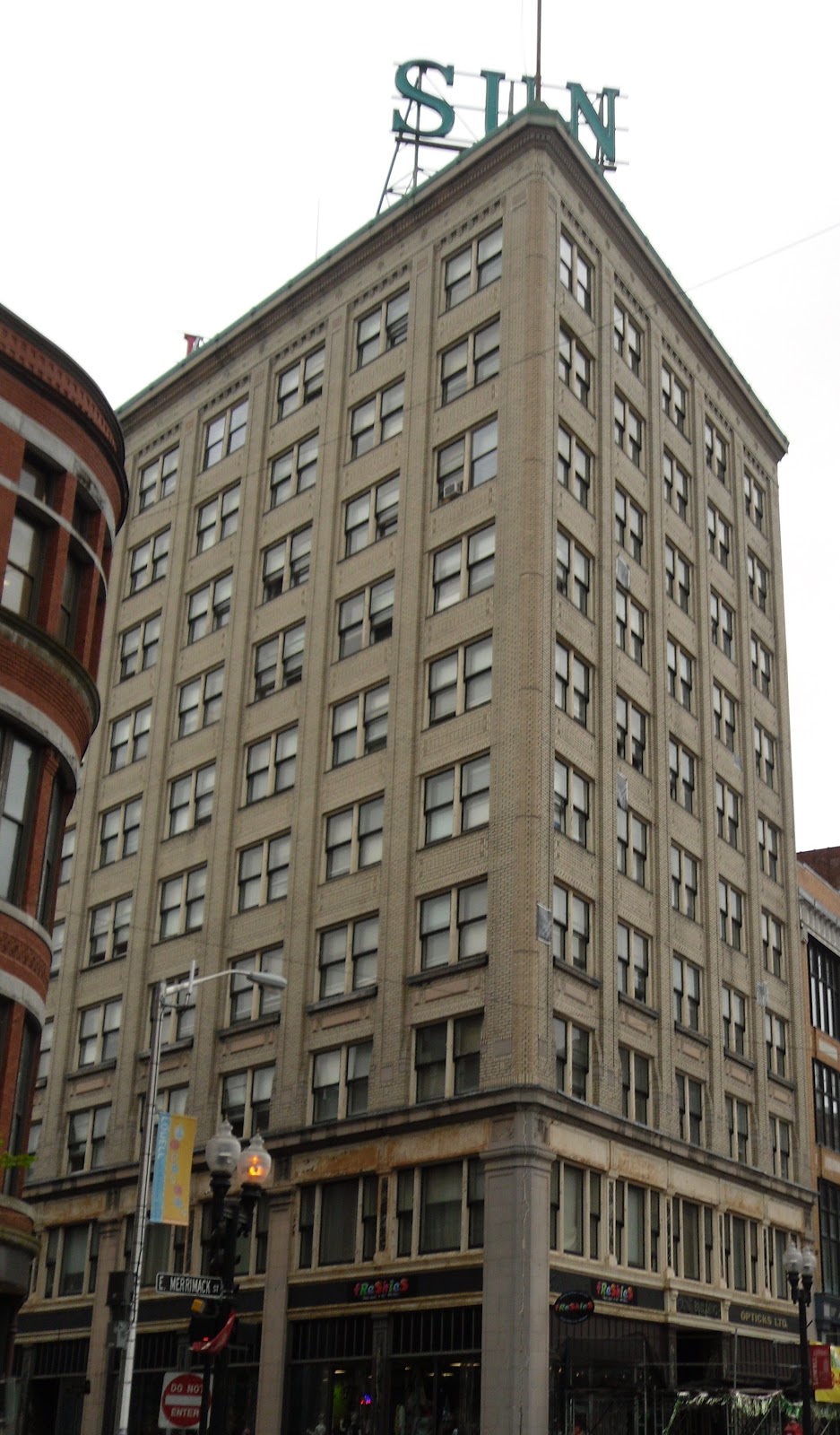
Kerouac briefly worked for the Lowell Sun as a sports reporter.

The elaborate clock by the Sun building is also mentioned.

The Kerouac Commemorative, Kerouac Park, Bridge Street/French Street, was conceived by the Lowell Historic Preservation Commission, which chose Ben Woitena to design it in 1988.

The design features eight polished granite slabs that are inscribed from quotations from five books of Kerouac's that draw on his early experiences of Lowell. A plaque explains:

'This work is a tribute to Jack Kerouac, voice of the Beat Generation. Kerouac's spirited novels and poems chronicled his life and adventures in Lowell and on the road. The design is based on a mandala, a pattern which symbolizes the universe. The cross-shaped path and circles refer to Kerouac's Christian and Buddhist beliefs.'

One side of the columns is a quotation from The Scripture of Golden Eternity:

'Stare deep into the world before you as if it were 
the void: innumerable holy ghosts, buddhies,
and savior gods there hide, smiling. All the
atoms emitting light inside wavehood, there is
no personal separation of any of it. A hummingbird
can come into a house and a hawk will not: so rest
and be assured. While looking for the light, you
may suddenly be devoured by the darkness
and find the true light.'

Scripture 22
Another side contains the beginning and the end of Kerouac's most famous - and most probably most significant - work, On the Road (1957), which is modeled on his experiences with the legendary Neal Cassady (1926-68).

'I first met Dean not long after my wife and I split up. I had just gotten over a serious illness that I won't bother to talk about, except that it had something to do with the miserably weary split-up and my feeling that everything was dead. With the coming of Dean Moriarty began the part of my life you could call my life on the road. Before that I'd often dreamed of going West to see the country, always vaguely planning and never taking off. Dean is the perfect guy for the road because he actually was born on the road, when his parents were passing through Salt Lake City in 1926, in a jalopy, on their way to Los Angeles. First reports of him came to me through Chad King, who'd shown me a few letters from him written in a New Mexico reform school. I was tremendously interested in the letters because they so naively and sweetly asked Chad to teach him all about Nietzsche and all the wonderful intellectual things that Chad knew. At one point Carlo and I talked about the letters and wondered if we would ever meet the strange Dean Moriarty. This is all far back, when Dean was not the way he is today, when he was a young jailkid shrouded in mystery. Then news came that Dean was out of reform school and was coming to New York for the first time; also there was talk that he had just married a girl called Marylou…'

'So in America when the sun goes down and I sit on the old broken-down river pier watching the long, long skies over New Jersey and sense all that raw land that rolls in one unbelievable huge bulge over to the West Coast, and all that road going, and all the people dreaming in the immensity of it, and in Iowa I know by now the children must be crying in the land where they let the children cry, and tonight the stars'll be out, and don't you know that God is Pooh Bear? the evening star must be drooping and shedding her sparkler dims on the prairie, which is just before the coming of complete night that blesses the earth, darkens all the rivers, cups the peaks and folds the final shore in, and nobody, nobody knows what's going to happen to anybody besides the forlorn rags of growing old, I think of Dean Moriarty, I even think of Old Dean Moriarty the father we never found, I think of Dean Moriarty.'

*Unfortunately, at the time of my visit to Lowell (I hadn't read Kristin Bierfelt's The North Shore Literary Trail: From Bradstreet's Andover to Hawthorne's Salem (Charleston, SC: The History Press, 2009)) I wasn't aware of its other famous writer - Lucy Larcom (1824-94). As well as the Kerouac Commemorative, there is also a Lucy Larcom Park, which has some sculptures with lines from some of the poems of Larcom, who was born in Beverley and moved to Lowell, later working at Boott Mills. She edited a paper from 1840 - sponsored by the mill - called Lowell Offering, which contained articles and poems written by the mill girls. Her autobiography, A New England Girlhood: Outlined from Memory (Boston: Houghton, Mifflin, 1889) is here.

My other Kerouac links:.
–––––––––––––––––––––––––––––––––––
Jack Kerouac's Grave
The Jack Kerouac Story

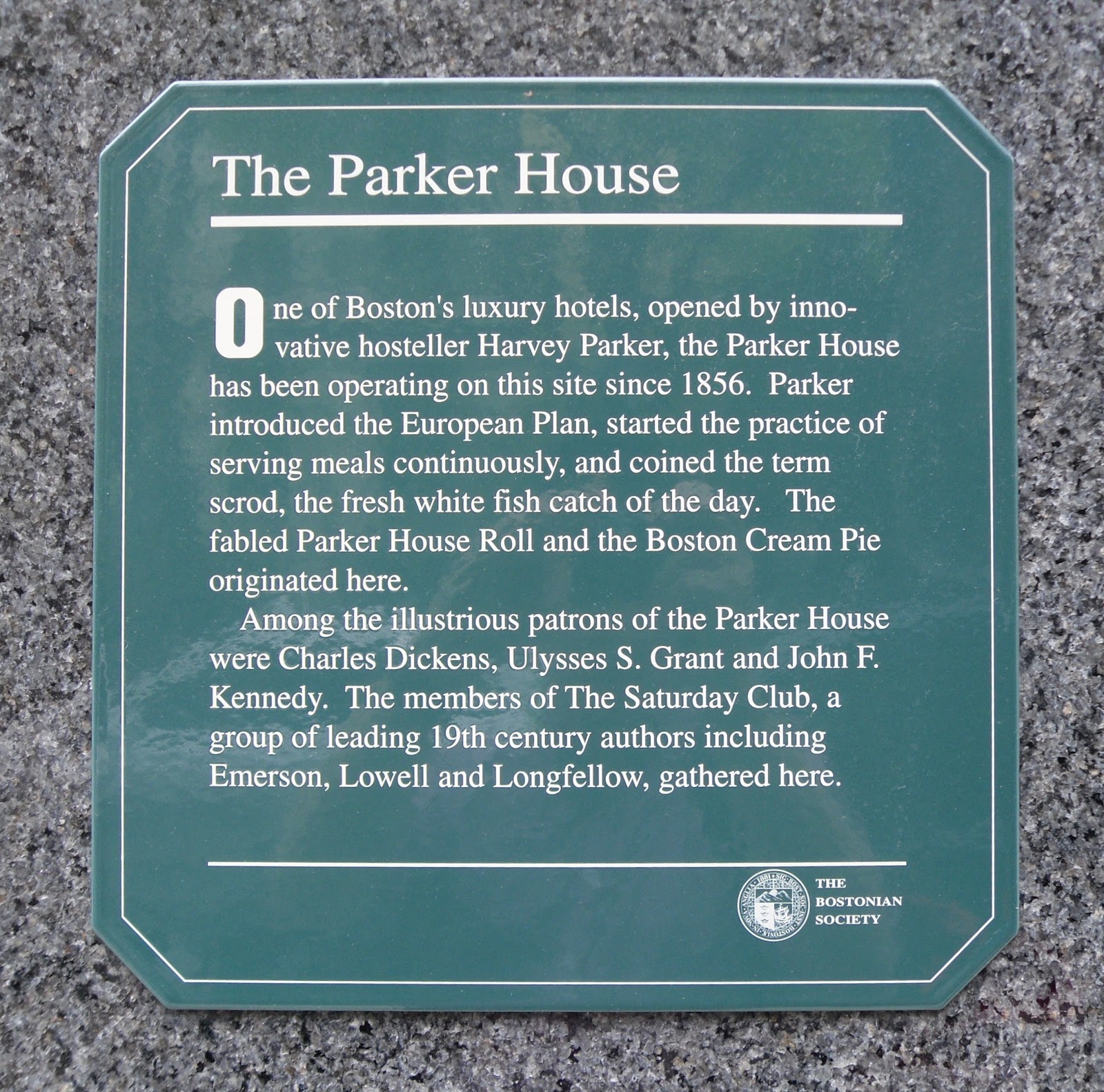
The Parker House, The Last Hurrah, and Edwin O'Connor, Boston, Massachusetts

 'The Parker House

'One of Boston's luxury hotels, opened by innovative hostellier Harvey Parker, the Parker House has been operating on this site since 1856. Parker introduced the European plan, started the practice of serving meals continuously, and coined the word scrod, the fresh white fish catch of the day. The famous Parker Roll and the Boston Cream Pie originated here.

'Among the illustrious patrons of the Parker House were Charles Dickens, Ulysses S. Grant and John F. Kennedy. The members of The Saturday Club, a group of leading 19th century authors including Emerson, Lowell and Longfellow, gathered here.'

The original Parker House has gone, but the bar of the present one is called 'The Last Hurrah' after a 1956 novel by Edwin O'Connor (1918-68), who won the Pulitzer Prize in 1961 for The Edge of Sadness.

Diagonally opposite the bar, on School Street, is the Old City Hall, which plays a prominent part in The Last Hurrah. O'Connor's protagonist is the mayor, Frank Skeffington Jr., who was obviously modeled on the highly disreputable mayor James Michael Curley.

Nathaniel Hawthorne and the King's Chapel Burying Ground, Boston, Massachusetts

King's Chapel Burying Ground is on Tremont Street, downtown Boston, the city's oldest cemetery. Nathaniel Hawthorne used to enjoy walking around cemetries, and this is was one of them. Legend has it that the above gravestone, of Elizabeth Pain, who died in 1704, inspired Hawthorne's Hester Prynne in The Scarlet Letter, because of the (tenuous) resemblance of the symbol at the top left to the letter 'A'.

Certainly, the closing paragraph of the novel seems to suggest something of this, even if the colors are incorrect:

'So said Hester Prynne, and glanced her sad eyes downward at the
scarlet letter. And, after many, many years, a new grave was delved, near an old and sunken one, in that burial-ground beside which King's Chapel has since been built. It was near that old and sunken grave, yet with a space between, as if the dust of the two sleepers had no right to mingle. Yet one tomb-stone served for both. All around, there were monuments carved with armorial bearings; and on this simple slab of slate - as the curious investigator may still discern, and perplex himself with the purport - there appeared the semblance of an engraved escutcheon. It bore a device, a herald's wording of which may serve for a motto and brief description of our now concluded legend; so sombre is it, and relieved only by one ever-glowing point of light gloomier than the shadow:
"ON A FIELD, SABLE, THE LETTER A, GULES"'

Mount Auburn Cemetery, Cambridge, Massachusetts

Mount Auburn Cemetery is a huge area in Cambridge, Massachusetts, and was established in 1831 as the US's first landscaped cemetery, with several lakes and many impressive trees, shrubs and flowers. People seem to come here as much for the plants and birds as the famous graves, and it's even considered a wonderful place for a first date. For fifty cents you can pick up a map showing the site of the graves or memorials of the most famous people here, or you can find lesser known ones on a computer in the visitor center. Unfortunately, we arrived here just as it was threatening to rain, and that threat established itself as a major torrent for the rest of the afternoon, so we had to return the following day. Needless to say, virtually all the graves below are of writers or people with assocations with writers.

William Ellery Channing (1780-1842) was a Unitarian preacher who had a profound effect on the Transcendentalists. There is a statue of him in Boston Public Garden.

This grave is of two poets: James Russell Lowell (1819-91) and his wife Maria White Lowell (1821-53), who was a member of the Boston Female Anti-Slavery Society who before their marriage persuaded James to become an abolitionist. They lived at Elmwood, James's birthplace not far from Henry Wadsworth Longfellow's home. One of his books written at Elmwood and published anonymously, A Fable for Critics: A Glance at a Few of Our Literary Progenies (1848), satirized a number of literary figures of the day.

Poet and novelist Thomas Bailey Aldrich (1836-1907) was born in Portsmouth, New Hampshire, and his widow Lilian turned their house into a memorial to him, which in 1979 became part of the much larger Strawbery (sic) Banke Museum. He spent most of his youth in the South with his father, and later in New York. Between these two periods, though - from to 1952 - he went back to Portsmouth to live with his grandfather.

On marrying in 1865 he moved to Boston, where he began writing by drawing heavily on his years in Portsmouth with his grandfather, and the result was the novel The Story of  a Bad Boy (1870). It was the first realistic treatment of boys in literature, and was an inspiration to Mark Twain.

Charles Eliot Norton (1827-1908) was born in Cambridge, educated at Harvard, and influenced by John Ruskin and the Pre-Raphaelites. He translated some of Dante's work, and edited North American Review with James Russell Lowell. He traveled a great deal in Europe and was friendly with Thomas Carlyle, John Ruskin (whose literary executor he became), and Edward FitzGerald. He is perhaps best known as an art historian, and until his retirement was for more than twenty years professor of the History of Art at Harvard.

Julia Ward Howe (1819-1910) was an abolitionist and a poet who is undoubtedly best remembered for her patriot song 'The Battle Hymn of the Republic', which is set to the tune of 'John Brown's Body', which became very popular during the Civil War on the Yankee side. She later devoted herself to women's welfare. Her autobiography, Reminiscences: 1819–1899 (1899) is here.

The polymath Buckminster Fuller (1895-1983), or 'Bucky' as he is usually more affectionately remembered, is noted - along with his sense of humor, tremendous energy, etc - for his popularization of the geodesic dome, one of which became his home during his stay at the University of Southern Illinois, Carbondale, which I believe I've mentioned elsewhere. 'Call me Trimtab'? Please don't ask - it's science, and I'd no doubt get any explanation hopelessly wrong.

Popularly, Margaret Fuller is perhaps best remembered for the effect she created among the sages of Concord, Massachusetts. Here, the memorial speaks in her many abilities, and of the tragedy of her death, along with that of her husband and son on the same occasion:

IN MEMORY OF
MARGARET FULLER OSSOLI
BORN IN CAMBRIDGE, MASS., MAY 23, 1810

BY BIRTH A CHILD OF NEW ENGLAND
BY ADOPTION A CITIZEN OF ROME
BY GENIUS BELONGING TO THE WORLD

IN YOUTH
AN INSATIATE STUDENT SEEKING THE HIGHEST CULTURE

IN RIPER YEARS
TEACHER, WRITER, CRITIC OF LITERATURE AND ART

IN MATURER AGE
COMPANION AND HELPER OF MANY
EARNEST REFORMER IN AMERICA AND EUROPE

AND OF HER HUSBAND
GIOVANNI ANGELO, MARQUIS OSSOLI
HE GAVE UP RANK, STATION AND HOME
FOR THE ROMAN REPUBLIC
AND FOR HIS WIFE AND CHILD

AND OF THAT CHILD
ANGLELO EUGENE PHILIP OSSOLI
BORN IN RIETI, ITALY, SEPT. 5, 1848
WHOSE DUST REPOSES AT THE FOOT OF THIS STONE

THEY PASSED FROM LIFE TOGETHER
BY SHIPWRECK JULY 19, 1850


It's always heartening to find a personal touch on a grave, however ephemeral it may be. But the note here has survived the long downpour of the previous day: 'Oh Robert! How I miss your advice, help, emails, letters, and your New England /yet Southwestern voice on the phone! 4.30.11'. That tells us a thing or two about Robert Creeley (1926-2005).

Amy Lowell (1874-1925) was born in Brookline, now part of greater Boston, and came from a wealthy family whose money derived from cotton: the Massachusetts towns Lowell and Lawrence are named after the two industrialists John Amory Lowell, her paternal grandfather, and Abbott Lawrence, her maternal grandfather.

She didn't begin writing poetry until 1902, when she was inspired by the great Italian actress Eleonora Duse. In 1912 she published her first book of poetry - A Dome of Many-Coloured Glass - and met actress Ada Dwyer Russell. Poetically, Lowell identified herself with imagism, although Ezra Pond disparagingly called it 'Amygism'.

Lowell began a 'Boston marriage' with Russell and wrote poems that clearly concerned the love of women. When Lowell died, Russell, both Lowell's executrix and her heir, destroyed personal correspondence accordingly to Lowell's instructions.

Fanny Merritt Farmer (1857-1915) was born in Boston and grew up in Medford, Massachusetts, but due to illness in her teens was forced to stay at home and do the cooking for her family and boarders her family took in, which she later developed into a career. She studied and graduated from the Boston Cooking School, and within four years was Principal.

Farmer detested vague, unscientific cooking instructions such as 'heaping cup' and 'rounded teaspoon', and the hard-earned publication of the clumsily named Boston Cooking Book Cook Book - latterly simply known as Fannie Farmer - was a huge success. 

The Longfellow plot is large and impressive. As repetition is pointless, I shall make no comments now because I shall speak more of Henry Wadsworth Longfellow (1807-82) when we visit his house and grounds - but alas, not the interior (we were out of season) - in a later post.

Francis Parkman (1823-93) is most noted The Oregon Trail (1849), and maybe that's the best entry into his work: his life just seems too bizarre for me to take in at the moment, so the book's here.

Oliver Wendell Holmes (1809-94) was so impressed by the publication of a newspaper article revealing the impending scrapping of an 18th century frigate, the USS Constitution, that he wrote the poem 'Old Ironsides' in 1930 as a tribute to the ship, and the great publicity caused by it led to the ship being preserved: it is now a tourist attraction. And although he's mainly remembered as a poet - he was often called upon to write commemorative verse - it was in the medical profession that he devoted most of his energy, first as a doctor and later as a lecturer at Harvard Medical School.

Jacob Bigelow (1787-1879) was the architect of Mount Auburn Cemetery, and the photo below gives an idea of how impressive it is:

This is Halcyon Lake, with Egerton Swartwout's monument to Mary Baker Eddy to the centre right reflected in the water.

A close-up of the monument. Mary Baker Eddy (1821-1910) was the founder of Christian Science, and has briefly been mentioned below in relation to the Mary Baker Eddy Library on Massachusetts Avenue, Boston. She wrote a number of religious books.

23 May 2011

Mark Twain and Harriet Beecher Stowe in Hartford, Connecticut

Mark Twain (1835-1910) and Harriet Beecher Stowe (1811-1896) used to live literally next door to each other in Hartford, Connecticut - Stowe at 77 Forest Street, and Twain at 351 Farmington Avenue.

'HARRIET BEECHER STOWE
DAUGHTER OF
THE REVEREND LYMAN AND ROXANNA FOOTE BEECHER
BORN LITCHFIELD CONNECTICUT 14 JUNE 1811
MARRIED AT CINCINNATI OHIO 6 JANUARY 1836
TO CALVIN ELLIS STOWE
WROTE "UNCLE TOM'S CABIN" AT BRUNSWICK MAINE IN 1851

RESIDED IN THIS HOUSE FROM 1873
UNTIL HER DEATH 1 JULY 1896'

'"AS COLUMBUS SOUGHT AN OLD CONTINENT AND DISCOVERED A NEW ONE SO HARRIET BEECHER STOWE MEANT TO WRITE AN ARGUMENT ON AN OLD THEME AND SUCCEEDED IN WRITING AN IMMORTAL CLASSIC!"
                                                                      WILLIAM LYON PHELPS'

'THIS TABLET PLACED BY
THE HARTFORD COLONY
NATIONAL SOCIETY
NEW ENGLAND WOMEN
13 JUNE 1935'

Mark Twain was born Samuel Langhorne Clemens in Florida, Missouri, although he spent most of his childhood and youth in Hannibal in the same state, which would serve as the inspiration for 'St Petersburg' in The Adventures of Tom Sawyer (1876) and The Adventures of Huckleberry Finn (1884).

Twain married Livy Langdon in 1870, and the following year the family moved to Hartford, where they initially rented a house, although in 1873 they commissioned Edward Tuckerman Potter, a New York architect, to design this house, where Twain wrote, among other books, Tom Sawyer and Huckleberry Finn. They lived here until 1881

Harriet Beecher Stowe, of course, will no doubt always be associated with Uncle Tom's Cabin, the full text of which is here.