22 May 2011

Wallace Stevens in Hartford, Connecticut

This plaque is outside the Hartford Fire Insurance Company building, and marks the first of thirteen stones on the Wallace Stevens Walk.

'WALLACE STEVENS

'Born in Reading, Pennsylvania, on October 2., 1879, died on August 2, 1955, in Hartford, Connecticut.

'Joined the Hartford Accident & Indemnity Co. in 1916, named a vice-president in 1934, and worked at the company for the remainder of his life.

'Published several volumes of poetry beginning at age 44 with Harmonium. (1923), and culminating with The Collected Poems of Wallace Stevens (1954).

'Awarded the Bollinger Prize (1949), two National Book Awards (1951, 1954) and a Pullizer Prize in Poetry (1955).

'Stevens, who never learned to drive, walked to work, often composing poetry along the way. The Wallace Stevens Walk inivites you to retrace the steps of the poet's imagination from his office to 118 Westerly Terrace, his former home.

'Thirteen Connecticut granite stones mark the course of the walk, each inscribed with a stanza from his poem, "Thirteen Ways of Looking at a Blackbird."'

A map of the 2.4 mile walk follows, which continues down Asylum Avenue for a long way, and then briefly continues into Terry Road for the tenth stone, and then into Westerly Terrace. I wouldn't recommend that anyone try driving this route, so prepare for a walk of almost five miles.
The Hartford, 690 Asylum Avenue.
I
Among twenty snowy mountains.
The only moving thing
Was the eye of the blackbird.

II
I was of three minds,
Like a tree
In which there are three blackbirds.

III
The blackbird whirled in the autumn winds.
It was a small part of the pantomime.

IV
A man and a woman
Are one.
A man and a woman and a blackbird
Are one.

V
I do not know which to prefer,
The beauty of inflexions
Or the beauty of innuendoes,
The blackbird whistling
Or just after.

VI
Icicles filled the long window
With barbaric glass.
The shadow of the blackbird
Crossed it, to and fro.
The mood
Traced in the shadow
An indecipherable cause.

VII
O thin men of Haddam,
Why do you imagine golden birds?
Do you not see how the blackbird
Walks around the feet
Of the women about you?

VIII
I know noble accents
And lucid, inescapable rhythms;
But I know, too.
That the blackbird is involved
In what I know.

IX
When the blackbird flew out of sight,
It marked the edge
Of one of many circles.

X
At the sight of blackbirds
Flying in a green light,
Even the bawds of euphony
Would cry out sharply.

XI
He rode over Connecticut
In a glass coach.
Once, a fear pierced him,
In that he mistook
The shadow of his equipage
For blackbirds.

XII
The river is moving.
The blackbird must be flying.

XIII
It was evening all afternoon.
It was snowing
And is was going to snow.
The blackbird sat
In the cedar-limbs.
Stevens's former house is opposite the stone in the central reservation.

The Old Corner Bookstore, Boston, Massachusetts

The Old Bookstore is on the corner of School and Washington streets in Downtown Boston.
'The Old Corner Bookstore

'Thomas Crease built this structure as his apothecary and residence shortly after the great fire of 1711 destroyed Anne Hutchinson's house on this site. Timothy Carter opened the Old Corner Bookstore here in 1829. Between 1845 and 1865, the booksellers Ticknor and Fields established the building's lasting literary significance as the publishers of Hawthorne, Longfellow, Stowe, Emerson, Thoreau and other prominent American and British authors, who often gathered here.

'In 1960, civic leaders raised the money and established Historic Boston Incorporated to acquire and preserve this site.'

Kahlil Gibran in Boston, Massachusetts

'KAHLIL GIBRAN, A NATIVE OF BESHARRI, LEBANON, FOUND LITERARY AND ARTISTIC SUSTENANCE IN THE DENISON SETTLEMENT HOUSE, THE BOSTON PUBLIC SCHOOLS AND THE BOSTON PUBLIC LIBRARY. A GRATEFUL CITY ACKNOWLEDGES THE GREATER HARMONY AMONG MEN AND STRENGTHENED UNIVERSALITY OF SPIRIT GIVEN BY KAHLIL GIBRAN TO THE PEOPLE OF THE WORLD IN RETURN.'

'IT WAS IN MY HEART TO HELP A LITTLE BECAUSE I WAS HELPED MUCH.'
Opposite Boston Public Library in Copley Square is this monument to Kahlil Gibran (1883-1931), a Lebanese immigrant who wrote most of The Prophet (1923) in Chinatown, Boston. His godson, also called Kahlil Gibran, sculpted this piece.

21 May 2011

The Robert Gould Shaw Memorial, and Poets, Boston, Massachusetts

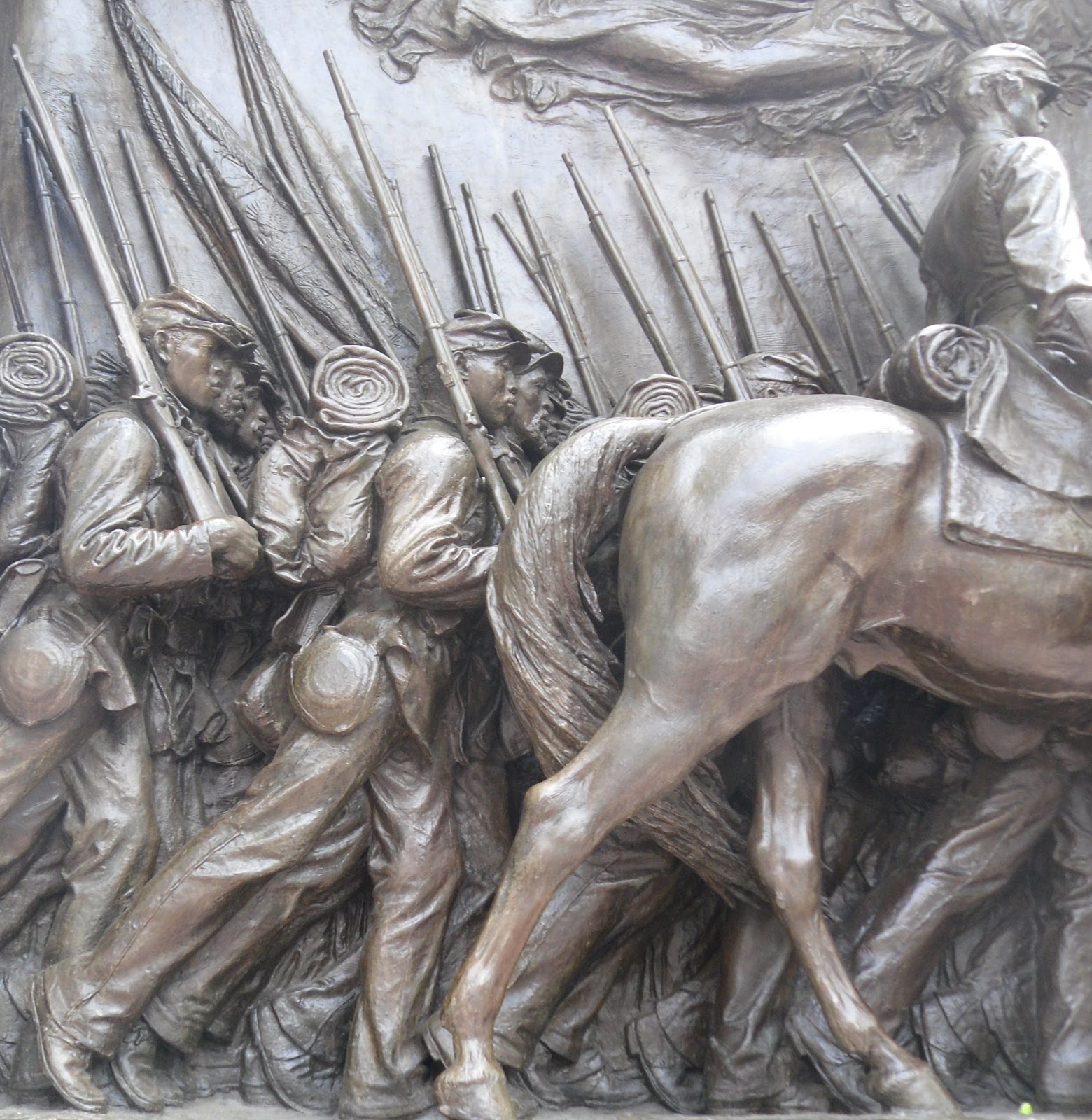
The magnificent Robert Gould Shaw memorial (described below) stands north-east of Boston Common opposite the Massachusetts State House on the corner of Beacon and Park streets.

A number of important poems have been written about Robert Gould Shaw, among them James Russell Lowell's 'Memoriae Positum R. G. S.' (1864), William Vaughn Moody's 'An Ode in Time of Hesitation' (1900), John Berryman's 'Boston Common' (1948), and Robert Lowell's 'Colonel Shaw and the Massachusetts 54th', which was reprinted as 'For the Union Dead' (1959 and 1960).

'THE MONUMENT
THE SHAW-54TH REGIMENT MEMORIAL HONORS COLONEL ROBERT SHAW AND MEMBERS OF THE MASSACHUSETTS 54TH REGIMENT WHO DIED IN THE ASSAULT ON FORT WAGNER, SOUTH CAROLINA, JULY 18, 1863. THE 54TH WAS THE FIRST REGIMENT OF BLACK VOLUNTEERS FROM THE NORTH TO FIGHT IN THE CIVIL WAR. ON THE BACK OF THE MONUMENT ARE INSCRIBED THE NAMES OF THE MEMBERS OF THE 54TH WHO DIED WITH COLONEL SHAW IN THE CAUSE OF FREEDOM AND UNION. THE MONUMENT WAS ERECTEDD THROUGH PRIVATE DONATIONS AND GIVEN TO THE CITY OF BOSTON IN 1897. IT BECAME PART OF BOSTON AFRICAN-AMERICAN NATIONAL HISTORIC SITE IN 1980. FUNDS CONTRIBUTED FROM ACROSS THE UNITED STATES MADE POSSIBLE ITS RESTORATION IN 1983-1984.'

'THE SCULPTOR
THE SHAW-54TH REGIMENT MEMORIAL, THE OUTSTANDING
TRIBUTE TO SOLDIERS OF THE CIVIL WAR, WAS CREATED
BY ONE OF AMERICA'S FOREMOST SCULPTORS, AUGUSTUS
SAINT GAUDENS (1848-1907). BORN IN DUBLIN, OF A
FRENCH FATHER AND AN IRISH MOTHER, HE GREW UP IN
NEW YORK, WAS APPRENTICED TO A CAMEO CUTTER AT 13,
AND STUDIED AT THE ECOLE DES BEAUX ARTS IN PARIS.
HE BEST KNOWN WORKS INCLUDE THE ADAMS MEMORIAL
IN WASHINGTON, D.C., GENERAL SHERMAN IN NEW YORK AND
PRESIDENT LINCOLN IN CHICAGO. HIS HOME IN CORNISH,
NEW HAMPSHIRE IS A NATIONAL HISTORIC SITE. THE SETTING
FOR THE MEMORIAL WAS DESIGNED BY THE DISTINGUISHED
ARCHITECT, CHARLES F. MCKIM.'

Edward Everett Hale in Boston, Massachusetts

The statue of Edward Everett Hale (1822-1909) stands close to the duckling sculpture near the Charles Street entrance to the Public Garden in Boston. Hale was a writer, historian and Unitarian clergyman who was born in Boston. A child prodigy, at the age of 13 he entered Harvard College, where he graduated four years later: he was thought of as the class poet.

Hale married Emily Baldwin Perkins, a niece of Harriet Beecher Stowe's, and like Stowe was a staunch abolitionist. He preached in the South Congregational Church in Boston, and is now perhaps best known for his patriotic work The Man without a Country, which was published in The Atlantic in 1853, and can be read here.

 
Bela Lyon Pratt (1867-1917) sculpted this, and also sculpted the Nathaniel Hawthorne statue in Salem, Massaachusetts.

Elizabeth Bishop in Boston, Massachusetts

A pedal-powered swan boat on the lake in the Public Garden, Boston, pulls into dock at the end of a tour. It was of an event during one such ride, a number of years ago, that a future major American poet later spoke.

Elizabeth Bishop (1911-79) was born in Worcester, Massachusetts, and her father died when she was eight months old. Her mother was institutionalized in 1916, when Elizabeth went to live with her maternal grandparents in Nova Scotia. Bishop never forgot the occasion when she was about three when she went for a ride on a swan boat with her mentally ill mother still wearing her widow's weeds, and her mother feeding peanuts to a swan which bit her and drew blood through her black glove. She later tried to write a poem about it but never managed to complete it.

Bishop's friend Robert Lowell (1917-77), born in Boston, wrote a poem titled 'The Public Garden', in which he speaks of a 'jaded flock of swanboats', and 'the arched bridge' from which I took this photo.

(Another book which includes the Public Garden is the children's story The Trumpet of the Swan (1970) by E. B. White (1899-1985), which concerns the trumpeter swan Louis, who is mute, but on learning to play a real trumpet becomes a celebrity on the swan boats before moving to richer pickings.)

Toward the end of her life Bishop lived for a few years at 60 Brattle Street, Cambridge, Massachusetts, but preferred Boston (particularly the North End with its Italian butcher shops, and bakeries for macaroons), and at the beginning of July, 1974 she moved to 437 Lewis Wharf, off Atlantic Avenue, on the fourth floor, where she had a superb view of the Atlantic Ocean. A late interview by Elizabeth Spires made at Lewis Wharf and published in the Paris Review is here.

20 May 2011

Robert McCloskey's Make Way for Ducklings, Boston, Massachusetts

Boston's Public Garden is a rectangle bounded by Beacon, Charles, Boylston, and Arlington streets, and there's a fascinating sculpture on the north-east corner of it. On the face of it, this post seems to smack of that awful animal, you know, the t-word: tourism. How many tourists in Boston stop to sit their kids on the ducks and take photos? Isn't this post about the p-word too? Yes: popularity!

So what possible defense could I make for this post? Well, this attaction is free, it doesn't cost about $50 dollars like the Boston CityPASS which droves of tourists buy to see a number of things they probably don't really want to see. Plus it's literature: this delightful culpture is based on a Boston book, but unlike such Boston books as The Bostonians, or Looking Backward, or Infinite Jest, or Laura Warholic, or any other book set in Boston, this one's for children. Of all ages. Make Way for Ducklings, by Robert McCloskey (1914—2003), was his second book and was published in 1941. It has sold over 2,000,000 copies, although I wonder how many of those were in the States alone. But it can certainly be called obscure in the UK: searching for the title in local libraries has proved fruitless, and Humphrey Carpenter and Mari Prichard's two column inch entry on McCloskey in The Oxford Companion to Children's Literature (1999, p. 327 ) expresses regret that very few of his books are available in the UK.

There is little text in the book, which an adult could easily read in a few minutes, but McCloskey's illustrations are bigger, and he studied ducklings to the point of keeping several of them in his studio in NYC.

The story is about a couple of mallards who fly around central Boston in search of a place to start a family. At first they're happy with the pond in the Public Garden, where people throw them peanuts from the swan boats, but a bicycle frightens Mrs Mallard so they find a nearby island on the Charles River. Mrs Mallard gives birth to eight ducklings: Jack, Kack, Lack, Mack, Nack, Ouac, Pack, and Quack. Policeman Michael feeds the family peanuts from the river bank.

Mr Mallard decides to investigate downstream while Mrs Mallard prepares the ducklings for the real world, and the couple agree that they should all meet at the Public Garden a week later.

When it comes to the time to leave, the ducks have a traffic problem, as they have to waddle across Embankment Road and down Mount Vernon and Charles streets to enter the park. Michael comes to the rescue by getting the police to stop the traffic as they make their way to the Public Garden where Mr Mallard is waiting, and where they decide to stay.

The ending is difficult to believe, as drakes are sexually promiscuous, and the idea of Mr Mallard being there after a week is of course an example of anthropomorphism. But it makes a good story, and one that has endured.

'THIS SCULPTURE HAS
BEEN PLACED HERE AS A TRIBUTE TO
ROBERT McCLOSKEY,
WHOSE STORY "MAKE WAY FOR DUCKLINGS"
HAS MADE THE BOSTON PUBLIC GARDEN
FAMILIAR TO CHILDREN THROUGHOUT THE WORLD
1987'

Oddly, there is no mention of the artist, but this bronze structure was made by Nancy Schön, who unsurprisingly chose to depict the troop of ducklings as they are waddling along the sidewalk, a piece of which is incorporated in the work itself. And, of course, there is no Mr Mallard. I had to wait a short time before all the kids clambered off the ducks, but an obliging couple of young women let me get on with the job without interfering.

Mrs Mallard with, as the book repeatedly choruses,

Jack,

Kack,

Lack,

Mack,

Nack,

Ouac,

Pack,

And Quack!

In 1991 the First Lady Barbara Bush gave a copy of the statue to the Soviet First Lady Raisa Gorbachev for the children of her country, and it was erected in Novodevichy Park in Moscow the same year.

17 May 2011

William Lloyd Garrison, Samuel Eliot Morison, Lucy Stone, Abigail Adams, and Phillis Wheatley in Boston, Massachusetts

The first seated statue on Commonwealth Avenue Mall - a long walkway between the two sides of Commonwealth Avenue where many people sit on benches eating and drinking or merely relaxing - was of the noted journalist and abolitionist William Lloyd Garrison (1805-79), about whom I shall say more in my post on Garrison in Newburyport, North Shore, Massachusetts.

The bronze statue was sculpted in 1885 by Olin Levi Warner, and the side facing north reads 'I am in earnest - I will not equivocate I will not excuse - I will not retreat a single inch - and I will be heard'.

And the south-facing side reads 'My country is the world - my countrymen are all mankind'.

Between Exeter and Fairfield streets (the street names ascend in alphabetical order from south-east to south-west from Arlington to Hereford) is a more recent seated statue - that of Samuel Eliot Morision (1887-1976), a maritime historian born on Charles Street, Boston MA. It was sculpted by Penelope Jencks and erected here in 1982. Morison sits on a large granite rock. His writings were many, including Builders of the Bay Colony (1930) and The Foundation of Harvard College (1935).

Some of the stones contain inscriptions:
'TO MY
READERS
YOUNG AND OLD
"A FLOWNE SHEATE
A FAIRE WINDE
A BOUNE VOYAGE"'

'DREAM DREAMS
THEN WRITE THEM
AYE BUT LIVE THEM FIRST'.

The newest additions to the statues on the mall are of a very different order from the others, and are a result of the efforts of the Boston Women's Memorial, which commissioned artist Meredith Gang Bergmann to make memorials to three women - Lucy Stone, Abigail Adams, and Phillis Wheatley - whose progressive ideas influenced society by their writings. This amazing monument is between Fairfield and Gloucester streets, was finished in 2003, and shows a very different conception of representation.

Here, men don't stand (or rather sit) on pedestals, but women are at ground level and engage with the pedestals, and the public can touch the statues: it is a very original work of art.

'ABIGAIL ADAMS
                           1744-1818
'BORN IN WEYMOUTH, MASSACHUSETTS, SHE WAS
THE WIFE OF THE SECOND PRESIDENT OF THE
UNITED STATES AND THE MOTHER OF THE SIXTH.
HER LETTERS ESTABLISH HER AS A PERCEPTIVE
SOCIAL AND POLITICAL COMMENTATOR AND
A STRONG VOICE FOR WOMEN'S ADVANCEMENT.'


'..AND BY THE WAY IN THE
NEW CODE OF LAWS
WHICH I SUPPOSE
IT WILL BE NECESSARY
FOR YOU TO MAKE
I DESIRE YOU WOULD
REMEMBER THE LADIES
AND BE MORE GENEROUS
AND FAVORABLE TO THEM
THAN YOUR ANCESTORS.
DO NOT PUT SO MUCH UNLIMITED
POWER INTO THE HANDS
OF THE HUSBANDS.
REMEMBER ALL MEN WOULD
BE TYRANTS IF THEY COULD.
IF PARTICULAR CARE AND
ATTENTION IS NOT PAID TO THE
LADIES WE ARE DETERMINED
TO FOMENT A REBELLION.
AND WILL NOT HOLD OURSELVES
BOUND BY ANY LAWS IN WHICH
WE HAVE NO VOICE,
OR REPRESENTATION.'

         LETTER TO JOHN ADAMS
                       MARCH 31, 1776

'IF WE WERE TO COUNT OUR YEARS
BY THE REVOLUTIONS
WE HAVE WITNESSED
WE MIGHT NUMBER THEM
WITH THE ANTIDILUVIANS.
SO RAPID HAVE BEEN
THE CHANGES: THAT THE MIND,
SO FLEET IN ITS PROGRESS,
HAS BEEN OUTSTRIPPED BY THEM,
AND WE ARE LEFT LIKE STATUES
GAZING AT WHAT WE CAN NEITHER
FATHOM, OR COMPREHEND.'

LETTER TO MERCY OTIS WARREN
MARCH 9, 1807

'LUCY STONE
        1818-1893

'BORN IN BROOKFIELD, SHE WAS ONE OF THE
FIRST MASSACHUSSETTS WOMEN TO GRADUATE FROM
COLLEGE. SHE WAS AN ARDENT ABOLITIONIST,
A RENOWNED ORATOR AND THE FOUNDER OF
THE WOMEN'S JOURNAL, THE FOREMOST
WOMEN SUFFRAGE PUBLICATION OF ITS ERA.'

'FROM THE FIRST YEARS TO WHICH MY MEMORY STRETCHES
I HAVE BEEN A DISAPPOINTED WOMAN. IN EDUCATION, IN MARRIAGE,
IN RELIGION, IN EVERYTHING DISAPPOINTMENT IS THE LOT OF WOMEN.
IT SHALL BE THE BUSINESS OF MY LIFE TO DEEPEN THIS DISAPPOINTMENT
IN EVERY WOMAN'S HEART UNTIL SHE BOWS DOWN TO IT NO LONGER.'

SPEECH, NATIONAL WOMAN'S RIGHTS CONVENTION, CINCINNATI 1755

'I BELIEVE THE WORLD GROWS BETTER BECAUSE I BELIEVE
THAT IN THE ETERNAL ORDER THERE IS ALWAYS A MOVEMENT,
SWIFT OR SLOW, TOWARD WHAT IS RIGHT AND TRUE.'

LAST PUBLISHED STATEMENT, THE INDEPENDENT 1893.

 
'THE LEGAL RIGHT FOR WOMAN
TO RECORD HER OPINION
WHEREVER OPINIONS COUNT,
IS THE TOOL FOR WHOSE
OWNERSHIP WE ASK.'

      WOMAN'S JOURNAL, 1891.

'LET WOMAN'S SPHERE BE BOUNDED
ONLY BY HER'


SPEECH, WOMAN'S RIGHTS CONVENTION, WORCESTER 1851.'

'PHILLIS WHEATLEY
CA. 1753-1784

'BORN IN WEST AFRICA AND SOLD AS A SLAVE
FROM THE SHIP PHILLIS IN COLONIAL BOSTON.
SHE WAS A LITERARY PRODIGY WHOSE 1773 VOLUME
POEMS ON VARIOUS SUBJECTS RELIGIOUS
AND MORAL, WAS THE FIRST BOOK PUBLISHED BY
AN AFRICAN WRITER IN AMERICA.'

'IMAGINATION! WHO CAN SING THY FORCE?
OR WHO DESCRIBE THE SWIFTNESS OF THY COURSE?
SOARING THROUGH AIR TO FIND THE BRIGHT ABODE,
TH'EMPYREAL PALACE OF THE THUND'RING GOD
WE ON THY PINIONS CAN SURPASS THE WIND.
AND LEAVE THE ROLLING UNIVERSE BEHIND:
FROM STAR TO STAR THE MENTAL OPTICS ROVE,
MEASURE THE SKIES AND RANGE THE REALMS ABOVE.
THERE IN ONE VIEW WE GRASP THE MIGHTY WHOLE.
OR WITH NEW WORLDS AMAZE TH'UNBOUNDED SOUL.'

                                               ON IMAGINATION

'I, YOUNG IN LIFE, BY SEEMING CRUEL FATE
WAS SNATCH'D FROM AFRIC'S FANCY'D HAPPY SEAT
WHAT PANGS EXCRUCIATING MUST MOLEST
WHAT SORROWS LABOR IN MY PARENT'S BREAST?
STEEL'D WAS THAT SOUL AND BY NO MISERY MOV'D
THAT FROM A FATHER SEIZ'D HIS BABE BELOV'D:
SUCH, SUCH MY CASE. AND CAN I THEN BUT PRAY
OTHERS MAY NEVER FEEL NO TYRANNIC SWAY?'

'IN EVERY HUMAN BREAST GOD HAS IMPLANTED A PRINCIPLE
WHICH WE CALL LOVE OF FREEDOM
IT IS IMPATIENT OF OPPRESSION
AND PANTS FOR DELIVERANCE.
THE SAME PRINCIPLE LIVES IN US.'
LETTER TO THE REVEREND SAMSON OCCOM

16 May 2011

Farewell Boston, Massachusetts

So we sit having a final skinny bagel with full egg and cheese for breakfast in the 'au bon pain' café (there's no capitalization), this branch of which is at the better end of Massachusetts Avenue in the center of Boston, Massachusetts. Fifteen days have elapsed since a blog post, but it feels like fifty years, so many things having happened, a lifetime of great people, sights and literary discoveries, many of which I shall reveal in future posts here. In the meantime, it's a last wander around Boston before Logan airport, jetlag recovery in a hotel in London, and the drive home which never feels like home: real home is out there, these last two weeks being filled with authors' houses, statues, plaques and graves of authors, underground interstate tunnels, merging lanes, open roads, and many literary marvels.

Diagonally opposite 'au bon pain' is the huge building of the Christian Science Publishing Company founded by Mary Baker Eddy, who was still writing books at 87. More of her later when I post about many of the authors buried in the amazing - and amazingly beautiful - Mount Auburn Cemetery, Cambridge, Massachusetts.