12 January 2013

Lawrence Earnshaw in Mottram in Longdendale, Tameside

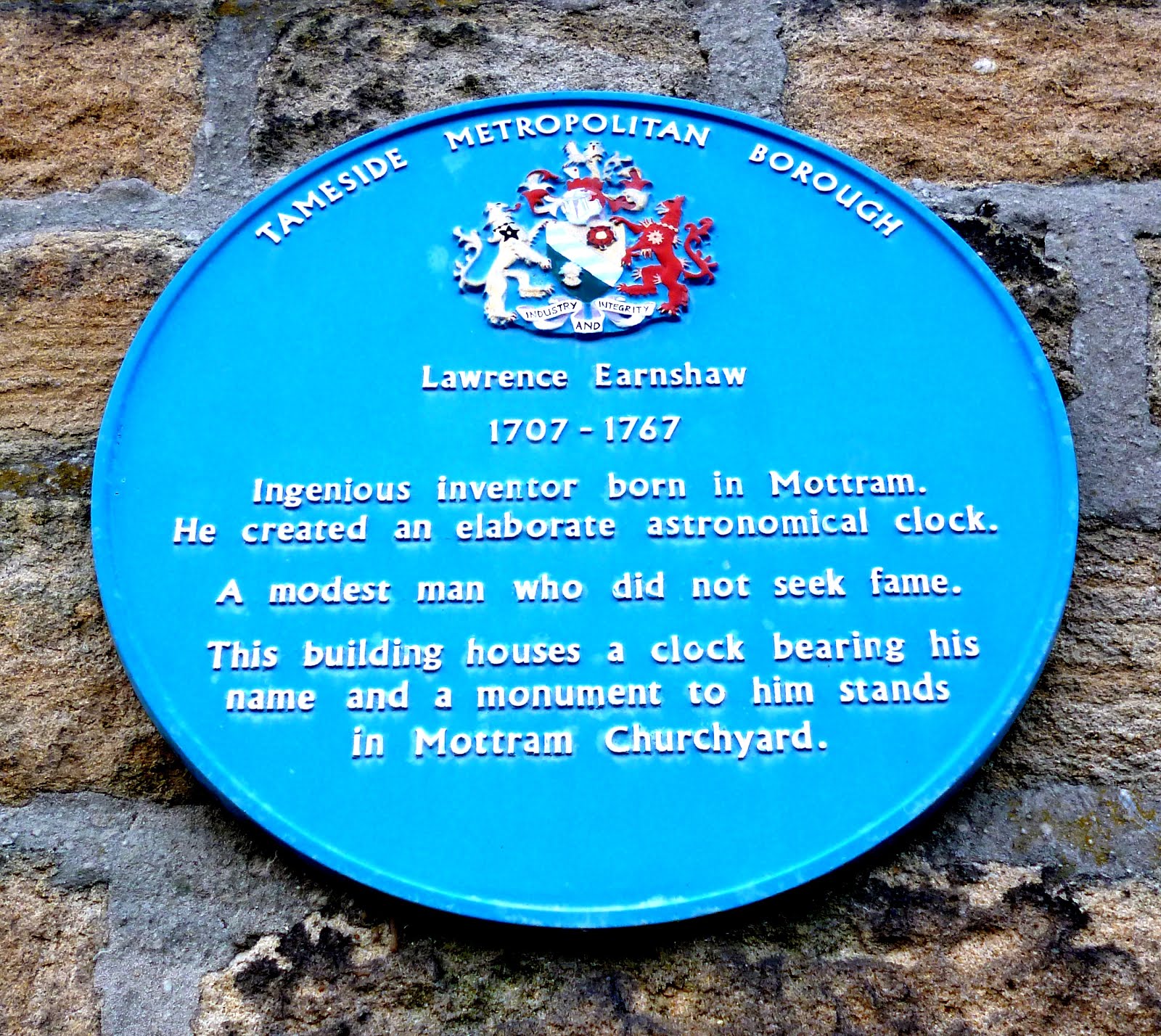
On the wall of the Court House, Market Place, Mottram in Longdendale:
 
'Lawrence Earnshaw
1707–1767
Ingenious inventor born in Mottram.
He created an elaborate astronomical clock.
A modest man who did not seek fame.
This building houses a clock bearing his
name and a monument to him stands
in Mottram Churchyard.'
 
Lawrence Earnshaw's monument at Mottram. There are four different inscriptions around the base:
 
'LAWRENCE EARNSHAW
MOTTRAM
DIED MAY 12TH 1767
AND WAS BURIED IN THE
ADJOINING CHURCHYARD.'
 
'A SELF-TAUGHT GENIUS AND
OF HUMBLE BIRTH HIS TALENTS
AS AN INVENTOR ANITCIPATED
BY MANY YEAR THE DISCOVERIES
OF OTHER EMINENT MEN.'
 
'BY HIS SKILL IN GEOMETRY
AND
ACQUIREMENTS AS A MECHANICIAN
HE DESIGNED AND CONSTRUCTED
AN ASTRONOMICAL CLOCK
REGISTERING THE REVOLUTIONS
OF THE HEAVENLY BODIES AND
THE FLOW OF THE TIDES.'
  
'A CENTURY AFTER HIS DECEASE
THE ADMIRERS OF HIS GENIUS
AND WORTH
ERECTED THIS MEMORIAL.
A. D. 1867.'
 
'JOHN EATON
ASHTON'
 
The Hyde poet James Leigh mentions Earnshaw's memorial in this verse from one his dialect poems in Glimpses of Sunlight and Other Poems:
 
'Bu' come, we'll have a look through t' yard
Th' owd ancient burial-greaund
Wheer Mottram's dead for ages
Ha'n slept so snug an' seaund;
We'll visit Earnshaw's Monument
(Neglected in his day
This cenotaph ne'er mark'd his worth
Till years had pass'd away).'
 
Below is a link to an online article on Earnshaw in the Tameside Citizen, with several more verses from Leigh's poem:
 
 –––––––––––––––––––––––––––––––––––
'A Tribute to Lawrence Earnshaw'

10 January 2013

André Blavier #3: Hyacinthe Dans

From February 1924 to November 1925 the bookseller Hyacinthe Dans in Liège was in charge of the (now, as it was his) scandalous rag Nanesse, which earned him two years' imprisonment for blackmail. Before his sentence could be carried out, though, he'd fled to Paris with his girlfriend Armande Comtat, whom he forced into prostitution to prevent himself from starving.

When she declared she was leaving him, he struck her on the head with a hammer and slit her throat, then killed his own mother (although why is unclear). Terrified of receiving the death sentence in France, he fled back to Liège, where he murdered a Jesuit priest whom he had known from Saint-Gervais college: but again, the reason is unclear, although insanity is a distinct possibility. He received life imprisonment, and became editor-in-chief of Journal des prisons belges under the pseudonym Tristan Chevreuse.

Georges Simenon had been familiar with Dans from the 1920s when they were regulars at the highly disreputable café La Cagne (which, for the record, means 'herring barrel'), and had worked on Dans's magazine. Simenon perpetuated Dans's name in his partly autobiographical first-person book Les Trois Crimes de mes amis (1928).

My André Blavier/Fous littéraires posts:
––––––––––––––––––––––––––––––––––––
André Blavier: Les Fous littéraires #1
André Blavier #2: Alexandre Ansaldi, G. Clair/Rupin Schkoff, Camarasa

André Blavier #3: Hyacinthe Dans
André Blavier #4: Ernest de Garay, aka Karl-des-Monts
André Blavier #5: Francisque Tapon-Fougas
André Blavier #6: Jules Allix
André Blavier #7: Alexandre-Vincent-Charles Berbiguier

9 January 2013

André Blavier: Les Fous littéraires (1982) #2

I mentioned André Blavier's Les Fous littéraires (1982)1 a short time ago (see link below), and have now bought a copy. This is the first edition (pub. Henri Veyrier), which contains 924 pages with details about – and examples of the writings of – many hundreds of authors who have received no or very little recognition for their (often self-published) work.2

The Introduction contains an epigraph by Latis (or Emmanuel Peillet), one of the founder members of Oulipo, stating that brevity is a positive thing, with the exception of prefaces: the Introduction is 90 pages long. After the first heading, 'Première émission ('First Programme'), there's a footnote with an explanatory note saying that the Introduction was originally conceived as a series of radio programmes that were never broadcast, and was later copiously annotated. On the second line, a second footnote explains that the expression boule de neige (lit. 'snowball') is not used here in the Oulipian sense.3 (It's used figuratively here to refer to a growing number of questions.)

As we might imagine, the influence of Queneau is very evident, so this is no conventional introduction simply explaining the rationale behind the book, but then this probably isn't a book you would read from cover to cover in any logical way. At the moment I'm getting distracted all the time, dipping into some of the characters in this colossal work. I'll give just a few examples at the moment:

– I was aware (but didn't mention it in my first post) that Paulin Gagne – who is given 26 pages here – had written a carrot culture Marseillaise (Allons enfants de la carotte, etc), but I now notice that Alexandre Ansaldi also wrote a book called La Marseillaise nouvelle in 1971: the song is on the back cover, and the text inside calls the traditional song 'imbecilic and grotesque', and 'bombastic and violent'. When Blavier was writing he knew nothing of another song titled La Marseillaise électrique (by G. Clair and Rupin Schkoff), although it's now online: it's a 'war song' for electricians, begins Allons enfants de la batt'rie ! / Le jour de voir est arrivé !, and the rest is here.4

– Antoine Madrolle wrote a theology of railways.

– Camarasa wrote a Receuil ou collection de notes, de croquis, de dessins, de schémas, pour un traité historique, théorique, pratique, philosophique, philologique, poétique, sportif, acrobatique, touristique, artistique et pittoresque de la brouette ('Book or collection of notes, sketches, designs, schemes, for a historical, theoretical, practical, philosophical, philological, poetical, athletic, acrobatic, touristic, artistic, and picturesque treatise on the wheelbarrow'.) It was printed in Madrid several times between 1915 and 1925, contained 539 pages and 993 illustrations, and was dedicated to Queen Christina.

Blavier's book is really remarkable.

––––––––––––––––––
1 Interestingly, the current English Wikipedia entry for Jean-Pierre Brisset (who is included in Blavier) has a number of similarities to the current French Wikipédia entry, and translates Fou littéraire as 'outsider writer'. In my previous post, I suggested that this is a good translation of the expression, and is one I shall continue to use about Blavier's writers: I shall be adding posts about this book when I come across interesting examples.

2 The second edition (pub. in 2000 Les Éditions des Cendres) has 1147 pages.


3 Boule de neige in the Oulipian sense refers to a poem which begins with a one-letter word for the first line, continues with a two-letter word for the second, then a three-letter for the third, etc. A boule de neige fondante (melting snowball) is a poem that begins with a word containing a certain number of letters in the first line, and then shrinks by a letter each following line.

4 Funny this undoubtedly is, although it would be a mistake to forget the gently subversive element: original words from the French national anthem –  patrie ('country') and gloire ('glory') – are changed to batt'rie ('battery') and voir ('seeing'): the song no longer glorifies the French nation, but the humble electrical workers.

My André Blavier/Fous littéraires posts:
––––––––––––––––––––––––––––––––––––
André Blavier: Les Fous littéraires #1
André Blavier #2: Alexandre Ansaldi, G. Clair/Rupin Schkoff, Camarasa

André Blavier #3: Hyacinthe Dans
André Blavier #4: Ernest de Garay, aka Karl-des-Monts
André Blavier #5: Francisque Tapon-Fougas
André Blavier #6: Jules Allix
André Blavier #7: Alexandre-Vincent-Charles Berbiguier

8 January 2013

James Prior: Three Shots from a Popgun (1880)


 Three Shots from a Popgun (1880) was Nottingham writer James Prior's first published work and contains three stories: 'Wise or Otherwise', 'Home Again' and 'Tug of War'.

Prior originally gave the copy of the book in my possession to his sister Jinnie Kirk on the year of publication. He signed it 'J. P. K.' as his real name was James Prior Kirk.

Because of the local history interest, I include the first few pages of the first story, 'Wise or Otherwise', below:

'Good-day to you, madam; and good-day to you, sir. Welcome to Nottingham. Have you any engagements, or may I hope you will accept my company for a stroll this sunny September afternoon? You will! I am greatly honoured. You have not seen much of the town, I daresay? As I thought; you have seen the Market-place pump and the Town Hall, and that is all. Well, be good enough, without more ceremony, to follow me, and I will show you a better sight.

Puff! Now we are out of the streets, and can speak and be heard. This broad avenue that you see before you is the Queen's Walk. These buildings that hedge it on every hand are the Meadows, so called because once, thirty years ago, there were meadows here green all the year, save in the springtime, when they were blue over with crocuses. Ah, if it were only thirty years ago! And why not, if we choose to have it so, and for an hour clear our memory of all the dust and rubbish that has been accumulating these thirty years? Let it be thirty years ago now, my companions. Pardon me, I am too soon familiar. Let the Queen and all of us be thirty years younger today; and let us see here nothing but what we might have seen thirty years ago.

So we are now at the end of the Walk, and by the banks of the Trent. This thing that fronts us is not an iron bridge, but a rustic ferry – Wilford Ferry, worked by one man's arm. We enter the boat, and cross in company with a milk-cart, a Nottingham stockinger, with fishing-rod and mat basket in hand, and a pair of sweethearts bound for Clifton Grove.

Safely landed with a bump! The village close at hand, almost hidden by innumerable elms, is Wilford. However, we will not enter it now, but will turn to the right by this White Horse Inn, making for the church, whose tower and spire you can see in spite of the trees.

Allow me, ladies, to assist you over this high stile. Now here we are, with nothing but a low barrier between us and the churchyard that grave-haunted Kirke White loved. But before you enter, sit down and admire the scene.

It is scarcely spoilt even now, though green fields are blotted out with red brick, and a colliery belches smoke on the opposite bank of the river. But yes, I remember we were at thirty years ago. Northward, beyond the Trent, see the broad sweep of rich meadow-land, besprinkled with trees, and bordered by pleasant hills, from which to our left rise the heights of Wollaton, clad with verdure, through which peeps the white face of a solitary mansion. To the right of these lie the houses and gentler slopes of Lenton; and next the bluff on which stands Nottingham, its two most prominent headlands crowned, the one by the Castle, the other by St. Mary's tower.

Further still, and faintly seen through the September haze, Sneinton Church sits on its own hill, like a little St. Mary's. Last of all the bold Rough Hill, covered with wood, flings round to our flank, and cuts off the view.'

Prior mentions the poet Henry Kirke White above, and there used to be a Kirke White Street in the Meadows, although with redevelopment the street was demolished. It was in the 1980s that his memory was preserved in Kirke White Court.

But Kirkwhite Walk, also in the Meadows, preserves his memory less accurately by fusing the two words and omitting the 'e'.

Anne Tyler: The Clock Winder (1972)

 
The Clock Winder is Anne Tyler's fourth novel, and the year it was published the New York Times had very little to say about it, just that it lacked substance. In a much later review in the Washington Post in 2003 – 'The Clock Winder: A Look Back to What Makes Anne Tyler Tick' – Jonathan Yardley is much more appreciative of it. And interestingly, he mentions a book I wasn't aware of – The Writer on Her Work (New York: Norton, c. 1980), edited by Janet Sternberg and containing an essay by Tyler titled 'Still Just Writing', in which she says that she's hurt when people say she chooses only to write about 'bizarre or eccentric people'. She goes on say that this is not a choice because 'even the most ordinary person [...] will turn out to have something unusual at his center.' Unusual? Well, yes, I can see that, but like most of her books The Clock Winder is (and I'm not ashamed of repeating myself ad nauseam) a world away from the milk and cookie world many believe she inhabits.

However, by coincidence, milk and cookies are literally what Mrs Emerson offers the young Elizabeth Abbott at the beginning of the book, after she does the widow a favor. But there isn't a great deal of cosiness in the rest of the novel, which depicts a very dysfunctional family with people behaving very oddly.

Mrs Emerson has had seven children, all of whom are odd, but some of whom are odder than others, such as Timothy, who kills himself earlier on in the presence of Elizabeth, and whose mentally disturbed twin brother sends her four letters in which he threatens to kill her. Most people would have been really spooked by this and called the cops, but Elizabeth doesn't tell anyone, doesn't take it seriously, and a few years later Andrew shoots her, although she's lucky to escape with a graze.

From this, it's clear that Elizabeth too is odd, and no less so for joining Dommie up the aisle only to say 'I don't'. And she doesn't just say this because she had second thoughts about that marriage proposal by Matthew, another of Mrs Emerson's sons who happens to be so persistent in chasing Elizabeth that he too seems a little spooky.

In short, and as Yardley notes, all of the characters in this novel have something odd about them, although we don't learn anything about Mrs Emerson's son Peter until the end of the book, which is in 1970, ten years after it began. For the first time in three years, Peter goes back to Baltimore to see his mother, accompanied by his wife P. J., although no one even knows he's married. Elizabeth (who's now called Gillespie and finally married to Matthew) shows P. J. their room, and they're just about set to have a meal when P. J. (alone with Peter) throws a funny and slips away quietly. Shortly afterwards, Peter slips out quietly too, finds P. J. and away they drive, back to New Jersey.

This could only be Anne Tyler. She never fails.


My other Tyler reviews are below:

–––––––––––––––––––––––––––––––––––
Anne Tyler: If Morning Ever Comes (1964)
Anne Tyler: The Tin Can Tree (1965)
Anne Tyler: Celestial Navigation (1974)
Anne Tyler: Earthly Possessions (1977)
Anne Tyler: Morgan's Passing (1980)
Anne Tyler: Dinner at the Homesick Restaurant (1982)
Anne Tyler: The Accidental Tourist (1985)
Anne Tyler: Breathing Lessons (1988)
Anne Tyler: Ladder of Years (1995)
Anne Tyler: A Patchwork Planet (1998)
Anne Tyler: Back When We Were Grownups (2001)
Anne Tyler: The Amateur Marriage (2004)
Anne Tyler: Digging to America (2006)
Anne Tyler: Noah's Compass (2009)
Anne Tyler: The Beginner's Goodbye (2012)

3 January 2013

The Collected Short Stories of Sir Temi Zammit (1995) (trans. Godwin Ellul)

Owing to a chronic allergy I hardly ever read translations – we can never be sure whose words we're reading, how faithful the translation is, and so on. Sometimes it's necessary to read in translation, though, and sometimes you just have to be generous and trust the translator.

So I had a try at this book. There are 31 short stories here, and in spite of feeling that I'd perhaps missed the point of a few of them, and noticing a few obviously off-centre expressions, I pressed on: Zammit's depiction of workers on the land in Malta in the first half of the 20th century, with its swindlers and get-rich-quick scoundrels, felt as though it was going to be interesting.

One sentence in 'Vincenza Goes to the Cinema' pulled me up sharp. It is obviously intended to say that Vincenza and her husband haven't been to the cinema before and will not do so again, but is rendered: 'This is the only time we've been to the cinema and it will not repeat itself.'

From then on I was paying as much attention to the translation as to the stories, but by 'Two Partners and Friends' (less than halfway through) I felt forced to give up: not only are there obvious errors that make comprehension difficult, but the words 'sheep' and 'goats' are used interchangeably.

That's a great pity, as it only serves to feed my translation allergy.

Linda Lê: Personne (2003)

In some ways, Linda Lê's Personne reminds me of Gilbert Sorrentino's postmodern Mulligan Stew, but then in other ways not, as Sorrentino's book is far more playful, for instance.

The usual Lê themes are here – such as death, doubles, and madness – although there's far more ambiguity. Personne, whose name means 'No one', is the main character and is a night watchman at a hotel until it burns down and he gets a job in a mail redirection business. Personne finds a computer on a tip with notes written by a woman he calls Tima, who describes her work at a museum (where she has been moved to the 'salle des gisants', containing recumbent statues), and a journey to Prague. Personne decides to retranscribe the notes, but in his own way, so it's unclear if Tima or Personne has written them.

But then, Personne is a kind of runaway train, escaping from the narrator. Other characters appear, such as Katimini the detective, Falmer (who is Personne's friend – perhaps), Ebua (whose name in reverse is 'Aube', which means 'Dawn' in French), and Abracadabra the psychiatrist is briefly mentioned. And aren't they all characters in the same book, facets of the same Personne?


My other posts on Linda Lê:

–––––––––––––––––––––––––––––––––––
Linda Lê: Les Évangiles du crime
Linda Lê: A l'enfant que je n'aurai pas
Linda Lê: Voix: une crise
Linda Lê: Lame de fond
Linda Lê: Lettre morte

1 January 2013

Mildred D. Taylor: The Road to Memphis (1990)

Mildred D. Taylor is sometimes mentioned as a writer of young adult fiction, but this novel certainly doesn't read that way. The Road to Memphis is set in 1941 and belongs to Taylor's Logan family saga, concerning the situation of blacks in mainly rural Mississippi, where they are very much second class citizens in a segregated society, where there are restaurants and toilets strictly for whites and blacks only, and where blacks sit or stand at the back of buses, and the seats at the front are for whites only.

Taylor was born in Jackson, Mississippi in 1943, and although her family moved to the North, as a child she frequently re-visited the South, absorbing the many stories she heard, later incorporating them into her novels, and The Road to Memphis is a fictional representation of archival and family research.

The author painfully depicts a world in which blacks must call whites 'Mr' and are daily forced to accept different kinds of intimidation that whites mete out with (usual) impunity. Jeremy Simms is a young white man who is an exception to these rules, though, as he believes that 'folks are folks', and is generally respected by the black community. Until, that is, he joins his racist cousins the Aames in chasing Harris, who badly breaks his leg as a result. However, Jeremy redeems himself when Moe snaps and beats up the Aames, and he not only hides Moe in his truck but secretly drives him to Jackson, from where he escapes in Stacey Logan's car to Memphis and by train to the safety of Chicago.

But there are no easy endings. There can't be.

30 December 2012

Linda Lê: Lettre morte (1999)

Lettre morte, which translates as 'Dead Letter', is a powerful book written in a single paragraph by a narrator whose Vietnamese father has just died. There are a number of parallels with Linda Lê herself, such as her mother leaving Vietnam for France with her daughters while her husband remained in Vietnam, the death of her father, the importance of the letters he wrote to her, etc.

The narrative is written to her friend Sirius, about whom we learn almost nothing: the important characters are the narrator's father and her lover Morgue (a word which also signifies pride), and the unnamed narrator herself.

The writing on the back cover, taken from the beginning of the book, is worth quoting:

'Les morts ne nous lâchent pas, dis-je à mon ami Sirius en rangeant les lettres de mon père dans un tiroir. C'est le supplice de Mézence que j'endure, attachée à un mort, main contre main, bouche contre bouche, dans un triste embrassement. Les lettres ont cessé d'arriver du pays de mon enfance. Celui qui les écrivait est mort d'une mort solitaire et enterré au bord d'un cours d'eau. Mais il est là, sa peau touche ma peau, mon haleine donne vie à ses lèvres. Il est là, dis-je à Sirius, quand je te parle, quand je mange, quand je dors, quand je me promène. Il me semble que je suis morte, tandis que mon père, ce mort qui ne me laisse pas en paix, déborde de vie. Il me possède, me suce le sang, me ronge les os, se nourrit de mes pensées.'

My translation:

'"The dead don't let us go", I told my friend Sirius while putting my father's letters into a drawer. "I'm going through the torment of Mezentius, tied to a dead man, hand to hand, mouth to mouth, in a painful embrace.* The letters stopped coming from my childhood home. The man who wrote them died a lonely death and is buried by a river. But he's here, his skin touching my skin, his breath giving life to my lips." I told Sirius: "He is there when I speak to you, when I eat, when I sleep, when I go for a walk. I feel dead, whereas my father, this dead man who will not leave me in peace, is brimming with life. He owns me, sucks my blood, eats into my bones, feeds on my thoughts."'

The narrator has intense feelings of guilt for not replying to her father's letters, for not going to see her father before he died. She describes her life with him, how her mother came to hate him, how he turned to drink, and how she used to fetch him alcohol as a child. Madness was around her, particularly from her uncle (her mother's brother) who frequently used to stay with the family before being sent to a psychiatric hospital, where he has periods of sanity and looks after the hospital library and goes around town on a moped. With the family, he used to sit on a car outside and bless people, and used to piss in bottles that he kept in the fridge and called it holy water.

In France the narrator has been in a destructive relationship (which she very recently terminated) with the married Morgue, who treated her very badly, but to whom she has been tied by an odd bond: he is abusive, a complete Philistine, and yet she has been unable to sever her relationship with him, which can perhaps only be understood in terms of her urge towards self-destruction.

Finally, after unremitting psychological pain and self-torture, the narrator decides to leave her flat and its terrible memories of Morgue, and tells Sirius to open the window and let the coolness of dawn enter.

*Mezentius is a king in Roman mythology who is particularly noted for his cruelty. Virgil's Aeneid mentions his method of torture: permanently tying a dead body to a person, which was, as Virgil called it: 'a slow death in a horrifying embrace'. The expression 'le supplice de Mézence' is evidently much more common than the English 'torment of Mezentius', and that appears to be the only English translation for it.

Below are links to other books of Lê's that I've reviewed:

–––––––––––––––––––––––––––––––––––

Linda Lê: Les Évangiles du crime (1992)
Linda Lê: Voix: une crise (1998)
Linda Lê: A l'enfant que je n'aurai pas (2011)
Linda Lê: Lame de fond
Linda Lê: Lettre morte

29 December 2012

Anton Corbijn's Control (2007)

Control is the first feature film by Anton Corbijn, and focuses on the life of Ian Curtis (played by Sam Riley), the lead singer and songwriter in the band Joy Division, between 1973 and 1980. As suited to the rather bleak content of the film, it is shot in black and white. We first see him – with books such as Allen Ginsberg's Howl and J. G. Ballard's Crash, and listening to David Bowie – in his parents home, although at the age of nineteen he married Deborah (Samantha Morton), who co-produced the film which is based on her book Touching from a Distance (1995). The rest of the band – 'Hooky', or Peter Hook (Joe Anderson), Bernard Sumner (James Anthony Pearson), and Stephen Morris (Harry Treadaway) – play relatively minor roles.

There were just three years between the band's first gig (before Morris joined as drummer, and when they were – briefly – known as Warsaw) and its abrupt demise on the eve of their American tour. During this time a great deal happened: Curtis – who had witnessed a girl have an epileptic fit and wrote the song 'She's Lost Control' as a reaction – had himself been diagnosed as epileptic; his relationship with Deborah deteriorated considerably; he began a relationship with Belgian Annik Honoré during a European tour; and he was suffering from depression.

On 18 May 1980 Ian Curtis hanged himself with a clothesline in the kitchen of his home in Barton Street, Macclesfield.

Corbijn's film is intense and compelling, the bleakness of it lessened by scatological humour from manager Rob Gretton (Toby Kebbell), and John Cooper Clarke reciting 'Evidently Chicken Town'.

At the end we see smoke coming from Macclesfield Crematorium, where Curtis was cremated, and where an increasing number of followers of the rock legend come to see his kerbstone. Below is a link to an amateur video clip from the 30th anniverary of Curtis's death at the cemetery, plus my other Curtis-related posts:

–––––––––––––––––––––––––––––––––––
Ian Curtis, Macclesfield Cemetery
Mick Middles & Lindsay Reade: Torn Apart
Ian Curtis in Macclesfield, Cheshire

27 December 2012

Elizabeth Stuckey-French: The First Paper Girl in Red Oak, Iowa (2000)

In 'Leufredus', one of the short stories in Elizabeth Stuckey-French's The First Paper Girl in Red Oak, Iowa, the narrator is working as a rehab counselor because, she says: 'I thought it would expose me to fascinating pathologies while at the same time reassuring me that I was normal, sort of an innoculation.' She is wrong, of course, although Stuckey-French's stories have that effect on me: they plunge us into a world of such eccentricity that we can only walk away with the feeling that at least we must be normal.
 
There are a number of dualities in these stories: truth versus fiction, reality versus fantasy, youth versus adulthood/old age, the spoken versus the unspoken, although there can be many stages between those dualities, there are times when they merge or become the opposites of themselves, such as the young being more mature than their parents, the unspoken more eloquent than the spoken, etc. Automatic verbal responses can hurt, but so can thinking too much before you speak.

The absurd lurks, such as when, in 'Scavenger Hunt', Francine Brick (divorced, living alone) finds a cigarette lighter (Peter the Pelican) in her kitchen, and goes to various places sleuthing down the reason for it, even inventing a name for herself as she piles fantasy on fantasy to emerge at the prosaic truth: her prodigal son (who's nothing like as rogueish as she thinks, or really as she would prefer) has visited and left it there. And another example of absurdity is (the thirtysomething?) Cherry paying for the 19-year-old Nick (who is in some ways the older person) to keep her company and join her and her children in a car journey to her husband at Virginia Beach, although on the way (after a little flirting) thinks they should push further, to Florida: impulse is a common trait in Stuckey-French's world.

And families are crucial to this world, which is peopled by mothers and fathers and their children in frequent conflict with each other. In the end, in general the young appear to come off as better people in this fictional world, slicing through the egotism, the self-deception and the arrogance of the grownup world. They may not be too diplomatic, and sometimes they're rude, but they have an honesty and a frankness that triumphs, such as when Jane, in 'Famous Poets', insults Miss X, a self-obsessed, self-defined 'famous poet', at the dinner table.

In 'Electric Wizard' the narrator says: 'Our conversation had become completely unmoored.' That seems to sum up The First Paper Girl in Red Oak, Iowa quite well.

Quirky, human, slightly insane, delightful. And that title isn't really significant, or rather, its just a fine title, so therein lies the significance.

25 December 2012

Chris Noonan's Miss Potter (2006)

After watching this movie yesterday, the lasting images in my memory are of the animated cartoons, which is by no means a good thing because they are one of the negative features of it.

Beatrix Potter was a naturalist, an artist, and a conservationist of note, and yet – in spite of director Chris Noonan's claims that he initially shyed away from this fimscript in horror of thoughts of cutesiness – 'cutesy' springs to mind here, as the film plays far too much on Potter's anthropomorphic characters as opposed to her other work.

The movie begins in 1902, when Potter (Renée Zellweger) secured a publisher (Frederick Warne & Co.) for her children's book The Tale of Peter Rabbit, the first true edition of which she in fact self-published the year before (although the movie misleads the audience on this issue).

There are a few flashbacks to Potter's youth, but the essence of the story is the publication of Potter's children's work, her conflict with her parents and her developing romance with Norman Warne (Ewan McGregor) which ends in his death before the marriage, and a little detail near the end about Potter saving land in the Lake District from the developers – she left much of the land she bought to the National Trust.

Noonan was aware that Potter, as an independently minded woman, was somewhat out of step with the prevailing Victorian ethos (which of course prevailed even after the event), but it's a pity that the movie makes so many omissions and includes so much extraneous matter.

Beatrix Potter is worthy of far more than this.

24 December 2012

James Mangold's Girl, Interrupted (1999)

Girl, Interrupted is largely set in a psychiatric hospital, which automatically makes the viewer think of comparisons with other movies set in such institutions, such as Samuel Fuller's Shock Corridor (1963), where a man posing as mad in the end becomes mad; Ken Loach's Family Life (1971), which is a fierce Laingian criticism of conventional psychiatry; Miloš Forman's One Flew Over the Cuckoo's Nest (1975), based on Ken Kesey's countercultural 1962 novel of the same name, which is by extension a savage indictment of many aspects of society in general; and the central section of Jane Campion's An Angel at My Table (1990), which is based on Janet Frame's 1984 book of the same name.
 
The movie Girl, Interrupted is based on Susanna Kaysen's (rather less linear) book of the same name which was published in 1993, and is an autobiographical account of Kaysen's experiences in McLean Hospital, Belmont, Boston, Massachusetts, in 1967 at the age of eighteen. She followed a number of other very notable writers who had been there as patients, such as Robert Lowell, Sylvia Plath, and Anne Sexton.
 
Kaysen was diagnosed as having borderline behavioral disorder, and the film charts the progress of her character (played by Winona Ryder) from ODing on aspirins, to being admitted to the fictional Claymoore Hospital, through befriending inmates with illnesses of very various seriousness and undergoing different traumas with them, to emerging more healthy and ready to face both the world and herself.
 
Unlike some movies mentioned above (notably Family Life and Cuckoo's Nest), this film is not as much a criticism of the psychiatric profession as a kind of mental coming of age, but it is nevertheless intensely powerful and relevant.

23 December 2012

Sean Durkin's Martha Marcy May Marlene (2011)

Sean Durkin (as T. Sean Durkin) directed a 13-minute short in 2010 titled Mary Last Seen, which involves a young guy driving a girl to a place he's says will be wonderful. They briefly make their way through a wood to get there, and he leaves the very dubious (probably frightened) girl in a clearing with a building and some unknown people. It could well be the beginning of Martha Marcy May Marlene.

The feature is beautifully played by the unknown Elizabeth Olsen as Martha, who has escaped from a violent, sex-obsessed, Charles Manson-like cult in the Catskills, New York State (where she is known as Marcy May) to a lakeshore house in Connecticut to rejoin her sister Lucy (Sarah Paulson) and brother-in-law (Hugh Dancy). But we only discover the backstory in flashbacks or dream sequences, which are not necessarily reliable.

All Martha  has told her sister is that she has been with a boyfriend, and nothing else, although it appears that for two years she has been in a sinister cult, that she has been raped by the leader (played by John Hawkes), been taught to use a gun under very disturbing circumstances, and has witnessed an act of apparently gratuitous murder of an outsider by a cult member. And although she says nothing about her experiences, it is clear from her bizarre behavior – from the relatively innocuous skinny-dipping in the public lake, through joining her sister and brother-in-law while they're having sex, to kicking her brother-in-law down the stairs for no reason – that she is a deeply disturbed person.

The movie tantalizingly reveals Martha's story bit by bit, but in the end there are probably not enough bits to make a whole. It grips, but then lets go a little too soon.

Anita Diamant: The Last Days of Dogtown (2005)

The blurb on the back cover of Anita Diamant's The Last Days of Dogtown gives a useful introduction to this novel, which is set in Dogtown near the fishing town of Gloucester, Cape Ann, Massachusetts:

'[T]he village of Dogtown is peopled by widows, orphans, spinsters, scoundrels, whores, free Africans, and "witches." Among the inhabitants of this hamlet are Black Ruth, who dresses as a man and works as a stonemason; Mrs. Stanley, an imperious madam whose grandson, Sammy, comes of age in her brothel; Oliver Younger, who survives a miserable childhood at the hands of his aunt; and Cornelius Finson, a freed slave. At the center of it all is Judy Rhines, a fiercely independent soul, deeply lonely, who nonetheless builds a life for herself against all imaginable odds.'

The 'real' Dogtown is now a deserted village remembered mainly for the inspirational boulders Roger Ward Babson paid workers to carve there (see link below), but Diamant's fictional construction, as the book title suggests, fictionally reconstructs the final years of Dogtown as an inhabited village.

The story begins in 1814 and continues over a number of years, and as the blurb suggests, Dogtown is depicted as a community of outsiders where (by 19th century values at least) social transgression is rife: Mrs Stanley's sex workers Sally and Molly have a happy (but hidden) lesbian relationship while her grandson seems to be asexual; the sexual relationship between the white Judy and the black Cornelius is to shock Cape Ann and drive Judy to Cambridge in the end; and the alcoholic Stanwood manifests distinctly psychotic tendencies: in parts, the reader can almost imagine, say, Jack Torrance, the character played by Jack Nicholson in The Shining.

The Last Days in Dogtown moves through a series of tableaux concerning one or two people as opposed to a strictly chronological sequence, and it follows from this that there is no central character. Nor is the style consistent: pages of cartoonish humor (Tammy Younger and her gruesome teeth extractions, Stanwood's brief (and very unconvincing) conversion) are counterpointed by pathos, by the triumph of different kinds of love over the material, making this a very moving – if slightly uneven – read.


–––––––––––––––––––––––––––––––––––
The Babson Boulders

21 December 2012

André Blavier: Les Fous littéraires (1982; repr. 2000) #1

It was while reading an article on Raymond Queneau that I discovered André Blavier (1922–2001), whose huge book Les Fous littéraires* was first published in 1982; this contained 924 pages, but additions in the 2000 edition increase it to 1147 pages. The title isn't at all easy to translate: literally it means 'Literary Madmen', but that entraps us in a gender specificity that's to some extent built into Latin-derived languages, although opting for the more politically correct 'Literary Mad People' is just ugly. And then there's the problem with the word 'mad': clearly, it frequently has pejorative connotations, but Blavier didn't intend any, so I think that – on an analogy with the expression 'outsider artists' – the term 'outsider writers' is the best to use here.

Blavier was a Belgian librarian of working-class origin from Verviers, whose life was overturned – indeed saved, as he was on the verge of suicide – by reading Queneau, who in the 1930s had unsuccessfully attempted to write a book about outsider writers, adding to Nodier's list of 'génies méconnus' ('little known geniuses'). He failed to publish, though, but salvaged his researches by incorporating some of his subjects into a novel read by Blavier: Les Enfants du limon (1938) (Children of Clay). Blavier later got to know Queneau and in 1961 became Oulipo's foreign correspondent.

From Blavier's huge collection of eccentric people has emerged what can perhaps be described as a canon of outsider writers, of whom I mention just two here:

Jean-Pierre Brisset (1837–1919), who wrote, among a number of books, La Natation ou l’art de nager appris seul en moins d’une heure (1870) ('Swimming or the Art of Swimming Self-Taught in Under an Hour'). He developed the theory that humans evolved from frogs.

Paulin Gagne (1808–76) wrote L'Unitéide, ou la Femme-Messie ('Woman Messiah') (1857), which is a poem of 726 pages said to contain some of the most fantastic names and strangest words ever written. In L'Histoire des Miracles he tells of the time he sub-let his salon to spritualists who were followers of Allan Kardec. Bearing a crucifix, he went into one of their sessions:

'[...] je suis allé seul dans la salle où se faisaient les évocations infernales ; ô miracle étonnant et épouvantable ! à l'instant, un mouvement de rotation irrésistible s'est emparé de moi ; je tournais comme une toupie autour de la table satanique, que je couvris de crachats et de bave, et d'où s'échappaient les esprits démoniaques par la présence du crucifix que je tenais toujours à la main : Satan et Dieu se disputaient mon corps et mon âme !!'

(My translation: 'Alone, I went into the room, from which hellish apparitions were coming; oh, astounding and dreadful miracle: suddenly, an irresistible rotary movement took hold of me; I spun like a top around the satanic table, which I covered with spit and dribble, and from which demonic spirits were escaping because of the presence of the crucifix I was holding: Satan and God were arguing over my body and soul!!').

After this bizarre event, Gagne was taken to a maison de santé to recover for several days.
Paulin Gagne, artist unknown.

*The expression originates from a book by Charles Nodier (1780–1844): Bibliographe de fous: de quelques livres excentriques (Paris: Techener, 1835).

My André Blavier/Fous littéraires posts:
––––––––––––––––––––––––––––––––––––
André Blavier: Les Fous littéraires #1
André Blavier #2: Alexandre Ansaldi, G. Clair/Rupin Schkoff, Camarasa

André Blavier #3: Hyacinthe Dans
André Blavier #4: Ernest de Garay, aka Karl-des-Monts
André Blavier #5: Francisque Tapon-Fougas
André Blavier #6: Jules Allix
André Blavier #7: Alexandre-Vincent-Charles Berbiguier

20 December 2012

Jean Giono: L' Homme qui plantait des arbres (1953)

In 1953 the Readers' Digest asked Jean Giono (1895–1970) to write a short account about the most extraordinary person he'd ever met, and the product was L'Homme qui aimait les arbres, which I believe has been translated using several different titles in English, but the most literal one is 'The Man Who Planted Trees'.

L'Homme qui plantait des arbres is set in the harsh climate of the French Alps, where Giono's books expressed his deep concern about the depopulation of the villages. Giono – who fought in World War I and whose experiences of it led to him becoming a staunch pacifist – was born and died in Manosque, the largest town in Alpes-de-Haute-Provence (04). In Giono's account, the young unnamed narrator is hiking in the area and is in need of water. He meets the much older Elzéard Bouffier, a shepherd who gives him a drink and puts him up for two nights. During this time, the narrator discovers that over three years Elzéard has planted 100,000 acorns in this austere and severely underpopulated land, expects them to yield about 10,000 trees after wastage, and has plans for growing silver birch, beech and ash. No one knows that he's doing it, and he is not seeking financial gain.

The narrator leaves for the war and finds on his return to Elzéard (who has now turned to bee-keeping) that the planting has yielded a forest whose trees are already taller than the two men. Over the years the narrator regularly returns to see Elzéard, the mushrooming forests, and the fresh growth of a happy community until the old man dies peacefully in Banon.

It was a few years before Giono confessed that this is just a story, that there'd never been an Elzéard Bouffier, but that is of no importance. Essentially, L'Homme qui plantait des arbres is a kind of parable about the regeneration of an area – without the use of any complicated technology – by the work of just one selfless man, a man living in harmony with the natural world. The ecological message is clear, as is the anti-war one.

My Jean Giono posts:
––––––––––––––––––––––––––––––––––––
Sylvie Giono: Jean Giono à Manosque
Jean Giono: L' Homme qui plantait des arbres
Jean Giono: Le Hussard sur le toit
Jean Giono: Colline | Hill of Destiny
Jean Giono: Un de Baumugnes | Lovers Are Never Losers
Jean Giono in Manosque
Jean Giono: Notes sur l'affaire Dominici
Jean Giono's grave, Manosque, Alpes-de-Haute-Provence
Pierre Citron: Jean Giono 1895–1970
Jean Giono: Regain | Second Harvest
Jean Giono: Que ma joie demeure
Jean Giono: Pour saluer Melville
Jean Giono et al, Le Contadour

18 December 2012

Wine Court Office in Fleet Street: London #57

On the wall of Ye Olde Cheshire Cheese pub, a rather eccentric sign:
 
'"SIR" said Dr Johnson "If you wish to have a just notion of the magnitude of this great City you must not be satisfied with seeing its great streets and squares but must survey the innumerable little lanes and courts........................................................................................................

This Court takes it's [sic] name from the Excise Office which was here up to 1665. VOLTAIRE came and, says tradition, CONGREVE and POPE, Dr. Johnson lived in Gough Square (End of the Court on the left), and finished his Great Dictionary there in 1755. OLIVER GOLDSMITH lived at No.6, where he wrote "The Vicar of Wakefield"
and Johnson saved him from eviction by selling the book for him..............................................................................
Here came Johnson's friends, REYNOLDS, GIBBON, GARRICK, Dr. BURNEY, BOSWELL and others of his circle. In the 19th C. Came CARLYLE, MACAULEY, TENNYSON, DICKENS, (who mentions the Court in "A Tale of Two Cities") FORSTER, HOOD, THACKERAY, CRUIKSHANK, LEECH and WILKIE COLLINS. More recently came MARK TWAIN, THEODORE ROOSEVELT, CONAN DOYLE, BEERBOHM, CHESTERTON, DOWSON, LE GALEIENE [sic] SYMONS YEATS – and a host of others in search of Dr Johnson, or "The Cheese"'.

Percy Bysshe Shelley and the Soho Mural: London #56

'PERCY
BYSSHE
SHELLEY
1792–1822
Poet
lived here
in 1811'.
 
This plaque is on the wall of 15 Poland Street, Soho. Shelley moved here after being expelled from Oxford University for publishing – with Thomas Jefferson Hogg – The Necessity of Atheism. In the same year he eloped to Scotland with the 16-year-old Harriet Westbrook. Round the corner on Noel Street is a mural:


'THE
SOHO MURAL
'Ode to the West Wind'
1989
Louise Vines for
LONDON WALL
01 737 4948'
 
'Ode to the West Wind' is part of Prometheus Unbound (1820), and Shelley wrote a two-paragraph introduction to it:
 
'This poem was conceived and chiefly written in a wood that skirts the Arno, near Florence, and on a day when that tempestuous wind, whose temperature is at once mild and animating, was collecting the vapours which pour down the autumnal rains. They began, as I foresaw, at sunset with a violent tempest of hail and rain, attended by that magnificent thunder and lightning peculiar to the Cisalpine regions.

'The phenomenon alluded to at the conclusion of the third stanza is well known to naturalists. The vegetation at the bottom of the sea, of rivers, and of lakes, sympathizes with that of the land in the change of seasons, and is consequently influenced by the winds which announce it.'
 
ODE TO THE WEST WIND
 
1.

O wild West Wind, thou breath of Autumn's being,
Thou, from whose unseen presence the leaves dead
Are driven, like ghosts from an enchanter fleeing,

Yellow, and black, and pale, and hectic red,
Pestilence-stricken multitudes: O thou,
Who chariotest to their dark wintry bed

The winged seeds, where they lie cold and low,
Each like a corpse within its grave, until
Thine azure sister of the Spring shall blow

Her clarion o'er the dreaming earth, and fill
(Driving sweet buds like flocks to feed in air)
With living hues and odours plain and hill:

Wild Spirit, which art moving everywhere;
Destroyer and preserver; hear, oh, hear!

2.

Thou on whose stream, mid the steep sky's commotion,
Loose clouds like earth's decaying leaves are shed,
Shook from the tangled boughs of Heaven and Ocean,

Angels of rain and lightning: there are spread
On the blue surface of thine aery surge,
Like the bright hair uplifted from the head

Of some fierce Maenad, even from the dim verge
Of the horizon to the zenith's height,
The locks of the approaching storm. Thou dirge

Of the dying year, to which this closing night
Will be the dome of a vast sepulchre,
Vaulted with all thy congregated might
Of vapours, from whose solid atmosphere
Black rain, and fire, and hail will burst: oh, hear!

3.

Thou who didst waken from his summer dreams
The blue Mediterranean, where he lay,
Lulled by the coil of his crystalline streams,

Beside a pumice isle in Baiae's bay,
And saw in sleep old palaces and towers
Quivering within the wave's intenser day,

All overgrown with azure moss and flowers
So sweet, the sense faints picturing them! Thou
For whose path the Atlantic's level powers

Cleave themselves into chasms, while far below
The sea-blooms and the oozy woods which wear
The sapless foliage of the ocean, know

Thy voice, and suddenly grow gray with fear,
And tremble and despoil themselves: oh, hear!

4.

If I were a dead leaf thou mightest bear;
If I were a swift cloud to fly with thee;
A wave to pant beneath thy power, and share

The impulse of thy strength, only less free
Than thou, O uncontrollable! If even
I were as in my boyhood, and could be

The comrade of thy wanderings over Heaven,
As then, when to outstrip thy skiey speed
Scarce seemed a vision; I would ne'er have striven

As thus with thee in prayer in my sore need.
Oh, lift me as a wave, a leaf, a cloud!
I fall upon the thorns of life! I bleed!

A heavy weight of hours has chained and bowed
One too like thee: tameless, and swift, and proud.

5.

Make me thy lyre, even as the forest is:
What if my leaves are falling like its own!
The tumult of thy mighty harmonies

Will take from both a deep, autumnal tone,
Sweet though in sadness. Be thou, Spirit fierce,
My spirit! Be thou me, impetuous one!

Drive my dead thoughts over the universe
Like withered leaves to quicken a new birth!
And, by the incantation of this verse,

Scatter, as from an unextinguished hearth
Ashes and sparks, my words among mankind!
Be through my lips to unawakened earth

The trumpet of a prophecy! O, Wind,
If Winter comes, can Spring be far behind?


17 December 2012

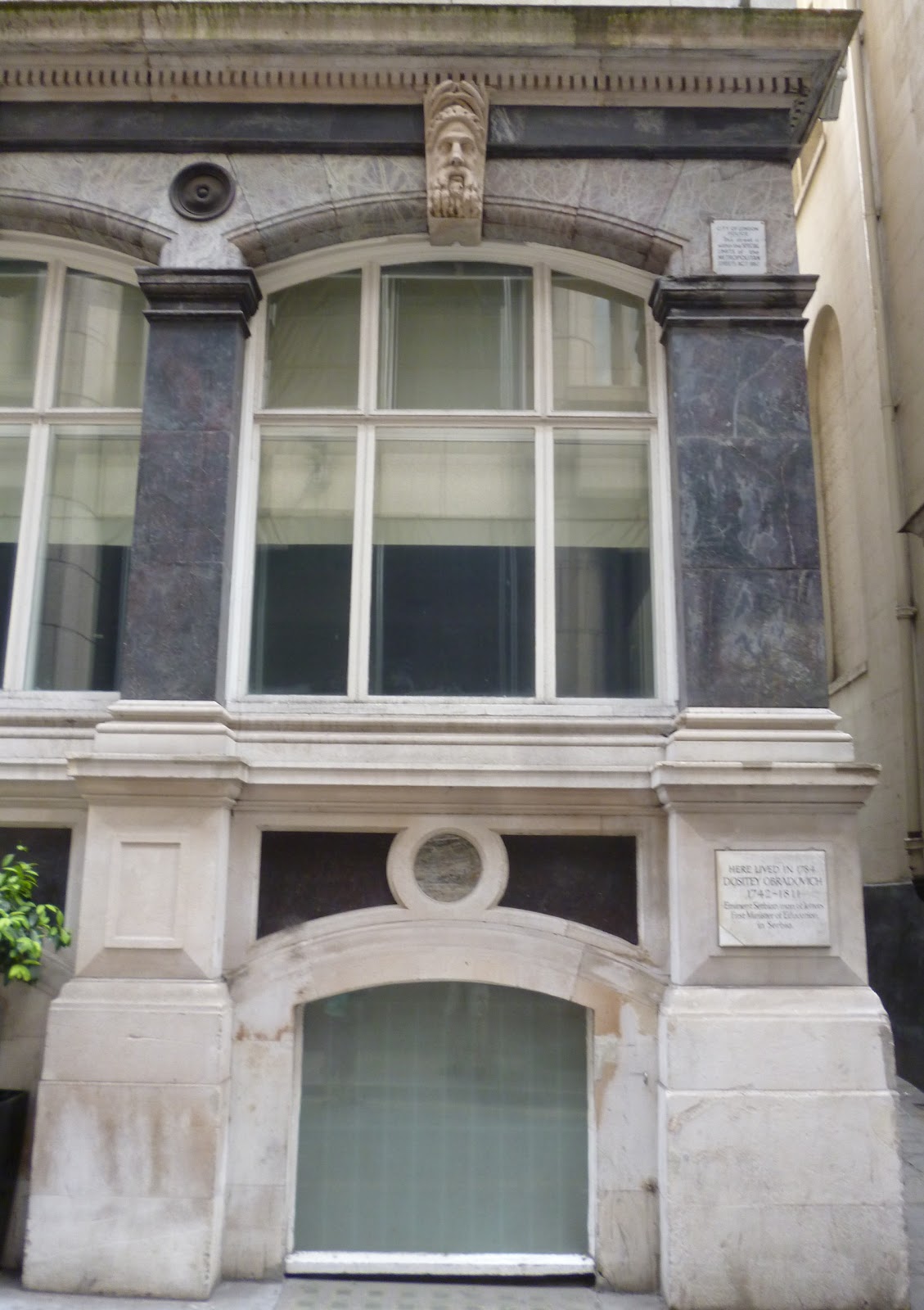
Dositey Obradovich in the City: London #55

27 Clement's Lane.
 
'HERE LIVED IN 1784
DOSITEY OBRADOVICH
[Dositej Dimitrije Obradović]
1742~1811
Eminent Serbian man of letters
First Minister of Education
in Serbia.'
 
Obradovich was the founder of Serbian literature and the translator of Aesop's Fables into Serbian.

John Bunyan in Holborn: London #54

The statue of John Bunyan by John Garbe, Baptist Church House, on the corner of Catton Street and Southampton Row.
 
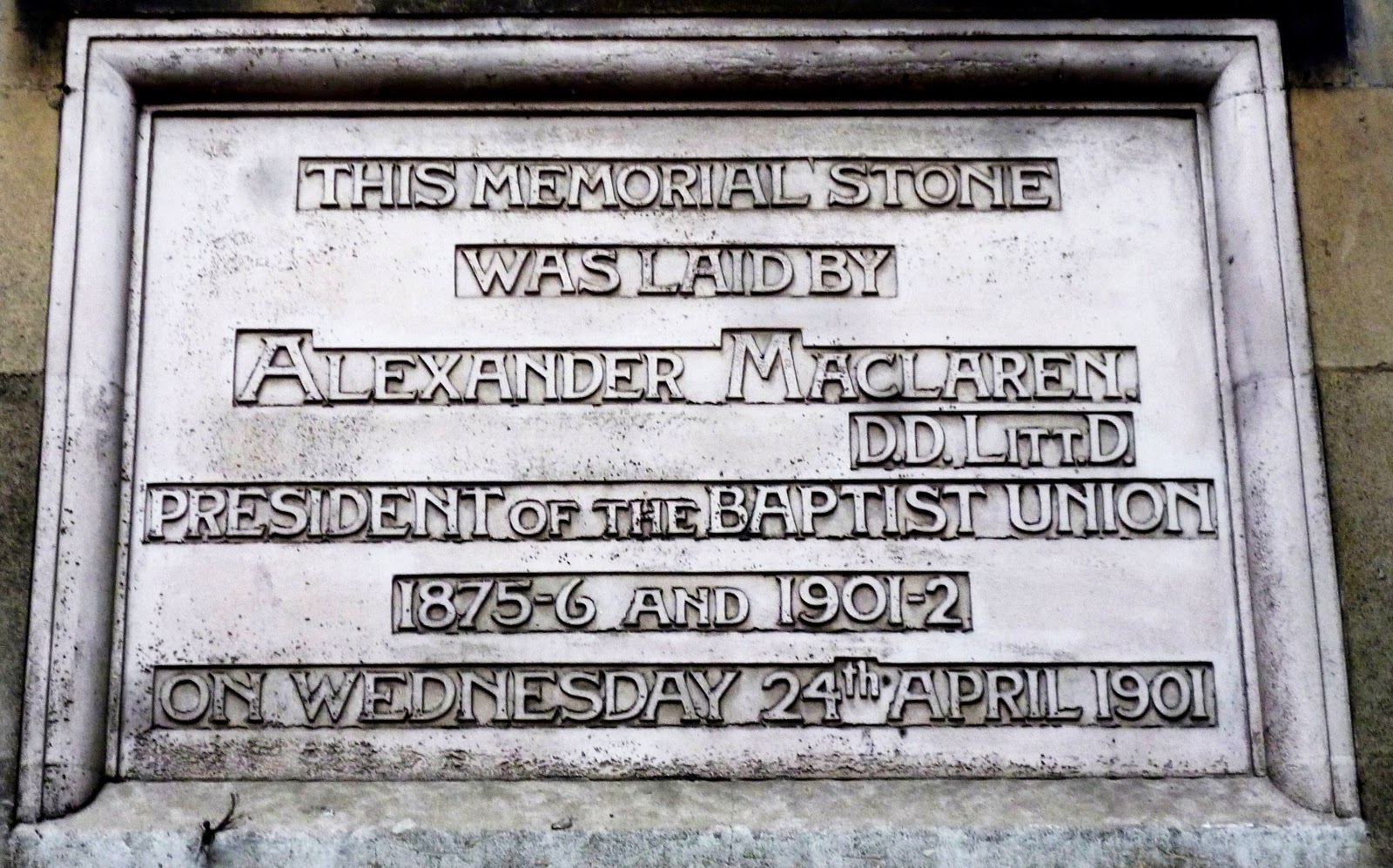
'THIS MEMORIAL STONE
WAS LAID BY
ALEXANDER MACLAREN,
                          D.D. LITT. D.
PRESIDENT OF THE BAPTIST UNION
1875–6 AND 1901–2
ON WEDNESDAY 24TH 1901'
 
'As I walk'd through the wilderness of this
world, I lighted on a certain place, where
was a Denn; & I laid me down in that place to
sleep: And as I slept I dreamed a dream.'
 
Obviously, this is a quotation from Pilgrim's Progress.
 
The link below is to a long, image-filled post I made on John Bunyan:

–––––––––––––––––––––––––––––––––––
John Bunyan in Bedfordshire