Showing posts with label Giono (Jean). Show all posts

28 May 2020

Jean Giono: Pour saluer Melville (1941)

Jean Giono published Pour saluer Melville at the same time as he published his (and Lucien Jacques's, with the assistance of Joan Smith) translation of Melville's Moby-Dick. It's a kind of introduction, a kind of biography, although fictionalised because Giono has access to Melville's thoughts.

The book begins in the right place, relating Melville's childhood, his decision to go to sea in a whaler, some of his travels, and his change of occupation by becoming a writer. But a little over halfway through things start to go weird. Certainly Melville visited a publisher during a stay in London in 1849, although what happened there according to Giono is pure fantasy.

Melville decides that while waiting for the next ship back home he has time to visit some of England, and so heads for the south-west in a horse-drawn coach. Initially his only travelling companion is a mysterious Adelina White, with whom Melville becomes obsessed and who in turn comes to love Melville platonically. She reveals that she is smuggling corn to the Irish during the famine, and they exchange addresses as they part.

What is evidently missing here is the fact – which the name 'White' gives away – that Adelina is a representation of Giono's lover Blanche Meyer. In the thirty-page chapter 'The creation of the Muse: Blanche, Adelina White and Pour saluer Melville' of her thesis 'Space of Passion: The Love Letters of Jean Giono to Blanche Meyer (2004), which is freely available online, Patricia A. Le Page analyses how Meyer deeply influenced Giono's writing. A fascinating little book.

My Jean Giono posts:
––––––––––––––––––––––––––––––––––––
Sylvie Giono: Jean Giono à Manosque
Jean Giono: L' Homme qui plantait des arbres
Jean Giono: Le Hussard sur le toit
Jean Giono: Colline | Hill of Destiny
Jean Giono: Un de Baumugnes | Lovers Are Never Losers
Jean Giono in Manosque
Jean Giono: Notes sur l'affaire Dominici
Jean Giono's grave, Manosque, Alpes-de-Haute-Provence
Pierre Citron: Jean Giono 1895–1970
Jean Giono: Regain | Second Harvest
Jean Giono: Que ma joie demeure
Jean Giono: Pour saluer Melville
Jean Giono et al, Le Contadour

15 May 2020

Jean Giono: Le Hussard sur le toit (1951)

Much like Camus's La Peste, Giono's Le Hussard sur le toit is an allegory of the Second World war seen as a plague. Giono detested war, having experienced it in World War I, when he was wounded. By extension, he intended it as an allegory of evil in general. As he was seen by some as a collaborator and his house was once attacked by angry residents, this novel can also be viewed as Giono's way of retaliating, of striking back at his attackers.

Only relatively recently has a fascinating story been revealed, one that was held back from the general public by the Giono family, meaning that Pierre Citron's mastery biography of his friend has a gaping hole in it: there is no mention of Blanche Meyer, with whom Giono had a relationship for a number of years, and who – it is generally thought – changed Giono's writing style. Here is not the place to talk about the weird way Giono's biography of Hermann Melville hurtles into fiction halfway through and invents a tale of Melville being in love with a certain Adeline White (as in Blanche). But it is time to say a word about Pauline de Théus.

There isn't much point in telling the long story of the French-speaking renegade hussar Angelo from Piedmont's adventures through a plague-ridden Provence, or the various characters he meets, that he is thought to be a poisoner of fountains in Manosque and takes to the rooftops, etc. But his relationship with Pauline (another incarnation of Blanche) is really crucial to the novel. He first meets her when coming down from a loft to investigate what he thinks is an empty house, but finds Pauline there, who amazingly welcomes him and gives him a drink of tea. We don't meet her again until some time later.

And when we do meet her she joins Angelo on his journey as they're both going to Gap. It will be a long and hazardous trail but in the course of it they come to love each other, although this love is unspoken and platonic: Pauline is heading north of Gap to join her husband, a rich man much older than her whom she came to love when he was being nursed by Pauline's father, a poor country doctor, for a buckshot wound. Dr A. Le Page, in her thesis 'Space of Passion: The Love Letters of Jean Giono to Blanche Mayer', has a chapter mainly concerning Le Hussard sur le toit 'as an expression of the myth of amour courtois' and seeing Pauline and Angelo 'as models of the chivalric ideal'. The full thesis is freely available online.

There are many things that could be said about Le Hussard sur le toit: it is enough to say that it is a major, essential work by a major author.
My Jean Giono posts:
––––––––––––––––––––––––––––––––––––
Sylvie Giono: Jean Giono à Manosque
Jean Giono: L' Homme qui plantait des arbres
Jean Giono: Le Hussard sur le toit
Jean Giono: Colline | Hill of Destiny
Jean Giono: Un de Baumugnes | Lovers Are Never Losers
Jean Giono in Manosque
Jean Giono: Notes sur l'affaire Dominici
Jean Giono's grave, Manosque, Alpes-de-Haute-Provence
Pierre Citron: Jean Giono 1895–1970
Jean Giono: Regain | Second Harvest
Jean Giono: Que ma joie demeure
Jean Giono: Pour saluer Melville
Jean Giono et al, Le Contadour

15 June 2019

Pierre Magnan in Revest-Saint-Martin (04)

Patrick Magnan (1922-2012) was born in Manosque and much inspried by Jean Giono. Thyde Monnier persuaded her editor Juillard to publish his first novel. L'Aube insolite appeared in 1946, although it was La Maison assassinée (1984) which was his most successful.

"'J'ai écrit dans ce pigeonnier la plupart de mes livres ; J'y ai vécu heureux pendant 30 ans.'
Pierre Magnan

1922-2012"


10 June 2019

The Observatory, Saint-Michel-l'Observatoire (04)

Marcel de Kerolyr (1873-) began his working life as a violinist and married a singer whom he accompanied in Europe. They lived in Nice and he and his wife are said to have witnessed the accidental strangulation of Isidore Duncan in 1927. His wife lost her voice and, after subsisting on menial jobs, de Kerolyr visited the observatory in Nice and resolved to devote himself to astrophotography. He began in Digne, moved to Forcalquier, and probably died in 1969. Jean Giono's ‎Le Poids du ciel (1938) contains thirty-two astrophotographs made by Kerolyr.‎ (He also joined in with Giono's Contadour 'utopia').

9 June 2019

Taos Amrouche in Saint-Michel-L'Observatoire (04)


'TAOS AMROUCHE
4 MARS 1913 - 2 AVRIL 1976'

Until relatively recently the grave of Taos Amrouche wouldn't have meant a great deal to many people. The Algerian singer, dancer and writer was the daughter of the writer Fadhma Aït Mansour Amrouche and the sister of the writer Jean Amrouche. With her brother she conducted a number of interviews with Jean Giono, with whom she was madly in love, with whom she had a brief affair, and of whom she wrote in her Carnets intimes, which was not published until 2014.

20 May 2019

Pierre Citron: Jean Giono 1875 [sic] –1970 (1990)

Pierre Citron's Giono 1875 [sic-1970 gets off to a bad start because the title page (as opposed to the correct cover title) makes his date of birth twenty years before it in fact was: he was of course born in 1895. That weird proofreading oversight – all the weirder because Seuil is a major publishing house – notwithstanding, this is still a huge contribution to knowledge of Jean Giono, a masterly work, on a great author, written by someone who not only had access to Giono's papers, but who knew him over a large period of time. I hesitate to call this the definitive work on Giono only because I believe Citron's later unpublished 'Les Ordres étranges. Sur les amours de Giono' should adjust the gaping hole in this biography – when the opening of it is allowed in, I think, 2040! But more of that below.

This biography is a work by an academic, a considerable 670-page book with copious textual apparatus. It's also a critical biography, including Giono's many works: his novels, plays, non-fiction, newspaper articles, film work, etc. And Citron often gives his opinion of the value of these works in Giono's oeuvre as a whole. I found Citron's brief mention of Giono's earlier substantivising of adjectives fascinating: 'le sensible des cuisses', 'le gluant du courant', 'le profond de sa pipe', etc –  this is part of his description of how Giono's writing develops between the years before and after World War II.

Citron's book isn't a eulogy of the man, either: it includes his faults, although that is at the same time a way of fleshing the man out, humanising him more. And of course in so doing it adds humour to the text: it's interesting to learn, for instance, of Giono's clumsiness, of how he tried to learn to drive earlier in his life when he was working in a bank in Manosque but failed to get the hang of a work colleague's Citroën. So it may appear odd that Giono, in his correspondence home during World War I, should mention apparent physical feats: Citron realises that Giono is merely trying to put his worried family's mind at rest, knowing from his experiences of playing darts and boules with him that Giono really was incorrigibly clumsy, that he had great problems with objects. He even mentions the time that Giono, in his Le Paraïs home, called out an electrician to mend his broken radio: he'd just forgotten to plug it in.

In Giono's work untruths have an importance, and as a story-teller – in other words a kind of professional liar – he often had a cavalier attitude to the truth: he couldn't, for instance, understand why Readers' Digest didn't like the work he had, as asked, sent them ('L'Homme qui plantait des arbres') but invented (which wasn't asked for) the man who planted trees: why bother to commission a story-teller if he wasn't allowed to tell stories? Pure and simply, Giono was often economical with the truth, treated it not so much perhaps with contempt but with indifference: any numbers he mentioned might well be exaggerated, certainly they changed frequently during different tellings.

This, in a roundabout way, brings us to how Pierre Citron, in writing this book, entered into a 'moral contract' with Giono's daughter Sylvie not to make any mention of Giono's extra-marital affairs, and this contract was also included in the Pléiadisation of his work. This means that there is only a fleeting mention of Simone Téry, only a few mentions of Hélène Laguerre (as a pacifist friend), but no mention at all of the woman who influenced a number of aspects of Giono's work (including the bizarre second half of the biography on Herman Melville – Pour Saluer Melville (1974)), a woman who appears in Giono's work under different guises, with whom Giono had a passionate love affair, and to whom he wrote well over a thousand letters between 1939 and the year of his death in 1970 : Blanche Meyer, who first came to Manosque with her solicitor husband, and first came to Giono's attention when she wanted a copy of Joyce's Ulysses from a local bookseller.

The vast majority of Giono's letters went to Yale University in Connecticut, and from these Patricia A. Le Page wrote her university thesis 'Space of Passion: The Love Letters of Jean Giono to Blanche Meyer' in 2004. The truth was at last out. Annick Stevenson's book Jean Giono et Blanche Meyer reached a larger public in 2007. In 2013 Pierre Citron's widow Suzanne wrote an article in Histoires Littéraires revealing the existence of the 232-page typescript 'Les Ordres étranges. Sur les amours de Jean Giono', which her husband had deposited at the Bibliothèque nationale. The half-title refers to an expression which appears in Giono's novel Le Chant du monde: 'Dessous campait cette partie de sa chair d'où jaillissaient les ordres étranges', which is obviously a reference to an erection. The following year (2014) the novelist and singer Taos Amrouche's Cahiers Intimes were published posthumously; this is a 476-page collection of her writings in her diaries, and it was quite evident that she was very much in love with Giono, although their liaison was brief. She mentions one sentence that a number of writers have repeated: 'Il m’a prise par trois fois et pour la première fois, il a osé me retourner et entrer par-derrière' ('He took me on three occasions, on the first of which he dared to turn me round and enter me from behind'): oddly, the title of the short chapter in Citron's typescript (revealed by Suzanne) is called 'Taos ou la tentation refusée' – an instance of Giono lying again?

My Jean Giono posts:
––––––––––––––––––––––––––––––––––––
Sylvie Giono: Jean Giono à Manosque
Jean Giono: L' Homme qui plantait des arbres
Jean Giono: le Hussard sur le toit
Jean Giono: Colline | Hill of Destiny
Jean Giono: Un de Baumugnes | Lovers Are Never Losers
Jean Giono in Manosque
Jean Giono: Notes sur l'affaire Dominici
Jean Giono's grave, Manosque, Alpes-de-Haute-Provence
Pierre Citron: Jean Giono 1895–1970
Jean Giono: Regain | Second Harvest
Jean Giono: Que ma joie demeure
Jean Giono: Pour saluer Melville
Jean Giono et al, Le Contadour

3 May 2019

Jean Giono: Regain | Second Harvest (1930)

The cover shows Arsule on the banks of a stream that she and Gédémus have pulled him from after a fall. She's been working like a slave for Gédémus, who has a knife-grinding machine he wanders around Provence with, earning very little. But Gédémus in a sense saved Arsule (whose real name might be Irène but Arsule seems to fit better) far from being a singing slave to Tony, playing the bars after walking to various places until she's fit to drop.

While Gédémus is sleeping they go to Panturle's house in Aubignane (modelled on Redortiers), a small village where he's the only person left after Gaubert and la Mamèche have gone. The title Regain can refer to a second harvest, or to a renewal, and is a very apt title because the book is about a number of different kinds of renewal: the life of both Arsule and Panturle are renewed, in the end the couple have new neighbours and the village is renewed, life is coming to it and Arsule is pregnant.

Arsule changes Panturle, renews the man who cared little for his appearance, who brought dirty wood into the house but now leaves it outside, and lived by killing wild animals but now is given a plough by the dying Gaubert and has a horse and a large quantity of corn seed borrowed from a friend from a nearby village. And soon Panturle grows the best (virtually only, but nevertheless very superior quality) corn, which he sells for a good price in town.

Marcel Pagnol made a film of Giono's Regain, although somehow it was a bit too comical, played for laughs as it (almost) could only be with the huge toothed, usually smiling, optimistic Fernandel as Gédémus. The two are rather different stories, but Giono's is the more powerful. It marks the final part of the author's Pan trilogy after Colline (1928) and Un de Baumugnes (1929). 

My Jean Giono posts:
––––––––––––––––––––––––––––––––––––
Sylvie Giono: Jean Giono à Manosque
Jean Giono: L' Homme qui plantait des arbres
Jean Giono: Le Hussard sur le toit
Jean Giono: Colline | Hill of Destiny
Jean Giono: Un de Baumugnes | Lovers Are Never Losers
Jean Giono in Manosque
Jean Giono: Notes sur l'affaire Dominici
Jean Giono's grave, Manosque, Alpes-de-Haute-Provence
Pierre Citron: Jean Giono 1895–1970
Jean Giono: Regain | Second Harvest
Jean Giono: Que ma joie demeure
Jean Giono: Pour saluer Melville
Jean Giono et al, Le Contadour

28 April 2019

Jean Giono: Que ma joie demeure (1935)

Jean Giono towers over Provençal literature. How can you describe the power of this big novel, which oozes, sings, and creeps into your system, eventually taking you over with its love of the rural countryside, the power of the mountains, the changes in the weather with the seasons, the bursting of nature, the various animals, trees, flowers, herbs, the joy of living out each second in a wonderland?

Well, it's not such a wonderland as that, and Jourdan is waiting for someone, a kind of saviour, a messiah. And so Bobi comes along, in whom everyone has an instinctive trust: he's a former acrobat who speaks French, but a kind of French that is at times difficult to understand, needs some explanation, which Bobi is only too willing to give.

The nature here – vegetable, wild animal and human animal – drips sex. I suppose Giono got away with it because he came decades after Zola, and was a little more subtle. Maybe so subtle that many missed the point.

The point of this book? There's a proto-ecological tale, even a communistic one, an urge for sharing, for delighting in uselessness for the sake of uselessness. This is a book which is anti-progress, anti-capitalist, it wears its heart on its sleeve, and although it yearns for happiness this is very short-lived.

Death is present amid the tremendous outpouring of life, and can come with age, accident or suicide. In the midst of the push for life, the contingent and the push towards opposition is inevitable.

My Jean Giono posts:

––––––––––––––––––––––––––––––––––––
Sylvie Giono: Jean Giono à Manosque
Jean Giono: L' Homme qui plantait des arbres
Jean Giono: Le Hussard sur le toit
Jean Giono: Colline | Hill of Destiny
Jean Giono: Un de Baumugnes | Lovers Are Never Losers
Jean Giono in Manosque
Jean Giono: Notes sur l'affaire Dominici
Jean Giono's grave, Manosque, Alpes-de-Haute-Provence
Pierre Citron: Jean Giono 1895–1970
Jean Giono: Regain | Second Harvest
Jean Giono: Que ma joie demeure
Jean Giono: Pour saluer Melville
Jean Giono et al, Le Contadour

23 October 2018

Jean Giono: Notes sur l'affaire Dominici (1955)

In the early morning of 5 August 1952 three people were murdered near the village of Lurs in Provence: the eminent scientist Jack Drummond, his wife Ann, and their daughter Elizabeth, aged ten. Jean Giono was asked by the weekly paper Arts to cover the trial, and presumably Giono (never possessing a car) went by train from his home in Manosque to Digne in order to do so. These are notes on his findings.

Much of this concerns the Dominici family, near whose home the Drummond family – on holiday from Long Eaton in Derbyshire, near where Jack worked for Boots – had stopped to perhaps camp for the night, but who were certainly in need of water for the Hillman's radiator, tortured by the the heat in Provence.

The trial was a little crazy, but the 72-year-old Gaston Dominici – who had admitted to the murders several times but then retracted his statements – seems to be a cooked goose still in the farmyard: Giono (surely slightly exaggerating?) states that he's worked out that Gaston (who must have left school between the age of nine and eleven) has a total vocabulary of 35 French words, and even though he's intelligent, this is no match against the many thousands of words lawyers and judges make use of, especially if they choose to use them to get a trial over quickly.

Giono says he wouldn't like to be in the shoes of one of the jurors, but Gaston is sentenced to death, in spite of the unbelievable bungling of the cops, and in spite of no motive for the murders being put forward, although the sentence was commuted to life imprisonment and de Gaulle freed Dominici on health grounds in 1960 (five years afters Giono published these notes). Giono is uncertain of Dominici's guilt, but certain that the trial was by no means fair.

But Dominici was never pardoned, which later generations of the family have tried to achieve. A German prisoner Wilhelm Bartkowski had confessed that he was partly responsible for the murders (the motive no doubt being robbery) although this doesn't appear to have been followed up by anyone. Such is the course of justice.

My Jean Giono posts:
––––––––––––––––––––––––––––––––––––
Sylvie Giono: Jean Giono à Manosque
Jean Giono: L' Homme qui plantait des arbres
Jean Giono: Le Hussard sur le toit
Jean Giono: Colline | Hill of Destiny
Jean Giono: Un de Baumugnes | Lovers Are Never Losers
Jean Giono in Manosque
Jean Giono: Notes sur l'affaire Dominici
Jean Giono's grave, Manosque, Alpes-de-Haute-Provence

Pierre Citron: Jean Giono 1895–1970
Jean Giono: Regain | Second Harvest
Jean Giono: Que ma joie demeure
Jean Giono: Pour saluer Melville
Jean Giono et al, Le Contadour

19 June 2017

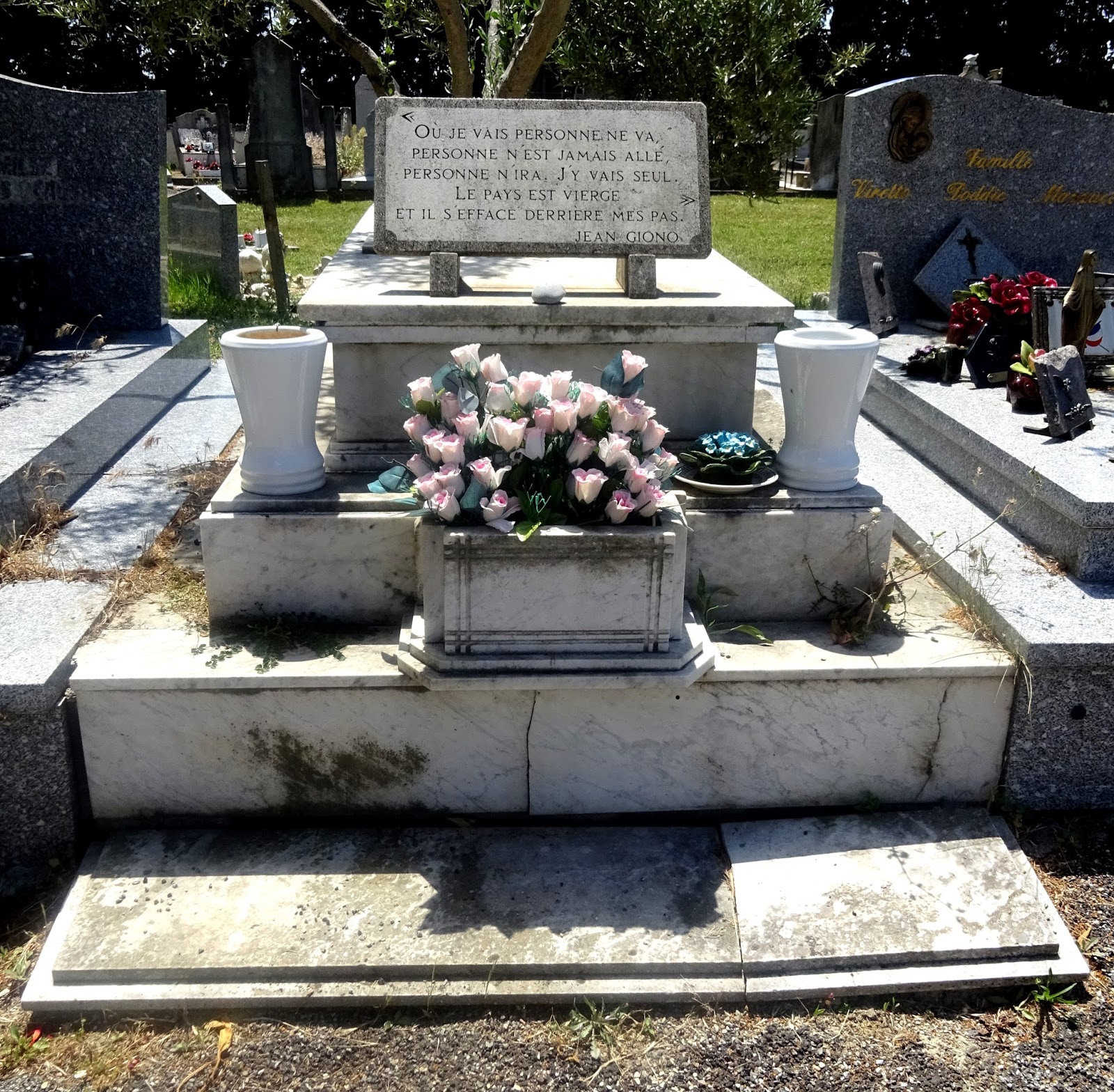
Jean Giono's grave, Manosque, Alpes-de-Haute-Provence (04)

This is what I completely forgot about last year, and which our guide to his home never even mentioned: Jean Giono's grave.

« OÙ JE VAIS PERSONNE NE VA,
PERSONNE N'EST JAMAIS ALLÉ,
PERSONNE N'IRA. J'Y VAIS SEUL.
LE PAYS EST VIERGE
ET IL S'EFFACE DERRIÈRE MES PAS
JEAN GIONO»

25 July 2016

Sylvie Giono: Jean Giono à Manosque: Le Paraïs, la maison d'un rêveur (2012)

Jean Giono à Manosque is written by Giono's daughter Sylvie, and is a biography of Le Paraïs the house as much as it is a biography of her father. But perhaps surprisingly, this little book (only just over a hundred pages) is far from being a hagiography: Sylvie says her father was far from perfect, being an egotist, very proud, seeking his own pleasure above all else. This is a man who was a stay-at-home, avoiding going anywhere, far preferring to remain in his family, but even there he was self contained, creating his own reality through his fiction. In 1954 he was nominated as a member of the Académie Goncourt in Colette's place, and when asked what was the best thing about his subsequent trips to Paris, said seeing the clock of Lyon station to take the train back to Provence. And this was in spite of a 'revolution' (for Sylvie) three years before, when Giono actually went to Italy – although it took him two years to plan the journey, and even then he had to find a friend who had a car, as Giono never learned to drive.

Maybe the above paragraph sounds a little negative towards Jean Giono, but it's not meant to be because Sylvie Giono also displays a tremendous interest in and great knowledge of her father's work and obviously recognises his huge value to French literature in general, that he was of course was not simply a 'regional' writer (whatever that may mean) but of importance not only to France as a whole but to the world.

But to return to Le Paraïs, the house, I discovered much more about it from this book than the guided tour of it we had last month. It's interesting to learn that Jean's friend the poet and artist Lucien Jacques  – who was almost a member of the family and who made a fresco in 1936 which includes the family – alludes to Giono's novel Que ma joie demeure (1935) in the fresco. L'Ange, the two-metre high wooden sculpture that dominates a room in the house, has been attributed to Pierre Puget's atelier. I remember the sculpture in a peasant's barn that Giono wanted to buy and that in the end he had to buy the barn itself, although that this may have been the head of a capitol from a Roman chapel sacked in the revolution and that Giono gave back the barn to the peasant after removing the piece from the lintel on which it stood? No, I don't remember that being mentioned. All these objects in the house fed Giono's imagination, Sylvie makes clear.

Like Lucien Jacques, Jean Giono was the son of a shoemaker and an autodidact. Giono read the Greeks in his teens, read Shakespeare, loved Victor Hugo like his father (who cried on the death of Hugo in 1885) and even read detective stories voraciously, of which Gallimard sent him four a month and he would read them all in one day. Sylvie says that Fabrice de Dongo (from Stendhal's La Chartreuse de Palme) has something of Angelo Pardi (from Le Hussard sur le toit) in him, and later speaks of 'la vengeance par l'écriture' ('revenge by literature') in Giono's famous novel, in which Manosque is struck by the plague. Giono, of course, was imprisoned, as a pacifist, for not taking sides during the Second World War, and some locals hated him for it. A little book, but there's a lot in it.

My Jean Giono posts:
––––––––––––––––––––––––––––––––––––
Sylvie Giono: Jean Giono à Manosque
Jean Giono: L' Homme qui plantait des arbres
Jean Giono: Le Hussard sur le toit
Jean Giono: Colline | Hill of Destiny
Jean Giono: Un de Baumugnes | Lovers Are Never Losers
Jean Giono in Manosque
Jean Giono: Notes sur l'affaire Dominici
Jean Giono's grave, Manosque, Alpes-de-Haute-Provence
Pierre Citron: Jean Giono 1895–1970
Jean Giono: Regain | Second Harvest
Jean Giono: Que ma joie demeure
Jean Giono: Pour saluer Melville
Jean Giono et al, Le Contadour

24 July 2016

Jean Giono in Manosque (04)


'LA MAISON NATALE ET D'ENFANCE DE JEAN GIONO

C'est dans la maison d'en face, au 14 rue grande, Jean Giono vécut toute sa jeunesse, de sa prime enfance jusqu'à son mariage en 1920. Au rez-de-chaussée, se trouvait l'atelier de sa mère, repasseuse et, au 3e étage, l'atelier de cordonnier de son père. Jean Giono décrit avec tendresse sa maison d'enfance dans beaucoup de ses écrits.'

A plaque opposite this house in Manosque, Alpes-de-Haute-Provence, states that Jean Giono (1895–1970) was born here, the son of a laundress who worked on the ground floor, and whose father was a shoemaker who worked on the third floor. Giono lived here until his marraige in 1920. The left panel of the plaque gives a quotation from Giono's autobiographical Provence Perdu (1967), in which he describes the house as having more than twenty large rooms with ceilings 'as high as the night'. He describes his family as free as birds, but adds that they lived in poverty, the floorboards were like a ship's deck, and the roof was like a colander, with rain falling on his bed.

1 rue torte also used to be given as Giono's birthplace, but I don't think it is any longer.


Lou Paraïs, Giono's house in Manosque, bought from the sales of his first, and obviously very successful, novel Colline (1929). He lived here from 1930 until his death in 1970, and here he wrote most of his work. His travels from here were very few* and largely mental, and he lived here with his wife Élise and his daughters Aline and Sylvie. Photography is not allowed inside. The town of Manosque now owns the house and envisages that after work it will be ready for the fiftieth anniversary of his death in 2020.

*Giono used to spend his grandes vacances at La Margotte farm between Mane and Forcalquier, only about ten miles from Manosque.

My Jean Giono posts:
––––––––––––––––––––––––––––––––––––
Sylvie Giono: Jean Giono à Manosque
Jean Giono: L' Homme qui plantait des arbres
Jean Giono: Le Hussard sur le toit
Jean Giono: Colline | Hill of Destiny
Jean Giono: Un de Baumugnes | Lovers Are Never Losers
Jean Giono in Manosque
Jean Giono: Notes sur l'affaire Dominici
Jean Giono's grave, Manosque, Alpes-de-Haute-Provence
Pierre Citron: Jean Giono 1895–1970
Jean Giono: Regain | Second Harvest
Jean Giono: Que ma joie demeure
Jean Giono: Pour saluer Melville
Jean Giono et al, Le Contadour

29 April 2015

Jean Giono: Un de Baumugnes | Lovers Are Never Losers (1929)


Un de Baumugnes (translated rather bizarrely as Lovers Are Never Losers) is the second part of Giono's Pan trilogy, and another bizarre thing is the cover of this Le Club du meilleur livre edition, suggesting a medieval setting for this book, but Un de Baumugnes – although unspecific about date – takes place when railways existed.

Disinterested friendship is of major interest in a book in which humans, as opposed to Nature in general in Colline, are the focal point of attention. (Although frequent comparisons are almost always images from the animal kingdom, such as roof tiles described as flying away like partridges, or (in the next sentence) hailstones appearing as big as hens' eggs.)

Amédée is an older man doing seasonal work from farm to farm, and meets the young Albin – who's from the fictional Baumugnes and doing the same – in a bar where they drink a great deal and Albin's tongue loosens and he tells his story of Angèle, the girl he loves, being seduced by his treacherous friend Louis, who takes her away from her family and leads her into prostitution. Albin still yearns for her.

The story touches Amédée so much that he resolves to track Angèle down, and with some difficulty manages to find work at her parents' run-down farm. La Douloire is 'run' by the miserable and easy-to-anger Clarius and his also sorrowful but more amenable wife Philomène. Also working there is Saturnin, who laughs at lot but not at all at the appropriate times.

Eventually Amédée's detective work pays off and he realises that the source of the couple's misery is Angèle, who came back to her parents, but with a baby whose father's identity she has no idea of: due to the shame, her parents hide her and her child away in a cellar so that no one will be aware of their existence.

Amédée has left Albin to work in nearby Pertuis, where Amédée used to live with a woman and where he returns to tell Albin of his findings. Eventually Albin – by means of a monica which is part of his short-tongued ancestors' history, but that's another story – establishes contact with his lover. Amédée slips her a screwdriver so she can pick the lock of her prison, and the four of them (with babe in Angèle's arms and relative ease) escape from La Douloire.

A coda to the novel is that a few years later Amédée – when walking near La Douloire – meets a young child who says she's from Baumugnes but lives at the farm and speaks of pépé, her grandfather. From this Amédée concludes that Albin and and Angèle have made it up with Clarius and Philomène. But although this is obviously a happy ending, there's no sentimentalising and Amédée decides not to pay his friend a visit: he simply tells the girl to let her father know that Amédée passed. He knows that she'll forget his name as soon as he leaves, but he's content just to know – and for Albin to know – that he's done his good deed.

My Jean Giono posts:
––––––––––––––––––––––––––––––––––––
Sylvie Giono: Jean Giono à Manosque
Jean Giono: L' Homme qui plantait des arbres
Jean Giono: Le Hussard sur le toit
Jean Giono: Colline | Hill of Destiny
Jean Giono: Un de Baumugnes | Lovers Are Never Losers
Jean Giono in Manosque
Jean Giono: Notes sur l'affaire Dominici
Jean Giono's grave, Manosque, Alpes-de-Haute-Provence
Pierre Citron: Jean Giono 1895–1970
Jean Giono: Regain | Second Harvest
Jean Giono: Que ma joie demeure
Jean Giono: Pour saluer Melville
Jean Giono et al, Le Contadour

26 April 2015

Jean Giono: Colline | Hill of Destiny (1929)

Born in Manosque where he also died, Jean Giono was the son of a shoemaker born in Provence and of Italian descent. He is one of the great uncompromising Provençal writers with nothing of the sentimentalism and commercialism of Marcel Pagnol. The first novel he wrote was Naissance de l'Odyssée – the title of which reveals a major source of his inspiration – although it was not actually the first novel of his to be published.

Colline (1929) – translated as Hill of Destiny (and now Hill) – was the first one published and is the first part of the Pan trilogy, the others being Un de Baumugnes (also 1929, and translated as Lovers Are Never Losers) and Regain (1930, translated as Second Harvest). Colline is set in a peasant community near Manosque in the imaginary hamlet of Les Bastides Blanches, which has just twelve inhabitants, and the novel is steeped in mythology and superstition.

Les Bastides Blanches is not a hermetic community – goods are sold to neighbouring communities and the postman and doctor make occasional visits – but it is otherwise cut off from the outside world. Here, Gondran lives with his wife Marguerite and Janet, his eighty-year-old former alcoholic father-in-law who is the éminence grise of the story; Arbaud lives with his wife Babette and two very young daughters; Maurras live with his mother; Jaume is considered as the leader of the community, and just lives with his daughter Ulalie now that his wife has hanged herself for reasons that remain completely unclear; and finally there's Gagou, the community idiot who lives in a self-made 'cabin' and who enjoys a sexual relationship with Ulalie because, well, she doesn't really have anyone else to choose.

Bedridden, Janet starts to babble and things start to go radically wrong. First, the well – the community's only source of water – refuses to work. Then Arbaud and Babette's young child Marie falls seriously ill and Jaume's copy of Dr François-Vincent Raspail's medical manual doesn't help.* It's as though Les Bastides Blanches is cursed, as if Nature is taking its revenge on the humans. And the appearance of a black cat is seen as a very negative omen. In desperation, Jaume looks to Janet for advice, but all he gets is pantheistic doom-laden words and insults.

Jaume suspects Janet is responsible for the community's misfortunes, and he believes that his theory is backed up when he notices the black cat on Janet's bed. After a fire nearly destroys the hamlet, Jaume calls the men together and tells them that the only way they can ease their burden is to kill Janet. A job which is more easily done than expected, and suddenly the well begins to work again.

A really striking aspect of Giono's dialogue writing is its directness, its trueness to life, which must have come across at the time as a little coarse?

*Boulevard Raspail in Paris is named after the amazing François-Vincent Raspail, of whom much more later this year.

My Jean Giono posts:
––––––––––––––––––––––––––––––––––––
Sylvie Giono: Jean Giono à Manosque
Jean Giono: L' Homme qui plantait des arbres
Jean Giono: Le Hussard sur le toit
Jean Giono: Colline | Hill of Destiny
Jean Giono: Un de Baumugnes | Lovers Are Never Losers
Jean Giono in Manosque
Jean Giono: Notes sur l'affaire Dominici
Jean Giono's grave, Manosque, Alpes-de-Haute-Provence
Pierre Citron: Jean Giono 1895–1970
Jean Giono: Regain | Second Harvest
Jean Giono: Que ma joie demeure

Jean Giono: Pour saluer Melville
Jean Giono et al, Le Contadour

20 December 2012

Jean Giono: L' Homme qui plantait des arbres (1953)

In 1953 the Readers' Digest asked Jean Giono (1895–1970) to write a short account about the most extraordinary person he'd ever met, and the product was L'Homme qui aimait les arbres, which I believe has been translated using several different titles in English, but the most literal one is 'The Man Who Planted Trees'.

L'Homme qui plantait des arbres is set in the harsh climate of the French Alps, where Giono's books expressed his deep concern about the depopulation of the villages. Giono – who fought in World War I and whose experiences of it led to him becoming a staunch pacifist – was born and died in Manosque, the largest town in Alpes-de-Haute-Provence (04). In Giono's account, the young unnamed narrator is hiking in the area and is in need of water. He meets the much older Elzéard Bouffier, a shepherd who gives him a drink and puts him up for two nights. During this time, the narrator discovers that over three years Elzéard has planted 100,000 acorns in this austere and severely underpopulated land, expects them to yield about 10,000 trees after wastage, and has plans for growing silver birch, beech and ash. No one knows that he's doing it, and he is not seeking financial gain.

The narrator leaves for the war and finds on his return to Elzéard (who has now turned to bee-keeping) that the planting has yielded a forest whose trees are already taller than the two men. Over the years the narrator regularly returns to see Elzéard, the mushrooming forests, and the fresh growth of a happy community until the old man dies peacefully in Banon.

It was a few years before Giono confessed that this is just a story, that there'd never been an Elzéard Bouffier, but that is of no importance. Essentially, L'Homme qui plantait des arbres is a kind of parable about the regeneration of an area – without the use of any complicated technology – by the work of just one selfless man, a man living in harmony with the natural world. The ecological message is clear, as is the anti-war one.

My Jean Giono posts:
––––––––––––––––––––––––––––––––––––
Sylvie Giono: Jean Giono à Manosque
Jean Giono: L' Homme qui plantait des arbres
Jean Giono: Le Hussard sur le toit
Jean Giono: Colline | Hill of Destiny
Jean Giono: Un de Baumugnes | Lovers Are Never Losers
Jean Giono in Manosque
Jean Giono: Notes sur l'affaire Dominici
Jean Giono's grave, Manosque, Alpes-de-Haute-Provence
Pierre Citron: Jean Giono 1895–1970
Jean Giono: Regain | Second Harvest
Jean Giono: Que ma joie demeure
Jean Giono: Pour saluer Melville
Jean Giono et al, Le Contadour