Showing posts with label Gironde (33). Show all posts

16 December 2020

Jean Eustache's La Rosière de Pessac 79 (1979)


Eleven years after Jean Eustache's fist cinematic return to Pessac with La Rosière de Pessac in 1968, came a second visit with a recording of the same event, but with a slightly changed situation.

La Rosière de Pessac 79 still includes the debate and the vote regarding the most virtuous young woman in the Mairie, the walk to her home, the processional march, the service in the church and the final celebration, but there are some differences. The black and white film has changed to colour, Pessac is dominated by HLMs from one of which La Rosière comes, the celebration is held outside as opposed to inside, and is much more raucous: the drinking song is a little more adventurous: surely unbecoming for such a sober occasion? Yes, I jest. But Eustache didn't, he was just recording.

Two years after this film was made Eustache killed himself – the last of several previously unsuccessful attempts. He was just 42, but leaves behind twelve films, of which of course the marathon La Maman et la putain is recognised as one of the most important films in French cinema.

15 December 2020

Jean Eustache's La Rosière de Pessac (1968)


La Rosière de Pessac is a tradition in Pessac (now a part of the Bordeaux conurbation) which honours a young woman every year for her virtuousness. The traditon dates from many centuries and in a number of places, but was renewed in Pessac in 1896 by a bequest and continues today. Jean Eustache, who was born in Pessac, made a documentry (62 minutes) of the events, although not out of nostalgia, historical imperative, or personal interest: he simply wanted to film the action of an event in a place with no voiceover, no ideological content, therefore no mockery at all. If self-importance and the love of pomp can be seen in this then it's in the eye of the viewer via the camera, although the camera is intended to cast a neutral light.

Eustache shows the initial debate and decision to award a young woman la Rosière de Pessac, which involves a discussion and a vote in the town hall. This particular vote in 1968 is for three virtuous young women – a fourth possibility having been excluded as her father was an alcoholic – and the vote as to who of those present should be her godmother. The decisions having been made, the town hall officials – in this three-day event – go to the young woman's family and announce the news with many instances during which people 'faire la bise'. There is then the crowning of the young woman with roses, a ceremony with choir in the church, the presentation of former rosières (including one aged 92), and a dinner attended by many people, with the inclusion of the drinking song 'Boire un petit coup'.

Eustache regretted that no cinematic record was made of earlier celebrations, including during World War I and 1939. He argued that a recording should be taken every year so that a view of the time could be made.

18 June 2010

Jean Fernand-Lafargue and Bordeaux, Gironde (33)

Novelist, poet and playwright Jean Fernand-Lafarque (1856-1903), born in Bordeaux, is perhaps best known as a writer of novels of manners. Some of his works include Une idylle à Tahiti (1882), Dette d’honneur (1883), La Fausse Piste (1885), La Gourme (1886) (which was considered rather shocking), Fin d'amour (1890), and Une seconde femme (1995).

The monument, which is in the Jardin Public in Bordeaux, was conceived by the sculptor Jules Rispal, and incorporates two characters from his novels: a gamekeeper from Les Landes and a grape-picker from the Médoc.

Léon Valade and Bordeaux, Gironde (33)

The poet and author Léon Valade (1844-84) was born in rue Thiac in Bordeaux and was a friend of Paul Verlaine, who dedicated his poem 'Pierrot' to him. Valade, one of the so-called Parnassian school of poets, was one of the first people to recognize the genius of Rimbaud.

This bronze monument in the Jardin Public is the work of Charles-Louis Malric (1872-1942) in 1904. It was melted down during the German occupation, but this new model was made from a plaster mould held in the Musée des Beaux-Arts in Bordeaux.


Verlaine's sonnet:

Pierrot

A Léon Valade.

Ce n'est plus le rêveur lunaire du vieil air
Qui riait aux aïeux dans les dessus de portes;
Sa gaîté, comme sa chandelle, hélas! est morte,
Et son spectre aujourd'hui nous hante, mince et clair.

Et voici que parmi l'effroi d'un long éclair
Sa pâle blouse à l'air, au vent froid qui l'emporte,
D'un linceul, et sa bouche est béante, de sorte
Qu'il semble hurler sous les morsures du ver.

Avec le bruit d'un vol d'oiseaux de nuit qui passe,
Ses manches blanches font vaguement par l'espace
Des signes fous auxquels personne ne répond.

Ses yeux sont deux grands trous où rampe du phosphore,
Et la farine rend plus effroyable encore
Sa face exsangue au nez pointu de moribond.

Montaigne and Montesquieu, Bordeaux, Gironde (33), France

Along with Mauriac, Montaigne (1533-92), and Montesquieu (1689-1755) are the other two giants of literature around here beginning with the same letter, and the size of the statues here on the Esplanade des Quinconces, Bordeaux, seems to give them a symbolic significance.

Around the side of Montaigne's statue are a few sentences from Chapter II of Book II of his Essais.

Montesquieu holds a copy of L'Esprit des lois.

These statues were made by Dominique Félix Maggesi (1801-92), who, from 1829, was the official sculptor in Bordeaux, where he ran his own school of sculpture until 1886.

This bust of Maggesi is in the Jardin Public.

There is another memorial to Montaigne in Bordeaux: 'In the 16th century on this site numbers 23 and 25 rue de la Rousselle and 3 rue Faure (formerly rue Montaigne) stood the family residence of Michel Montaigne author of Essais Mayor of Bordeaux 1581-1585.'

14 June 2010

François Mauriac and Bordeaux, Gironde (33), France

As this plaque clearly states, François Mauriac (1885-1970) was born in this house, 86 rue du pas St Georges, in the center of Bordeaux.

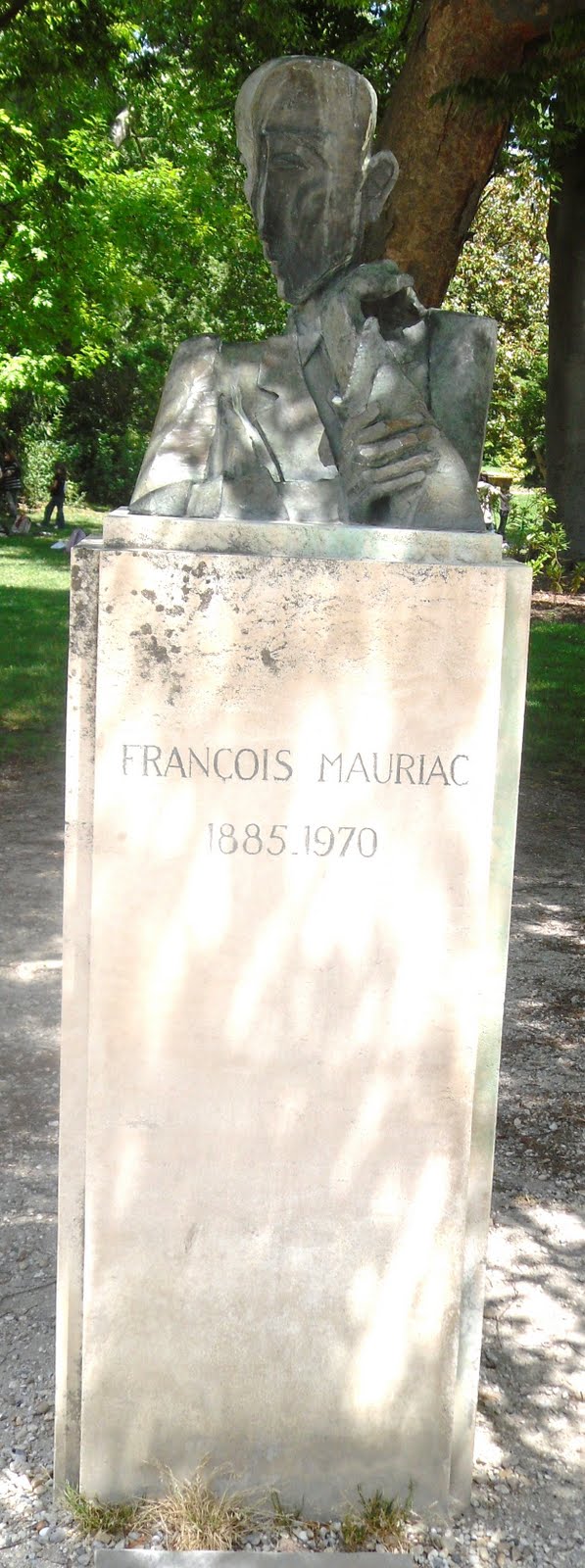
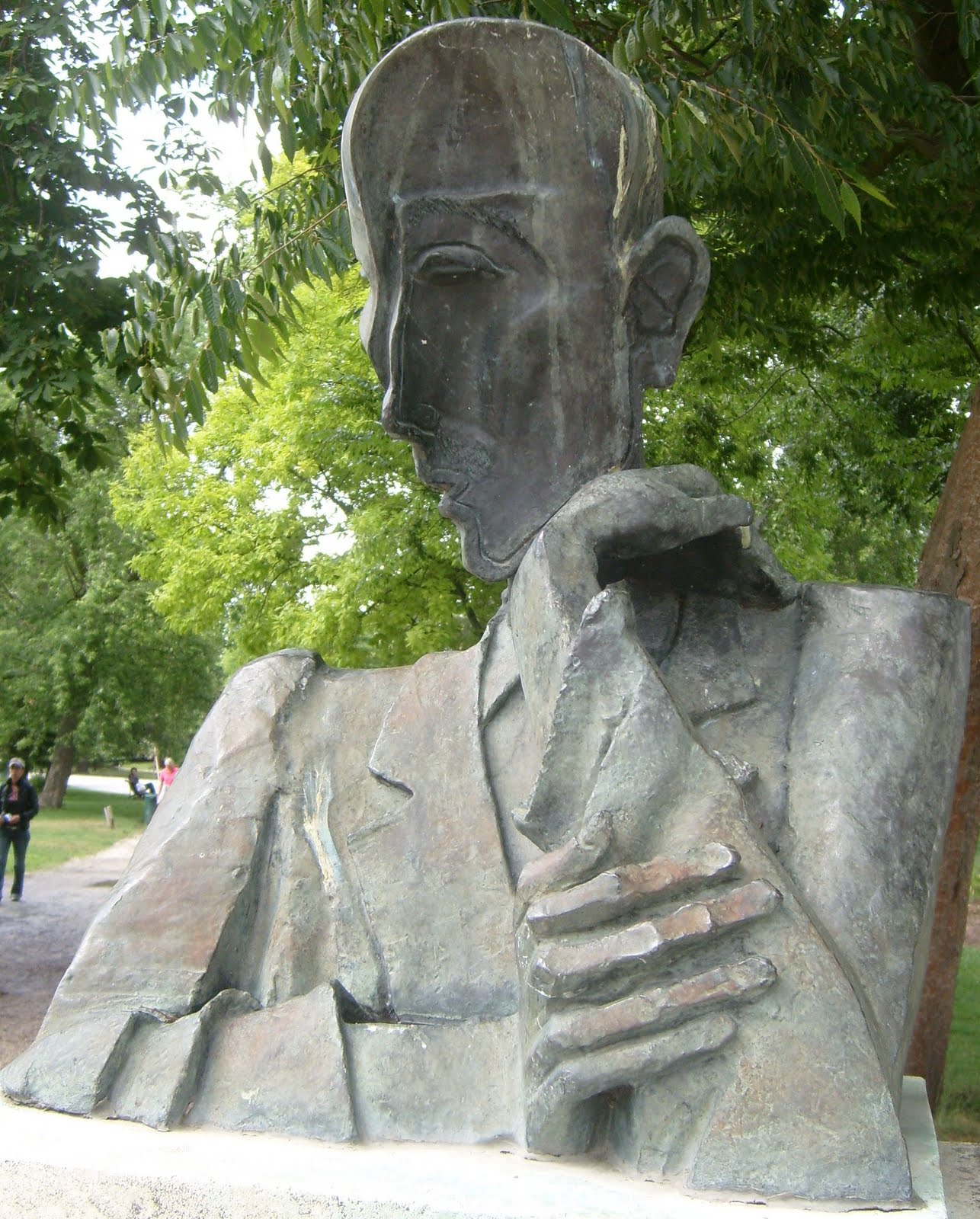
In Préséances (1921), Mauriac was quite clear about what he saw as the ugliness of Bordeaux women: 'les bordelaises sont laides comme des gouvernantes anglaises'. His mother pointed out that that statement ensured that he would never have a public monument in Bordeaux, although of course she was wrong. This sculpture was erected in the Jardin Public in Bordeaux on the 100th aniversary of Mauriac's birth. But it has not remained there without problems, and in March 1993 the modernist bust (actually a copy of the original) was stolen. It was assumed that the bust would never again see the light of day, although the police received a tip-off in January 1995, and as a result found it in a parcel in a disused warehouse in Bordeaux.

At the back of the bust is the signature of the sculptor Ossip Zadkine, a Russian exiled in the USA when he made the work in 1943. He said that a cure for his homesickness was involving himself in his passions.