Showing posts with label Thoreau (Henry David). Show all posts

16 December 2012

Henry David Thoreau: Cape Cod (1865)

I've only just discovered that Henry David Thoreau wrote a book about Cape Cod, which is very interesting, amusing, and begins with Thoreau as an ambulance chaser – arriving in Boston and finding difficulties catching the boat to Provincetown, he makes for a shipwreck off the coast of Cohasset.
 
There is a link to the text below, plus a link to an earlier post I made about Thoreau in more familiar territory – Walden Pond just outside Concord:
 
–––––––––––––––––––––––––––––––––––
Henry David Thoreau: Cape Cod (1865)
Henry David Thoreau's Walden Pond, Concord

22 December 2011

Maylis de Kerangal: Naissance d'un pont (2010)

Naissance d'un pont (lit. 'Birth of a Bridge') is on the surface about just that: the building of a bridge between the fictional Californian towns Coca and Edgefront. The dream of the Dubai-obsessed local mayor, the building of the bridge will in less than a year directly involve attempted sabotage (linked with a death), strong violence, strike action, accidental death, delay due to bird behavior, etc; indirectly, the effects are far more.

Maylis de Kerangal is interested in 'porosité', or porousness, the way things seep through to other things, which she shows not only in her characters (the resemblance between the apparent opposites Jacob and Diderot, for example) but in the words she uses: the technical language of the world of engineering merges seamlessly into the colloquial, and the spoken word — even in conversation — is not marked by punctuation but allowed to join in the narrative flow. And this flow sometimes goes on and on, with the use of very long sentences. So it's not surprising to learn that she was impressed by Mathias Énard's Zone, a novel consisting of only one sentence.

What is perhaps surprising, though, is that there is much humor. This can come in the form of the narrator's mocking repetition, as in 'John Johnson, known as the Boa'; it can come in the deadpan but chilling description of the way Soren previously walked out on his girlfriend: 'hardly has the bear entered the appartment than he turns the key in the lock with a feverish hand, shuts the door on the bear and the girl', which is retributively and laconically recalled in the way Soren (now known to be dead but the reason originally unclear) meets his end in the forest in Edgefront: 'There is a bear missing from the town zoo'; or it can come in an almost slapstick manner, as when Shakira joins the cranedriver Sanche — who is armed with a liter of Jack Daniel's, dry cakes and a CD player — in his cabin fifty feet up in the air for cramped sex.

Some of the names are playful too, as in the architect Ralph Waldo, or the materialistic building site boss Georges Diderot, or in the naturalness of Katherine Thoreau.

The bridge is where outsiders of many kinds meet, where history joins the present and the future, where a modern itinerant Lone Ranger becomes a kind of spaghetti western actor in the multicultural internet generation. One of the most interesting books I've read this year.

5 December 2011

Susan Cheever: American Bloomsbury (2006)

Susan Cheever's American Bloomsbury: Louisa May Alcott, Ralph Waldo Emerson, Margaret Fuller, Nathaniel Hawthorne, and Henry David Thoreau: Their Lives, Their Loves, Their Work (New York: Simon & Schuster (2006)) gives the impression of a designed-for-Googling title, cramming in the important members of the writing set in Concord, Massachusetts. This book is not a critical analysis of the authors' works — that would be a whistlestop tour in just 200 pages — but it does manage to bring the main characters of a literary phenomenon to life very well.

The Concord phenomenon would not have been possible without the financial support of Emerson, who — thanks to the money he inherited from his first wife Ellen Tucker — provided assistance to the writers, as one of the many blunt chapter titles, 'Emerson Pays for Everything', makes quite clear.

This book is essentially a popular representation of a highly talented literary community concentrated in a very small area. It isn't a work of original research and relies, apart from some speculation, entirely on secondary sources. As the chapter title already mentioned suggests, this is also slightly sensationalized. And he words 'American Bloomsbury' of course suggest not just a concentration of great talent in a small area, but also bed-hopping, sex triangles, homosexuality, free thinking, etc.

How does that square with the reality of Concord? Was it a 19th century Bloomsbury, or is the title just a publisher's exaggeration? Apart from the concentration of talent, are there any other similarities to Bloomsbury? Yes and no. In both communities, we have the freshness of new ideas, the spirit of adventure, the break with the past, etc. But to suggest that Concord was a hotbed of wild sex — and not only the word 'Bloomsbury' does that, but also Cheever's titillating chapter titles 'Sex' and 'Margaret Fuller, the Sexy Muse' — is going way too far. The first sentence of 'Sex' points out that the 'more liberal ways' of the previous century were giving way to the 'uptight views' of the mid-nineteenth century, and the chapter itself — scarcely more than two pages in length — only speaks of one of the five writers in relation to sex outside marriage, and that's to speak of Hawthorne's fictional Hester Prynne!

Desire is abundant though: Lousia May Alcott falls first for natural man Thoreau, then philosopher Emerson; Thoreau falls for, well, several women; and Cheever's 'Sexy Muse' Fuller (incidentally the only one of the five not to be buried in Sleepy Hollow Cemetery, but Mount Auburn) gets both Hawthorne and Emerson's lusting after her. But through all this, there's not a scrap of proof any of the five heros spent any of their 'Transcendental Wild Oats', as Louisa humorously puts it, on any of their objects of desire.

If Margaret Fuller was a tantalizer, so is Susan Cheever. This is still well worth a read though — just don't be conned by the title.

31 May 2011

Beacon Hill, Boston, Massachusetts

Beacon Hill is a neighborhood in Boston north of the Public Garden and Boston Common, with the boundaries Storrow Drive to the west, Cambridge Street to the north, Beacon Street to the south, and Somerset Street to the east. Many notable literary figures have lived here, but unfortunately the dense foliage and the parked vehicles make it very difficult to take a decent photo. However, I managed a few.

This quotation on a mural in Charles Street, Beacon Hill, is from Robert Lowell's 'The Ruins of Time', which consists of two sonnets, and the tercet here is from the end of the second sonnet:

'O Rome! From all your palms, dominion, bronze
and beauty, what was firm has fled. What once
was fugitive maintains its permanence.'

This second sonnet is a version of 'A Roma sepultada en ruinas' by Francisco de Quevedo y Villegas (1580–1645), of which the second tercet is:

Oh Roma!, en tu grandeza, en tu hermosura
huyó lo que era firme, y solamente
lo fugitivo permanece y dura.'

And this in turn is a Spanish translation of the fourth sonnet  of the 'Les Antiquités de Rome' sequence (1556) by Joachim du Bellay (c. 1522-60), of which the second tercet is:

'Reste de Rome. Ô mondaine inconstance !
Ce qui est ferme, est par le temps détruit,
Et ce qui fuit, au temps fait résistance.'

'From 1865 to 1893
THE HOME OF
FRANCIS PARKMAN
American Historian' 

As I've already mentioned Parkman in the Mount Auburn Cemetery post, I shall say nothing here. Except that it was impossible to photograph the house because the foliage rendered it almost invisible.

Henry David Thoreau once lived in an apartment at 4 Pinckney Street.

Irish-American Louise Imogen Guiney (1861-1920) was a poet and essayist born in Roxbury, MA, and was a friend of Annie Fields and Sarah Orne Jewett. Her most noted publications are A Roadside Harp (1893) and Patrins (1897). She died in Chipping Camden, England.

'20 Pinckney Street

As a litle girl Louisa May Alcott lived in rented rooms at 20 Pinckney Street. The Alcott home was part of the Boston literary scene during the decades before the Civil War.  Louisa's father, Bronson Alcott, was an innovative educator whose friends included Ralph Waldo Emerson, William Ellery Channing, and William Lloyd Garrison.

In the 1880s, her reputation and fortune secure, Miss Alcott returned to Beacon Hill. She lived at 10 Louisberg Square until her death.'

'ROBERT LEE FROST
1874-1963
AMERICA'S "POET LAUREATE
AND FOUR-TIME PULITZER PRIZE WINNER
LIVED AT 88 MT. VERNON STREET
FROM 1938-1941
WHILE TEACHING POETRY
AT HARVARD UNIVERSITY

"THE FIGURE A POEM MAKES,
IT BEGINS IN DELIGHT AND ENDS IN WISDOM."'

29 May 2011

Sleepy Hollow Cemetery, Concord, Massachusetts

Most of the noted Concord writers are buried on Authors' Ridge, Sleepy Hollow Cemetery, Concord, MA, which is about a half mile north out of downtown Concord on the west side of Bedford Road, and no doubt the highest area of the cemetery. Very unusual it must be to find such of cluster of famous people all in one spot. 

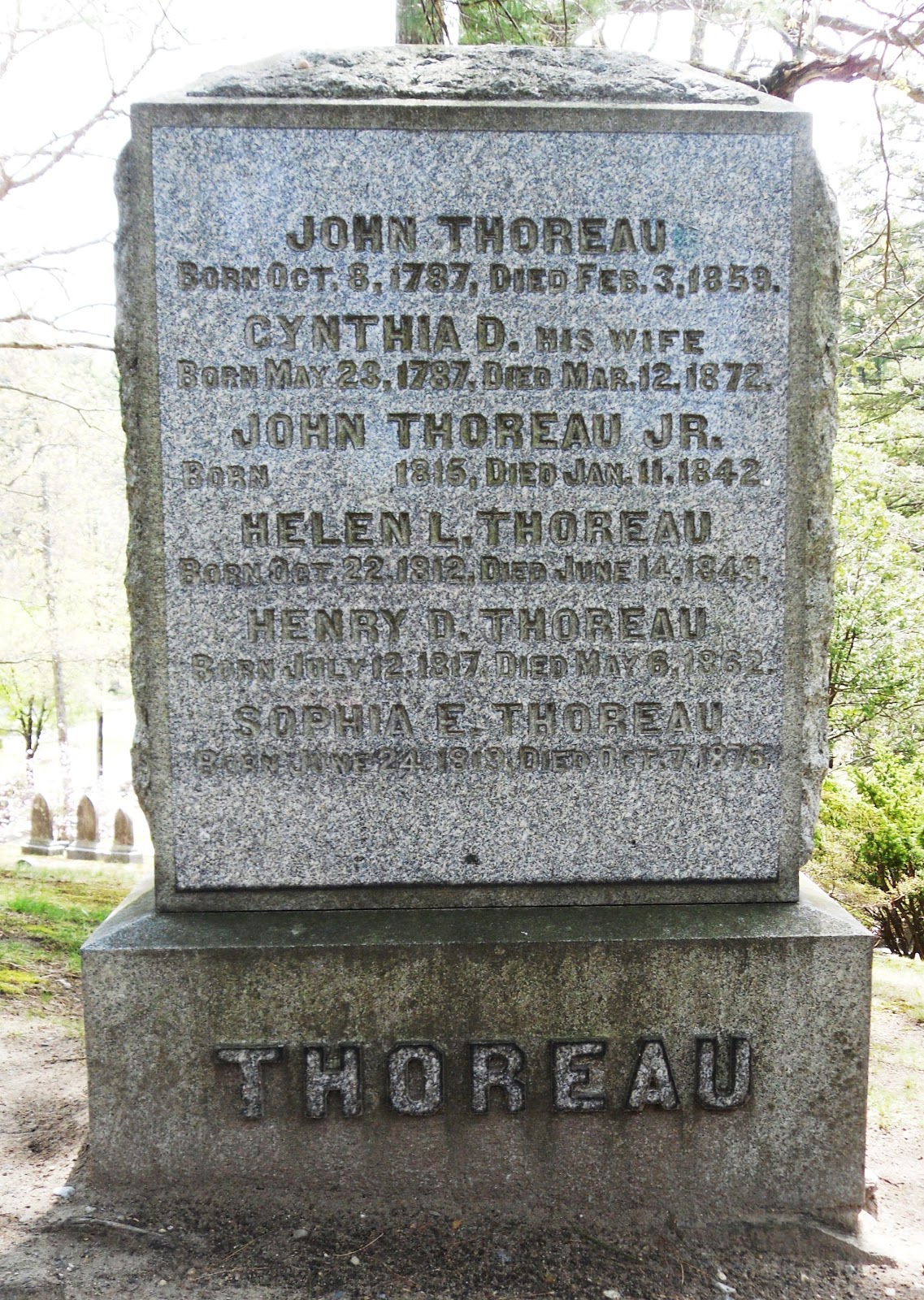
The Thoreau plot contains - along with Henry David Thoreau - the remains of Henry David Thoreau's pencil maker father John Thoreau (1787-1858), his wife Cynthia Dunbar Thoreau (1787-1872), his brother John Thoreau Jr (1816-42), and his younger sister Sophia E. Thoreau (1819-76).

It's not difficult to spot the grave of the most noted Thoreau.

And right opposite is the grave of Nathaniel Hawthorne in the Hawthorne plot.

'SOPHIA
WIFE OF
NATHANIEL HAWTHORNE
BORN IN SALEM MASSACHUSETTS
DIED IN LONDON
JANUARY TWENTY-FIRST 1871
BURIED IN KENSAL GREEN
REINTERRED HERE JUNE 2006'

Emerson's huge slab of granite.

'RALPH WALDO
EMERSON
BORN IN BOSTON MAY 1803
DIED IN CONCORD APRIL 27 1882
THE PASSIVE MASTER LENT HIS HAND
TO THE VAST SOUL THAT O'ER HIM PLANNED'

The above two-line quotation is from Emerson's poem 'The Problem'.

'LIDIAN
Wife of Ralph Waldo Emerson,
Wife of Charles & Lucy (Cotton) Jackson.
Born on 20th September 1802, close by
Plymouth Rock, as she loved to remember.
Died November 30th 1892 in Concord.'

Emerson's second wife (see post above).

'HARRIETT MILFORD STONE LOTHROP
MARGARET SIDNEY
THE CREATOR OF THE FIVE LITTLE PEPPERS
ALWAYS A LOVER OF AND WORKER FOR CHILDREN'

Lothrop (1844-1924) - as 'Margaret Sidney' (see the post above) - wrote children's stories.

As this marker states, Lothrop was the founder of the Children of the American Revolution. Had the marker not been there, it would have been difficult to find the grave.

The Alcott family plot.

Louisa May Alcott.

Edmund Hosmer (1798-1881) was a Concord farmer who was a friend of Emerson and Thoreau who was associated with the Transcendentalists and had helped Thoreau in the construction of his cabin.

'EPHRIAM WALES BULL
THE ORIGINATOR OF THE CONCORD GRAPE
BORN IN BOSTON MAR 4 1806
DIED IN CONCORD SEPT 26 1806
HE SOWED OTHERS REAPED'

Presumably the final line refers to the fact that Bull, a neighbor of Bronson Alcott's - thanks to Thomas Jefferson -  was unable to patent his invention, so lost out big time. The story of this is in an essay in Paul Collins's Banvard's Folly: Thirteen Tales of Renowned Obscurity, Famous Anonymity, and Rotten Luck (London: Picador, 2001).

'ELIZABETH PALMER PEABODY
1804-1894
A TEACHER OF THREE GENERATIONS OF CHILDREN,
AND THE FOUNDER OF KINDERGARTEN IN AMERICA.
EVERY HUMAN CAUSE HAD HER SYMPATHY.
AND MANY HER ACTIVE AID.'

Sophia Hawthorne's sister is buried far from Authors' Ridge.

27 May 2011

Henry David Thoreau's Walden Pond, Concord, Massachusetts

I first came across Thoreau when I was 17 - and he's intrigued me ever since. So it was a great pleasure to get round to visiting Concord (pronounced 'Concud', I learned), and even more of a pleasure to visit Walden Pond. I'd noticed on reviews on the internet that it fills up in summer, so May seemed like a saner idea than going in the cold. Even then, at 10am, there was a party of schoolkids on bicycles.

As for my initial impressions of Thoreau, it was the idea of exploring the 'private sea' that impressed me so much. From Walden (1854):

What does Africa - what does the West stand for? Is not our own interior white on the chart? black though it may prove, like the coast,
when discovered. Is it the source of the Nile, or the Niger, or the
Mississippi, or a Northwest Passage around this continent, that we would
find? Are these the problems which most concern mankind? Is Franklin the only man who is lost, that his wife should be so earnest to find him?
Does Mr. Grinnell know where he himself is? Be rather the Mungo Park,
the Lewis and Clark and Frobisher, of your own streams and oceans;
explore your own higher latitudes - with shiploads of preserved meats to
support you, if they be necessary; and pile the empty cans sky-high for
a sign. Were preserved meats invented to preserve meat merely? Nay, be
a Columbus to whole new continents and worlds within you, opening new
channels, not of trade, but of thought. Every man is the lord of a realm
beside which the earthly empire of the Czar is but a petty state,
a hummock left by the ice. Yet some can be patriotic who have no
self-respect, and sacrifice the greater to the less. They love the soil
which makes their graves, but have no sympathy with the spirit which may
still animate their clay. Patriotism is a maggot in their heads. What
was the meaning of that South-Sea Exploring Expedition, with all its
parade and expense, but an indirect recognition of the fact that there
are continents and seas in the moral world to which every man is an
isthmus or an inlet, yet unexplored by him, but that it is easier to
sail many thousand miles through cold and storm and cannibals, in a
government ship, with five hundred men and boys to assist one, than it
is to explore the private sea, the Atlantic and Pacific Ocean of one's
being alone.'

The whole of the book Walden is here.

Henry David Thoreau lived in his tiny cabin from 4 July 1845 (the date being a pure coincidence) to 6 September 1847. He didn't live a hermit-like existence, and sometimes walked into Concord just over a mile away. Emerson owned the land, and willingly allowed Thoreau to make his home there. His reasons for staying there are best answered by his own words in Walden:

'I went to the woods because I wished to live deliberately, to front only
the essential facts of life, and see if I could not learn what it had to
teach, and not, when I came to die, discover that I had not lived. I did
not wish to live what was not life, living is so dear; nor did I wish
to practise resignation, unless it was quite necessary. I wanted to
live deep and suck out all the marrow of life, to live so sturdily and
Spartan-like as to put to rout all that was not life, to cut a broad
swath and shave close, to drive life into a corner, and reduce it to its
lowest terms, and, if it proved to be mean, why then to get the whole
and genuine meanness of it, and publish its meanness to the world; or
if it were sublime, to know it by experience, and be able to give a true
account of it in my next excursion. For most men, it appears to me, are
in a strange uncertainty about it, whether it is of the devil or of God,
and have somewhat hastily concluded that it is the chief end of man here
to "glorify God and enjoy him forever."'

By the visitor center near the statue, a replica reconstruction of Thoreau's cabin.

Thoreau says in Walden:

'I have [...] a tight shingled and plastered house, ten feet wide by
fifteen long, and eight-feet posts, with a garret and a closet, a large
window on each side, two trap doors, one door at the end, and a brick
fireplace opposite. The exact cost of my house, paying the usual price
for such materials as I used, but not counting the work, all of which
was done by myself, was as follows; and I give the details because very few are able to tell exactly what their houses cost, and fewer still, if any, the separate cost of the various materials which compose them:-


Boards                                         $8.03½  mostly shanty boards.
Refuse shingles
for roof sides                               4.00
Laths                                            1.25
Two second-hand
windowswith glass                      2.43
One thousand old
brick                                             4.00
Two casks of lime                       2.40      That was high.
Hair                                              0.31      More than I needed.
Mantle-tree iron                         0.15
Nails                                             3.90
Hinges and screws                     0.14
Latch                                           0.10
Chalk                                           0.01
Transportation                           1.40       I carried a good part
                                                                     on my back.
                                                      -----------
                 In all                           $28.12½'

At the back of the structure is the woodshed.

And the interior. I was very fortunate in that a horde of schoolkids had just left it.

Opposite the shop and the parking lot is Walden Pond, here taken from the beach, which mercifully was deserted.

And the crowning glory is the site of Thoreau's cabin, marked out by posts and chains.

'SITE OF

THOREAU'S CABIN
DISCOVERED NOV. 11, 1945
BY ROLAND WELLS ROBBINS'

'Beneath these stones lies the chimney foundation
of Thoreau's cabin 1845-1847
"Go thou my incense upward
from this hearth"'

The above quotation comes from a poem of Thoreau's called 'Smoke':

'Light-winged smoke, Icarian bird,
Melting thy pinions in thy upward flight,
Lark without song, and messenger of dawn,
Circling above the hamlets as thy nest;
Or else, departing dream, and shadowy form
Of midnight vision, gathering up thy skirts;
By night star-veiling, and by day
Darkening the light blotting out the sun;
Go thou my incense upward from this hearth,
And ask the Gods to pardon this clear flame.'

Obviously this is at the back of the site, as in the reconstruction.

The cairn, where people leave stones in respect. The sign at the side partly reproduces what I reproduced above about Thoreau's reasons for living by Walden Pond.

The symbol of peace in stone.

A few of the stones are from organizations.

Others give the names of people, this young man presumably having expressed a wish after death.

Some are less professionally presented, and are obviously personal to the individual.

No idea!

This creation is distinctly phallic looking, and I'm unclear why. Thoreau and women is an interesting subject, though. Louisa May Alcott was a little young when, as a pupil of his, she became emotionally fascinated by him - something to do with his affinity with nature, being able to recognize beaver dam construction as distinct from just a pile of logs, or identifying a heron's nest, etc, but Thoreau wisely appears not to have responded. He had a brief attaction for the much older Lucy Jackson Brown, and flung a love poem through her bedroom window. On the other hand, the Emersons' tutor Sophia Foord proposed to him and he was horrified.

In a letter, Thoreau proposed to Ellen Sewall from Plymouth, MA, but she turned him down, as she had his brother David (after her father had brought her to her senses). Nevertheless, and despite the handsome Hawthorne calling Thoreau 'as ugly as sin', and Oliver Wendell Holmes detesting his lack of table manners (he ate with his hands), there was no shortage of women who were attracted to him - he just didn't feel the same way about them. So perhaps what he told his sister on his deathbed is true: that he had always loved Ellen.

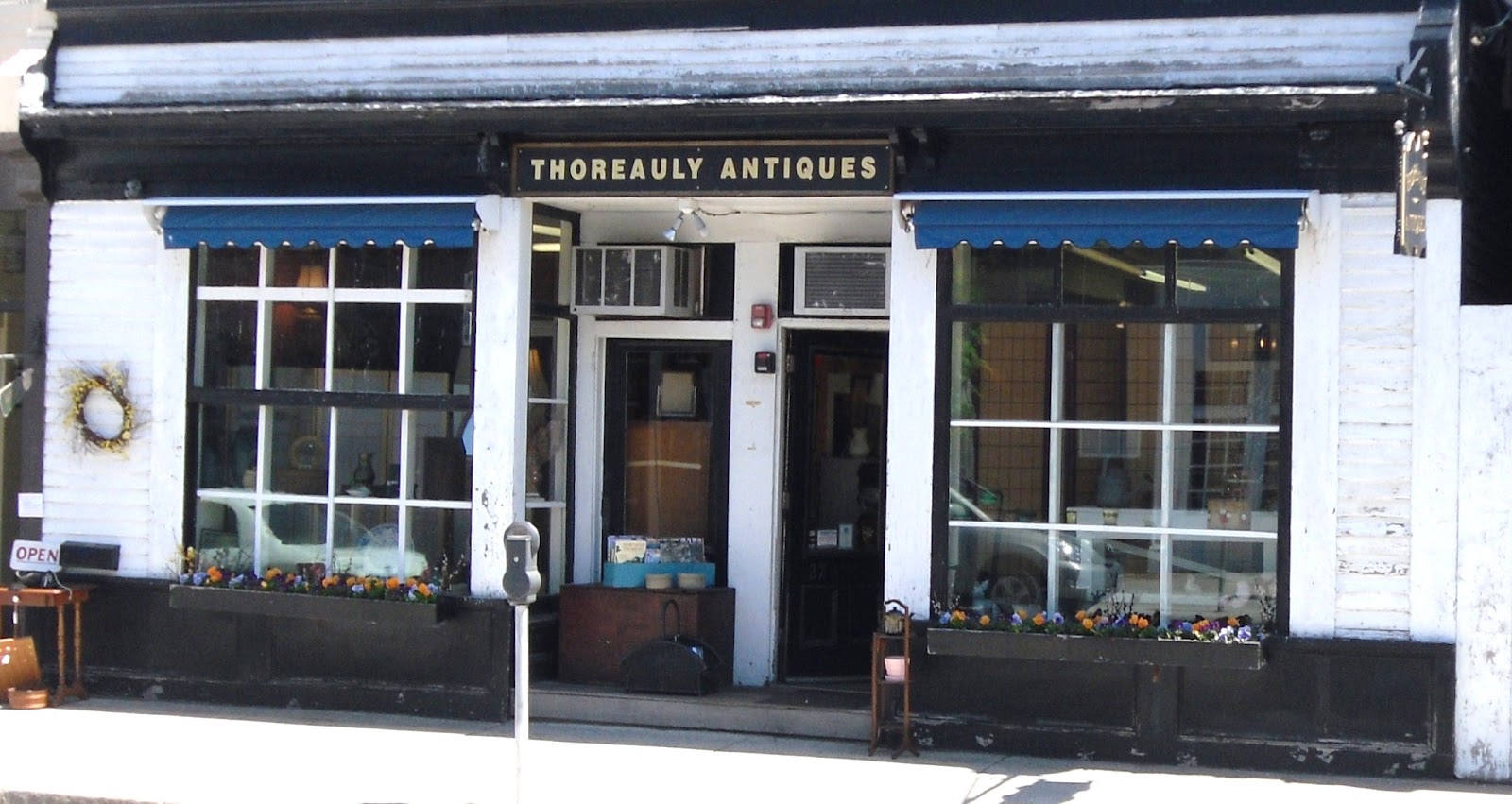
Thoreauly Antiques on Concord Main Street? I can imagine what the great man would have thought of that.