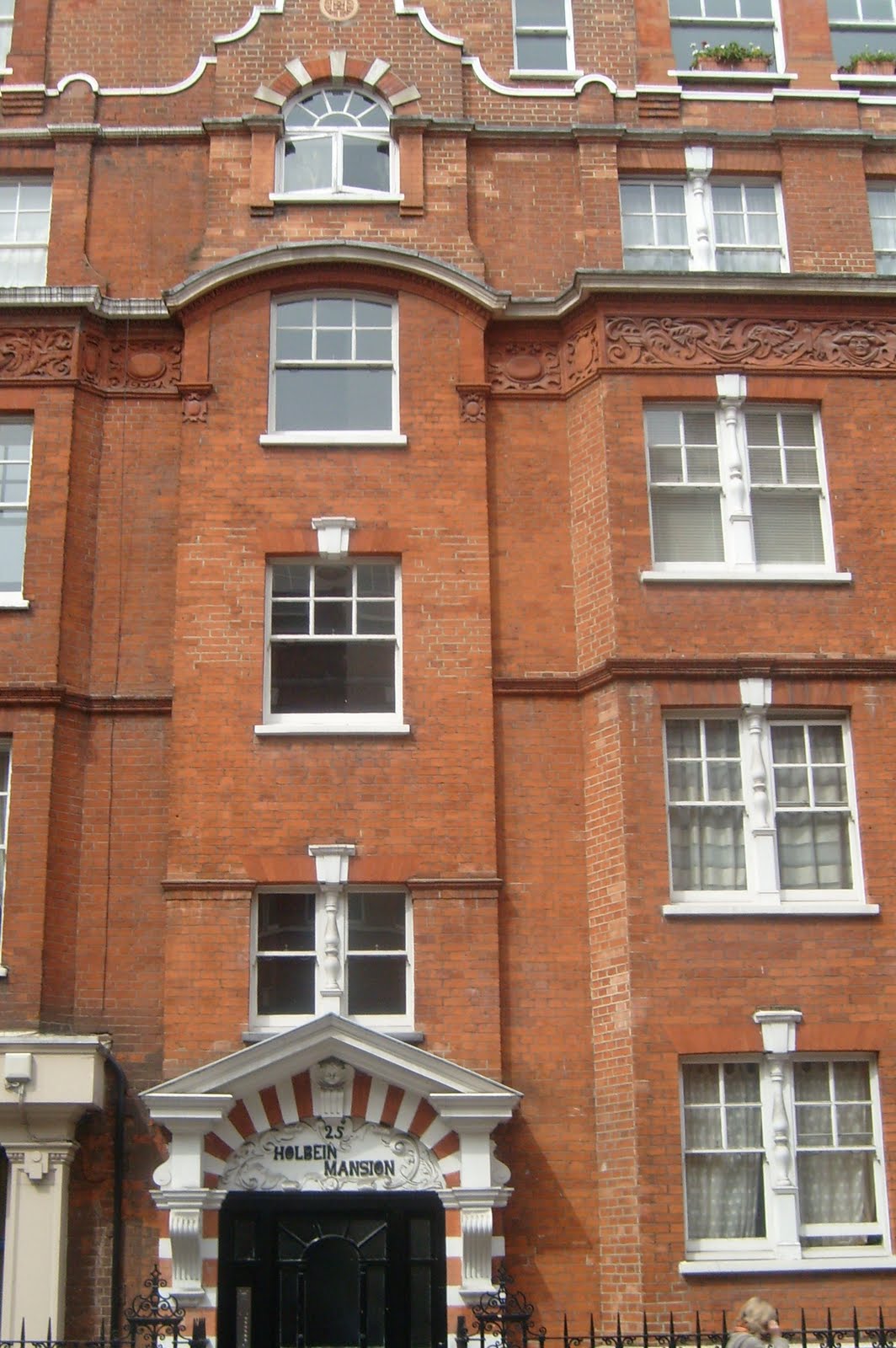
 George Bernard Shaw lived here with his mother from 1881 to 1886, where he began his unsuccessful novel Cashel Byron's Profession. From here, Shaw moved to Osnasburgh Street before Fitzroy Square.
Showing posts with label Fitzrovia. Show all posts
Showing posts with label Fitzrovia. Show all posts
2 May 2010
George Bernard Shaw and Fitzroy Street, Fitzrovia: Literary London #11
Libellés :
Fitzrovia,
London,
Shaw (Bernard)
George Bernard Shaw lived here with his mother from 1881 to 1886, where he began his unsuccessful novel Cashel Byron's Profession. From here, Shaw moved to Osnasburgh Street before Fitzroy Square.

Jeremy Bentham pub, University Street, Fitzrovia: Literary London #10
Libellés :
Bentham (Jeremy),
Fitzrovia,
London

 The sign outside the Jeremy Bentham pub on University Street reads:
'Known for many years as the "Lord Wellington" it is still frequently referred to as the "Welly Bar" by many academics and local residents. Renamed in October 1982 to commemorate the 150th anniversary of the death of Jeremy Bentham who is recognised as the spiritual founder of University College London. The myth that he was the founder is sustained in a bizarre manner buy the college.
His 'Auto-Icon' as he called it, is in fact his skeleton, dress in his own clothes and topped with a wax model of his head.
His actual Head is mummified and kept in the college vaults. It is brought out for meetings of the college council and he is recorded as being present but not voting. Above the bar can be seen a copy of the wax head, made by students at the college. In renaming the pub after him we are reminded of his great ideal, "The greatest happiness for the greatest numbers."
"A GREAT MAN HAS GONE FROM AMONG US, FULL OF YEARS OF GOOD WORKS AND OF DESERVED HONOURS IN THE HIGHEST DEPARTMENTS IN WHICH THE HUMAN INTELLECT CAN EXERT ITSELF. HE HAS NOT LEFT HIS EQUAL OR HIS SECOND BEHIND HIM."
30 April 2010
Virginia Woolf, George Bernard Shaw, and Roger Fry at Fitzroy Square, Fitzrovia: Literary London #9
Libellés :
Fitzrovia,
London,
Shaw (Bernard),
Woolf (Virginia)

 Two plaques are attached to 29 Fitzroy Square, the upper one with the following information:
'George Bernard Shaw lived in this house from 1887 to 1898.
From the coffers of his genius he enriched the world.'
The last sentence is what Shaw's housekeeper, Mrs Laden, wrote on a note that she attached to his gate to announce his death.
While Shaw lived here, along with his unsuccessful novels, he published his early plays: Widowers' Houses (1893), Arms and the Man, (1894) and Mrs Warren's Profession (1898).
 The newer blue plaque is more sober:
 'Virginia Stephen (Virginia Woolf) 1882-1941 Novelist and Critic lived here 1907-11.'
Woolf moved in here with her brother Adrian before moving on to 38 Brunswick Square, Bloomsbury.
 At 33 Fitzroy Square, Roger Fry had his Omega Studios between 1913 and 1919. Fry was a 'member' of the Bloomsbury Group, and soundproofed his walls with seaweed. Wyndham Lewis also used the premises, but left after a strong argument and started the Vorticists.
Charles Dickens and Cleveland Street, Fitzrovia: Literary London #8
Libellés :
Dickens (Charles),
Fitzrovia,
London
 The Dickens family lived here, at 22 Cleveland Street (formerly Norfolk Street), on two occasions - the first (from 1816 to 1817), when Dickens was not yet four, and his father worked as a clerk at Somerset House; and the second from 1829 to 1831.
T. S. Eliot, Wyndham Lewis, and L'Etoile, Charlotte Street, Fitzrovia: Literary London #7
Libellés :
Eliot (T.S.),
Fitzrovia,
Lewis (Wyndham),
London
 L'Etoile, at 30 Charlotte Street, was T. S. Eliot's favorite restaurant, and where Ezra Pound and Wyndham Lewis launched the magazine Blast in 1914.
Coventry Patmore, 1984, and Percy Street, Fitzrovia: Literary London #6
Libellés :
Fitzrovia,
London,
Orwell (George),
Patmore (Coventry)

 This blue plaque remembers that the poet and essayist Coventry Patmore (1823-96) lived here - at 14 Percy Street - from 1863 to 1894, a stay perhaps so brief because of outside noise disturbing his concentration. Patmore is best known for his poem sequence The Angel in the House (1854-63).
 Now the Soho Wine Store at 18 Percy Street, this is where Sonia Brownwell, later to be George Orwell's second wife, lived in a flat in the 1940s. He modeled the place Winston and Julia used to share their secret meetings in 1984 on this place.
The Literary Pubs of Fitzrovia: Literary London #5

 The Fitzroy Tavern on 16 Charlotte Street was a key drinking spot in the pre-World War II years for such writers as Dylan Thomas, Julian Maclaren-Ross and John Singer, and the artists Augustus John and Nina Hamnett.
 Ed Glinert gives an amazing story about the Duke of York on 47 Rathbone Street. On one occasion in 1943, Anthony Burgess and his wife Lynne were drinking there when a razor gang invaded, tipped beer on the floor, smashed glasses and menaced the customers. When Lynne protested about the waste of beer, they poured a large number of pints and challenged her to drink them, which she did. Such was their subsequent respect for her that they paid for the beer and offered Lynne protection from any other gangs.
 The Newman Arms on 23 Rathbone Street was the model George Orwell used in the argument about socialism between his characters Gordon Comstock and Ravelston in Keep the Aspdistra Flying (1936), and also the model for the prole pub Winston visits in 1984.
 The Marquis of Granby on the corner of Rathbone Street and Percy Street was thought too violent for many literary Fitzrovians, but it appears to be the very reason why Dylan Thomas chose to go there.
 The Wheatsheaf, on 25 Rathbone Place, is where the Fitzrovians, tired of the attention they were receiving at the Fitzroy Tavern, felt forced to move to. Here, Augustus John introduced Dylan Thomas to Caitlin Macnamara, who would become his wife. In Anthony Powell's A Buyer's Market (1952), X. Trapnel is modeled on the hard-drinking, frequently in debt, Julian Maclaren-Ross, who wore a teddy bear coat and carried a silver-topped cane. Raynor Heppenstall's character Dorian Scott-Crichton in The Lesser Infortune (1953) is also modeled on Maclaren-Ross.
 Tucked away on tiny Gresse Street, the Bricklayers' Arms was a quiet place for the Fitzrovians if the mood so took them. Glinert says that this was known as the Burglars Rest following a buglary in which the culprits drank themselves senseless and fell asleep.
29 April 2010
Great Portland Street, The George, Fitzrovia: Literary London #4
Libellés :
Fitzrovia,
London,
Thomas (Dylan)
 55 Great Portland Street. The George was one of the haunts of Dylan Thomas and lesser would-be scriptwriters.
Langham Street, Fitzrovia: Literary London #3
Libellés :
Fitzrovia,
Lessing (Doris),
London,
Malone (Edmund),
Pound (Ezra)
My posts now are mainly culled from A Literary Guide to London by Ed Glinert (London: Penguin, 2000), which is a mine of information. There's probably too much literary information here in a sense, but of its kind this book is indispensable to anyone who wants to discovery more of London's literary secrets than the blue plaques reveal, and indeed even makes very valuable addenda to them. Any truncated versions I may give of Glinert's literary anecdotes come with a rider: read the book, as this will teach you much more. I only include some of Glinert's landmarks, as there are way too many of them for me personally as I don't live in London, but also because of personal geographical limitations, at times you are bound to hit the rush hour, and there's nothing more boring than looking at a photo with a car or a crowd in the way. A far as I could, I've edited these out of the photos without, I hope, ruining the general impression of the landmark. My next posts come from my brief foray into Fitzrovia, W1, and Bloomsbury, including east Bloomsbury, both WC1. To begin with Fitzrovia, there is a marked difference between this place and Bloomsbury: Bloomsbury tends to be more sedate and quieter, with peaceful squares and parks. Fitzrovia is noisier, more lively, with many pubs (especially to the south around the north-eastern end of Oxford Street), and obviously less relaxed.
 25 Langham Street was Doris Lessing's address between 1959 and 1963, and socialist Howard Samuels made it financially possible for her to live here.

 40 Langham Street is the site of where Edmund Malone lived from 1779 to 1812. He was a friend of Boswell's and a member of Johnson's Club, and greatly assisted Boswell in his Life.
 48 Langham Street, next to the Yorkshire Grey. Ezra Pound moved here after being thrown out of Duchess Street, and mentally wrote The Ballad of Goodly Fere on his way to the British Library, then on Great Russell Street.
 25 Langham Street was Doris Lessing's address between 1959 and 1963, and socialist Howard Samuels made it financially possible for her to live here.
 40 Langham Street is the site of where Edmund Malone lived from 1779 to 1812. He was a friend of Boswell's and a member of Johnson's Club, and greatly assisted Boswell in his Life.
 48 Langham Street, next to the Yorkshire Grey. Ezra Pound moved here after being thrown out of Duchess Street, and mentally wrote The Ballad of Goodly Fere on his way to the British Library, then on Great Russell Street.
Subscribe to:
Posts (Atom)


 Posts
All Comments
Posts
All Comments