
The distance from Pontoise to Auvers-sur-Oise to the east is only about four miles, although it is rich in the history of famous painters, the most famous of whom is Vincent van Gogh.

'LE PEINTRE
VINCENT VAN GOGH
VÉCUT
DANS CETTE MAISON
ET Y MOURUT
LE 29 JUILLET 1890'
Van Gogh spent his last seventy days here, arriving at the Auberge Ravoux (sometimes now called the 'Maison de Van Gogh') on 20 May 1890 and dying here on 29 July of the same year after shooting himself in the chest.

The above photo was taken in 1890 and shows Adeline Ravoux, the thirteen-year-old daughter of the innkeeper, standing at the entrance to the auberge. In 1954 she still remembered 'Monsieur Vincent' regularly returning to the auberge at midday for the usual simple lunch of the time consisting of meat, vegetables, salad and dessert. She remembered that he never complained about any of the dishes.

Van Gogh's oil painting of Adeline.

The auberge wasn't open when we visited, although it has apparently not changed a great deal since Van Gogh's day. The auberge runs tours of the artist's room, of which the photo above is on display on the main street along with a number of other items. (The artist Anton Hirschig's room there is also preserved.)

Notre-Dame de L'Assomption at Auvers.

And Van Gogh's painting of the church.

The best shot of Docteur Gachet's house that I could get, as that too was closed.

One of Van Gogh's representations of the doctor.

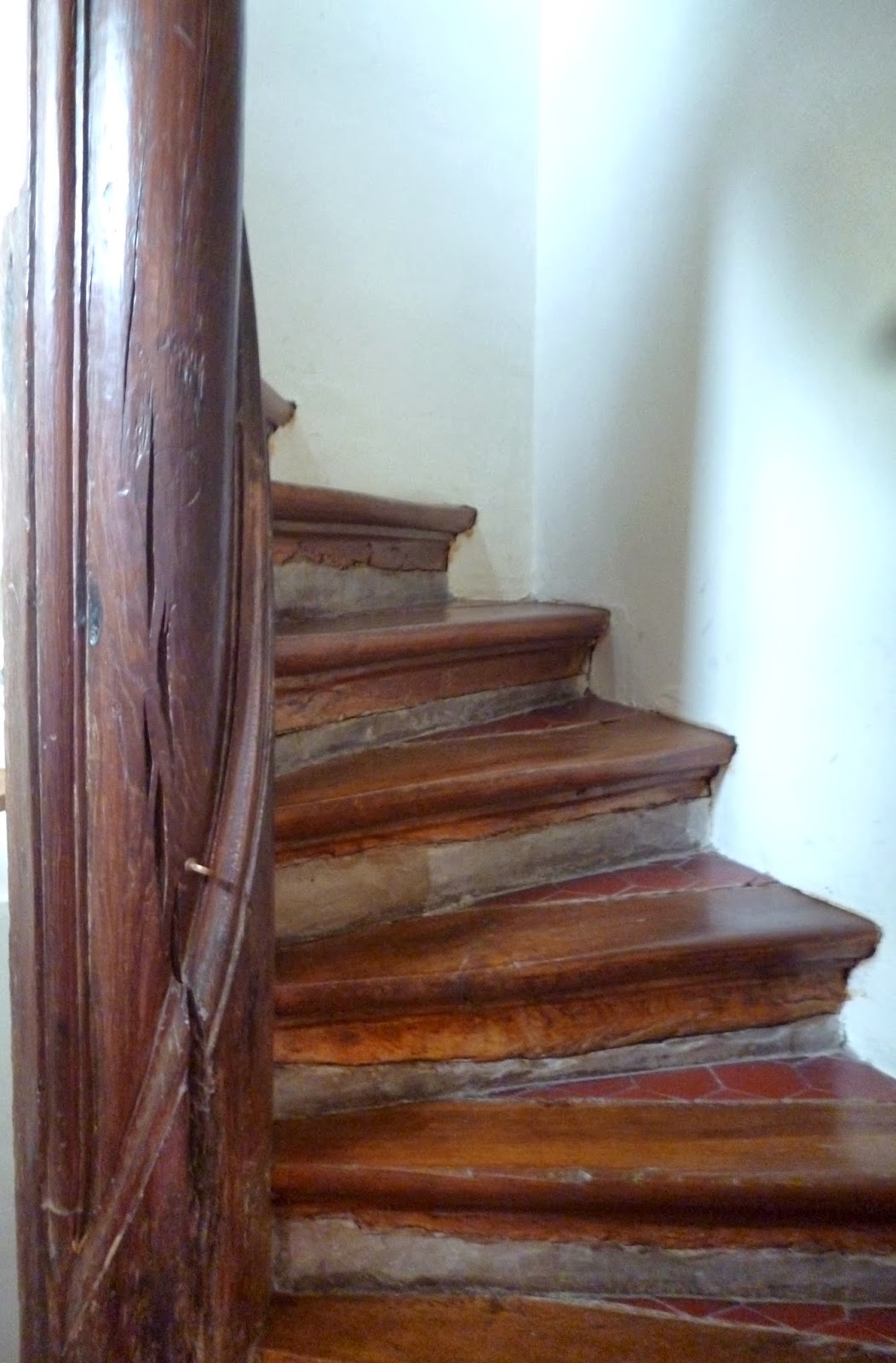
Steps leading up to the house as seen through the bars of a side door.

I know nothing of the history of the painters' names engraved on the steps.

'LA TOMBE DE VAN GOGH
EST SITUÉE LE LONG DU MUR
ENTRE CETTE PORTE
ET CELLE DE DROIT'
Unfortunately we entered the cemetery via the gate on the right, which didn't have such a useful explanatory sign telling us exactly where the grave was located, although it's a small cemetery and not difficult to find.
Outside the cemetery a reporter from Le Parisien eagerly approached me about a biography of Van Gogh to be published the next day: it was the French translation of Steven Naifeh et Gregory White Smith's biography published in (American) English in 2011, which proposes a revised death: the painter was accidentally shot by two youths, one of whom was fond of brandishing a gun and obsessed by the Wild West. The article appears to be anonymous, and that's not us in the photo, but it quotes my views here. I would translate the title – 'La biographie de Van Gogh sème toujours le trouble' – as 'Van Gogh's Biography Is Still Stirring up Trouble'.

Vincent lies with his brother Théo in front of a large bed of ivy.

'ICI REPOSE
VINCENT VAN GOGH
––––––
1853 – 1890'

'ICI REPOSE
THÉODORE VAN GOGH
––––––
1857 – 1891'

I couldn't resist taking a shot of a lizard sunbathing on Van Gogh's gravestone.

Several other painters are buried in this cemetery, such as Eugène Murer (1846–1906), or Hyacinthe-Eugène Meunier.

There's also Léonide Bourges (1838–1909).

And Paul Adolphe Rajon (1843–1888).

And finally Émile Boggio (1857–1920).


Nearer towards the town is this impressive bust of Charles-François Daubigny (1817–78), whose museum is also in Auvers.

Yet another museum is the Musée de l'Absinthe. Van Gogh was a great lover of absinthe, the drink banned in France for many years, and which no doubt contributed to the painter's poor mental health.

This old advert seems to associate absinthe with youth, sex, and (almost) worship.

The back of the museum.


Ossip Zadkine's À Van Gogh.

Oh, and there's a castle, which was open, but we didn't bother to investigate as we had already seen so much in this charming little town.




 Posts
Posts

