Showing posts with label Maupassant (Guy de). Show all posts

19 February 2018

Maupassant in Étretat (76), Seine-Maritime (76)

The street where Maurice Leblanc lived, and which is now an author's house, is in fact named after Guy de Maupassant.

Maupassant bought some of the land on which La Guillette stands from his mother, who had bought it for a vegetable garden. Originally Maupassant wanted to call it 'La Maison Tellier', although his mother (and some friends) strongly objected to any suggestions that it was a brothel. Instead, he adopted Hermine Lecomte de Noüy's suggestion of La Guillette. The house was eventually built in 1883, and is where the author finished 'Pierre et Jean' and wrote a large part of 'Bel Ami'.


The original figures on top of the posts were jade Chinese lions.

What we didn't realise at the time of visiting Étretat on Saturday is that the place now belongs to L’Association les amis de la Guillette, and that visits can be arranged online.

18 February 2018

Maupassant in Fécamp (76), Seine-Maritime (76)

La fontaine du Précieux-Sang. Legend has it that a little of Christ's blood, concealed in the trunk of a fig tree, fell from the cart carrying it in Fécamp. A (healing) well sprang from this, and Fécamp, along with the Mont-Saint-Michel, became the greatest places of pilgrimage in Normandy. In the second half of the nineteenth century through to the first half of the twentieth century the pilgrimages were so successful that a train service was set up specifically to cater for religious tourists. Maupassant mentions the tale in his short story 'Histoire d'une fille de ferme' (1881).

27 September 2016

Guy de Maupassant: Contes de la bécasse | Tales of the Woodcock (1883)

I'll pass up on describing the exact nature of the signification of Contes de la bécasse, or Tales of the Woodcock as the book's title is translated in English. It's sufficient to say that it's pretty gruesome and involves eating woodcocks, and that the 'tales' involve a collection of stories told by a particular member of the meat-eating fraternity.

There are sixteen short stories here, a number involving cruelty to others (including animals as in the case of 'Pierrot'), several involving cruelty within the family. There are also a few really gruesome tales, as in the case of 'En mer', where the older Javel allows his younger brother to lose his arm as the alternative is saving it and losing his own boat.

Yes, money counts a lot for the characters in Maupassant's literature, as in 'Le Testament', which again involves (slightly reminiscent of Pierre et Jean) 'illegitimate' half-brothers. People are avaricious to the point of being penny-pinching, they're violent, despicable, but the victims, the reader is made to feel, are certainly worthy of sympathy.

It's a long time since I've read any Maupassant, but the exercise has reminded me of his irony and his power in general as a writer, and I'm certainly grateful for the person who left two of his books at his grave. I shall return them to the place I found them, hoping that others will read them and do the same.

My other Guy de Maupassant post:

–––––––––––––––––––––––––––––––––––
Maupassant: Pierre et Jean

24 September 2016

Maupassant: Pierre et Jean (1888)

This is another book I found on my travels, again quite by chance but at the grave of Guy de Maupassant (which I just happened to be passing). There were in fact two books at his grave, both of which I picked up, and the other of which I shall comment on in a later post. I'd not read either before, although I'd read a number of his short stories filled with irony, pessimism, etc.

Pierre et Jean is not a short story but a novel about the two very different brothers of the title, Pierre recently having qualified as a medical doctor (after some repeat student years) and Jean having just qualified as a lawyer. Both have shown some interest (if apparently only casually, maybe not seriously) in the young widow Mme Rosémilly, who has only seemed to show interest in Jean.

Initially this novel appears to concern Pierre's jealousy: Léon Maréchal, an old friend of the family, has died and leaves quite a fortune to Jean, but nothing to Pierre. Not unnaturally Pierre resents this, but resents it even more when he suspects, on information a female bar server acquaintance, that Maréchal may have been Jean's real father, which throws him into even more depression because she's perfectly right.

So Jean's only Pierre's half brother, his mother had Maréchal as a lover, and Pierre goes off as a doctor on a ship, leaving his mother with her guilt, his father in ignorance of the whole business, and Jean in his wealth with his new wife, the widow Rosémilly.

My other Guy de Maupassant post:

–––––––––––––––––––––––––––––––––––
Maupassant: Contes de la bécasse | Tales of the Woodcock

8 November 2011

Montparnasse Cemetery / Cimetière du Montparnasse, 14th arrondissement, Paris, France: Literary Île-de-France #16

Joris Karl Huysmans (1848—97), still very much remembered for his novel À rebours (1884), which the decadent Pete Doherty named a song after on Babyshambles's Down in Albion album.

Honoré Champion (1846—1913) owned a bookstore and published books under his own name. His publications had a scientific bias, although the history of literature was his specialization. Albert Bartholomé was the sculptor of his grave.

Tristan Tzara (1896—1963).

Rather messy, but maybe this is appropriate for the founder of Dadaism.

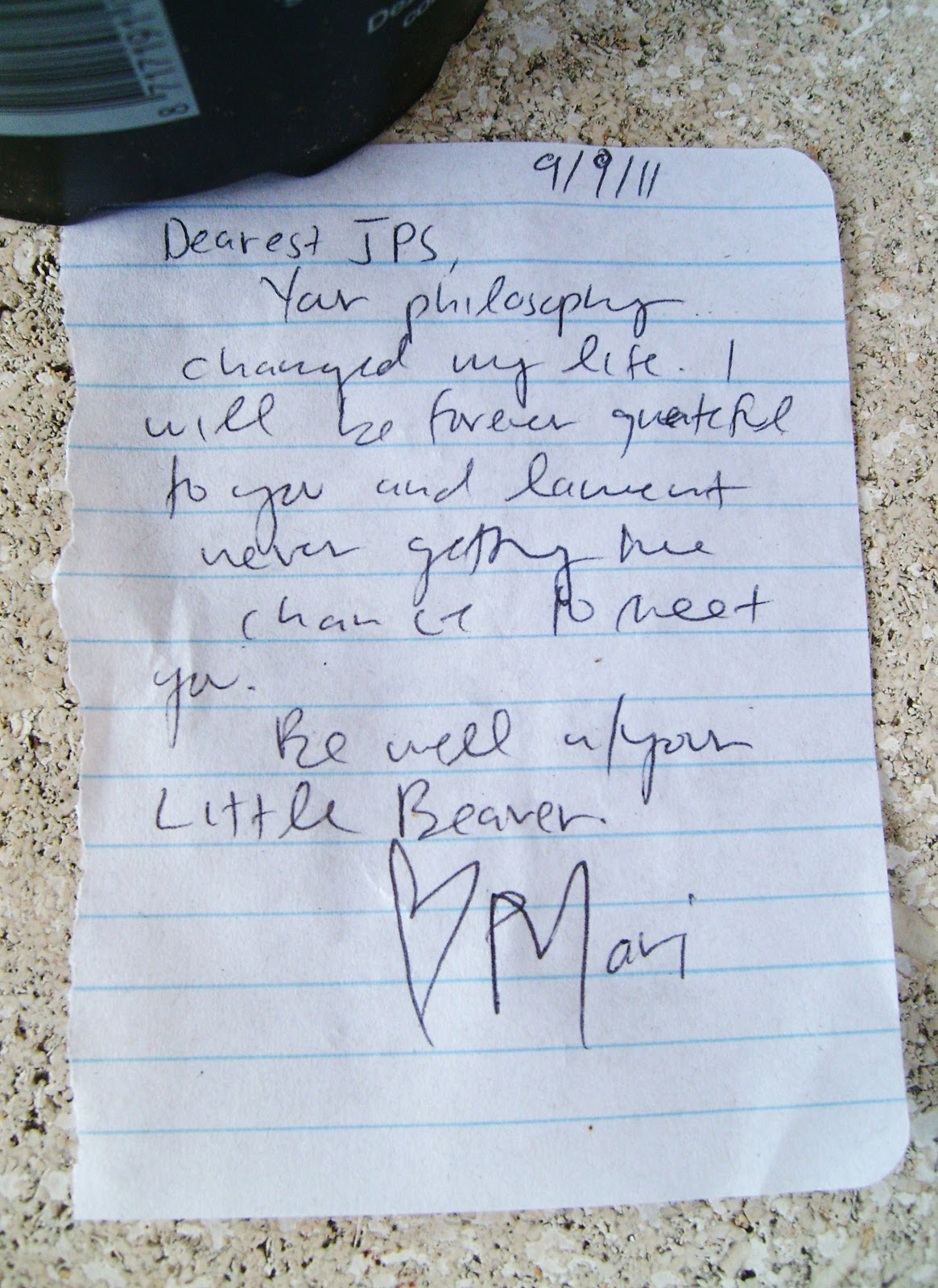
The grave of Jean-Paul Sartre (1905—80) and Simone de Beauvoir. I was slightly surprised to see them receiving the red lipstick treatment à la Serge Gainsbourg here, or Oscar Wilde in Père-Lachaise.

'9/9/11

Dearest JPS,

Your philosophy changed my life. I will be forever grateful to you and lament not having the chance to meet you.

Be well w/your Little Beaver.

[heart symbol] Mari'.

'Las personas mueren, las ideas no'.
['People die, ideas don't']

Eugène Ionesco (1909—94). My comments on this blog on four Ionesco plays are here

Of note is what is written at the bottom edge of the grave:

'Prier le Je Ne Sais Pas Qui
J'espère: Jésus Christ.'

['Praying for the I Don't Know Who
Jesus Christ, I hope']


Samuel Beckett (1906—89). It would have been a shock if it hadn't been a minimalist grave.


An honest rather than a flattering facial representation, by José de Charmoy, of the essayist and literary critic Sainte-Beuve (1804—69), but an extremely impressive monument.


'Poète et Romancier

"tu t'enfonces dans la rose
ébloui par l'or de la nuit'.
                                 R.B.'


Rabah Belamri (1945—95) was born in Algeria and lost his sight in 1962, on the day Algeria was declared independent. After leaving the University of Algiers, he continued his education in Paris, where he earned a doctorate on the work of Louis Bertrand Miroir, which was published several years later. He published several collections of poems and short stories and novels inspired by his Algerian childhood. He is buried with 'L'homme des voyages' Yves Rachid Lefort, although the internet doesn't seem able to tell me why that is.


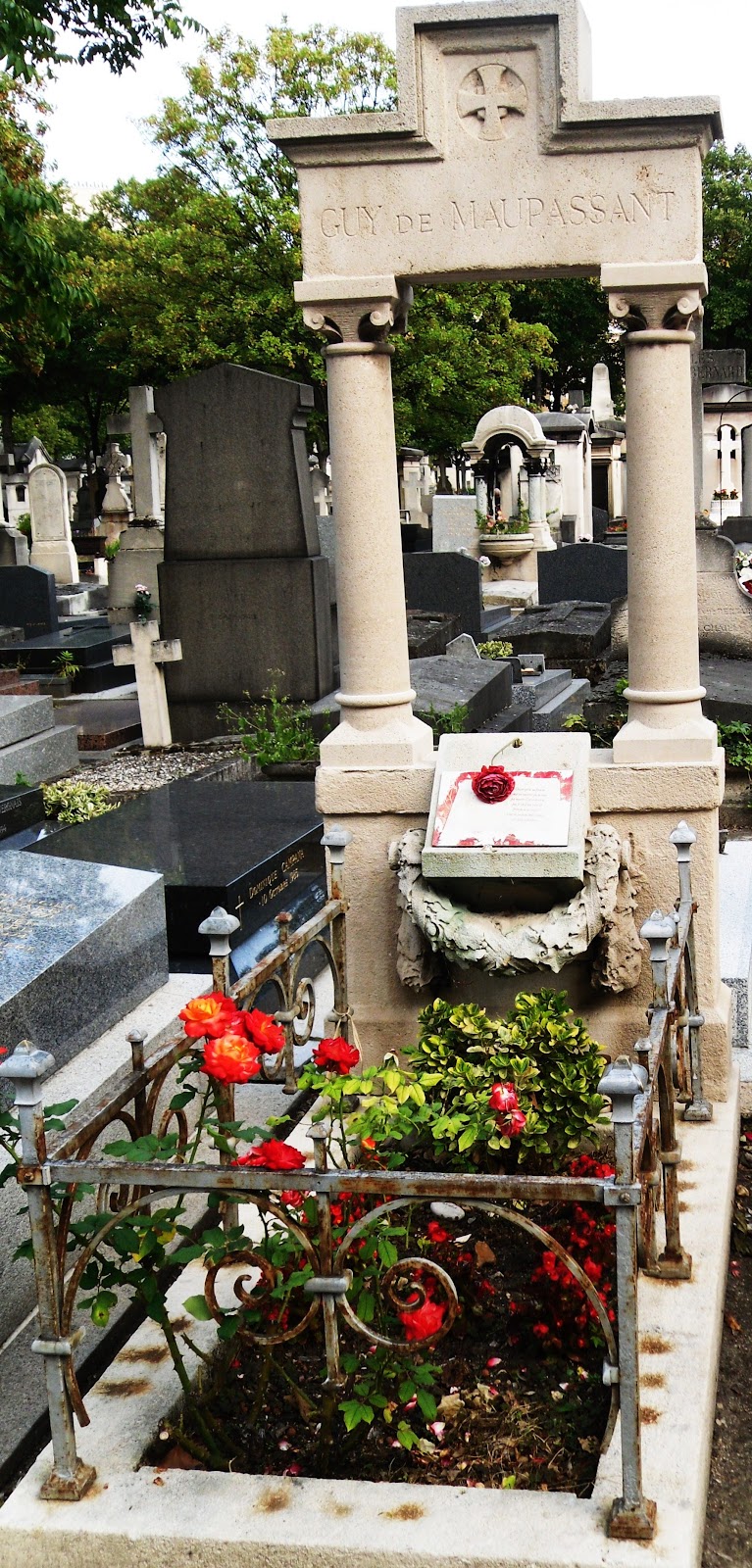
Guy de Maupassant (1950—93), a writer much influenced by the very popular Schopenhauer, although the French translation leaned heavily on the philosopher's more sensational theories about egoism, pessimism and misogyny. Flaubert thought Boule de suif a great work, and Maupassant saw him as a father figure. A very enthusiastic frequenter of brothels who wrote a number of stories about prostitutes, he died insane, riddled with syphilis at the age of 43.


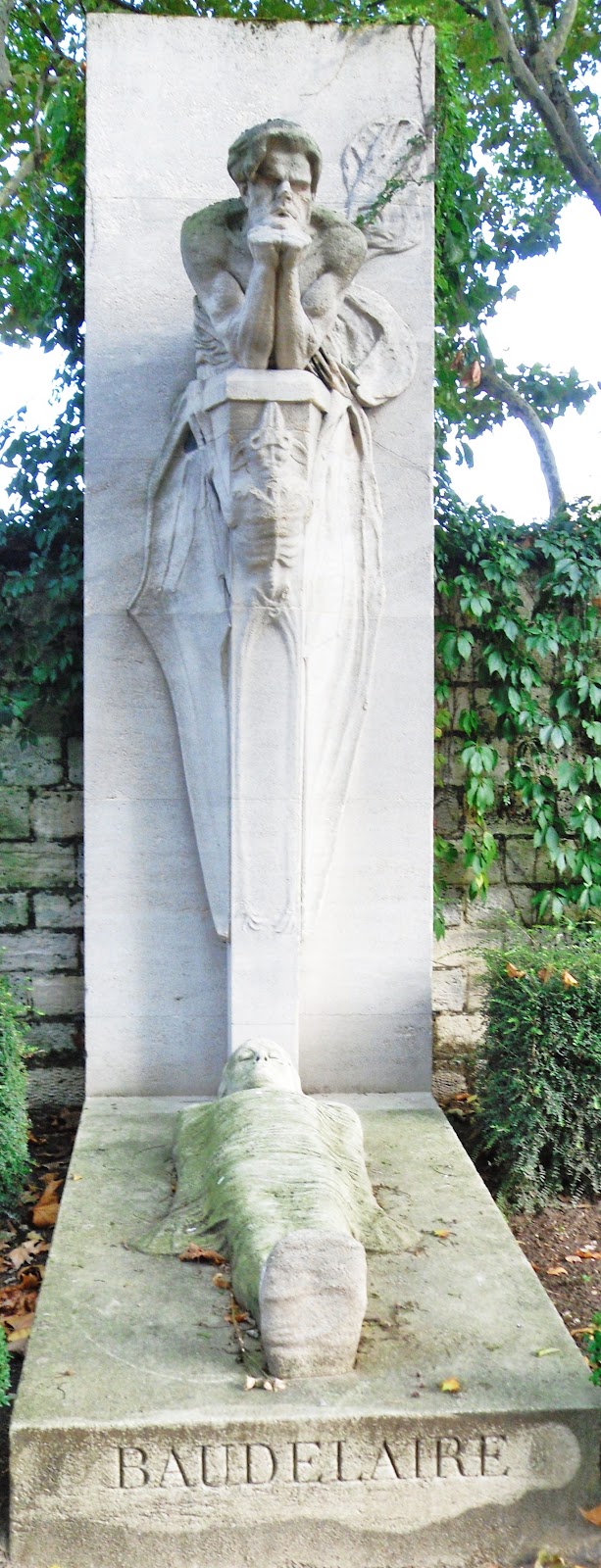
Charles Baudelaire (1821—67), whose grave (which I couldn't find) is sometimes confused with this cenotaph, which was sculpted in 1902 by the same person who made Sainte—Beuve's column — Jose de Charmoy. It features a scowling Baudelaire at the head of a column.


A (slightly vandalized) bat sprawls below him. (Baudelaire is in fact buried with Jacques Aupick, the father-in-law he hated.)

And there is a mummified figure lying on the ground in front of him.

3 November 2011

Parc Monceau, 8th arrondissement, Paris, France: Literary Île-de-France #12

Parc Monceau, in the 8th arrondissement at the junction of boulevard de Courcelles, rue de Prony, and rue Georges Berger is perhaps one of the lesser known recreational areas in the city but is certainly one of the most popular among Parisians, and the park is packed to bursting on a hot weekend's day. Which is quite something for a place whose only obvious attractions are a children's carousel, a tiny circular café with no seating and several different kinds of pancake, and free wifi. But it's my favorite park in Paris, and for four weeks I just found myself being forced to return to it almost every day, although I'm not too sure why. Oh, and there are the statues, but that wasn't it.

Nevertheless the statues are impressive. There are three literary ones, and the Chopin is an honorary literary one because of his connections with George Sand.

Raoul Verlet sculpted this statue, which represents Maupassant with, at his feet, a composite of the female hero of his 1889 novel Fort comme la mort, and an anonymous reader.

The statue was installed in the park in 1897.

Édouard Pailleron (1834—99).

Pailleron's statue was made by Léopold Bernstam and erected in parc Monceau in 1907.

The woman is dedicated to the actor Jeanne Samary (1857—90), who is represented here as she appeared in Pailleron's L'Étincelle (1879). 

Alfred de Musset (1810—57). This statue was begun by Alexandre Falguière, and then completed by Antonin Mercié. It was erected here in 1906.

Musset is seated while his muse inspires him.

Frédéric Chopin (1810—49).

An angel spreads flowers over the man and woman.

Chopin is at the piano composing a funeral march.

At his feet, a personification of pain, sorrow. The piece was sculpted by Jacques Froment—Meurice, and erected in the park in 1906.

The carousel too has literary associations, being named after Jules Verne (1828—1904).

My later Parc Monceau post is below:

–––––––––––––––––––––––––––––––––––
Parc Monceau (revisited), 8th arrondissement