Showing posts with label La Fontaine (Jean de). Show all posts

13 October 2018

Jean de La Fontaine in Boulogne-sur-Mer, Pas-de-Calais (62)

Jean de La Fontaine (1621–95).

2018 brought the twelfth 'edition' of the jardin éphémère, dedicated this year to the Fables of La Fontaine. Eight illustrations of his Fables are on display  in the old town in Boulogne-Sur-Mer, just in front of the mairie. 2018 marks the 350th anniversary of the first edition of the Fables (1668). The illustrations are also inspired by the engravings of Jean-Baptiste Oudry (1686–1755). The Fables are in verse, often modelled on Aesop's Fables, and are often criticisms of the court of Louis XIV, with animals usually serving the allegorical function.
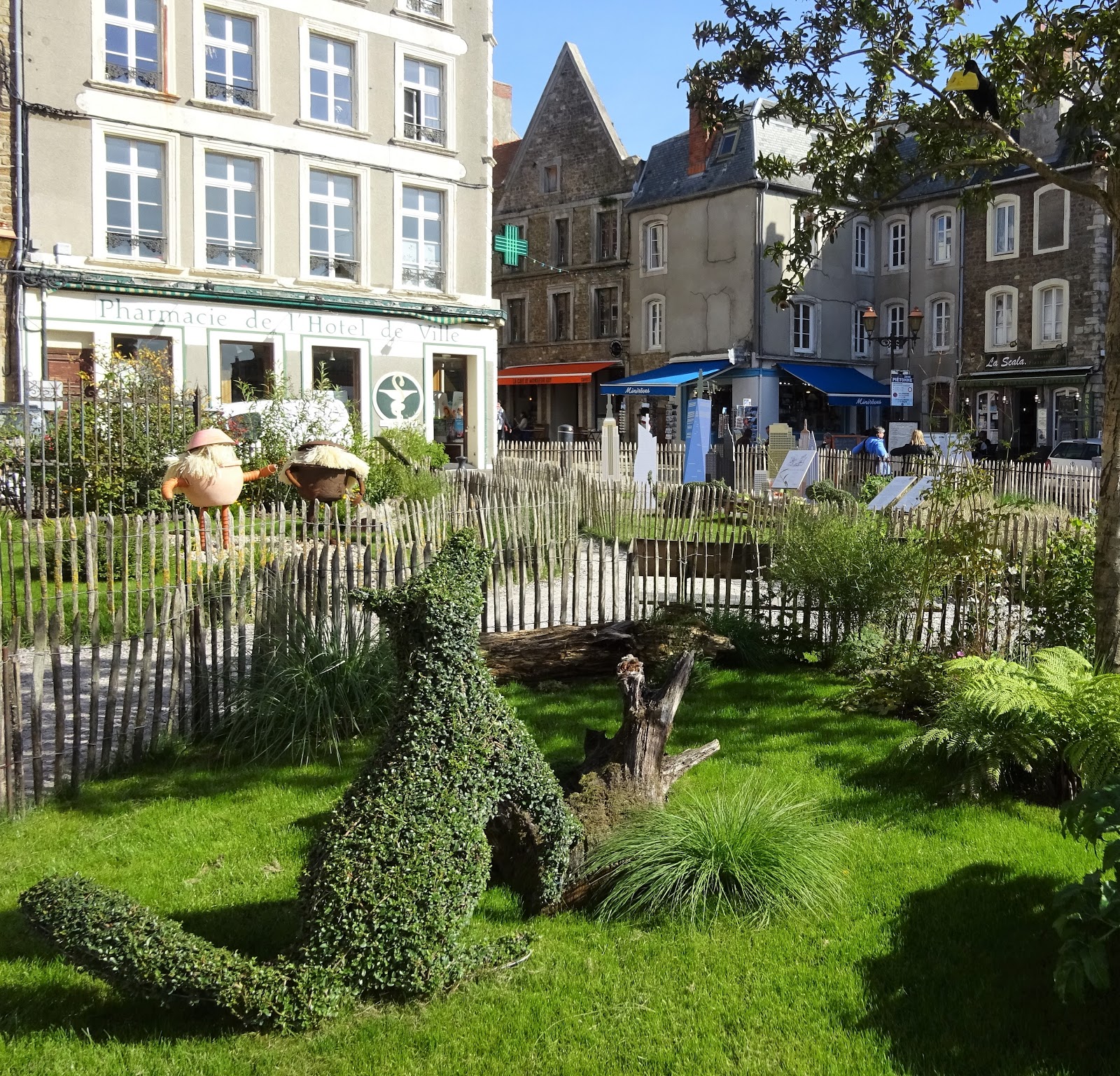

'Le corbeau et le renard'. Here, the fox sees the large chunk of cheese in the crow's bill, and tells the animal how fine he looks. Unable to resist squawking about the compliments, and crow of course drops the cheese and the fox snatches it. The moral is a lesson to the crow as well as the reader: don't listen to flatterers or you'll regret it.


'La Grenouille qui veut se faire aussi grosse que le bœuf'. So the frog is envious of the ox and tries to puff itself up to be as big, but in the process explodes. The moral: don't try to do things that aren't in your nature, be content with your limitations.
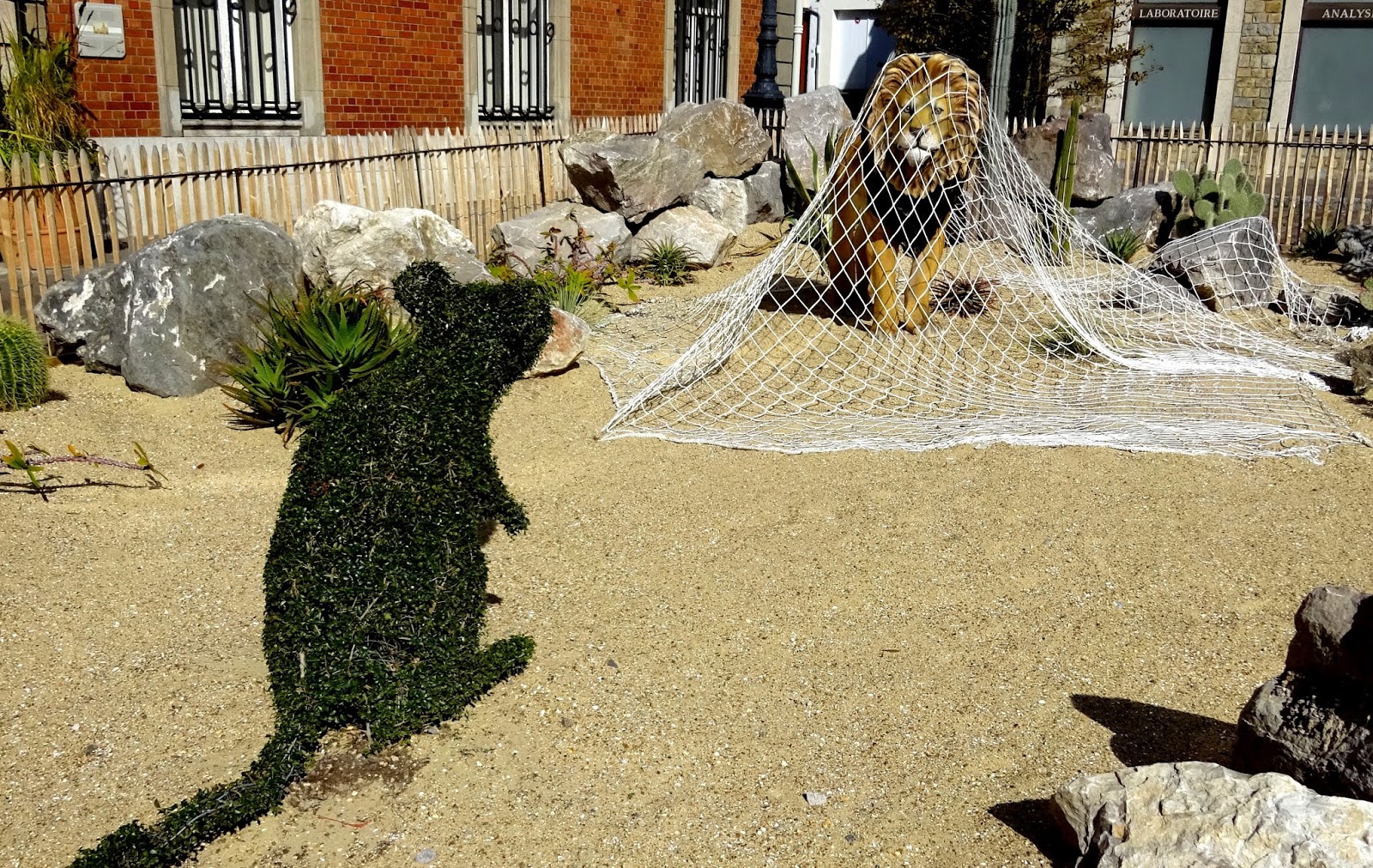
'Le rat et le lion'. A rat escapes from the ground and the lion spares him. Then the lion is caught in a trap and struggles madly and roars in its attempts to escape. The rat slowly gnaws into the rope to free the lion. The moral: well, there are two here: be as obliging as you can to everyone; and don't go at everything like a bull at a gate, just be patient.

'Le pot de terre et le pot de fer'. The iron pot asks the earthenware pot to go out walking with him, but the earthenware pot is frightened because he might smash. The iron pot eventually persuades him that he'll protect him, so they go out and the earthware pot gets smashed to bits. The moral: keep to the company of your equals or you'll suffer the same fate as the weaker pot.

'Le rat de ville et le rat des champs'. The town rat invites the country rat to a meal in town, where ortolans (a kind of bunting once considered a delicacy in France) are on the menu with all the trimmings of a royal feast. But they're interrupted and have to hide for a while. They return when the coast's clear, but the country rat has had enough and invites the town rat to his place the next day where (the moral) things are very quiet, no interruptions, and no fears as in as in an urban environment, and you can be yourself without all the fancy stuff.

'Le renard et les raisins'. This looks a little like 'Le corbeau et le renard', and it is and it isn't. The fox is starving and sees the bunches of grapes on the tree, but there's no way he can get at them. In the end he decides that they're not ripe enough, too green, not fit for the likes of him. The moral: there's a bit of pre-Freudian rationalisation here, as you shouldn't complain about what it's not possible for you to have. (This is the shortest of La Fontaine's 240 Fables.)

'Le renard et la cigogne'. The fox invites the stork to dinner, but only serves it on a plate, which the stork can't manage to eat a crumb of, so the fox eats it all up. Then the strork invites the fox to dinner, which smells delicious. However, the stork serves it in a long-necked jug, meaning the fox has to go home hungry. The moral: expect to receive as much as you give – in other words, if you deceive people they'll in turn deceive you.

'Le chêne et le sureau'. The oak tree, being very important, is tremendously haughty, and pities the humble reed. Whereas the reed gets tossed about all over the place with the slightest wind, the oak tree stands firm. The oak tree monopolises the conversatsion, the reed says little but is content with its flexibility. There comes a storm and the oak tree is uprooted, dead. But the reed lives on. The moral: death is the great leveller, and a little humility doesn't go amiss.

11 December 2015

Héléna Marienské: Le Degré suprême de la tendresse (2008)

In the Prologue to Héléna Marienské's Le Degré suprême de la tendresse  the title being taken from the macho Salvador Dalí's definition of cannibalism  the narrator relates a fait divers or news item she heard about a drunken couple leaving a bar in the Bastille area. We are told to remember the place, the passage des Taillandiers (a taillandier being a maker of cutting tools). The young woman is forced to perform fellatio on the man, but she uses extreme force and gives him a glansectomy, cutting off his glans penis (or bell-end in common parlance), letting it roll into the gutter for the pompiers to retrieve. Yes, this is a feminist book to make men wince in parts.

And although there are some pretty gruesome episodes in it, the erotically suggestive nature of the cover conceals a very clever, and often very comical, novel. Although many in the Anglophone world would perhaps disagree with the French world's much more flexible description of this book as a 'novel', because it consists of eight very separate parts, each is linked by that particular sex act, and each written in a different pastiche of a French author: Michel Houellebecq, Gédéon Tallemant des Réaux, Louis-Ferdinand Céline, Jean de La Fontaine, Christine Angot, Michel de Montaigne, Vincent Ravalec, and Georges Perec. My aim here is not to comment on all eight pastiches, but simply to comment on a few aspects of the book which particularly captured my attention.

The first 'Restriction du domaineis an obvious comment on Houellebecq's Extension du domaine de la lutte, and the 'restriction' evidently relates to the severing of the organ, so we know where the stories are leading, but we don't know how. Although we know the area when we laugh at the Houellebecqian cynicism, the obsession with sex, and the restricted sex. For instance, the protagonist Pierre Hitkartoff has troubles with getting an erection, although he experiences something of a new lease of life when he becomes a writer. Needless to say, perhaps, there's a particularly violent scene in it when Pierre loses not only his glans penis but also his limbs.

I'm unfamiliar with Tallemant des Réaux (1619–92), let alone his Historiettes, but then Marienské does say in the Prologue that he's little known, and that it's not necessary to be familiar with his work to enjoy the story, and it certainly isn't. Here we have the very sassy fourteen-year-old Marquise Héloïse who's far too independent for her own good, although the reader surely applauds when she bites a few centimeters from the sexually aggressive Capitaine's organ. The king Louis XII has already experienced the young girl's cheekiness, so locks her away in a convent to, er, keep her mouth shut. On pretending to be penitent there though, she asks the Mother Superior for a a crucifix and a hairshirt: she then stuns the Mother with the former, gags her with the latter and runs off to marry a Turkish Sultan!

Another name I was unfamiliar with is the contemporary Vincent Ravalec, whose writing is imitated in this way, with my translation here:

'Virgi's life at the time, it was pure Zola. One stoned evening when we were mates, real mates I mean, Virginia had told us that her father, long-term unemployed embittered by the vicissitudes of his existence, used to sodomize her without Vaseline when he wasn't bashing her mother. She found that really shitty. She was seventeen years old, [...] and no shit, Daddy's perverse practices really stank.'

She goes to see an overworked social worker who just gives her five euros for a tub of Vaseline, so with the male narrator she escapes, becomes a rich high-class prostitute and to cope takes lots of drug cocktails, and the narrative helterskelters into surreal multiple glansectomies, but somehow works its way into a kind of happy ending. Weird.

Next there is the final story dedicated to 'G.P', or Georges Perec, but Marienské couldn't say that because – unlike the previously story mentioned above which has chemical Es in it – this is like Perec's La Disparition in which there are no typographical Es in it. And there are some of the characters in Perec's novel here. There are also, like Perec's novel – many tortuous sentences which abound with foreign words and phrases ('miniskirt' for 'minijupe', 'nada' for 'rien', etc), many slang or familiar words ('toubib' for 'docteur' or 'médecin', 'gus' for 'mec', 'soutif' for 'soutien-gorge', etc), slightly odd expressions ('cubain' for 'cigare', 'RV' for 'rendez-vous') – all to dodge the e-word: inevitably, the plot tends to go adrift as you marvel at the inventiveness.

Yes, a very clever book which all-in-all manages not quite to get too lost in its own cleverness. A book with real bite (although slightly less in the French sense).