Showing posts with label Shakespeare (William). Show all posts

10 August 2015

NYC #4: Representations of Shakespeare

The Delacorte Theater in Central Park, Manhattan is the home of 'Shakespeare in the Park', the performances of which are in the summer and free to anyone queuing (and queuing and ...) for a ticket. As we hate queuing these performances will remain unseen by us. But meanwhile, these statues outside the theater are of interest:
 
Obviously Romeo and Juliet in a classic romantic pose.

And The Tempest. Both of these sculptures were a gift by George Delacorte.

9 August 2015

NYC #3: Other Literary Landmarks in Central Park

In the early stages of this blog I used to take the 'Obscure' in the title perhaps a little too literally, and my post on our visit to New York city in 2008 was not only very short but only included Fitz-Greene Halleck (1790–1867) because he's now very obscure, in fact almost forgotten. Earlier this century there was a none-too-serious attempt to bring a Fitz-Greene Society into existence, but the man is probably irredeemably obscure, so there we go. But let's not forget the really famous here in the Mall:
 
Influenced by many writers – among them Balzac – Walter Scott in a not entirely comfortable looking pose. John Steell did this work, of which there's a replica in Edinburgh.
 
Facing Scott is Steel's statue of Robert Burns (1771–96), replicas of which can also be found in Dunedin (New Zealand) and London.
 
 
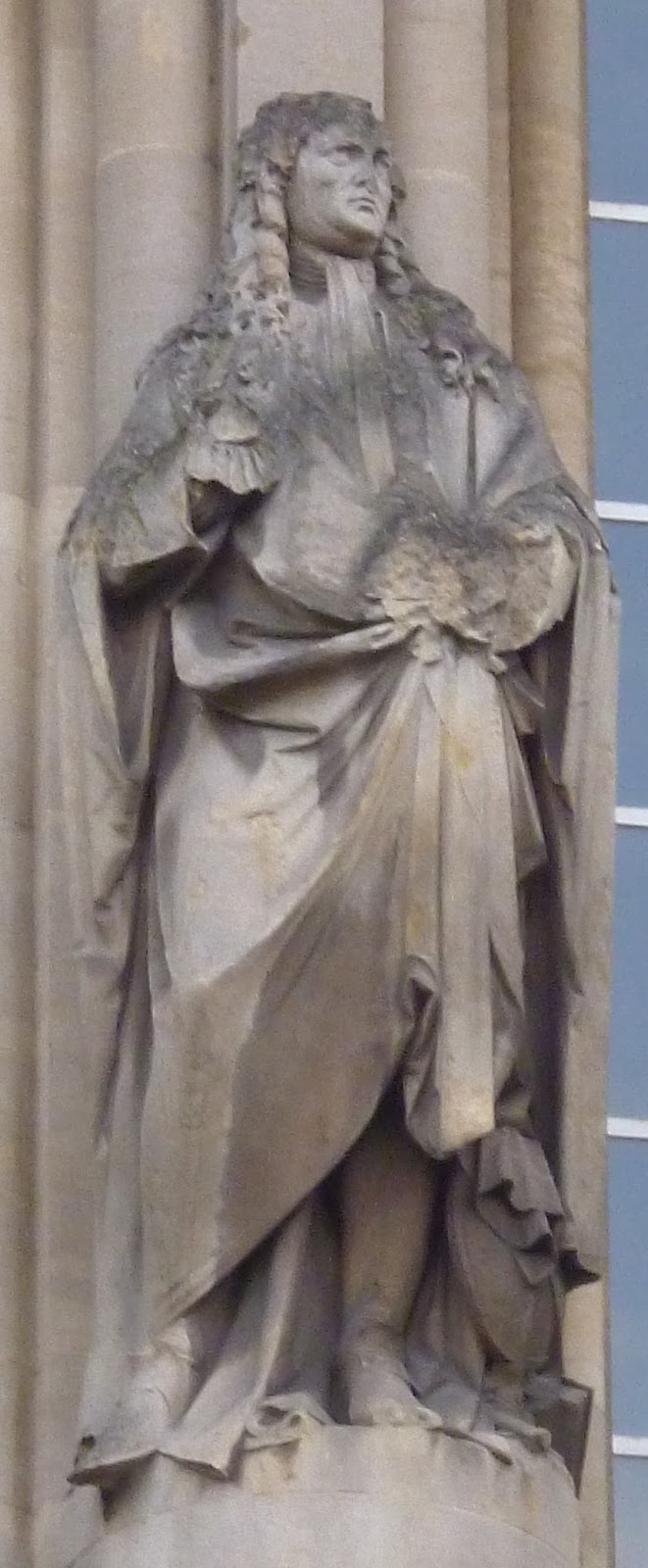
The statue of William Shakespeare (1564–1616) was erected in 1864, the three hundredth anniversary of his birth. It is by Henry Parry.
 
Finally, the bust of Friedrich Schiller (1759–1805).

30 July 2015

The Shakespeare Window, Central Library, Manchester UK

Rosa Grindon donated the Shakespeare window, which stands at the main entrance to the Central Library in Manchester, in memory of her husband the botanist Leo Grindon. It was designed by Robert Anning Bell. My blog post on the couple is here.

The famous quotation below the representation of Shakespeare is from Act 4, Scene I of The Tempest:

'The cloud-capp'd towers, the gorgeous palaces,
The solemn temples, the great globe itself,
Ye all which it inherit, shall dissolve
And, like this insubstantial pageant faded,
Leave not a rack behind. We are such stuff
As dreams are made on, and our little life
Is rounded with a sleep.'


The library itself is Grade II* listed.


15 April 2014

Shakespeare in Glossop, Derbyshire

Above of course is the very familiar figure of Hamlet reminiscing about Yorick, the king's jester, while staring at his skull. This statue niche is on the present Partington Players Theatre in Henry Street in Glossop.

The odd thing, though, is that the building began life not as a theatre but as the Glossop Liberal Club, Sir Edward Partington having laid the foundation stone in 1914 (although it wasn't completed until 1917).

15 May 2012

William Mulready in Kensal Green Cemetery, London


'WILLIAM MULREADY ARTIST ROYAL
ACADEMICIAN KNIGHT OF THE LEGION
OF HONOR BORN AT ENNIS IRELAND.
A. D. 1786 DIED IN LONDON A. D. 1863'

This monument has been described as 'six-poster Lombard Renaissance' and was designed by Godfrey Sykes and created by James Pulham. The face above is based on Mulready's death mask.

The base of the tomb has a number of representations of Mulready's paintings.

Above, from left to right: Haymaking, The Last In, and The Younger Brother.

Giving a Bite, Choosing a Wedding Gown (an illustration for the first chapter of Oliver Goldsmith's The Vicar of Wakefield), and The Sonnet, which was apparently for a popular novel, although I don't know which.

The Travelling Druggist, Boy Firing a Cannon, and I can't identify the one on the right.

Between the two seated nudes is a representation of The Seven Ages of Man, which is an illustration of Shakespeare's As You Like It: in Act II, Jacques says:

'All the world's a stage,
And all the men and women merely players;
They have their exits and their entrances;
And one man in his time plays many parts,
His acts being seven ages. At first the infant,
Mewling and puking in the nurse's arms;
Then the whining school-boy, with his satchel
And shining morning face, creeping like snail
Unwillingly to school. And then the lover,
Sighing like furnace, with a woeful ballad
Made to his mistress' eyebrow. Then a soldier,
Full of strange oaths, and bearded like the pard,
Jealous in honour, sudden and quick in quarrel,
Seeking the bubble reputation
Even in the cannon's mouth. And then the justice,
In fair round belly with good capon lin'd,
With eyes severe and beard of formal cut,
Full of wise saws and modern instances;
And so he plays his part. The sixth age shifts
Into the lean and slipper'd pantaloon,
With spectacles on nose and pouch on side,
His youthful hose, well sav'd, a world too wide
For his shrunk shank; and his big manly voice,
Turning again toward childish treble, pipes
And whistles in his sound. Last scene of all,
That ends this strange eventful history,
Is second childishness and mere oblivion;
Sans teeth, sans eyes, sans taste, sans every thing.'

12 May 2012

Isabella Glyn's Grave, Kensal Green Cemetery, London


'HERE RESTS
ALL THAT WAS MORTAL
OF THE CELEBRATED TRAGEDIAN
ISABELLA GLYN
(WIDOW OF E. S. DALLAS)
BORN 22 MAY 1823. DIED 18 MAY 1889.
AGE COULD NOT WITHER HER NOR CUSTOM STALE
HER INFINITE VARIETY.
AFTER LIFE'S FITFUL FEVER SHE SLEEPS WELL.
NOTHING CAN TOUCH HER FURTHER.'

Enobarbus's praise of Cleopatra in Shakespeare's Antony and Cleopatra is turned into an elegy for Isabella Glyn, who was most noted for her readings of Shakespeare.

'Widow of E. S. Dallas'? She married her second husband Eneas Sweetland Dallas (1828–79) in Scotland in 1853, and this was resolemnized in London in 1855. They separated soon after this, and she divorced him in 1874. She was later imprisoned for contempt of court in a matter related to the divorce case.

11 March 2012

The Arkwright Building, Nottingham, and Its Statues

The Arkwright Building of the the former Nottingham University College (later to become the University of Nottingham) on the corner of South Sherwood Street and Shakespeare Street dates from 1881 by Lockwood and Mawson, and it is here that D. H. Lawrence studied, gaining his teaching certificate in 1908. Four other notable people are represented as statues at the Shakespeare Street side:

William Shakespeare (1564–1616) himself,

John Milton (1608–1674),

Francis Bacon (1561–1626)

and Isaac Newton (1643–1727).

The building now belongs to Nottingham Trent University.

16 March 2010

Eugene Schieffelin and Shakespeare

This is just the kind of eccentricity that appeals to me. Eugene Schieffelin, a wealthy drug manufacturer, intended to introduce into the States all the birds mentioned in the works of Shakespeare. He was unsuccessful in that some species just didn't take to the country, but with the starling it was a very different story.

In 1890 and 1891, Schieffelin released a total of 100 starlings in Central Park, and his introduction of the bird into the country became so successful that the starling is now a pest.

On 1 September 1990, 100 years after the initial release of the starlings, the New York Times published an article on the story, and this is one of the paragraphs:

'By 1928 [starlings] were found as far west as the Mississippi. By 1942 they were in California. By the mid-1950's they numbered more than 50 million. Schieffelin's mission had become more appropriate to a work of Hitchcock than of Shakespeare.'

As I don't have an image of a starling, here's one of a female chaffinch. Originally I'd assumed that Eugene Schieffelin hadn't introduced the chaffinch, but in fact he had, as Dr Robert DeCandido kindly points out in a comment below. 'A List of Birds in Shakespeare', which has links to the quotations and includes two of the finch, is here.

20 August 2009

William Shakespeare and Stratford-upon-Avon, Warwickshire

From this family tree, we see that John Shakespeare married Mary Arden in 1557, and that William Shakespeare (1564–1616) was their third child and first son.

For many years, Shakespeare's birthplace in Henley Street in Stratford-upon-Avon has been a shrine to Bard worshippers, and The Shakespeare Trust has preserved a window in the 'birthroom' where various people have etched their names in the glass, some of the more noteworthy including Shelley, Keats, Dickens, Carlyle, and Mark Twain. Towards the end of the 19th century, the working-class poet Joseph Skipsey (1802–1903) was the curator of the house/museum for two years.

Shakespeare's daughter Susanna married the physician Dr John Hall in 1607, and they lived in Hall's Croft in the town:


One of Hall's patients was the poet Michael Drayton (1563–1631), who was born in Hartshill, Warwickshire:

Susanna and John Hall's daughter Elizabeth married Thomas Nash, and William Shakespeare bought the very imposing house next door to Nash's House: New Place, where he spent his final years. The house has long since been demolished, although the Elizabethan-type knott gardens are open through Nash's House (shown below):


The stone below, in New Place gardens, tells the story:

'On this site stood from 1483 to 1702 the house called New Place, which Shakespeare purchased in 1597, and in which he died on 23, April 1616.

'The residence passed successively to Shakespeare's elder daughter Mrs Susanna Hall who died in 1649. And to Elizabeth, Shakespeare's only granddaughter and last surviving descendant, who died in 1670.

'Subsequently the house was owned in turn by Sir Edward Walker, Garter King of Arms, and by his son-in-law Sir Hugh Clopton.

'In 1702 the edifice was completely rebuilt by Sir Hugh Clopton and in 1756 it was acquired as a summer residence by the Rev. Francis Gaskrell, who demolished it in 1759 [to avoid paying taxes on the property]. Since that year the land has remained vacant.'

Not far from Nash's House, in Church Street, is Mason Croft, which is now the University of Birmingham's Shakespeare Institute, although it was once the home of another author.

The popular novelist Marie Corelli (1855–24) moved to Mason Croft in 1901, and believed that the building had belonged to Shakespeare's daughter. She was a very colourful character noted for activities such as having herself rowed along the River Avon in a gondola, and having a photo of herself altered on the frontispiece of her books to make her seem much more attractive than she really was. The Sorrows of Satan (1895), perhaps the only one of her novels still in print, is notable for its anti-New Woman stance. Corelli adored Shakespeare, worked hard to preserve Stratford's architectural heritage, and this plaque is close to the entrance to Mason Croft.

Shakespeare was probably educated at King Edward VI school.


The Gower Monument stands in Bancroft Gardens by the River Avon, and a plaque reads:

'These figures were designed and modelled by Lord Ronald Gower, who presented the Monument to the Town of Stratford-upon-Avon in 1888.

'The work was executed in Paris and took twelve years to complete. Associated with Lord Ronald in his task were his assistant, Monsieur L. Madrassi, the firm of Tassel, who made all the figures save that of Hamlet, which was entrusted to Messieurs Graux and Marley, and the House of de Cauville and Perzinku, who cast the wreaths, the masks, the fruit and the flowers.

'The Stone used in the Monument is partly Boxground Bath, partly York. The group was erected on its original site by Mr. Frederick Taylor, Contractor, under the supervision of the Architects, Messieurs Peigniet and Marlow, of Paris.'

A more recent interpretation panel adds more:

'In 1769, [David] Garrick's Stratford Jubilee festival in honour of William Shakespeare started a growing public appreciation of the Bard in Startford-upon-Avon, an appreciation which is reflected in the grandeur of this memorial statue.
'[...]

'Each [figure] stands in front of individually-modelled bronze masks with flowers symbolic of each character. Hamlet represents Philosophy with ivy and cypress; Lady Macbeth is Tragedy with poppies and peonies; Comedy is represented by Falstaff with hops and roses; and History is represented by Prince Hal with English roses and French lilies.

'Originally, the statue group was situated on the other side of the theatre, with Falstaff aligned to face Holy Trinity Church. In 1926, the theatre was destroyed by fire. Following constructon of the new Memorial Theatre, the entire monument was moved to its present location in 1933 when the alignment was changed and the statues moved further from the base.'

The figures around the monument are very impressive, and of course very predictable: Hal's reformation glittering, like the crown he holds, o'er his faults; Hamlet telling Horatio he knew Yorick well; Lady Macbeth asking herself if these hands will ne'er come clean; and Falstaff after a cup of sack too many. Delightful.


Shakespeare married Anne Hathaway (1556–1623) in 1582: he was 18, and she was 26. Anne Hathaway's cottage is at Shottery, a very short distance from Stratford itself, and this is the Hathaway home where she lived before her marriage.

At Wilmcote in Warwickshire, Mary Arden's House, or Farm,– as it was continuously such – was the childhood home of Shakespeare's mother.

As we left Stratford in the afternoon on our way to Anne Hathaway's Cottage, car parks were full, the streets were becoming more crowded, and a thought occurs: is this town the most significant shrine in the world dedicated to a writer?