Showing posts with label Charente (16). Show all posts

3 March 2018

Luce Berthommé and Christian Le Guillochet in Villejésus (16), Charente (16)

In his invaluable Guide des tombes des hommes célèbres – which of course also includes graves of famous women – Bertrand Beyern describes Luce Berthommé (1944–2004, born in Villejésus) as an 'author, [film and play] director and actor'. His 2008-published book of course excludes her husband Christian Le Guillochet (1933–2011, born in Albi), who is described in Wikipédia as an 'actor, playwright and director of films and plays'.* Together (with the support of the actor Laurent Terzieff), they founded Lucernaire, a cultural centre in Paris involved with drama, the cinema and photography, in 1968. It began near the Gare Montparnasse in the Impasse Odessa, although ten years later Lucernaire was forced to move due to the construction of the Tour Montparnasse. In the sixth arrondissement at 53 rue Notre-Dame-des-Champs, in a disused factory, the second incarnation of Lucernaire consisted of three theatres, three cinema screens, an art gallery, small library, restaurant and bar. In 2004, after the death of his wife,  Christian Le Guillochet sold Lucernaire to Les Éditions L'Harmattan. And in 2006 Christian Le Guillochet published, via Les Éditions L'Harmattan, a book about the history of Lucernaire: 50 ans de Théâtre, depuis l'impasse Odessa jusqu'à la rue Notre-Dame des Champs.

*He also wrote two novels: L'Oiseau-éventail (1995) and Le Chien citoyen (2008).


2 March 2018

François Mitterrand in Jarnac (16), Charente (16)

François Mitterrand (1916–96) was the President of France for fourteen years, from 1981 to 1995. He died of prostate cancer – from which he had long been diagnosed – several months after the end of his presidency. François Mitterrand was born in Jarnac (Charente), into a bourgeois, Catholic and conservative family. His paternal grandfather was station master in Jarnac, although his father Joseph was an engineer for the Compagnie du Chemin de fer from Paris to Orléans, in 1919 moving to Jarnac to take up directorship of his father's vinegar factory: he later became president of the Fédération nationale des syndicats de fabricants de vinaigre. François was the fifth child in the marriage between Joseph and Yvonne, and was baptised in Jarnac in May 1917. He is buried in Jarnac cemetery. No inside photography in his birthplace is allowed.

'DANS CETTE MAISON
EST NÉ LE 26 OCTOBRE 1916
FRANÇOIS MITTERRAND
PRÉSIDENT DE LE RÉPUBLIQUE
1981–1995'

The front of the house.

And the back of it.

The old washing area.

The words 'Fabrique de Vinaigre' (Vinegar Factory) still clearly visible.


I couldn't avoid the light getting in.

Église Souterraine Saint Jean, Aubeterre-sur-Dronne (16), Charente (16)

The Église souterraine (also known as 'Église monolithe') in Aubeterre-sur-Dronne, Charente, was hollowed out of the calcareous rock beneath the castle, and is one of the largest underground churches in Europe. Discovered was a Roman reliquary six metres high and three metres wide, and a pit containing religious relics. A necropolis contains eighty sarcophagi. It is quite possible that pilgrims on their way to Compostela used to visit this place, believing that the relics would protect them on their way. Unfortunately, it was closed at the time of our visit.

28 February 2018

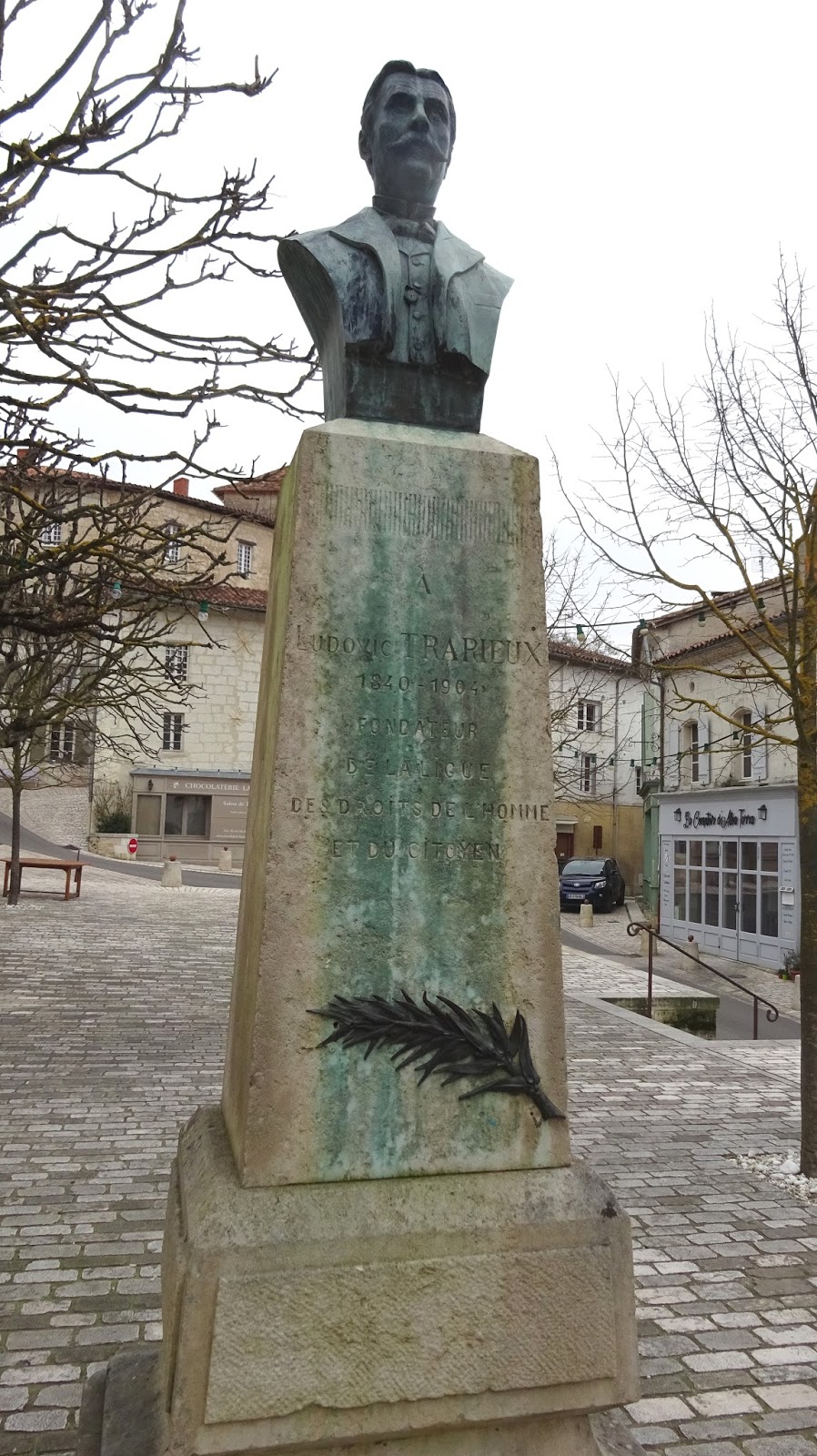
Ludovic Trarieux in Aubeterre-sur-Dronne (16), Charente (16)

Ludovic Trarieux (1840–1904) was born in Aubeterre-sur-Dronne, Charente, and was a lawyer and a politician of the 'soft' right. He was the founder and the first president of La Ligue des droits de l'homme (1898) (The League of the Rights of Man), and the instigator of the revision of the trial of Captain Alfred Dreyfus. As such, he was also a strong supporter of Émile Zola, who was suffering from huge legal problems following his publication of 'J'accuse' in the newspaper L'Aurore in 1898 in support of Dreyfus, an issue which was dividing France in two. Trarieux himself published a number of papers, mainly on legal questions, including the Dreyfus case. The bust of him is in the centre of Aubeterre-sur-Dronne, just a few meters away from his birthplace, with a plaque recognising his contributions to humanity.


Pierre Véry in Aubeterre-sur-Dronne and Bellon (16), Charente (16)

Pierre Véry (1900–60) was a crime writer born in Bellon (Charente), where he is buried. His first novel, Pont-Égaré (1927), featured in the selections that year for both the Renaudot and the Femina, although after hesitating between literary fiction and crime, he chose crime in 1934. Among his most famous books are L'Assassinat du père Noël (1934), Les Disparus de Saint-Agil (1935), and Goupi-Mains rouges (1937), all of which were adapted to the cinema screen. Some of his works are set in the area of his birth. His former home in Aubeterre-sur-Dronne is now a restaurant named after him:


'PIERRE VÉRY
HOMMES DE LETTRES
NÉ LE 17 NOVEMBRE 1900
DÉCÉDÉ LE 12 OCTOBRE 1960'

30 May 2010

Alfred de Vigny and Le Maine Giraud, Charente (16), France

Le Maine Giraud manor - now in part a museum remembering Alfred de Vigny, the 19th century romantic poet - was built and altered between the 12th and the 15th centuries, and belonged to Vigny between 1827 and his death in 1863.

Vigny inherited it from his aunt Sophie de Baraudin, who was his mother's elder sister. He had first seen it in 1823, when he was 26 and a military captain, and had been very impressed. His grandfather, the Marquis of Baraudin, was an admiral who wished to remain close to the ports Rochefort and La Rochelle.

On Vigny's inheriting it, the manor was in a bad state of repair, but instead of selling it he decided to restore it bit by bit.

One restoration of note is one of the towers (interior photos below), where he wrote La Mort du loup La Bouteille à la mer, and parts of other poems.

Le Maine Giraud, near Champagne-Vigny, Charente.

The bust of Vigny at le Maine Giraud.

Two different plaques at the entrance to the building.

The former dining room, which contains many things, including:

A bust of Vigny.A modern sketch of Vigny.

The last page of Vigny's marriage contract.

Vigny's tiny room, with twisting stairs leading up to it, where he went to write and relax.

Today, cognac is distilled on the premises, and this is an example of the wine they sell.

A quotation in the parking lot at Champagne-Vigny reads:

'Il y a dans le pays le moins connu de l'Angoumois, une chaîne de collines qui s'étend vers la mer, sans se briser et qui forme des sinuosités dont les aspects sont toujours imprévus et pittoresques...'.

'There is in the least known land of l'Angoumois a chain of hills reaching down toward the sea, unbroken and so sinuous, always unexpected and picturesque.'

There is a monument to Vigny in Champagne-Vigny.

Vigny's name is well-remembered in this village.

L'Église St Christophe is where Vigny went with his wife, Lydia Bunbury, to mass when he was staying at le Maine Giraud.

Vigny presented the church with the statue of the Madonna and child which stands on the lefthand side of the entrance to the chancel. It once stood in a corner in Sophie de Baraudin's bedroom.

Vigny was the godfather of the church bell, and his name is etched on it.