Showing posts with label Kensal Green Cemetery. Show all posts

18 October 2012

Kensal Green Cemetery Revisited: London #35

 
The grave of Mary Scott Hogarth (1819–37), a girl much loved by her brother-in-law Charles Dickens. Dickens's hated mother-in-law Georgina is also buried here, as is his father-in-law, the music critic George Hogarth (1783–1870), who wrote for the Daily News and the Illustrated London News.
 
Terence (Mervyn) Rattigan (1911–79), author of such famous plays as French without Tears and Separate Tables, and the screenplays The Winslow Boy and The Browning Version, was cremated in Bermuda and his remains were deposited here.
 
George Grossmith (1847–1912) is most noted for writing Diary of a Nobody (1894) with his brother Weedon.
 
Jane Loudon (1807–58), née Webb, anonymously wrote an early science fiction novel called The Mummy! A Tale of the Twenty-Second Century (1827), which mentions air flight, telegraph, and a steam mower among other things. She met her husband through the novel, although he initially thought it was the work of a man. She later wrote books on gardening and botany and did editorial work.
 
Her husband John Claudius Loudon (1783–1843), a landscape gardener and horticultural writer, is buried next to her. The written works he was most noted for are Encyclopaedia of Gardening (1822) and the Gardener's Magazine, started in 1826.
 
Harriet Marian Stephen (1840–75), the youngest daughter of William Makepeace Thackeray and the first wife of Leslie Stephen (1832–1904), who was the first editor of the Dictionary of National Biography and the father of Virginia Woolf (1882–1941).
 
Sir William Molesworth (1810–55), who edited Thomas Hobbes's Works (1839–45) and began the London Review.
 
John Leech (1817–64), a cartoonist most remembered for his contributions to Punch, but who also illustrated some of Dickens's work. A nineteenth century absurdist.
 
 
 'IN MEMORY OF
JOSEPH RICHARDSON
FORMERLY OF UNDERSKIDDAW, KESWISK, CUMBERLAND
THE INVENTOR OF
THE INSTRUMENTS OF THE ROCK, BELL AND STEEL BAND
DIED 8TH. APRIL 1855, AGED 65'
 
Richardson invented the 'rock harmonium' which made music by striking pieces of Skiddaw slate. But only his son is buried here.


'IN MEMORY OF
JEAN FRANCOIS GRAVELET BLONDIN
WHO DIED AT NIAGARA HOUSE EALING
22ND FEBRUARY 1897
IN HIS 73RD YEAR'
 
Émile Blondin was a tight-rope walker who first crossed the Niagara Falls in 1859, and followed this up by crossing them with different handicaps: blindfold, carrying a man, on stilts, and making an omelette in the middle. His real name was Jean-François Gravelet.
 
His wife Charlotte died in 1888.
 
John St John Long (1798–1834) was a successful quack specializing in the treatment of consumption, rheumatism and various other illnesses, and was convicted three times, and once acquitted, for the manslaughter of his patients. He wrote a book called A Critical Exposure of the Ignorance and Malpractice of Certain Practitioners in Their Theory and Treatment of Disease, although he wouldn't take his own medicine and died of consumption.
 
The Irish composer William Vincent Wallace (1812–65), who was also an enthusiastic traveller, and is said to have been 'nearly murdered by savages in New Zealand'.
 
I came upon this gem quite by chance, as I knew nothing about him. Below I copy his Wikipedia entry:

'Emidio Recchioni (1864-1933) was an Italian anarchist and businessman who was involved in a 1931 plot against the life of Benito Mussolini, the fascist leader of Italy.
 
Born in Ravenna in 1864, Recchioni came to England in 1899 after he was implicated in a plot against Francesco Crispi, a former Italian prime minister. He subsequently bought a delicatessen on the Old Crompton Road, named King Bomba, frequented by a variety of prominent writers and intellectuals, including George Orwell, Emma Goldman, Sylvia Pankhurst, as well as a number of Italian anti-Fascist exiles. As a political activist, he acquired a wide circle of friends, which allegedly included Prime Minister Ramsay McDonald himself.
 
Nonetheless, Recchioni was monitored by British intelligence services, who suspected him of providing money and weapons to a group of potential assassins based in Rome. The rumours that Recchioni was planning the death of Mussolini began in 1929, and were passed by Ovra, the Italian secret police, to Colonel Carter of the British Special Branch. On a trip to Brussels in 1931 Recchioni was followed by a Special Branch agent. While in the city he met Angelo Sbardellotto, an Italian anarchist, who is reported to have offered to go to Rome and kill Mussolini if he could get money and weapons. Recchioni is alleged to have offered to provide both.
 
Sbardellotto was later arrested in Italy, after several abortive assassination attempts, and found to be carrying two bombs and a revolver. A copy of his confession, detailing meetings in Brussels and Paris, was forwarded to Special Branch. It was also accompanied by a request for Recchioni's extradition.
 
While the Home Office was considering this, the matter was complicated still further when the Daily Telegraph named Recchioni as one of those involved in the assassination plots, quoting Italian 'sources'. He promptly began legal proceedings against the newspaper. The Telegraph appealed to Carter for information, but was told that there was none to give. It would seem that the whole matter was just too politically sensitive, with the potential to embarrass the government.
 
Reccchioni won his case, and was awarded £1117 in damages, a decent amount for the day. No further action was ever taken against him and he died in Paris in 1933. His son Vero Recchioni, who later called himself Vernon Richards, went on to become a noted editor of anarchist publications.

It remains unclear why British authorities declined to assist the Telegraph when there clearly was evidence implicating Recchioni. The details of the whole affair were kept secret for over sixty years, and were only released by the British Home Office in the early 2000s.'

––––––––––––––––––––––––––––––––––––––––––––––
As before, I owe much of the above information to the invaluable 107-page A4 guidebook available through the cemetery website: Paths of Glory or A Select Alphabetical and Biographical List, Illustrated with Line Drawings of Their Monuments, of Persons of Note Commemorated at the Cemetery of All Souls at Kensal Green (London: The Friends of Kensal Green Cemetery, 1997).

16 May 2012

Charles Dickens Connections in Kensal Green Cemetery, London

The grave of Robert Bell (1800–67) is now illegible. He was born in Cork, Ireland, and moved to London where he first worked as an editor for the weekly Atlas, and later as a journalist. He edited a large number of books of English poets, and was a friend of Dickens.

'SAMUEL LOVER
BORN FEB. 24, 1797.
DIED JULY 6, 1868.'

Lover was an Anglo-Irish songwriter and novelist who founded Bentley's Magazine with Dickens. He is probably best remembered for his novel Handy Andy (links to both volumes below).

Famously, John Forster (1812–76) wrote the biography of his friend Dickens, and also wrote biographies of Swift and Goldsmith. His bequest to the country was his library of 18,000 books, which included the manuscripts of all of Dicken's novels except A Christmas Carol. Dickens probably modelled Podsnap in Our Mutual Friend on him.

'DWARKANAUTH TAGORE,
OF CALCUTTA,
OBIIT 1ST. AUGUST 1846.'

'Tagore was the grandfather of the great Indian poet Rabindranath
Tagore (1861–1941), and met both Dickens and Thackeray when visiting London.
ADDENDUM: I forgot to include this one of William Harrison Ainsworth (1805–82), who for a time lived in nearby Kensal Lodge, and had both Dickens and Thackeray as guests.

 –––––––––––––––––––––––––––––––––––
Samuel Lover – Handy Andy: A Tale of Irish Life: Volume One
Samuel Lover – Handy Andy: A Tale of Irish Life: Volume Two
William Harrison Ainsworth, Manchester

15 May 2012

Lord Byron's Friend, John Cam Hobhouse, in Kensal Green Cemetery, London


'IN MEMORY OF
JOHN CAM HOBHOUSE, BART.
BARON BROUGHTON DE GYFFORD, G. C. B.
BORN JUNE 27TH. 1786. DIED JUNE 3RD. 1869.'

HE WAS EMINENT ALIKE IN POLICTICAL AND LITERARY LIFE
AND FOUND UNBROKEN HAPPINESS IN DOMESTIC REPOSE
WHICH HE ADORNED
BY HIS RARE GIFTS OF SCHOLARSHIP AND ELOQUENCE.

Hobhouse is perhaps best remembered for his relationship with Lord Byron, whose great faithful friend and travel companion he was for a number of years. Canto IV of Byron's Childe Harold's Pilgrimage is dedicated to Hobhouse, 'a friend often tried and never found wanting'. It was Hobhouse who identified Byron's body (his face being unrecognizable) by his deformed foot. And it was Hobhouse who ensured that, because Westminster Abbey refused to accept the remains of the disgraced poet, he should at least have as dignified a burial as possible.

–––––––––––––––––––––––––––––––––––
Lord Byron and Newstead Abbey
Lord Byron in Hucknall
Lord Byron and Sir Walter Scott in Newark on Trent

William Mulready in Kensal Green Cemetery, London


'WILLIAM MULREADY ARTIST ROYAL
ACADEMICIAN KNIGHT OF THE LEGION
OF HONOR BORN AT ENNIS IRELAND.
A. D. 1786 DIED IN LONDON A. D. 1863'

This monument has been described as 'six-poster Lombard Renaissance' and was designed by Godfrey Sykes and created by James Pulham. The face above is based on Mulready's death mask.

The base of the tomb has a number of representations of Mulready's paintings.

Above, from left to right: Haymaking, The Last In, and The Younger Brother.

Giving a Bite, Choosing a Wedding Gown (an illustration for the first chapter of Oliver Goldsmith's The Vicar of Wakefield), and The Sonnet, which was apparently for a popular novel, although I don't know which.

The Travelling Druggist, Boy Firing a Cannon, and I can't identify the one on the right.

Between the two seated nudes is a representation of The Seven Ages of Man, which is an illustration of Shakespeare's As You Like It: in Act II, Jacques says:

'All the world's a stage,
And all the men and women merely players;
They have their exits and their entrances;
And one man in his time plays many parts,
His acts being seven ages. At first the infant,
Mewling and puking in the nurse's arms;
Then the whining school-boy, with his satchel
And shining morning face, creeping like snail
Unwillingly to school. And then the lover,
Sighing like furnace, with a woeful ballad
Made to his mistress' eyebrow. Then a soldier,
Full of strange oaths, and bearded like the pard,
Jealous in honour, sudden and quick in quarrel,
Seeking the bubble reputation
Even in the cannon's mouth. And then the justice,
In fair round belly with good capon lin'd,
With eyes severe and beard of formal cut,
Full of wise saws and modern instances;
And so he plays his part. The sixth age shifts
Into the lean and slipper'd pantaloon,
With spectacles on nose and pouch on side,
His youthful hose, well sav'd, a world too wide
For his shrunk shank; and his big manly voice,
Turning again toward childish treble, pipes
And whistles in his sound. Last scene of all,
That ends this strange eventful history,
Is second childishness and mere oblivion;
Sans teeth, sans eyes, sans taste, sans every thing.'

14 May 2012

Thomas Hood's Grave, Kensal Green Cemetery, London


'HE SANG THE SONG OF THE SHIRT

IN MEMORY
OF
THOMAS HOOD
BORN 23RD. MAY 1798.
DIED
3RD. MAY 1845.
–––––––––––––––
ERECTED
BY
PUBLIC SUBSCRIPTION
A. D. 1854

ALSO OF JANE HOOD, HIS WIFE.
BORN 6TH. NOV. 1792. DIED 4TH. DEC. 1846.

This monument was designed by Matthew Noble.

Paths of Glory, the excellent guide book to the cemetery published by the Friends of Kensal Green Cemetery, mentions that the poet 'once mortgaged his brain with his publishers in return for a cash advance'. Not exactly certain what that means. Anyway, the sorry sight above is a void where a relief once was: there were two, one representing a scene from 'The Bridge of Sighs', the other The Dream of Eugene Aram, the Murderer, but they were stolen some time ago.

12 May 2012

George Cruickshank's Grave, Kensal Green Cemetery, London

'In Loving Memory
OF
GEORGE CRUICKSHANK,
ARTIST,
DESIGNER, ETCHER, PAINTER,
BORN SEPT. 27TH., 1792,
DIED FEBY. 1ST., 1878,
AT 263 HAMPSTEAD RD., LONDON,
AGED 86.

FOR 30 YEARS A TOTAL ABSTAINER,
AND ARDENT PIONEER AND CHAMPION
BY PENCIL, WORD AND PEN,
OF
UNIVERSAL ABSTINENCE
FROM
INTOXICATING DRINKS.

HIS REMAINS
LAID IN THIS CEMETERY
FEB. 9TH., 1878
WERE REMOVED ON
NOV. 29TH., 1878
TO ST PAUL'S CATHEDRAL,
WHERE THEY FINALLY REPOSE.

THIS MONUMENT IS ERECTED
BY HIS AFFECTIONATE WIDOW
ELIZA CRUICKSHANK.'

Cruickshank illustrated Dickens's Oliver Twist. The granite bust of him, by William Behnes, has gone, although there is a marble copy in Dickens's Doughty Street museum house.

Isabella Glyn's Grave, Kensal Green Cemetery, London


'HERE RESTS
ALL THAT WAS MORTAL
OF THE CELEBRATED TRAGEDIAN
ISABELLA GLYN
(WIDOW OF E. S. DALLAS)
BORN 22 MAY 1823. DIED 18 MAY 1889.
AGE COULD NOT WITHER HER NOR CUSTOM STALE
HER INFINITE VARIETY.
AFTER LIFE'S FITFUL FEVER SHE SLEEPS WELL.
NOTHING CAN TOUCH HER FURTHER.'

Enobarbus's praise of Cleopatra in Shakespeare's Antony and Cleopatra is turned into an elegy for Isabella Glyn, who was most noted for her readings of Shakespeare.

'Widow of E. S. Dallas'? She married her second husband Eneas Sweetland Dallas (1828–79) in Scotland in 1853, and this was resolemnized in London in 1855. They separated soon after this, and she divorced him in 1874. She was later imprisoned for contempt of court in a matter related to the divorce case.

7 May 2012

Robert Owen, and the Reformers' Memorial, Kensal Green, London

The cenotaph to Robert Owen, who was buried in Newtown, Montgomeryshire, Wales, is fittingly at the side of the Reformers' Memorial.

'ROBERT OWEN
PHILANTHROPIST
BORN MAY 14TH. 1771.
DIED NOVR. 17TH. 1858.'

'1879
ERECTED BY SUBSCRIPTION
IN MEMORY OF
ROBERT OWEN
OF NEW LANARK,
BORN AT NEWTOWN, N. WALES 1771.
HE DIED AND WAS BURIED
AT THE SAME PLACE 1858,
AGED 87 YEARS.
–––––––––––––
HE ORIGINATED AND ORGANIZED INFANT SCHOOLS, HE SECURED A REDUCTION OF THE HOURS OF LABOUR FOR WOMEN AND CHILDREN IN FACTORIES. HE WAS A LIBERAL SUPPORTER OF THE EARLY EFFORTS IN FAVOUR OF NATIONAL EDUCATION AND LABOURED TO PROMOTE INTERNATIONAL ARBITRATION. HE WAS ONE OF THE FOREMOST ENGLISHMEN WHO TAUGHT MEN TO ASPIRE TO A HIGHER SOCIAL STATE BY RECONCILING THE INTERESTS OF CAPITAL AND LABOUR. HE SPENT HIS LIFE AND A LARGE FORTUNE IN SEEKING TO IMPROVE HIS FELLOW MEN BY GIVING THEM EDUCATION, SELF-RELIANCE AND MORE WORTH.
                          HIS LIFE WAS SANCTIFIED BY HUMAN AFFECTION AND LOFTY EFFORT.
                                                                     J. W.CORFIELD'

'MR. OWEN'S WRITINGS.
–––––––––––––––––
REPORT TO THE COUNTY OF LANARK.
NEW VIEWS OF SOCIETY.
TWELVE LECTURES.
LECTURES ON MARRIAGE.
LECTURES ON A NEW STATE OF SOCIETY.
THE BOOK OF THE NEW MORAL WORLD.
SIX LECTURES AT MANCHESTER.
MANIFESTO OF ROBERT OWEN.
SELF SUPPORITNG HOME COLONIES.
LETTERS TO THE HUMAN RACE.
REVOLUTION IN MIND AND PRACTICE.
ROBERT OWEN'S JOURNAL.
LIFE OF ROBERT OWEN.'

The Reformers' Memorial, which contains a great number of names.

'THIS MEMORIAL
IS RAISED AS A TOKEN OF REGARD TO THE
BRAVE MEN AND WOMEN WHOSE NAMES IT BEARS BY JOSEPH W. CORFIELD,
AUGUST 1895.'

'THE REFORMERS' MEMORIAL

ERECTED TO THE GLORY OF MEN AND WOMEN WHO HAVE GENEROUSLY GIVEN THEIR TIME AND MEANS TO IMPROVE THE CONDITIONS AND ENHANCE THE HAPPINESS OF ALL CLASSES OF SOCIETY. THEY HAVE FELT THAT A FAR HAPPIER AND MORE PROSPEROUS LIFE IS WITHIN THE REACH OF ALL MEN, AND THEY HAVE EARNESTLY SOUGHT TO REALIZE IT. THE OLD BRUTAL LAWS OF IMPRISONMENT FOR FREE PRINTING HAVE BEEN SWEPT AWAY AND THE RIGHT OF SELECTING OUR OWN LAW MAKERS HAS BEEN GAINED MAINLY BY THEIR EFFORTS. THE EXERCISE OF THESE RIGHTS WILL GIVE THE PEOPLE AN INTEREST IN THE LAWS THAT GOVERN THEM, AND WILL MAKE THEM BETTER MEN AND BETTER CITIZENS.'

A great number of people are mentioned on the monument, and among them are:

Robert Owen (New Lanark), John Bellars, Robert Dale Owen, Abraham Combe, Joseph Lancaster, William Thompson, John Minter Morgan, William Pare, William Galpin, Henry Travis, MD, Alex Campbell, James Rigby, W. D. Saull, Julian Hibbert, Rev. Charles Kingsley, Lady Noel Byron, Francis Wright, Thomas Spence, Allan Davenport, Mary Hennell, Francis Place, Harriet Martineau, George Odger, Elizabeth Fry, Sarah Martin, Mary Carpenter, Benjamin Flower, Henry Fawcett, Barbara Bodichon, Maria Grey, Arnold Toynbee, W. K. Clifford, Edward T. Craig, C. Dobson Collet, Charles Bradlaugh, Richard Congreve, William Morris, John Ruskin, F. Power Cobbe, Herbert Spencer, Hodgson Pratt, Francis Newman, Lydia Becker, Josephine Butler, Anna Swanwick, C. Jacob Holyoake, J. Kells Ingram, Joseph Priestley, Thomas Paine, William Hone, John Stuart Mill, Major Cartwright, Richard Carlile, William Lovett, William Carpenter, John Frost, William Cobbett, W. J. Fox, Richard Moore, William Howitt, Samuel Bamford, Henry Hunt, George Thompson, David Williams, Thomas Wooller, Ebenezer Elliott, Ernest Jones, Alex Macdonald, Richard Cobden, Robert Cooper.


––––––––––––––––––––
Robert Owen in Manchester

6 May 2012

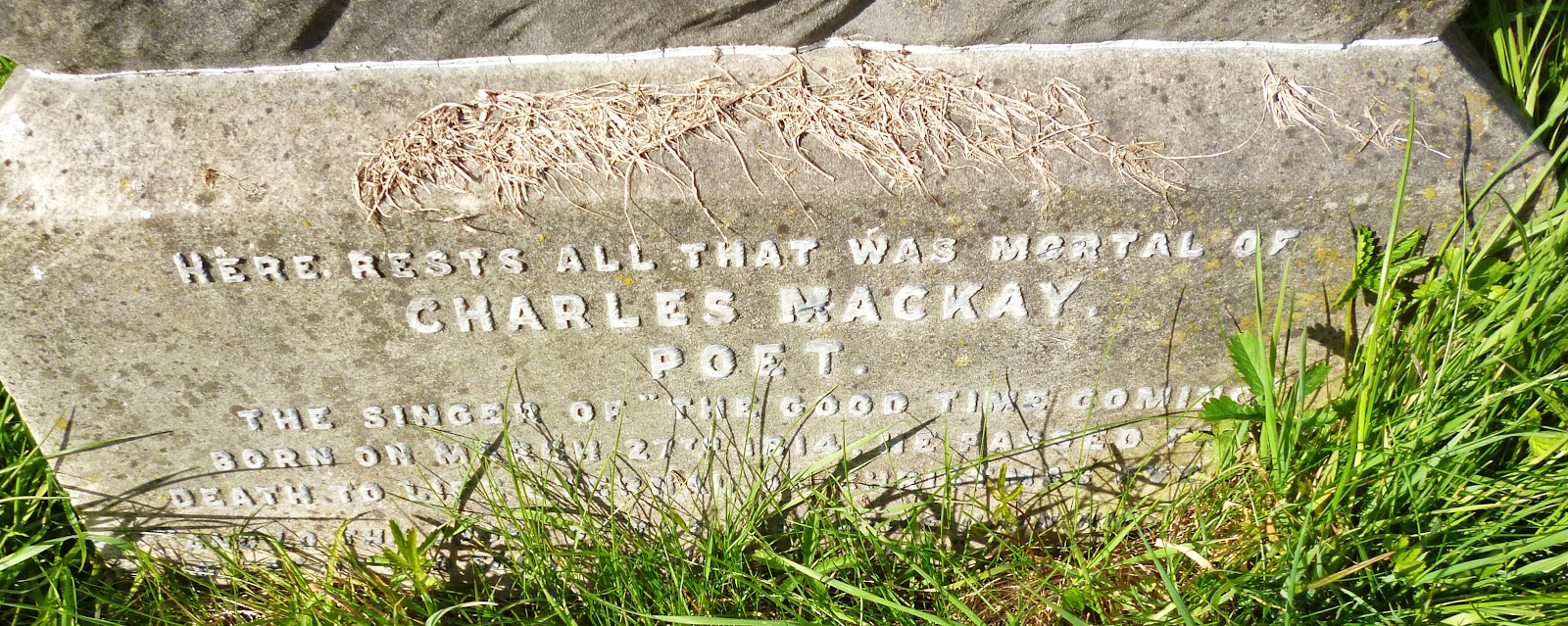
Charles Mackay's Grave in Kensal Green Cemetery, London

The grave of Charles Mackay (1814–1889) has (on top) a dove with a lyre, which is now broken.

Mackay was a Scottish poet and journalist whose most widely known book is almost without doubt Extraordinary Popular Delusions and the Madness of Crowds (1841), a history of 'popular' madnesses, such as 'economic bubbles' (like the South Sea Bubble and 'tulip mania'), fortune telling, witch hunts, crusades, etc.

One of Mackay's well known poems is 'You have no enemies, you say?':

'You have no enemies, you say?
Alas, my friend, the boast is poor,
For those who have mingled in the fray
Of duty, that the brave endure,
Must have made foes.
If you have none,
Small is the work that you have done.
You’ve hit no traitor on the hip,
You’ve dashed no cup from perjured lip,
You’ve never set the wrong to right.
You’ve been a coward in the fight.'

Mackay was the father of, er, Marie Corelli.

––––––––––––––––––––––––––––––––

30 April 2012

Tom Clarke's Grave: Kensal Green Cemetery #4

'TOM
CLARKE
writer
7 NOVEMBER 1918
14 JANUARY 1993'

One of the pleasures of wandering around cemeteries is that you often make interesting discoveries. I'd never heard of Tom Clarke, but I took this shot in case he proved interesting. As it happens, he wrote for television. Now, I know virtually nothing about television, although my knowledge of it far exceeds my interest in it. All the same, Ken Loach and Mike Leigh did some great things with this medium, and this guy was obviously around in the days before Big Brother took over people's consciousness, so maybe he's interesting?

It would certainly seem so from this article – by Richard Eyre – in the Independent:

––––––––––––––––––––––––––––––
Obituary: Tom Clarke