Showing posts with label East End. Show all posts

14 February 2013

Stewart Home: Down and Out in Shoreditch and Hoxton (2004)

Stewart Home believes it's a waste of time reading such well known writers as Martin Amis and Julian Barnes because, following Joyce and Beckett, they write as if 'modernism never really happened'. Obviously I'm in complete agreement, and merely reading the first few pages, for instance, of Amis's last novel Lionel Asbo (2012) is indication enough of the author's cliché-ridden style, his spite against his English enemies – in a word his apparent imaginative bankruptcy. Clearly, Down and Out in Shoreditch and Hoxton offers something more than an attempted rehash of worn-out words.

That this novel promises something very different from the ordinary is indicated by the cover alone. It boasts a 'quotation' by Kathy Acker, who calls the novel a 'repellent, sick psychodrama', adding that is 'sadistic, morally reprehensible and has no redeeming features whatsoever', but concludes 'I loved it!'. The reader might expect Acker, noted for the sex and violence of her novels, to enthuse about a book that contains lashings of sex and violence, but the quotation is unreliable: Kathy Acker died seven years before it was published. The back cover gives a (reliable, presumably) quotation from the NME favorably comparing Stewart Home's writing to Will Self's, and a definitely reliable quotation from the London Review of Books firmly stating that anyone interested in serious literature should be aware of Stewart Home. The last quotation, coming from an august publication, would appear to contradict Acker's ostensible puff, and indeed this novel has many contradictions.

The story (and that's a very bad description of a work that fights shy of traditional narrative) is told by an intellectual, female, college-educated artist-turned-prostitute operating in the East End who discusses her theories – mainly about the identity of Jack the Ripper – with a 'john', with such authors as Henry James and George Gissing rather convincingly being put forward as the Whitechapel murderers, but in the end leaning toward a time-traveling William Burroughs.
 
And Burroughs (or rather one of his writing techniques) quietly makes a number of appearances in the central section, where a john (Alan Abel) stars in a snuff movie in which he is supposed to be 'fucked to death' by numerous women in five-minute sessions,  most of them high on something, and one being a 72-year-old who 'gives a demon blow job when she takes her false teeth out': the hookers are given a paragraph each, and like all of the book's paragraphs this consists of exactly 100 words (an Oulipian constraint), but in this section the regularity of the procedure is emphasized by the cut-up technique in which different hookers' names are given to often identical/interchangeable descriptions of their physical features and actions.

The narrator bemoans the fact that a 400-year tradition of prostitution in the East End is being forced by gentrification out to the margins – in fact to Bow, aka Tower Hamlets Cemetery, where (following two incidents in which the narrator exercises her own rather gorier cut-up technique on two johns) a long (and very movingly written) apocalyptic dream-like sequence takes place.

Down and Out in Shoreditch and Hoxton is in part (as its Orwellian title might suggest) social study, but also prose poem, literary criticism, philosphical digression, literary experiment, anti-capitalist tract, horror story, porn, Ripperology essay, and much more. Who cares about the well known writers: this novel is as addictively engrossing as it is infuriatingly ungraspable.

12 December 2012

Mark Gertler's Merry-Go-Round in Spitalfields: London #50

This roundel, or coal hole cover, is in front of Mark Gertler's former house at 32 Elder Street, Spitalfields, and is one of 25 different ones made for Spitalfields by Keith Bowler in 1995. It depicts a detail of Gertler's painting Merry-Go-Round (1916), which clearly shows Gertler's perception of war as absurd and horrific.

Below is an earlier link to another post I made about Gertler:

–––––––––––––––––––––––––––––––––––
Mark Gertler in Spitalfields

Isaac Rosenberg in Whitechapel: London #49

The Whitechapel Gallery, formerly the Passmore Edwards Library (clearly visible in relief), 77 High Street. The plaque below was unveiled by Emanuel Litvinoff.

ISAAC
ROSENBERG
1890–1918
Poet and Painter
lived in the East End
and studied here'.

28 August 2012

Edgar Allan Poe in Stoke Newington: London #12

The Fox Reformed restaurant and wine bar, Stoke Newington Church Street, Hackney, London.
 
'EDGAR ALLAN POE
1809–1849
Writer and Poet
Was a pupil at the
Manor House School (1817–1820),
Which stood on this site.'
 
'POE
 
unveiled by Stephen Berkoff
on 4 June 2011
 
the flicker club
–––––––––––––––––––––––
The Edgar Allan Poe Society'
 
Edgar Poe was born in Boston, Massachusetts, and became an orphan in 1811, when he was fostered by the self-made merchant John Allan and his wife Frances of Richmond, Virginia, which is how his middle name came to be 'Allan'. In 1815 the Allans, including Edgar, left for England where John Allan had business, and after eventually settling in London Edgar had three years' education in Chelsea. After that he continued at the Rev. John Bransby's school in the then small village of Stoke Newington, where he was very much an outsider: his accent and lack of skill at sport were laughed at, he had his own sleeping accommodation away from the dormitory, but his skills in literature and French  surpassed those of even older students. Bransby thought John Allan spoiled Edgar, but with Allan's business failing (temporarily as it happened), the family were forced to leave England and return to the States in May 1820.
 
(The photo at the top of my blog is, of course, Poe's Cottage in The Bronx, New York City.)
 
––––––––––––––––––––––––––––––––––
Richmond, Virginia: Edgar Allan Poe Museum

Edgar Allan Poe in Boston, Massachusetts

Features of Two Spitalfields Pubs: London #10

This painting in Spitalfields, by Ian Harper, is inside The Ten Bells on the corner of Commercial Street and Fournier Street. It depicts the entrance to the pub in the middleground on the left and Nicholas Hawksmoor's colossal Christ Church in the background on the right. Framing the painting in the foreground are the artists Gilbert and George, who are Spitalfields inhabitants. Dennis Severs seems to be staring at the viewer, although I'm at a loss as to the identity of the eccentrically dressed guy with the ostrich-feathered hat, although I'm pretty certain someone will soon be informing me. This painting, Spitalfields in Modern Times, now serves as a kind of companion piece to the much older work, Spitalfields in ye Olden Time – Visiting a Weaver's Shop, which is also in the pub.
 
I prefer not to mention the (relatively brief) pub name change.
 
'The one
and only
GIZMO
Local personality
and shihtzu
LIVED HERE
5.11.88–13.1.99'
 
This memorial is on the wall of The Golden Heart pub, also in Commercial Street, and is dedicated to landlady Sandra Esquilant's pet dog.

27 August 2012

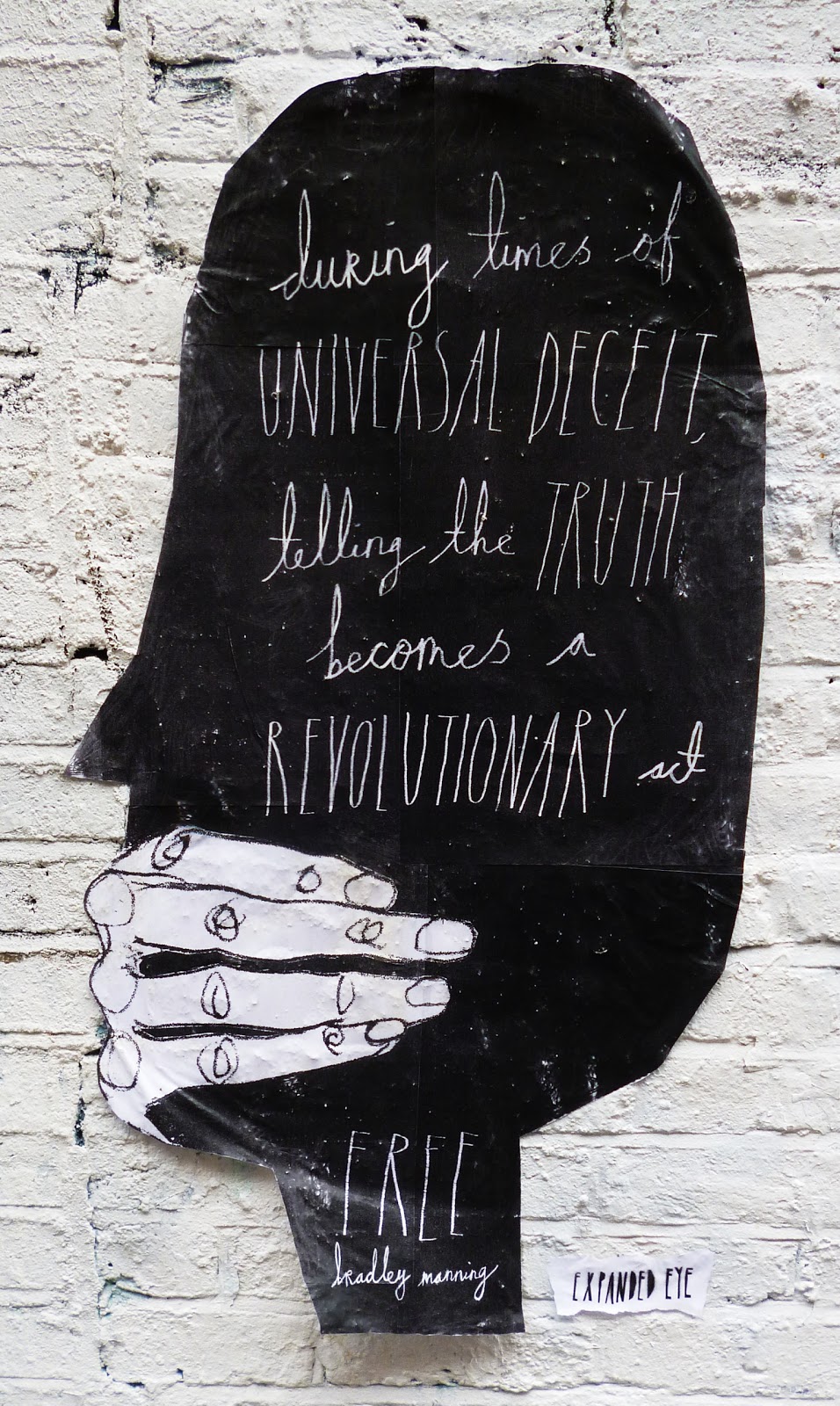
Expanded Eye Street Art, Spitalfields: London #9

'during times of
UNIVERSAL DECEIT,
telling the TRUTH
becomes a
REVOLUTIONARY act

FREE
bradley manning'

I noticed this in Hanbury Street, Spitalfields, and I don't think it was there when I was last there in April this year. Some people have attributed the quotation (obviously without the reference to Bradley Manning) to George Orwell, but it's perhaps far more recent.

Below is  a link to the Expanded Eye website.

–––––––––––––––––––––––––––––––––––
Expanded Eye

16 August 2012

Gerard Manley Hopkins in Stratford: London #1

This memorial is in a prominent position outside the public library in The Grove, Stratford, London.

'GERARD MANLEY HOPKINS
Poet
Born 28th July 1844
Died 8th June 1889

Was born and lived at 87 The Grove Stratford near this site
until 1851/2

"Loathed for a love men knew in them
Banned by the land of their birth,
Rhine refused them. Thames would ruin them,
Surf, snow, river and earth
Gnashed: but thou art above, thou Orion of light.'

from: Stanza 21 'The Wreck of the Deutschland'".'

A few yards away, at 146–148 The Grove, is the Goldengrove pub, which named after the word in Hopkins's poem 'Spring and Fall'.

28 June 2012

Alexander Baron: Rosie Hogarth (1951; repr. 2010)

Rosie Hogarth is Alexander Baron's third novel, coming after From the City, from the Plough (1948) and There's No Home (1950). Set in the Angel area of Islington, predominantly in the fictional Lamb Street which may well be inspired by Baron Street near Chapel Market – and which may also be the inspiration for Alexander Baron's name change from Bernstein – Rosie Hogarth explores a working-class community through the central character Jack Agass, who has just returned to London in 1949 after the end of the war, following civilian work in Persia.

Now thirty, Jack wants to settle down and is welcomed back to Lamb Street as a lodger in the Wakerell household, Mrs Wakerell seeing him as a strong candidate for her daughter Joyce's husband.

Rosie Hogarth underlines the sometimes very subtle class differences in the working class itself – how the respectable Angel area contrasts with the less respectable Hoxton; the insufferable snobbishness of Joyce's sister-in-law Gwendoline (and its attendant, psychologically violent divisiveness); Jack and Joyce's embarrassment as Mrs Wakerell trumpets her daughter and future son-in-law's relative wealth; and Joyce's own social aloofness.

But Joyce's aloofness is mainly a symptom of the alienation several of the characters experience. The brain-damaged 'Barmy' Naughton is the novel's central outsider, stamped by that epithet which perpetuates, indeed defines, his difference – but Jack and Joyce (and the lesser character Mr Wakerell) are wounded too.

The novel was written before the sexual revolution of the sixties and seventies freed so many people from their inhibitions, and although sex is clearly close to the surface of these working-class lives, although pre- and extra-marital sex are (largely tacitly) rampant, these inhibitions still form a strong retaining wall which prevents the expression of natural desires. Mix sexual taboos with a certain shy predispositon, expecially if the subject's partner is also shy, and a kind of stalemate results, making communication difficult if not impossible.

Such (though not necessarily sexual) inhibitions are a key theme in the book, as is memory. Jack was an orphan brought up by Kate Hogarth, whose daughter Rosie he remembers fondly and with whom he seems to be in love. Rosie appears to be everything Joyce is not – contrast the sexual attractiveness and sexual confidence of Rosie with Joyce, a timid, rather plain virgin who retreats behind her glasses, and it is evident that a sexually frustrated Jack will be drawn to Rosie like a moth to a flame. And Rosie can burn.

I'm not too sure that I find the secret revolutionary Rosie hiding behind a smokescreen of assumed prostitution all that believable though, and I'm not the only one. In the Introduction to the novel, Andrew Whitehead quotes Alison Macleod – who, with her husband Jack Selford, had known Baron well – as saying that he wasn't completely successful in his depiction of her; Whitehead continues by expressing strong doubts about the 'Shavian-style dialogue about politics and society' that takes place between Rosie and her father Mick Monaghan near the end of the novel.*

But this is a powerful book: Baron doesn't do stereotypes, and his characters are convincingly drawn with their all illusions, their doubts, and their contradictions. This is published by New London Editions, an imprint of Five Leaves, and is a welcome addition to the recover of Baron's hitherto almost forgotten oeuvre.

*Alison Macleod was once a longtime television critic with the Daily Worker, a committee member of Unity Theatre, and is the author of the story of her disillusionment with communism: The Death of Uncle Joe (1997); she is incidentally also the niece of Rebecca West. Significantly, while we're on the subject of Shavian issues, Alison once wrote to me to register astonishment that anyone should be interested in Lionel Britton: Herbert Marshall had once wanted to put on Britton's Spacetime Inn (1932) – in which a central character called Bernard Shaw appears – at Unity Theatre, but the committee had objected on the grounds that they saw it as 'pretentious piffle'.

–––––––––––––––––––––––––––––––––––
Alexander Baron: There's No Home

11 June 2012

Alexander Baron: There's No Home (1950; repr. 2011)

Alexander Baron (1917–99) was a Jewish writer brought up in Hackney, London, and is perhaps most remembered for his London novel The Lowlife (1963). He also wrote three war novels: From the City from the Plough (1948), There's No Home (1950) and The Human Kind (1953), the second of which was published last year by Sort of Books.

In the Afterword to this edition, John L. Williams, who was a friend of Baron's, suggests that one reason Baron's wartime books are now far less known than, for example, Evelyn Waugh's, Graham Greene's, or Olivia Manning's is because Baron's interests are more in the infantrymen than the officers. I think this is largely true because canonical works of this sub-genre tend to foreground the upper social echelons. The two principal characters in There's No Home, however, are Sergeant Joe Craddock from the East End, and his lover Graziella from Catania, a poor town in Sicily.

Baron served in the Eighth Army, and for a few months was garrisoned in Catania, an experience from which he evidently drew in writing this novel, although how much is autobigraphcial is unknown: the inside cover, for instance, shows a photo of an unknown Sicilian woman which was found in Baron's pesonal papers. There's No Home isn't a war story but a love story to which war, although creating the conditions for the central story, otherwise largely forms the backcloth, and the emphasis is on the effect that the soldiers have on the people in the town – and one soldier on Graziella in particular.

Mutual exploitation is ubiquitous, and sex is a vital commodity. The main love (as opposed to lust) interest in the novel is of course between the two main characters, and it is of note is that Baron was interested in the 'Woman Question', and his feminism is clear in his depiction of Graziella: she is definitely more sympathetically portrayed than Craddock.

Surprisingly honest and insightful, and surprisingly fresh.

–––––––––––––––––––––––––––––––––––
Alexander Baron: Rosie Hogarth

31 May 2012

Bernard Kops: Shalom Bomb: Scenes from My Life (2000)

The World is a Wedding (1963) is Bernard Kops's autobiography up to the age of 28, and Shalom Bomb – named after one of his poems – takes up his story soon after that point.

Bernard Kops saw John Osborne's Look Back in Anger in 1956, declared it 'crap', and determined to write his own play. The Hamlet of Stepney Green was performed at the Oxford Playhouse in 1957, and was a great success. Unfortunately that success wasn't consolidated by the follow-up, and this book charts Kops's recovery from later failures. The book records Kop's friends and associates in his long struggle for recognition/economic survival. Some of these were homosexuals, such as Colin MacInnes, Quentin Crisp, and Lindsay Anderson, with whom Kops, as a Jew, identified as another persecuted minority.

This book is a in part a story of illness (due to drug addiction), and also a love story, of Kops's wife Erica's remarkable support for her husband though this illness. It's a story told with such frankness that it is at times almost embarrassing  to read, but it is told so well that even most of the horrifying sequences are tinged with humour.

Some of the most memorable parts for me are descriptions of the addiction (to speed), when Kops, during the worst and final phase, asks 'Erica, am I just going out or have I just come in?' or, far more chillingly, when he looks at his kids: 'I knew the best gift I could give them all was the taking of my life, but I was always a terrible coward'.

Amazingly, Kops (born in 1926) has survived. I have to read more of his books, as he is a really powerful writer.

20 May 2012

Save the Crane

A few weeks ago I made a post about street art in East London, which included this magnificent painting of a crane by Roa in Hanbury Street, Spitalfields, London. I now discover from The Gentle Author's latest post that the painting has now been hidden by a hideous, and totally superfluous, banner proclaiming: 'BANGLATOWN | BRICK LANE | CURRY CAPITAL 2012'.

A petition against the banner is now attracting attention. It can be signed by clicking on the link below. Also below is a link to The Gentle Author's post on the banner and more art by Roa, plus my original post on street art in this area.

–––––––––––––––––––––––––––––––––––
Petitioning Tower Hamlets Council: Save the Crane

Spitalfields Life: The Sacred Crane, The Flayed Pig & The Mighty Hedgehog

Street Art, East London

10 May 2012

Rodinsky's Room and 19 Princelet Street, Spitalfields, London


19 Princelet Street was built in 1714 and was the home of the French Huguenot Ogier family, who developed a very successful silk weaving concern.

In 1839 there was a synagogue on these premises, and now this Grade II* listed building is the Museum of Immigration and Diversity.

David Rodinsky (1925–69), a reclusive Jew who understood a number of languages and whose papers reveal a knowledge of cabbalism, lived above the synagogue for many years until his death in a psychiatric hospital in 1969, although this was not discovered until some time after his room – left suddenly, a little like Dennis Severs' imaginary family left their rooms in Folgate Street (see link below) – was unlocked in 1980.

The book Rodinsky's Room (1999) is written by Rachel Lichtenstein (whose Polish grandparents came to the East End in the 1930s) and Iain Sinclair (who wrote an early article on Rodinsky's room) in alternating chapters, although most is written by Lichtenstein, who slowly uncovers the mystery of Rodinsky at the same time as she discovers her own past.

–––––––––––––––––––––––––––––––––––
Dennis Severs' House (6-minute video)

8 May 2012

Mark Gertler in Spitalfields, London

32 Elder Street, Spitalfields.

'MARK GERTLER
1891–1939
Painter
lived here'

Gertler inspired several writers to include representations of him in their novels: in D. H. Lawrence's Women in Love, Loerke's huge frieze is modelled on Gertler's painting Merry-Go-Round; Huxley's Gombauld in Chrome Yellow is modelled on him, in which he is described as 'a black-haired young corsair of thirty, with flashing teeth and luminous dark eyes'; and Gilbert Cannan's Mendel: A Story of youth (1916) bases his central character on Gertler's early life, including his relationship with Dora Carrington and C. R. W. Nevinson.
 
Below is a link to a post I later made when I returned here to take a photo of the coal hole cover sculpture I missed:
 
–––––––––––––––––––––––––––––––––––
Mark Gertler's Merry-Go-Round in Spitalfields

Robson Cezar's Bottle Tops at The Bell, Middlesex Street, London

The often fascinating book Spitalfields Life (2012) by the enigmatic The Gentle Author, along with the daily blog that inspired it, has informed me of a number of things in and around the Spitalsfields area, one of them being the artwork on The Bell pub.

The Bell is in Middlesex Street (or Petticoat Lane), and its fascia ('YOU CAN RING MY [...] DING DONG') was crafted by Brazilian artist Robson Cezar, who now lives in Spitalfields with his studio at Tower Bridge, where he works on his bottle tops, of which The Gentle Author says that over 6000 were used on the pub.

In a self-conscious stance with his coat draped over one shoulder, Cezar posed in a photo that echoes that of his artistic Brazilian predecessor Hélio Oiticica (1937–1980).

A detail of Cezar's bottle top work on the pub.

Dennis Severs' House, Spitalfields, London

Dennis Severs' (pronounced 'Seevers'') house at 18 Folgate Street – built about 1724 – may not look particularly unusual from the outside, but inside this is a museum, or rather a movie set-cum-visual novel that the eponymous owner worked on between 1979 and his death in 1999, creating its rooms in styles from the Georgian era through to the late Victorian based on an imaginary family of silk weavers.

Severs, an Anglophile of American birth, invented the Jervis family of Huguenot descent who lived here from 1725 to 1919. He refurnished the ten rooms in the styles of different periods lived through, giving the appearance that the occupier(s) of them have just left them, and leaving bread unfinished, chopped onions, rumpled bedclothes, etc.

The house is only open at limited times and I was unable to make a visit, but I shall be back later in the year.

Below is a link to a six-minute video clip taken, I imagine, in the 1990s, and in which Severs makes an appearance.

–––––––––––––––––––––––––––
Dennis Severs' House

1 May 2012

Angela Burdett-Coutts and Charles Dickens, London

This Gothic drinking fountain in Victoria Park, Tower Hamlets, designed by H. A. Darbyshire, was a gift by Angela Burdett-Coutts (1814–1906) to the people of the East End. Burdett-Coutts was heir to the Coutts bank fortune and a noted philanthropist.

Her relationship with her friend Charles Dickens is interesting from a literary point of view because, with Dickens, she established Urania Cottage (above), a refuge for 'fallen' women, in 1847. Urania Cottage was in Lime Grove, Shepherd’s Bush, London, and was funded by Burdett-Coutts's fortune. And Dickens may have collected material from the inmates of Urania Cottage for, say, the characters Em'ly and Martha in David Copperfield.

John Taylor, Water Poet, Spitalfields, London

The pub The Water Poet is at the corner of Folgate Street and Blossom Street, Spitalfields, and was formerly called The Old Pewter Platter. It is named after John Taylor (c.1578–1653), who called himself 'the Kings Majesties Water-Poet': Taylor spent much of his life ferrying passagers across the Thames. His book The Pennyles Pilgrimage (1618) describes in verse 'How he travailed on foot from London to Edenborough in Scotland, not carrying any Money to or fro, neither Begging, Borrowing, or Asking Meate, drinke or Lodging:
––––––––––––––––––––––––––––––––––
The Pennyles Pilgrimage, Or The Money-lesse Perambulation of John Taylor

27 April 2012

Street Art, East London

This superb crane in Hanbury Street, Spitalfields, was drawn by the Belgian artist Roa, who is noted for his animal subjects. The Gentle Author – author of Spitalfields Life – saw Roa as he was painting this from a motorized cherry picker. Initially, Roa had intended to depict a heron, but on learning that the crane is a bird sacred to Bengalis he decided to change it.

This shot brings out more of the detail of the work.

Unfortunately, only the top part of Roa's work here, in the Foundry parking lot, Old Street, can be seen from ground level.

And I note a report that his squirrel on the corner of Club Row and Redchurch Street has been attacked by vandals.

Hanbury Street is a rich site for street art. Ben Slow's mural shows a member of the extreme right-wing English Defence League and an Islamic extremist. He intended it as a challenge to others and himself, to show two sides of evil. The two people represent intolerance, racism, and hate. Slow was encouraged by the essentially positive response his work received.

A Pleasure Unknown, on Hanbury Street again, shows a girl wearing a tee shirt of Joy Division's Unknown Pleasures album cover, and was painted by Fin DAC, who describes himself as a painter who 'ignores the accepted visual language of street art', and terms it 'Urban Aesthetics' after the 19th century art movement.

At the top (Liverpool Street) end of Middlesex Street or Petticoat Lane is a mural whose subject (the alphabet) is perhaps more recognizable than most, as it's by Ben Eine, who also painted the alphabet on shop shutters further down Middlesex Street. Eine also gained considerable interest when David Cameron gave Barack Obama Eine's painting Twenty First Century City in 2010.

More examples of the four artists' work can be seen by clicking on the links below.
––––––––––––––––––––––––––––––––
Roa
Ben Slow
Fin DAC
Ben Eine

22 April 2012

Alternative Fashion Week, Spitalfields Market, Tower Hamlets, London

Returning from Hackney Central in a downpour, I took shelter in Spitalfields Market, where I was surprised to find a fashion parade: I quickly learned that this was close to the end of the Alternative Fashion Week, so I show several photos I took of the event, the first a post-catwalk pose, and the rest of models going onto or out of the catwalk. Many images are blurred because of the swift movements of the models, and this is almost certainly the first time that a bikini has appeared in this blog:

1 April 2012

The Gentle Author: Spitalfields Life: In the Midst of Life I Woke to Find Myself Living in an Old House beside Brick Lane in the East End of London (2012)

In a blog post below I briefly mentioned the recent publication of The Gentle Author's book Spitalfields Life, but I've now had time to read a great number of its many features, and can say that this is a whopping Christmas cake of a book that deals with an area largely left out of the guide books to London. This isn't a guide book as such, but a celebration of the diversity of the Spitalfields community which covers many different aspects of life there. Mercifully, Jack the Ripper is left to the tourists to find out about elsewhere, but then that's in Whitechapel, and anyway this is a very long way from the done-to-death conventional features of guide books – almost all of this is new material culled from people living in Spitalfields, and is about those people.

And The Gentle Author doesn't adhere strictly to geographical boundaries, as his (or her) Spitalfields includes parts of Bethnal Green, Whitechapel, the City, Shoreditch, and I was also pleased to learn of the grave of William Shakespeare's brother Edmund in Southwark Cathedral.*

These are some of the articles I really enjoyed in the book:

– Brazilian Robson Cezar, who collects bottle tops from local pubs to make artistic creations with, a very notable one being the fascia of the Bell pub on the corner of Middlesex Street and New Goulston Street.

– 16-year-old rapper Yasin Ahmed, also known as King Sour DA MC.

– Sandra Esqulant, landlady of the Golden Heart on Commercial Street, who was caught one night hoolahooping in the road and captured by (sometimes candid) photographer Phil Maxwell.

– Carrom Paul, who is introducing many people to the joys of the board game carrom.

– Belgian artist Roa, who has huge paintings on street walls, such as a squirrel at the corner of Club Row and Redchurch Street, and a crane on the corner of Hanbury Street and Brick Lane. A link to a number of his animal paintings elsewhere: ROA, l'homme et l'animal.

– The delightful Mr Pussy, The Gentle Author's cat.

– Stanley Rondeau, a volunteer at Nicholas Hawksmoor's Christ Church, who has traced his Huguenot family tree and written a booklet about it.

– London's Next Top Tranny contest, consisting of drag performances held at Bethnal Green Men's Social Club. (Interesting to learn that Hessel Street is named after Phoebe Hessel, who dressed as a man in order to join the army and be with her partner.)

– Aldgate pump on the corner of Fenchurch Street and Leadenham Street, which once caused hundreds of deaths through people drinking water polluted by human remains in cemeteries. The Gentle Author notes that Dickens gave a passing mention to it in The Uncommercial Traveller.

– The lovingly kept and still-functioning 1899 toilets under John Wesley's Chapel on City Road.


– Paper bag seller Paul Gardner, whose family has had a business in the same building since 1870. The Gentle Author claims you can't say you've been to Spitalfields without shaking his hand.

– Dennis Severs' House at 18 Folgate Street. The American Severs moved in here in 1979 and created a time capsule in each of the ten rooms, which have been furnished in styles of the 18th and 19th centuries, complete with smells. This is now a museum.


I think my only criticism is that there's not an Index – there are a few pages entitled 'Index', but in reality this merely amounts to another Table of Contents, this time divided into subject areas as in The Gentle Author's 'Spitalfields Life' blog.

The attractiveness of the book is enhanced by the illustrations of Mark Hearld, Lucinda Rogers, and Rob Ryan. Included at the back are two suggested routes for tours around Spitalfields.

*The Gentle Author's latest blog post (1 April) is about Charles Dickens in Shadwell and Limehouse.

–––––––––––––––––––––––––––––––––––––––––––––––––––––

'Spitalfields Life' blog.

66,000 Miles Per Hour: The Gentle Author of Spitalfields Life.