Showing posts with label Hurston (Zora Neale). Show all posts

28 July 2015

Zora Neale Hurston: Jonah's Gourd Vine (1934)

This Virago edition of Zora Neale Hurston's Jonah's Gourd Vine has an Afterword by Holley Eley dated 1987, in which it states that hitherto Hurston's first novel had been 'inexplicably ignored'. Now, copies can be found in abondance online. And it's well worth reading.

Whereas Their Eyes Were Watching God revolves around the strong female character Janie Starks, the main character here is John Pearson, whom we follow from his mid-teens until his untimely death in, perhaps, his early fifties. Despite the image on the book cover, John is half-white and called a 'yaller nigger' by some. After a fight with his step-father Ned, John leaves to work for the sympathetic Alf Pearson, who gives him his name and there are perhaps subtle suggestions that Pearson may even be his father.

The early section of the book in Alabama is largely taken up by his partly chaperoned relationship with Lucy, who is several years younger and marries him a few years later. But following a violent attack on his brother-in-law over a minor debt, he is forced to flee and goes to Florida, where Lucy and their baby join him later.

Lucy, although a force behind John's highly successful profession as a preacher, is nevertheless content to have several children by him and almost turn a blind eye to his infidelities: Alf Pearson had much earlier called the tall, well-built and very handsome John 'a walking orgasm' and this was a strongly prophetic statement because John finds women as irresistible as they do him.

John – now State Monitor as well as the most powerful preacher in Florida – has problems with the church leaders over growing rumors about his relationship with a woman called Hattie. Things come to a head when Lucy dies and John marries Hattie just three months afterwards, and he loses his State Monitor status.

And the knives are still out, within the church and within John's home: the marriage is failing and Hattie – incidentally a great believer in voodoo – is (
with a church official) plotting a divorce on the grounds of adultery, plus John's professional demise. John doesn't exactly put up a fight and walks out of the church to recommence working as a carpenter, although his name is mud and he fails miserably to reassert himself professionally.

Until, that is, he moves to another town and meets the rich widow Sally who has admired him for years, so they marry and she buys him a Cadillac, in which he pays a short visit to his former town. On the way back the greying John takes a young gold digger – who's unsuccessful on this occasion – to a hotel room: old habits die hard.

The first time John saw a train he was frightened, although when he escaped from Alabama and took one for the first time – into Sanford, FL – he was mightily impressed by the monster. As he finally drives home toward Sally he meets another train, only this time it crashes into the Cadillac and kills him. Florida mourns.


My other posts on Zora Neale Hurston:

–––––––––––––––––––––––––––––––––––
Zora Neale Hurston in Fort Pierce, FL
Zora Neale Hurston: Their Eyes Were Watching God

26 March 2015

Zora Neale Hurston in Fort Pierce, Florida

The Zora Neale Hurston Branch Library in Fort Pierce, which has a large collection of audio-visual resources on Hurston. At the time of writing, it is only open three days a week.

The Zora Neale Hurston Dust Tracks Heritage Trail takes in eight locations, although for a number of reasons I only visited the first four, but these include by far the most important: the house in which she lived for a short time, and her grave. The places I didn't see are the Fort Pierce Chronicle headquarters, where editor C. E. Bolen persuaded Hurston to come and write a column for his paper; Means Court School, the first public school (in the American sense) in Fort Pierce for African American kids; Peek Funeral Chapel, where memorial services were given for Hurston on 28 January 1960; and Backus Studio, where Friday evenings she listened to jam sessions at painter A. E. 'Bean' Backus's studio.

The Zeta Phi Beta Sorority, along with other groups, has given a large number of Hurston-related works to the library.

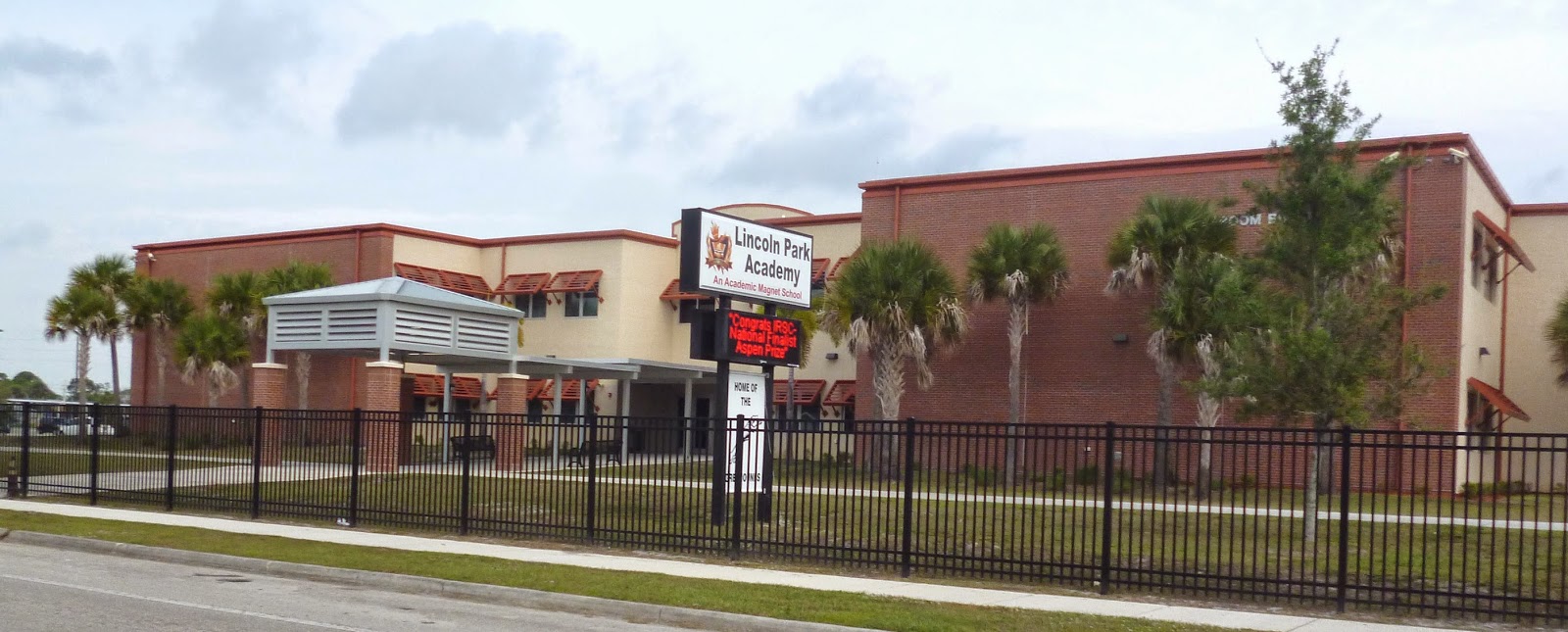
Lincoln Park Academy, Avenue I.

Hurston briefly taught English here in 1958. At the time, it was segregated.  

Hurston's home on Avenue L.

The home was owned by the physician Dr. Clem C. Benton, a friend of the family who allowed Hurston to live rent-free for nearly two years from early 1958 to late 1959, when she was close to her death January 1960. The house has been slightly moved from its original location.

'ZORA NEALE HURSTON
MEMORIAL MONUMENT
 
TERRACOTTA & CONCRETE
 
JIM LICCIONE'
 
This was a bonus for me because I was unaware of the existence of Liccione's memorial  – which stands right at the entrance to the Garden of Heavenly Rest Cemetery at 17th Street and Avenue S – before my visit. It is very impressive.


'ZORA NEALE HURSTON
A GENIUS OF THE SOUTH
1901* –––1960
NOVELIST FOLKLORIST
ANTHROPOLOGIST'

This was originally a segregated cemetery, and Zora Neale Hurston was buried in an unmarked grave. Alice Walker, trying to retrace Hurston's tracks, 'discovered' it in the early 1970s.

* Hurston's date of birth is ten years out – she was born in 1891.

My other posts on Zora Neale Hurston:

–––––––––––––––––––––––––––––––––––
Zora Neale Hurston: Jonah's Gourd Vine
Zora Neale Hurston: Their Eyes Were Watching God

3 February 2015

Zora Neale Hurston: Their Eyes Were Watching God (1937)

One of the most important writers of the Harlem Renaissance, Zora Neale Hurston was born in 1891 in Eatonville, Florida, the first incorporated black town in the US. She is most remembered for Their Eyes Were Watching God, which is set in different areas in Florida and was written in Haiti. When it was first published the novel received some criticism within the black writing community for her interpretation of black speech, even of Uncle Tomism, although there has been much favorable critical revisionism since.
 
Their Eyes Were Watching God strongly strikes me as a feminist novel in which the main character – Janie Crawford Killick Starks – comes to realise herself, her desires and her integrity as a human being, only with her experiences with her third husband.
 
The narrative is told by Janie and framed within a modern setting in which she relates her story to her friend Phoeby. Janie was brought up in north Florida by her grandmother Nanny, who was originally a slave made pregnant by her owner, and who escaped with her child Leafy, who is raped by her school teacher and consequently gives birth to Janie. Because of Nanny's experiences, she is determined that Janie should be saved from the problems she and her daughter had, so she marries her grandchild off at the earliest opportunity.
 
Janie comes to hate her grandmother for the arranged marriage, and her husband is the older Logan Killicks, a farmer who disappoints her greatly because she feels that marriage should be about love, and yet she doesn't feel it. Janie's disillusionment increases, and she readily runs off with the misleadingly enticing Joe Sparks.
 
The couple marry and move to the embryonic black township of Eatonville, where the entrepreneurial Sparks buys up some land, sets up a general store and soon becomes mayor of the town. Again, Janie is disappointed because she doesn't get the partnership she craves for but just becomes a trophy wife to a jealous man who considers it unbecoming for her to have a joke with her customers. Their relationship becomes aggressive and Sparks hits her, even displaying his anger in public. But Janie is saved by Sparks's untimely death, which leaves her a reasonably well-off widow.
 
Janie becomes the object of town gossip when after a while she meets Tea Cake Woods, an amusing man twelve years her junior: he doesn't have any money but is keen to work, although inevitably the townsfolk think he's just a gold digger. But Tea Cake makes Janie laugh, he introduces her to games and shows that Sparks would have considered beneath them, and although this was written in 1937 and obviously Janie can't breathe a word of what happens between the sheets, it's pretty obvious that Tea Cake is giving her a good time in bed: in a word, Janie for the first time in her life now feels like a woman, and feels on equal terms with a man. And not once has Tea Cake asked her for money as all their outside amusements are paid for by Tea Cake.
 
They marry and leave for the Everglades, where they can earn money from the rich soil, planting and harvesting beans around Lake Okeechobee (called 'Lake Okechobee' in the novel). However, they are hit by the 1928 hurricane, and although both survive Tea Cake gets bitten by a rabid dog. It is only discovered some time later that he has contracted the disease: crazed and terminally ill, he tries to shoot Janie, whose only recourse is to kill him. An all-white jury find her innocent, and Janie returns to Eatonville, where the novel began.
 
Hurston herself returned to Florida and died in 1960 in Fort Pierce, where she is buried.

My other posts on Zora Neale Hurston:

–––––––––––––––––––––––––––––––––––
Zora Neale Hurston: Jonah's Gourd Vine
Zora Neale Hurston in Fort Pierce, FL