Showing posts with label Kent. Show all posts

30 August 2018

Pebbleart Preston at Ashford, Kent

This delightful handpainted pebble originates from Pebbleart Preston, a Facebook site. I found it on a small car park bollard outside the Premier Inn North/Woolpack pub in Ashford, Kent. At first I didn't know what to do with it exactly, then went online for Pebbleart Preston, and discovered that it runs on similar lines to Bookcrossing, only without all the tracking: it seems that the only rule for these sites (and there are a few more apart from Preston) is just post on the appropriate site and either keep or leave somewhere else. Love it, great idea. I'd love to know the history of it.

31 May 2018

Wasted Rock Rangers in Folkestone, Kent

Now, anyone who even considered that Folkestone, Kent, UK, is a dull place deserves a very good talking to. There we were in Folkestone yesterday and suddenly noticed this, er, English Heritage plaque to the 'legendary' Wasted Rock Rangers. 'Who?' I thought, but then I did the Google and discovered (I think) that Wasted Rock Rangers, in a previous incarnation, were known as Hotel Bill and the Incidentals. They also, I should have remembered, released an album called Fuck Christmas. Ah, that Wasted Rock Rangers! For the uninitiated, the plaque reads:

'Legendary
Rock 'n' Roll band
WASTED ROCK
RANGERS
Performed at this venue on 26th April 2013
The first WRR gig to feature
the classsic line-up of
Joe Ranger, Shaun Ranger,
Ken Ranger, River Vegas
& Jim Cassidy'

So now you know.

15 August 2016

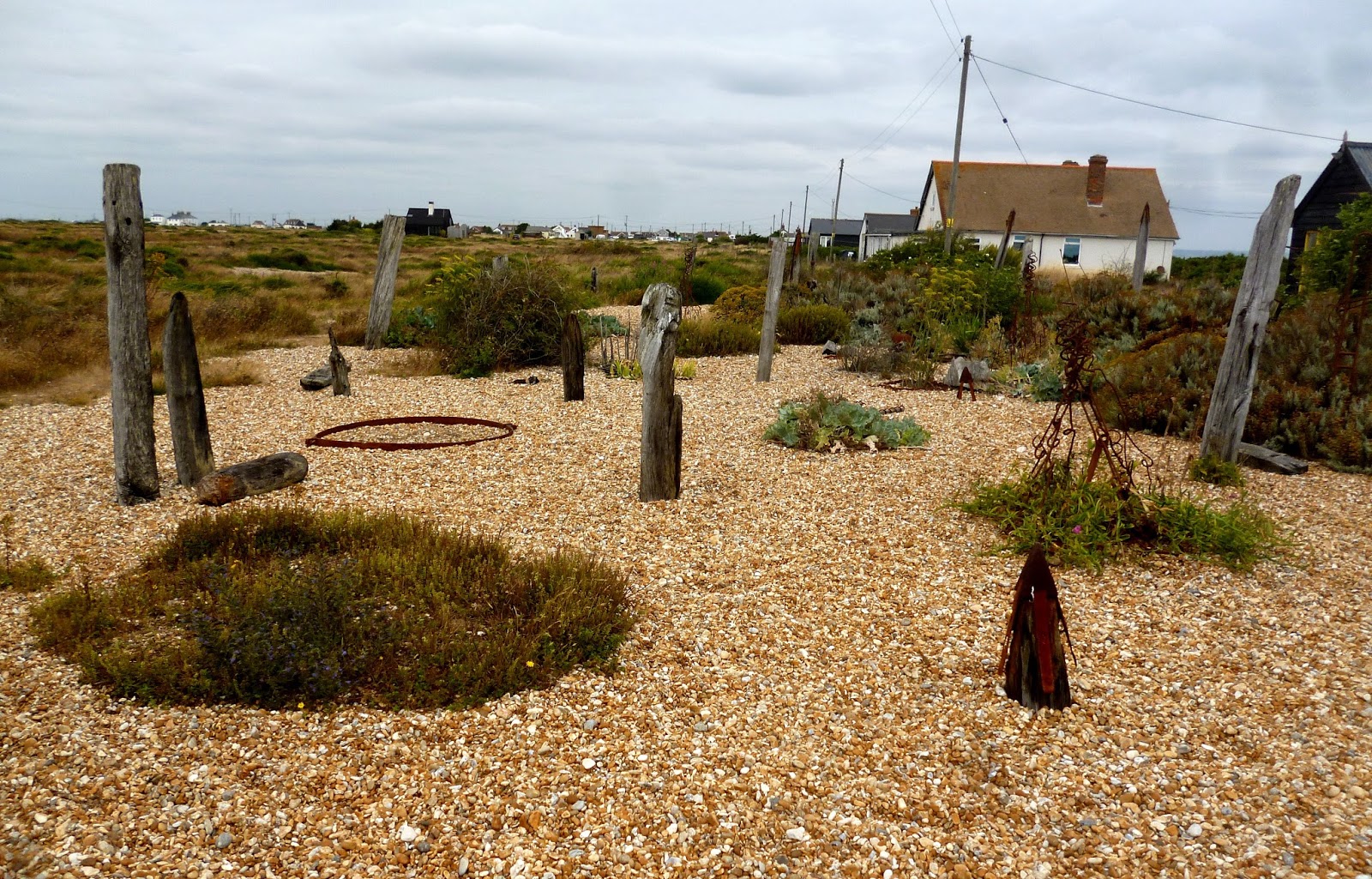
Derek Jarman's garden, Prospect Cottage, Dungeness, Kent

Prospect Cottage near Dungeness power station, which belonged to Derek Jarman (1942–94), and is noted for its bizarre garden. Shingle surrounds the flowers which grow here, although this is light years away from my former post on Vita Sackville-West's garden. Here, the yellow of the flowers blend with the yellow of the door and window frames, objets trouvés abound, bits of metal, sea- and weather-worn phallic posts stand, a part of the John Donne poem 'The Sun Rising' is in relief on a wall, the remains of a rowing boat take a prominent place, stones cluster to form a circle, much appears to be haphazard. I let the photos below speak for themselves.


My other Derek Jarman post:
–––––––––––––––––––––––––––––––––––
Derek Jarman's grave

13 August 2016

Vita Sackville-West and Harold Nicolson at Sissinghurst Castle, Sissinghurst, Kent

In 1930 Vita Sackville-West (1892–1962) and her husband Harold Nicolson (1886–1968) bought Sissinghurst Castle and its extensive surrounding property for £12,375. It was a wreck, with no electricity, tap water, heating or drains. But the couple restored the site remarkably quickly, and as early as 1932 they had achieved a great deal. This was to be their homes for the rest of their lives, and although Vita hated the idea of the castle going to 'Nat Trust or any other foreign body', it was indeed given to The National Trust in 1967, the year before Harold's death, by her younger son Nigel, who had inherited the property and had no option but to get rid of it – and preserve it at the same time – in order to avoid heavy death duties.

The sixteenth century entrance arch, seen here from the top of the Tower, was probably built by Sir Richard Baker.

The Library at the north end of the front range also served as a sitting room, and Vita called it the Big Room. It is redolent of Knole, Vita's birthplace which she didn't inherit, but appears to reflect a sense of continuity.

The painting of a very young Vita, now above the fireplace in the Library, was never there in her lifetime because she hated it. Philip de Laszlo is the painter.

Richard Baker, who was Sir John's wildly ostentatious son, urged Queen Elizabeth I to come to Sissinghurst, which she did for a few days, and knighted him a few days later. All a world away from Vita and Harold's lives, of course.

'Here lived
V. SACKVILLE-WEST
who made this garden
Born at Knole 9 March 1892
Died at Sissinghurst 2 June 1962'

Harold Nicolson of course also played no small part in the gardens. Photography (very oddly now that the NT seems to have relented on many (off-flash) photos) is not allowed within the tower, where there is the famous painting of Vita's great lover Violet Trefusis, and a reproduction of the poem 'Sissinghurst', which Harold thought was her best, and which Vita dedicated to her former lover Virginia Woolf.

One of the two tower peaks.

A partial view of the gardens as seen from the tower.

The Priest's House.

South Cottage, with the Tower in the background.

The Gazebo, used by Nigel Nicolson to write in and as a memorial.

'This
pavilion was
built in 1969 by
his sons in memory of
HAROLD NICOLSON
author, diplomatist and
Member of Parliament:
Sissinghurst was his
home from 1930
until his death
in 1968.'

The boathouse was also an idea Nigle Nicolson's, and was built in 2002.

The oast houses within the grounds, just outside the main centre of interest.

My other Nicolson-related post

–––––––––––––––––––––––––––––––––––
Nicolsons in Sissinghurst Cemetery

12 August 2016

Literary connections of Romney Marsh, New Romney, Kent

'Library Mural
Literary Connections of Romney Marsh
Artists
Paula MacArthur and Alison Stump'

The mural at the side of the local library contains a number of authors, such as H. G. Wells, Henry James, E. F. Benson, Edith Nesbit, Radcliffe Hall, Joseph Conrad, Ford Maddox Ford, Monica Edwards, U. A. Fanthorpe, Russell Thorndike, etc.

11 August 2016

Derek Jarman's grave, Old Romney, Kent

Just a simple signature without his dates. Derek Jarman (1942–94) was a film director, gardener (a post on Prospect Cottage to follow soon) and author. Although an atheist, he is buried in the churchyard of St Clement:

Jarman lies to the north-west of St Clement.

A view towards the chancel from the eighteenth century minstrels' gallery seats, which doesn't show the box pews painted pink: this was done for the film version of Russell Thorndike's book Doctor Syn: A Tale of the Romney Marsh (1916), which was cinematised in 1963. I don't remember the interpretation paddle being this specific about the colour though, only that it wasn't out of keeping with the originals!

And a glimpse of pink pews.

My other Derek Jarman post:
–––––––––––––––––––––––––––––––––––
Derek Jarman's garden

10 August 2016

Nicolsons in Sissinghurst Cemetery, Kent

Sissinghurst Cemetery isn't obviously locatable: it's very near to the parish church, but not reachable from it, and there's no sign to it. Unfortunately, these photos were taken before midday and the blotches on them get increasingly worse because of the shadows from the overlooking trees.

'HAROLD
NICOLSON
1886–1968'

This image of the grave of Harold Nicolson might be thought to need no comment on the man: he was famous for being the husband of Vita Sackville-West, for their joint work on Sissinghurst Castle and gardens, and of course for his open homosexual relationships, as was his author (and gardener) wife. The fact that he was a diplomat and very prolific author himself often gets forgotten. Nevertheless, Harold wrote a large number of books, several of them on writers such as Tennyson, Byron, Swinburne, Benjamin Constant, and Sainte-Beuve. He also wrote books on English diplomacy.

'BENEDICT
NICOLSON
1914–1978'

Benedict was Harold and Vita's first son. He became an art historian, and his published works include The Painters of Ferrara (1950), Hendrick Terbrugghen (1958), Wright of Derby: Painter of Light (1968), The Treasures of the Foundling Hospital (1972), Courbet: The Studio of the Painter (1973), and Georges de La Tour (1974).

'NIGEL
NICOLSON
1917–2004'

Nigel was the younger son and went on to be an author, publisher and politician. His books are many and include works on such authors as Virginia Woolf, Fanny Burney, and Jane Austen; one on his parents' marriage; and editing Woolf's letters in six volumes, as well as (one volume of) his parents' letters. As a publisher he co-founded Weinenfeld and Nicolson, which was the cause of the failure of his (slightly wet Conservative) political career when the house published Nabokov's controversial Lolita in 1959.

My other Nicolson-related post:
–––––––––––––––––––––––––––––––––––
Nicolson (and Vita) in Sissinghurst

8 August 2016

Simone Weil in Ashford, Kent


SIMONE
WEIL
3 février 1909
24 août 1943

'IN 1942 SIMONE WEIL
JOINED THE PROVISIONAL FRENCH
GOVERNMENT IN LONDON
BUT DEVELOPED TUBERCULOSIS
AND DIED IN GROSVENOR
SANATORIUM, ASHFORD.

HER WRITINGS HAVE ESTABLISHED
HER AS ONE OF THE FOREMOST
MODERN PHILOSOPHERS.'

Simone Weils's grave is in Bybrook Cemetery near Ashford. She died of a heart attack and the 'official' report was that she effectively killed herself by starvation, although her biographers refute this claim, citing her wish to eat no more than the allowance of her fellow kinsfolk in occupied France.

Close to the cemetery, Simone Weil Avenue is named after her in 1983.

'SIMONE WEIL
This road is named in honour of Simone Weil,
the French authoress and philosopher who died
in Grosvenor Sanatorium, Ashford in 1943 at
the age of 34 years.

Bybrook Cemetery, where Simone Weil is buried,
is situated in the north side of the M20 motorway
and can be seen from here.'

Even in 1983 they still demeaned female authors by calling them 'authoresses'? Shocking. And could Bybrook Cemetery ever be seen from the corner of Simone Weil Avenue and Canterbury Road? It would surprise me.

4 June 2016

Samuel Peto and H. G. Wells in Folkestone, Kent

As non-purpose-built pubs go, the Samuel Peto in Rendezvous Street, Folkestone, Kent, must surely rate as one of the most impressive in the country:
 
 
Samuel Morton Peto (1809–1889) was a civil engineer, a railway contractor and a Member of Parliament. He was a also a Baptist who lent money towards the building of Salem Chapel in Folkestone, which is now this superb pub named after him.
 
Wikipedia includes a few interesting sentences on him: 'An extremely unfavourable portrait of Peto is included in the Appendix to George Borrow's Romany Rye, where he is described as "Mr. Flamson". When Peto promoted the Lowestoft Railway and Harbour Company in the 1840s, the railway split Borrow's estate at Oulton Broad, just outside Lowestoft. Borrow deeply resented this and bore a grudge against Peto thereafter."'
 
One of several plaques on the walls is also noteworthy, although 'most important novels' is obviously a surely subjective statement:
 
'H. G. WELLS
 
The author H. G. Wells lived at Sandgate on the coast to the west of Folkestone. He moved there to recuperate following a painful illness, and decided to stay. Wells had Spade House built with royalties from novels like First Men in the Moon and The War of the Worlds.
 
Whilst at Spade House he wrote three of his most important novels – Kipps, which is set in Folkestone, The History of Mr Polly and Tono Bungay. They were written in what is now a tool shed, and Wells would start as early as 4am to escape from his young sons.
 
He lived at Sandgate between 1890 and 1910 and throughout his stay many of the leading literary figures of the time came to visit. Among them, Sir James Barrie, the creator of Peter Pan, the authors G. K. Chesterton, Henry James and George Bernard Shaw.
 
Whilst at Sandgate, Wells enjoyed a brief period of respectability as a Borough Magistrate. He attended "boring lunches" at Sir Edward Sassoon's house, where he met the young Winston Churchill.'

18 September 2012

William Morris in Bexleyheath, Kent: London #30

 'RED HOUSE
built in 1859–1860
by Philip Webb, architect,
for
WILLIAM MORRIS
poet and artist
who lived here
1860–1865'
 
For Dante Gabriel Rossetti, this Victorian Gothic structure was 'more a poem than a house'.
 
William Morris (1834–96) married Jane (or Janey) Burden in April 1859, and moved here when his friend Webb had completed it the following year. The weather vane is inscribed 'WM 1859' with a horse's head at the side. Shown here is the Well Courtyard: the original intention was for a similar building at the side for Edward Burne-Jones and his family to live in, but it was not to be.

A closer view of the well with its very impressive roof.
 
The west elevation with the oriel window of particular note.
 
The north elevation, showing the main entrance.
 
Morris named the garden porch 'Pigrims' Rest' as this would have been near the route taken by Chaucer's Canterbury group.
 
The tiling behind the bench here is worth a closer look.
 
On some of the tiles, Morris's motto 'Si je puis' is curled round an oak tree, with his initial at the side.
 
But on most of the others it's the Tudor rose.
 
An early example of Morris's stained glass, with figures by Edward Burne-Jones.
 
–––––––––––––––––––––––––––––––––––
William Morris in Walthamstow: London #29