Showing posts with label Renoir (Jean). Show all posts

11 February 2022

Jean Renoir's La Grande illusion (1937)

La Grande illusion is the same title as Norman Angell's book The Great Illusion (1909; rev. 1933), the latter version of which assisted Angell in earning the Nobel Peace Prize in the same year of publication. However, Renoir said that he'd chosen this title 'parce qu'il ne voulait rien dire de précis' ('because it had no precise meaning'), although he also said he made the film because he was a pacifist.

There are three main parts to this film set in World War I but in which we see none of the action of the war itself. A plane carrying the working-class Lieutenant Maréchal (Jean Gabin) and Captain de Boëldieu (an aristocrat) has been shot down by von Rauffenstein (also an aristocrat). The two men have survived and are now in a German prison camp with British and Russian soldiers from all walks of life.

Class divisions are of important note in this film, which shows how they can not only divide but unite: Rauffenstein and Boëldieu, despite the different sides they are on, nevertheless find important class similarities, and in certain respects it can be said that Boëldieu relates more to his aristocratic counterpart; and the wealthy Jew Rosenthal (Marcel Dalio) receives hampers of the finest food and drink which he shares with the French prisoners irrespective of their class. One talking point is expensive restaurants such as Maxim's and Fouquet's, which provokes Maréchal to comment that he's at home in an unassuming café with the local pinard (plonk).

Certainly uniting them is the desire to escape and they are digging a tunnel which is almost complete when they are moved to a more secure prison in the mountains: it is lack of a common language which prevents Maréchal from passing on knowledge of the tunnel to the new batch of prisoners. Nevertheless, work again begins on escape via a long rope from the new prison, which is again commanded by Rauffenstein, who has been grounded by injury. The friendly rapport between Rauffenstein and Boëldieu continues, although the German is forced by duty to shoot Boëldieu as he allows Maréchal and Rosenthal to escape: unfortunately, although he aimed at Boëldieu's legs, the wound is fatal but the aristocratic has freed the two people who are lower down in the class pecking order.

From the point of view of food, the rich Rosenthal and the working-class Maréchal are now equals as the slow progress towards Switzerland begins and they eke out the sugar they have taken from the prison camp. But their passage towards neutral territory is stalled for a brief time as they take refuge on a farm. This again shows the common bond of fraternity not between classes but nationalities as the two men are warmly greeted by the lonely German widow  Elsa (Dita Parlo), whose husband died at Verdun. And this is more than fraternity, as Elsa and Maréchal fall in love, and it is with great reluctance that Maréchal has to leave.

A pacifist film of fellowship in time of war this certainly is, although there are ambiguities, and interesting gender questions in this important movie, but this is not the place to go into them.

22 June 2021

Jean Renoir's La Nuit du carrefour | Night at the Crossroads (1932)

Crossroads lead places, but in themselves are just passing places where many activities can be carried out, as Maigret (Pierre Renoir), in this – one of Renoir's early talkies – will show. Godard rated this film as a very important example of a film policier.

There are just three houses at the crossroads: the garage of Oscar (André Dignimont); the house of insurance agent Émile Michonnet (Jean Gehret) and his wife Michèle (Lucie Vallat); and the house of the apparent Danish brother and sister Carl Andersen (Georges Koudria), who is a decorative designer, and Else (Winna Winfried).

And then the body of a Dutch jeweller Goldberg is found in Michonnet's car, but in the Andersens' garage. It will take Maigret a day, but mainly a day and a night, to discover that the initial obvious suspect Carl is just a stool pigeon in a deadly game in which his 'sister' Else is his second(?) wife; that the garage is a front to hide criminal activities; that Else is far from innocent, but that her first husband Guido (Manuel Rabby) is the real criminal, etc: quite a can of worms for the first filmic version of Maigret to open.

12 January 2021

Jean Renoir's Une partie de campagne | A Day in the Country (1936; release 1946)


Renoir's Une partie de campagne is adapted from Maupassant's story of the same name, lasts just forty minutes, and concerns the Dufour family's day trip from Paris to the countryside (Bezons, which has changed a little since then). Cyprien (André Gabriello) is the ironmonger father, Juliette (Jane Marken) his wife, Henriette (Sylvia Bataille) his daughter, Anatole (Paul Temps) Henriette's fiancé and Gabrielle Fontan plays Cyprien's mother-in-law. They borrow the milkman's horse and cart and stop by an auberge by the river, where they order a meal.

There is a clear difference in classes here: the lust as the canotiers Henri (Georges Darnoux) and Rodophe (Jacques Brunius) watch Juliette and Henriette on the swings, particularly Rodolphe trying to see up Henriette's skirt, is one of the major moments in the film; the clumsy city clothes of the Parisians are out of place compared with the appropriate light clothing of the canotiers. Rodophe takes Juliette in his boat, Henri takes Henriette, and they are both easily seduced while Cyprien and the pathetic Anatole are left fishing.

At a later date Henriette is with her husband Anatole on the riverbank where she was with Henri and, while Anatole is snoozing, she sees Henri a short distance away. Both are visibly moved to see the other.

24 December 2020

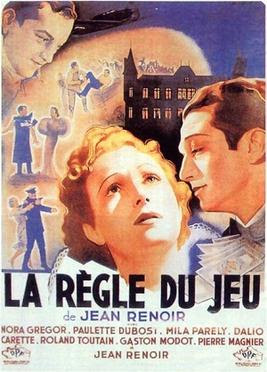
Jean Renoir's La Règle du jeu | The Rules of the Game (1939)


Martin O'Shaughnessy, in his Jean Renoir (2000), which is part of Manchester University Press's excellent 'French Film Directors' series, includes this film in his 'The Popular Front Years' chapter, a film made just before Renoir retreated to the States, and which O'Shaughnessy sees as a considerable contrast to the 'dark intensity of La Bête humaine', the film which preceded it. O'Shaughnessy argues that Renoir now had the freedom to delve into other areas, his main influences in this film being Marivaux, Beaumarchais and Musset: the theatrical take is self-evident.

This is not a space to talk about a well-known film, although suffice to mention that the film centres on changing love interests, mistaken identity, concealed misdemeanurs (or crimes), conflicting differences (and interests) between classes, etc.

There is a constant reminder of war and the senseless play and the horror of it: the cull of game, the pantomime of the men playing Jews, and perhaps most of all the skeletons that walk among the audience: almost a prediction.

9 December 2020

Jean Renoir's Boudu sauvé des eaux | Boudu Saved from Drowning (1932)


The film critic André Bazin said that the charm of Boudu sauvé des eaux is in the glorification of vulgarity, that the film is 'magnificently obscene'. Well, if it has ever been possible to define 'vulgarity' and 'obscenity' such an imaginary definition has obviously changed radically in the last eighty years. Nevertheless, such viewpoints are still understandable today in relation to Jean Renoir's film, which over the years has continued to attract interest. Originally adapted from René Fauchois's 1919 play of the same name, Boudu sauvé des eaux has been remade as Paul Masursky's Down and Out in BeverleyHills (1986) and Gérard Jugnot's Boudu (2005).

Starring in this suberb satire on the French middle class are Michel Simon as the ungrateful and rebellous tramp Boudu; Charles Granval as the kindly bookseller Édouard Lestingois who (out of the vision and earshot of his testy wife Emma (Marcelle Hainia)) gives two of Voltaire's books to an impecunious student whom he 'knows': his name is 'Youth'; and Anne-Marie (Séverine Lerczinska), the Lestinois' maid Lestingois has a sexual penchant for.

And then along comes Boudu, who has lost his dog and throws himself off the Pont des Arts into the Seine. Lestingois has seen this from an upper floor of Quai de Conti where his shop and home is, and dashes out to save Boudu and brings him back into his home, where he manages to revive him. Lestingois's home is now Boudu's, and the satire starts.

Lestingois wants to rehabilitate Boudu, change him into a respectable bourgeois individual like himself. Initially full of good middle-class intentions, his good will begins to fade as Boudu spits out the wine he's offered, in fact spits regularly, although the limit comes when Boudu (symbolically) spits in pages of Physiologie du mariage by Balzac. But Boudu has won Anne-Marie over, even won his saviour's wife over by an initial rape that turned into a success sex scene (unseen apart from in Emma's eyes, of course).

But all the same, the only thing to do with this wild creature who makes a mess of the kitchen and even polishes his shoes on his hosts' bedspread (especially after he's won on the lottery) is to marry him off to Anne-Marie. Which takes place, although Boudu overturns the canoe, the people swim to the shore, Boudu changes into a scarecrow's clothing and goes back to his former life, although presumed dead. And this of course gives the title (particularly in French) two meanings: Boudu's been saved from the waters: from drowning literally or figurately from being destroyed by marriage.