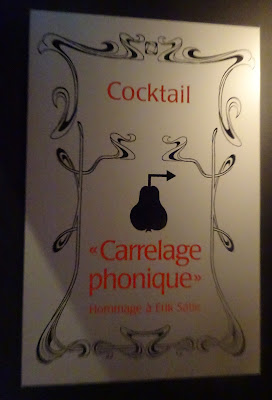
Open since 1998, the Maisons Satie are a homage to the musician and composer Erik Satie (1866-1925) who was born in Honfleur. He collaborated with Picasso, Picabia, Braque, Cocteau and René Clair and influenced such composers as Debussy, Ravel and Stravinsky. The museum is a liberally inspired view of the man and the visitor listens to his music on headphones as he or she drifts through the displays; the pear with wings represents his soul flying away. This is quite an experience.
Erik Satie (1866-1925), born in Honfleur, said that painters had taught him much more about music that musicians had. And his music is also hard to classify, being seen as a precursor to such movements as surrealism, minimalism and the theatre of the absurd. He died in poverty in Paris, hating to ask friends or family for money, and never allowing anyone into his studio. On his death his studio was found to contain two untuned pianos tied together, full of unopened letters which he had partly replied to. In a cupboard was a collection of umbrellas and false collars, and in his wardrobe identical grey suits which he always wore.
Erik Satie (1866-1925) needs no introduction, but he too was born in Honfleur, where the house where he was born is a tribute to his life and highly unconventional mind. As the leaflet advertising his house(s) says, he collaborated with such people as Picasso, Picabia, Braque, Cocteau and René Clair, and influenced such people as Debussy, Ravel and Stravinsky. To remind, among his most noted musical works are Trois Gymnopédies (1888), Six Gnossiennes (1890-97), Trois morceaux en forme de poire (1911), Sports et Divertissements (1914), Parade (1917) and Socrate (1919). Unsurprisingly, there is a representation outside of him as the 'fonctionnaire bourgeois' with his bowler hat and umbrella.




 Posts
Posts

