Showing posts with label Nottinghamshire. Show all posts

11 November 2019

Christopher Thomson, Edwinstowe, Nottinghamshire

My thanks to Edwinstowe Historical Society for informing this May of the erection of a plaque to Christopher Thomson (1799-1871). The plaque reads:

'Christopher Thomson
1799-1871
Sailor, Comedian, Social Reformer, Artist, Author
and advocate for the local Oddfellows.
He contributed much to supporting the community
of Edwinstowe setting up a "Penny Library",
"Night Classes" and lectures, as well as
"Self-Help" groups from 1838-1849.
This building (formerly the Old Library
built 1913) followed in
a similar tradition.'

Robin Hood and Maid Marian, Edwinstowe, Nottinghamshire

I missed this statue of Robin Hood and Maid Marian when I last visited Edwinstowe, so here it is. It's on the High Street, is by Neale Andrew and was unveiled here in 1998.

Ebenezer Cobham Brewer's Grave, Edwinstowe, Nottinghamshire

Seven years ago Alan Smith sent me a photo of Ebenezer Cobham Brewer's grave in Ewinstowe, which had been restored after lying with its cross broken for a number of years. As I no longer live in the Nottingham area and spend several months in France every year these days, I don't often get the opportunity to visit much in England. Here though, is the relatively new cross and base photographed today: I noted that Brewer's name is still legible, but wonder for how long. As a reminder, this is what the brand new cross was like in September 2012:


13 November 2018

The Forest Folk memorial window, Blidworth, Nottinghamshire

Now that we live in the north-west of England, in the Manchester area, we only go back to Nottingham a few times a year. After learning that there are remains of the lamented Forest Folk pub windows dedicated to James Prior, the regional novelist who wrote Forest Folk (1901), I had to see them. They're in the chapel of St Andrew's Mission Hall, The Crescent, Blidworth, and even if you have a supply of phone numbers you still might have to work on the task some time, especially if you don't live in the area. But we made it! Not all of the windows, of course, were salvaged, but these are all the remaining ones, showing animals in a rural setting. There are a number of posts relating to Prior on this blog, including my full (75, 000 word) MA on the book as a de-historicised, working-class take on the New Woman. (The Forest Folk pub, by the way, was opened in 1926 and demolished in 2005.)


15 May 2018

Tuxford Lock-up, Nottinghamshire

The Tuxford lock-up, Nottinghamshire, which screams the date it was built, 1823, before county police forces. An elected police constable would do his duty, temporarily locking up paupers and highwaymen, for instance. Navvies (employed on the local railway) were often locked up for drunken behaviour. The central entrance is where the constable stayed, the two areas at the side (compete with metals chains for violent prisoners) reserved for the 'inmates'.

14 May 2018

Elizabeth Penrose in East Markham, Nottinghamshire

East Markham parish church, Nottinghamshire.

One of the south aisle windows, this one dedicated to the author Elizabeth Penrose.

'This window was rebuilt
Ao. Dni. 1885
To the Honour of GOD
and in memory of Eliza Daughter
of Edmund Cartwright. D.D.'

'For many of her earlier years
resident in this Parish,
and afterwards wife
of the Reverend
John Penrose M.A.'

'She was authoress
of Mrs Markham’s History
of England etc
and was buried in
Lincoln Minster in 1837'

Elizabeth Penrose (1780–1837), née Cartwright, wrote under the pseudonym Mrs Markham, after the village where she spent her youth. Her History of England was published in 1865. Among other books, she also wrote A History of Germany from its Invasion by Marius to the year 1850 (1853), and more than one edition of A History of France.

Telephone Box Library (Boîte à lire), East Markham, Nottinghamshire


The boîtes à livres in France are many, and I've mentioned a few of them on my blog here. There'is even a website devoted to recording where boîtes à lire can be found. In England, though, this one in a redundant telephone box is the only one I've come across: I was interested to note Kerouac's Dharma Bums. OK, I far prefer these days to drive around France than the UK, and I've discovered that there is one of these places in Banbury. Who knows where else? Tardily, I've also found out that Todd Bol has created Little Free Libraries, and that there are thousands of these places around the USA, and probably the entire world. I don't see it as resistance against new technology, far from it: these places are where people can go and maybe meet like-minded people, people interested in or curious about ideas and the world outside their own lives in general: not a reaction against the internet, but more of an extension of their own reality. That can't be bad in any way.

Boîtes à lire:
––––––––––––––––––––––––––––––––––––
Boîte à Lire, Dicy, Nièvre
Boîte à lire, Maisons-Laffitte, Yvelines
Boîte à lire, Sorigny, Indre-et-Loire
Boîte à Lire, Jonzac, Charente-Maritime
Boîte à lire, La Roque-d'Anthéron, Bouches-du-Rhône
Boîte à Lire, Épineuil-le-Fleuriel, Cher
Boîte à lire, Marseille, Bouches-du-Rhône
Boîte à lire, East Markham, UK
Boîte à lire, La Folie Couvrechef, Caen, Calvados
Boîte à lire, Bergues, Nord
Boîte à lire, Le Havre, Seine-Maritime
Boîte à lire, Villerville, Calvados
Boîte à lire, Saint-Servan, Saint-Malo, Ille-et-Vilaine
Boîte à lire in Caen, Calvados
Boîte à Lire, Noyant d'Allier, Allier
Boîte à lire, Dampierre-en-Burly, Loiret
Boîte à lire, Illiers-Combray, Eure-et-Loir
Boîte à lire, Chartres, Eure-et-Loir
Boîte à lire, Saint-Romain-au-Mont-d'Or, Rhône

13 May 2018

Elizabeth Glaister in Southwell, Nottinghamshire

Elizabeth Glaister (1840–1892) was born in Sussex and died in Southwell, Nottinghamshire. She wrote several novels: The Markhams of Ollerton: A Tale of the Civil War 1642–1647 (1873), A Constant Woman (1878), The Perfect Path (1884), the triple-decker Bernard and Marcia: A Story of Middle Age (1888) and Two and Two: A Tale of Four (1890). She also wrote a book on needlework and a guide to Southwell Minster. The grave here is near the south door of Southwell Minster.

27 March 2018

Joan Adeney Easdale, aka Sophie Curly, in Wilford Hill Cemetery, Nottingham

The grave of the poet Joan Adeney Easdale is in Wilford Hill Cemetery, Nottingham. She re-invented herself in Nottingham as Sophie Curly,* a well-known figure, particularly in the city centre pubs. In the 1930s Leonard and Virginia Woolf published three books of poems by her; she married the geneticist Jim Rendel, who also had (albeit slightly distant) Bloomsbury connections: his father's uncle was Lytton Strachey, and his mother's sister was Frances Partridge. Her grave calls her by her three names: Joan Adeney Easdale, Joan Rendel, and Sophie Curly.

My comments on Celia Robertson's biography of her grandmother, Who Was Sophie?: My Grandmother, Poet and Stranger, are here.

*Although Celia Robertson calls her grandmother 'Sophie Curly' throughout her book, and although 'Sophie' and 'Sophia Curly' are inscribed on her grave, there are a few incorrect references online to her as 'Sophie Curley'.

12 May 2017

J. T. Becher, Lord Byron, and the Workhouse, Southwell, Nottinghamshire


The Reverend John Thomas Becher (1770–1848) lived with his wife Mary at Hill House in Easthorpe, Southwell. He was a friend of Lord Byron's, who wrote this:

'Dear Becher, you tell me to mix with mankind;
I cannot deny such a precept is wise;
But retirement accords with the tone of my mind:
I will not descend to a world I despise.

But Becher! you’re a "reverend pastor",
Now take it in consideration,
Whether for penance I should fast,or
Pray for my "sins" in expiation.

Candour compels me, BECHER! to commend
The verse, which blends the censor with the friend;
Your strong yet just reproof extorts applause
From me, the heedless and imprudent cause;
For this wild error, which pervades my strain,
I sue for pardon,–must I sue in vain?'

Becher had a great interest in poor law and prison reform, and the workhouse at Southwell (now in the possession of the National Trust), was built to his specifications.

20 November 2016

James Prior and Robert Dodsley in Mansfield, Nottinghamshire


Many thanks to Bob O'Neill for sending me scans of this programme, which he discovered among some old documents that his mother L. B. Allsop had saved. This details two plays performed at Queen Elizabeth's Grammar School, Chesterfield Road, Mansfield, in the School Hall on 24 March 1947: Robert Dodsley's The King and the Miller of Mansfield (1737) and a stage version of James Prior's novel Forest Folk (1901) by J. H. Rowley. The programme gives these notes on the authors:

'JAMES PRIOR KIRK, son of a Nottingham tradesman, wrote his neglected regional masterpiece in 1901. In addition to the vigour, charm and humour of the narrative, and the vivid depiction of the vanishing life and speech of the countryside, he introduces three momentous historical disturbances that changed the aspect of England – the Enclosure of the Commons, the Industrial Revolution and the Methodist Revival. Our play presents the opening chapters in a sequence of dialogues. We regret that exigencies of production have necessitated liberties with the text and plot, and deprived us of the principal character in the drama – Sherwood in all its moods, but we have faithfully endeavoured to preserve the spirit of our author and the fabric of his dialogue, and commend any who may be pleased or displeased by our rendering to meet the original in the fine new Bromley Press edition.

ROBERT DODSLEY, son of a Dissenting Schoolmaster of Mansfield, and presumed to be an Old Boy of the School, fled from his apprenticeship as a Stockinger to take service as a Footman in London, where his literary talent attracted the favour of his aristocratic employers. He became the most illustrious publisher of the age, and the friend of distinguished writers, noblemen and divines, being generally esteemed for his kindliness, wisdom and integrity: This interlude, based on a legend of his native town, was one of the most popular productions of the day, and we shall endeavour to suggest within our limitations not only the costume but the theatrical style of the period.'

A link to a number of my other posts on James Prior is here.

11 February 2016

Lady Chatterley in Eastwood, Nottinghamshire

A very silly Guardian article, written by Claire Armistead and purely coincidentally written 1 April 2014 and concerning the opening of a D. H. Lawrence-themed pub in Eastwood, Nottinghamshire on Midsummer's Day, June 24 of that year, suggests (no doubt ironically) that perhaps it should have been named 'The Rainbow' or, er, 'The Plumed Serpent' (which I found Lawrence's most tedious novel). No, surprise, surprise, local people in the Eastwood & Kimberley Advertiser opted for The Lady Chatterley: after the book Lady Chatterley's Lover of course, which is by far Lawrence's most famous and his most influential novel, a book which can even be said to have played an important part in the sexual revolution of the 1960s (and I've no need to quote from Larkin's 'Annus Mirabilis'): a major book, in a word. And The D.H. Lawrence Society declared that it was 'delighted' with this choice of name. Me too, and the Mellors beer (after the main male character, again of course), which has the same image on the pump clip as is on the pub sign, is brewed especially for Wetherspoons by the Lincoln Green brewery based in nearby Hucknall.

21 July 2015

The Windmill, Fiskerton, Nottinghamshire

To me it looks like a scene from a holiday brochure, and certainly it's difficult to imagine this idyllic setting in this country, let alone at the back of anyone's home in Nottinghamshire. It doesn't seem that long, but it's over twenty years since I visited this private property: at the time I recorded in my Windmills of Nottinghamshire (West Bridgford: Nottinghamshire County Council Planning and Economic Development Heritage Team, 1995) that the post mill roundhouse had a 'gaping hole in the brickwork', lacked a roof and was home to a colony of bats.

When the windmill artist Karl Salsbury Wood came along with his bicycle to make a watercolour of in 1932 it was in a rather forlorn state, having been out of use for well over forty years.

The only known photograph of the windmill in anything like its original state is this above shot dating from about 1890,  showing its spring sails with shutters missing: the mill had ceased to work some time in the last quarter of the 19th century and the last recorded miller was William Bailey in 1875. The photo was created from an ambrotype, an image on  glass with (in this case) a black japan lacquer backing. I'm very grateful to Geoff Pogson for giving me this superb photograph.

And again, how the outside of the mill remains look today. The pool was made in 2001, the ground floor houses the pool plant with toilet and showers, and upstairs is a treadmill and pool table:  I seem to remember it was used as a tool shed when I first visited. Unfortunately I was only able to see the outside this time, although I look forward to re-visiting and seeing more in the near future.

20 July 2015

Zachariah Green in Hucknall, Nottinghamshire

The Zachariah Green monument in Titchfield Park, Hucknall, Nottinghamshire.


'ERECTED
BY PUBLIC SUBSCRIPTION
IN MEMORY OF
ZACHARIAH GREEN,
A NATIVE OF THIS TOWN
WHO WAS GIFTED IN THE ART OF HEALING
AND SPENT HIS LIFE IN ALLEVIATING THE
SUFFERINGS OF HIS FELLOW MEN.
BORN MAY 5TH 1817
DIED JANUARY 22ND 1897'

The grave of Zachariah Green in St Mary Magdalene parish church, Hucknall.

19 July 2015

Mollie Morris (aka Katharine Morris), Bleasby, Nottinghamshire

'IN MEMORY OF
KATHARINE,
DEARLY BELOVED WIFE OF
ROBERT ERNEST MORRIS,
DIED JULY 27TH 1952.
ALSO HER BELOVED HUSBAND
ROBERT ERNEST MORRIS,
DIED OCT. 27TH 1958.
ALSO IN REMEMBRANCE OF THEIR SON
ROBERT VARLEY MORRIS,
KILLED IN ITALY 1944.'

'IN LOVING MEMORY OF THEIR DAUGHTER
KATHARINE (MOLLIE) MORRIS
NOVELIST POET AND FRIEND
BORN 22ND MAY 1910, DIED 22ND AUGUST 1999.
RESIDENT IN BLEASBY FOR 80 YEARS.'

My other Mollie / Katharine Morris post, which details the link with Lionel Britton:

–––––––––––––––––––––––––––––––––––
Mollie Morris (aka Katharine Morris) and Lionel Britton

10 April 2015

Charles Bell Taylor (1829–1909), Nottingham

Here we have a clearer picture than the sculpted likeness on his gravestone in Nottingham General Cemetery – surely taken from this? – of what the ophthalmic surgeon, feminist, defender of animal rights, and writer Dr Charles Bell Taylor looked like. This picture is from Centenary of the Nottingham Medico-Chirurgical Society on March 7th, 1928.
 
Link to my previous post:

–––––––––––––––––––––––––––––––––––
Charles Bell Taylor (1829–1909)

16 February 2014

Thomas Bailey in Basford, Nottingham

Thomas Bailey (1785–1856) was a journalist and poet and the father of the poet Philip James Bailey (1816–1902). He was born in Nottingham and was the owner and editor of the Nottingham Mercury, although in his article in the ODNB Thompson Cooper says that Bailey was 'too moderate for his readers', and that the paper suffered from declining circulation as a result and folded in 1852. Basford House in Church Street, Basford, Nottingham, dates from 1730 (or perhaps earlier) and was formerly named the Manor House. It was bought by Bailey in the 1830s, and he lived here until his death, 'writing and collecting books and engravings'.

Among Bailey's writings, Cooper lists A Sermon on the Death of Byron (1824), the four-volume Annals of Nottinghamshire (1852–5), Village Reform: the Great Social Necessity of Britain (1854), and Records of Longevity (1857).


 'THIS MEMORIAL WAS ERECTED BY
THOMAS BAILEY
THE HISTORIAN, IN THE GROUNDS
BELOW, (OPPOSITE THIS CEMETERY)
TO COMMEMORATE THE PASSING
OF THE REFORM ACT, A.D. 1852:
& WAS REMOVED HERE TO MARK
THE RESTING PLACE OF HIS MUCH
ESTEEMED & VALUED FRIEND.'

The old cemetery opposite the house. Writing in Old Nottingham Suburbs: Then and Now (1914) Robert Mellors states that Bailey also erected a column in the grounds of the house to commemorate the act, but that it was removed and re-erected in the old cemetery when the house was sold. Bailey's friend, anonymously mentioned above, was R. B. Spencer. The column is no longer there.


A link to my earlier post on Philip James Bailey is below.

–––––––––––––––––––––––––––––––––––
Philip James Bailey, Nottingham

13 January 2014

Philip James Bailey, Nottingham

A plaque on a building on the corner of Fletcher Gate and Middle Pavement, Nottingham, reveals that the writer Philip James Bailey once lived there. There is also a bust of Bailey by Albert Toft at the rear entrance to Nottingham Castle – both images are on another of my posts here.

I originally put a little piece of information about Bailey on the sidebar several years ago, which I reproduce below:

Bailey was born in Nottingham and educated in Glasgow, and is usually associated with the Spasmodic school of poetry along with J. W. Marston, S. T. Dobell, and Alexander Smith. He is most noted for Festus, a huge work to which Bailey was continually adding, and which was heavily influenced by Milton's Paradise Lost. Its most famous lines are:

'We live in deeds, not years; in thoughts not breaths;
In feeling, not in figures on a dial
We should count time by heart throbs; he most lives
Who thinks most, feels noblest, acts the best.'


Thanks to Dr Rowena Edlin-White for locating Bailey's grave in Rock (or Church) Cemetery, Mansfield Road, Nottingham, and for her transcript – which can't have been an easy thing to do – which I reproduce below:

'SACRED
TO THE CHERISHED MEMORY OF
ANNIE SOPHIA
FOR 33 YEARS THE DEVOTED WIFE OF
PHILIP JAMES BAILEY
ENTERED INTO REST OCTOBER 27th 1896
“BLESSED ARE THE PURE IN HEART FOR THEY
SHALL SEE GOD”

TO THE REVERED AND BELOVED MEMORY OF
PHILIP JAMES BAILEY
(FESTUS)
WHO ENTERED INTO REST SEPTEMBER 6th 1902
AGED 86 YEARS

“DEATH IS ANOTHER LIFE. WE BOW OUR HEADS
AT GOING OUT, WE THINK, AND ENTER STRAIGHT
ANOTHER GOLDEN CHAMBER OF THE KING’S
LARGER THAN THIS WE LEAVE, AND LOVELIER.”*

PHILIP FESTUS JAMES BAILEY
ONLY SON OF PHILIP JAMES BAILEY
WHO DIED MARCH 9th 1904 AGED 62 YEARS.'
*From Festus.

5 January 2014

Five Leaves Bookshop, Nottingham (with many extensive self-indulgent preliminary digressions)

When I was studying for my MA in Literature a fellow student told me that he'd been to Waterstones in Oxford and that an American assistant had expressed interest that he'd purchased a book on the second generation Romantics, and remarked that she was studying for a PhD on 'Shelley and Music'. My friend slunk away in tongue-tied ignorance of how to react to that announcement. Although equally ignorant of Shelley and music I doubt if I'd have reacted in the same way, but then in my experience of Waterstones I've never experienced such a response to buying a book.

About ten years ago – when studying for my own PhD on the working-class anarchist novelist and playwright Lionel Britton, I ordered Melba Cuddy-Keane's Virginia Woolf, the Intellectual and the Public Sphere from Waterstones in Nottingham, as it was important for my chapter on working-class modernism, arguing that mainstream modernism has never been the elitism that some critics claim. Cuddy-Keane's book was a pretty obscure work and as the assistant handed it to me and I fished in my wallet for my credit card, he almost whispered the price of this very slim CUP book – '£27' – adding 'That's the price of education.'

Well, as a former working-class kid from a virtually bookless family – to my knowledge my father only bought one novel in his life, which was Lady Chatterley's Lover, and that was only to discover just how 'terrible', as he put it, the 'language' was – I know it's impossible to put a price on education. At the time, the arcane nature of libraries – an arcaneness protected by snooty librarians and assistants determined (I imagined) to prevent people (particularly members of the working class) from gaining access to knowledge – was a very difficult barrier to breech, although I made it through, albeit very late in the day but still (post-PhD) have a determinedly Foucauldian view of some librarians, plus an inexplicable residual fear of them.

Enter, then, independent bookshops in Nottingham in my intellectual foraging. Bux was a wonderful shop before the Broad Marsh bulldozers moved in on Drury Hill, which could have been a fine example of Nottingham's quaint past. There, I could (as a budding hippie) stock up on the latest issues of such 'underground' magazines as IT (International Times) and Oz (some time before the (harmless but considered provocative) Schoolkids issue), as well as buy, for instance, (as my interests broadened) a book called McLuhan: Hot and Cool, which influenced me in a number of ways. Unfortunately – towards Bux's end, long after its move to Lincoln Street – they found it necessary to employ a highly obvious young female store detective twirling about on a stool in the center. It felt like the end had already come.

Later – thoroughly pissed off by the library-like snootiness of the main Nottingham bookstore on Wheeler Gate, Sisson & Parker – I decided to order books from Concord Books on Woodborough Road, run by the vegetarian, pacifist, Friend of the Earth and (I seem to remember) teetotaller David Lane.

My first conversation with David was about Theodore Roszak, as David had met him, and I came to order a few of Roszak's books through Concord. Whiling away my time in Nottingham before moving on to university, I was forced at the time – in order to gain independent student status – to work for three years.

And I worked at Nottingham Central Library (then on south Sherwood Street) for eighteen months in order to acquire that status, developing all kinds of psychosomatic illnesses in the process. Some lunchtimes – maybe twice a week – I visited Concord Books and ate my sandwiches there washed down with David's crazy sanity.

On one of the last times I visited him before I left the country for a few months touring Provence in its healing sunshine, and before I began at Leicester University to study single-subject French, David was frantically trying to get through to the French Embassy to protest about some ecological catastrophe or other. I couldn't help thinking that all the phone calls wouldn't necessarily help his business's declining finances.

All this is to say that independent bookshops are vital: where, other than Concord Books, would I have bought all those books about the population explosion, the evils of Concorde (the plane), a signed copy of Richard St. Barbe Baker's My Life, My Trees, a book on the Tuparmaros of Uruguay (even though David was to some extent apolitical and saw 'left' and 'right' as largely irrelevant terms), etc.

I have little memory of Mushroom – I believe that much of the time I was living elsewhere – although I remember finding a cherished copy of Linton Kwesi Johnson's poems there.

But now – after thirteen years of independent bookshop drought – there is a new one in Nottingham: Five Leaves Bookshop, in an alley at the side of The Works (or Primark), Long Row. Created by Ross Bradshaw of Five Leaves Publications, this is a bold venture in these times, and the above publicity card lists the bookshop's specialities:

'History and landscape, politics, fiction and poetry, lesbian and gay, counterculture, psychology, weird and wonderful, international writing, magazines and journals.

Specialising in independent publishers'.

Children's books and Roma were added after this was printed (plus there's a section on the Beats). The rationale seems to be no royal family (hurrah!), no military history (hurrah!), no Jamie (hurrah!), and no celebrity biographies – ditto, although the wonderful new Mozzer book is to be stocked: see below for my coverage of it, or click on this for the same (although I'd pass on it if you're a Daily Mail reader): Morrissey's Autobiography.

I have hardly any time for venturing into Nottingham city center (like Moz, I prefer the more logical American orthography) these days, but Penny and I managed a flying visit: Penny – a very late convert to growling Leonard Cohen  was interested in the material on her ageing hero, whereas I was amazed to see a copy of Susheila Nasta's Wasifiri, a magazine that I know from years of experience can lure you into its literary web and just leave you there to fight your way out of.

I was very pleased to see several books by B. S. Johnson, one the few experimental writers so different from the usual largely boring mess of English – as opposed to British – literature (yawns such as Amis, McEwan, Mantel, etc). But missing was Jonathan Coe's Like A Fiery Elephant: The Story of B.S. Johnson: surely his best work and far more interesting than his fictional efforts?

I could go on and on, rambling, but I'll just say support British independent bookshops such as the highly commendable Five Leaves or they'll die: use somewhere else for showrooming – these kinds of places can and should educate you as they educated (and continue to educate) me.

18 October 2013

Karl Wood, George Green and Simple Films Limited at Bromley House Library, Nottingham

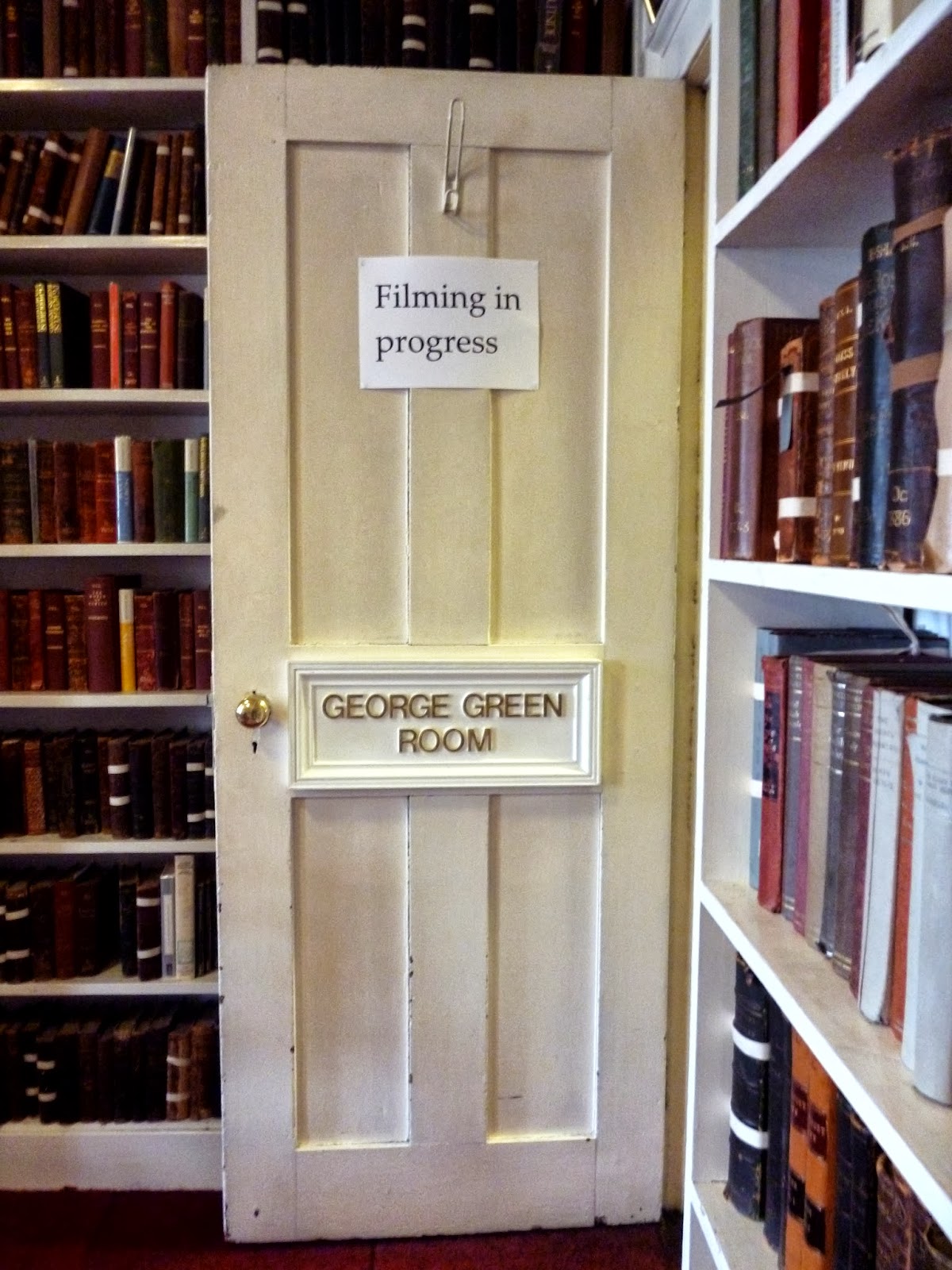
This morning I was interviewed about Karl Wood by Stuart Cresswell, the Managing Director of Simple Films Limited, Welsford, Nova Scotia, Canada, in the splendid setting of the George Green Room at Bromley House, Nottingham. Stuart and crew are on the point of completing the filming of the hour-long The Mühlendämmerungs of Karl Salsbury Wood, a part-biography of the bookish windmill artist Wood, so this was a highly appropriate background.

The George Green Room with, from left to right: Paul Allen (Camera), Stuart Cresswell, and Charley Cresswell (Sound).

I also took the opportunity to photograph a few things that had escaped my attention when I last came here in June this year. Above is a representation of the plaque in Westminster Abbey, placed there on 16 July 1993, just two days after the bicentenary of the birth of George Green, who was a member of the library from 1823 to 1833.

Mrs Jane Moth (1824–1900), née Jane Smith, was George Green's eldest daughter.

Due to building works in June I was unable to get a decent view of the garden, but now there's a view of the back of Bromley House Library unhindered by scaffolding.

The garden of Bromley House Library.

An impressive 'mean time' sundial. A page of explanation is attached to it, but this is science so I won't run the risk of making a cock-up of a précis of it.

A very enjoyable morning: I look forward to the screening of the film and thank the crew for their relaxed style and their hospitality.

Thanks also to Dr Rowena Edlin-White and Carol Barstow for making this venue possible, and to the rest of the staff there today for their enthusiastic welcome.


–––––––––––––––––––––––––––––––––––
Bromley House Library, Nottingham
Windmill Wood: A Biography of Midlands Artist Karl Salsbury Wood