Showing posts with label Oxfordshire. Show all posts

26 March 2017

George Orwell in Sutton Courtenay, Oxfordshire

'NEAR TO THIS PLACE LIE
THE MORTAL REMAINS OF
GEORGE ORWELL . WRITER
. ERIC ARTHUR BLAIR .
25 JUNE 1903 . 21 JANUARY 1950'

This plaque is on the south wall of All Saints's church, Sutton Courtenay, Oxfordshire.

'HERE LIES
ERIC ARTHUR BLAIR
BORN JUNE 25TH 1903
DIED JANUARY 21ST 1950'

Orwell wanted to be buried in a country graveyard, and he was. To the right is a rather rain-weathered copy of his Homage to Catalonia which an admirer has obviously left.
'DAVID
ASTOR
1912 – 2001'

David Astor was the editor of the Observer, an owner of estate in Sutton Courtenay, a friend (and employer) of Orwell's, also responsible for seeing that Orwell's wishes were carried out. He bought two graveyard plots in All Saint's', and is buried immediately behind Orwell's grave.

25 March 2017

Mary Arnold Ward (Mrs Humphry Ward) in Oxford (UK)


'MARY ARNOLD
WARD
(MRS HUMPHRY WARD)
1851 – 1920
Social Reformer
Novelist
lived here
1872 – 1881'

17 Bradmore Road.

Walter Pater and Clara Pater in Oxford (UK)


'WALTER PATER
1839 –1894
Author and Scholar

CLARA PATER
1841 – 1910
Pioneer of Women's Education

Lived here
1869 – 1885'

2 Bradmore Road.

Wolvercote Cemetery, Oxford #6 Louise Imogen Guiney

Finally in Wolvercote Cemetery, the most difficult grave to find (at least for us.) Difficult not because of the relatively distinctive grave itself, but due to the erosion of the inscription. As far as I know this is the only photo of the grave of Louise Imogen Guiney (1861–1920) that is on the internet, which is perhaps hardly surprising because I couldn't make out a single word at the base of the grave, so my thanks to Dr Rowena Edlin-White for taking a rubbing and discovering this inscription:

'ANNO MCMII
DECEMBRIS XXVIII
IN CORDE JESU
ELIZABETH DOYLE
DELASSATA                  (this is her aunt who lived with her)

LOUISE IMOGEN GUINEY
JAN VII MDCCCLXI
NOVII MCMXX

DILIGENSE ET FIDELIS'

Apparently Guiney and her friend Alice Brown did a walking tour of England, which was detailed in Brown's By Oak and Thorn (1896), and Guiney eventually returned to England. She also found and had restored the grave of Henry Vaughan in St Bride's churchyard, Llansantiffraed, Powys.

A former home of Guiney's in Beacon Hill, Boston, MA.

Wolvercote Cemetery, Oxford #5: Albert Habib Hourani

'ALBERT
HABIB
HOURANI
1915 – 1993
Scholar and Historian
Of the Middle East
Teacher at the
University of Oxford
Much loved
And greatly missed
By all who knew him'

Wolvercote Cemetery, Oxford #4: James Legge


'HERE REST IN GOD
JAMES LEGGE,
MISSIONARY TO CHINA,
AND
FIRST PROFESSOR OF CHINESE
IN THE UNIVERSITY OF OXFORD.
BORN 20 TH DEC. 1815, DIED 19 TH NOVEMBER 1897.'

Wolvercote Cemetery, Oxford #3: James Murray


'SIR JAMES A. H. MURRAY, L. L. D.
EDITOR OF
THE OXFORD ENGLISH DICTIONARY.
1878 – 1915
BORN 7. FEBRUARY 1837,
DIED 26. JULY 1915.'


78 Banbury Road, Oxford, where James Murray lived from 1885 to 1915.

Wolvercote Cemetery, Oxford #1: J. R. R. Tolkien


'EDITH MARY TOLKIEN
LUTHIEN
1889 – 1971
JOHN RONALD
REUEL TOLKIEN
BEREN
1882 – 1973'

Obviously no introduction needed here, and of course Tolkien's grave is the most searched for one in the cemetery, several signs pointing the way to it. Tolkien's book Beren and Lúthien is to be published by their son Christopher in 2017.

The plaque on Tolkien's former home at 20 Northmoor Road, north Oxford, states that he lived here from 1930 to 1947.

9 August 2013

Alexander Pope in Stanton Harcourt, Oxfordshire

Pope's Tower is where Alexander Pope, who was a friend of Simon Harcourt, finished his translation of Homer's Iliad in 1718.

On the outside church wall is a plaque on which Pope detailed the unfortunate accident that befell two lovers from the parish who were fatally struck by lightning:

'NEAR THIS PLACE LIE THE BODIES
OF JOHN HEWET AND SARAH DREW
AN INDUSTRIOUS YOUNG MAN
AND VIRTUOUS YOUNG MAIDEN OF THIS PARISH
CONTRACTED IN MARRIAGE.
WHO BEING WITH MANY OTHERS AT HARVEST
WORK, WERE BOTH IN ONE INSTANT KILLED
BY LIGHTNING ON THE LAST DAY OF JULY
1718.

Think not by rigorous judgment seiz'd
A pair so faithful could expire;
Victims so pure Heav'n saw well pleaſd
And snatch'd them in cœlestial fire.

Live well & fear no sudden fate,
When God calls Virtue to the grave,
Alike 'tis juſtice soon or late,
Mercy alike to kill or save.

Virtue unmov'd can hear the call
And face the flaſh that melts the ball.'

 
Inside the church on the north wall is a memorial to Robert Huntington and his son (also Robert), on which is inscribed an epitaph by the playwright William Congreve:

'This peacefull Tomb does now contain
Father and Son together laid,
Whoſe liveing vertues shall remain,
When they and this are quite decay'd.

What man should be to ripeneſs grown.
And finiſh'd worth should do or shun
At full was in the Father shown
What Youth could promote in the Son.

But Death obdurate, both destroy'd
The perfect fruit and opening bud,
First seiz'd thoſe fruits we had enjoy'd
Then robb'd us of the comeing good.'


My earlier Pope posts are linked below:
 
–––––––––––––––––––––––––––––––––––
Anthony Beckles Willson: Mr Pope & Others at Cross Deep
Alexander Pope in St Marys Church, Twickenham
Alexander Pope's Grotto in Twickenham
Alexander Pope in Chiswick

8 August 2013

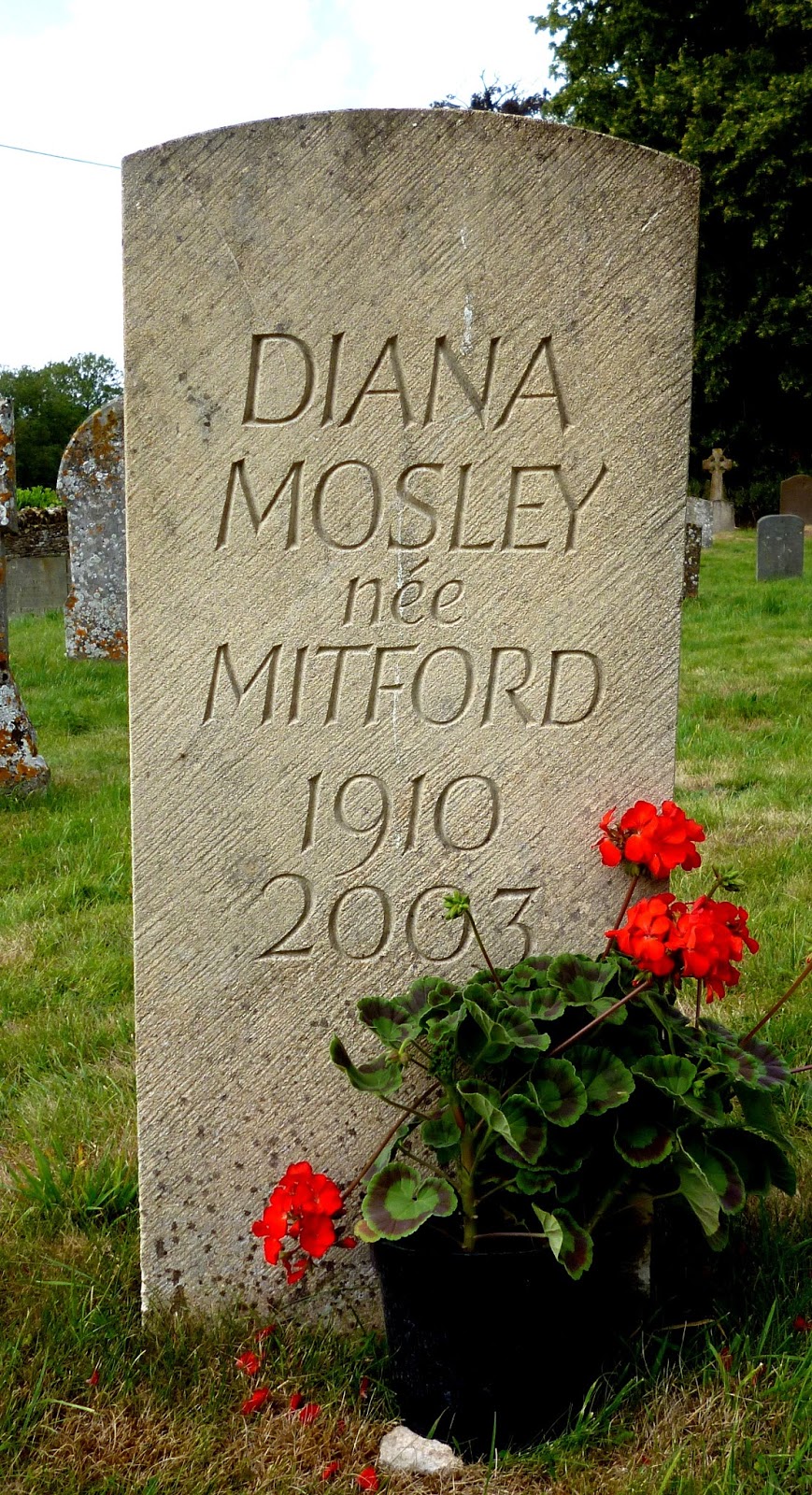
Three Mitford Sisters in Swinbrook, Oxfordshire

The graves of three Mitford sisters in a row in Swinbrook, Oxfordshire, which was their family home.
 
'NANCY
MITFORD
Authoress
wife of
Peter Rodd
1904–1973'
 
Despite what the gravestone says, Nancy Mitford was divorced from Rodd in 1959. She was noted for her novels, particularly The Pursuit of Love (1945) and Love in a Cold Climate (1949). She also popularised the whimsical expressions 'U' and 'non-U' in an essay in Noblesse Oblige: An Enquiry Into the Identifiable Characteristics of the English Aristocracy (1956).
 
'UNITY VALKYRIE
MITFORD
Born 8th Aug 1914
Died 28th May 1948
Say not the struggle
naught availeth'
 
Now we come to the notorious two sisters. Unity Mitford is famous for her obsession with Adolf Hitler, for stalking him and greatly impressing him with her Ayrian looks (and her middle name).  And after Britain declared war on Germany she shot herself in the head, although it took nearly nine years for the bullet still lodged there to kill her.
 
'DIANA
MOSLEY
née
MITFORD
1910
2004'
 
Notorious for – among other things – leaving her husband Bryan Guinness for the fascist leader Oswald Mosley, having her second marriage at Goebbels's house with Hitler as guest of honour, etc. Some called her the most hated woman in the country: it wasn't exactly surprising that her appearance on Desert Island Discs in 1989 should have received so many complaints.

Arturo Barea and Other Spanish Writers in Oxfordshire

The Times Literary Supplement's 26 April 2013 issue contains a fascinating article by Martin Murphy titled 'Pub Poets: The Exiles of Eaton Hastings'. In 1934 the socialist and pacifist Gavin Henderson inherited the Buscot estates in Oxfordshire from his grandfather Alexander Henderson, the first Lord Faringdon. Gavin Faringdon was a founder of the National Council for Spanish Relief during the Spanish Civil War, which commissioned a ship to transport four thousand refugee Basque children following the siege of Bilbao. Some of the young exiles were housed at a lodge of Faringdon's (still called Basque House) in the hamlet of Eaton Hastings, and the death of one of them in an Oxford infirmary led the poet Luis Cernuda – who witnessed the death – to write a poem: 'Elegía a un muchacho vasco muerte en Inglattera'.

In 1939 a group of adult Spanish exiles came to Basque House, among them the poets Domènec Perramon and Pedro Garfias, and the journalists Eduardo de Ontañon and Fermí Vergés. Most of them moved on to Mexico, although Perramon stayed in England and became a translator of Spanish.

Arturo Barea was the son of a washerwoman and was very proud of his working-class roots. He left Spain in 1938 but didn't arrive at Eaton Hastings until 1947, where he spent his last ten years at Gavin Faringdon's Middle Lodge. He had married the Austrian journalist Ilsa Kulcshar, née Pollak. As 'Juan de Castilla', Barea broadcast eight hundred programmes for the BBC's Spanish American service, from 1940 until the year of his death. He is most noted for his autobiographical trilogy La forja de un rebelde, which his wife (as Ilsa Barea) translated as The Forging of a Rebel (1946).
 
Barea's ashes were strewn over his garden at Eaton Hastings, and Ilsa returned to Austria, although their friend Olive Renier erected a memorial to them in the cemetery on Coach Lane, Faringdon, behind Ilsa's parents' grave above.
 
'POR ARTURO BAREA
BORN MADRID 20TH SEPT 1897.
DIED BUSCOT 24TH DEC 1957.
AND HIS WIFE
ILSE BAREA POLLAK
BORN VIENNA 20TH SEPT 1902
AND DIED THERE
1ST JANUARY 1973.'

7 August 2013

William Morris in Kelmscott, Oxfordshire

St George's Church, Kelmscott.
 
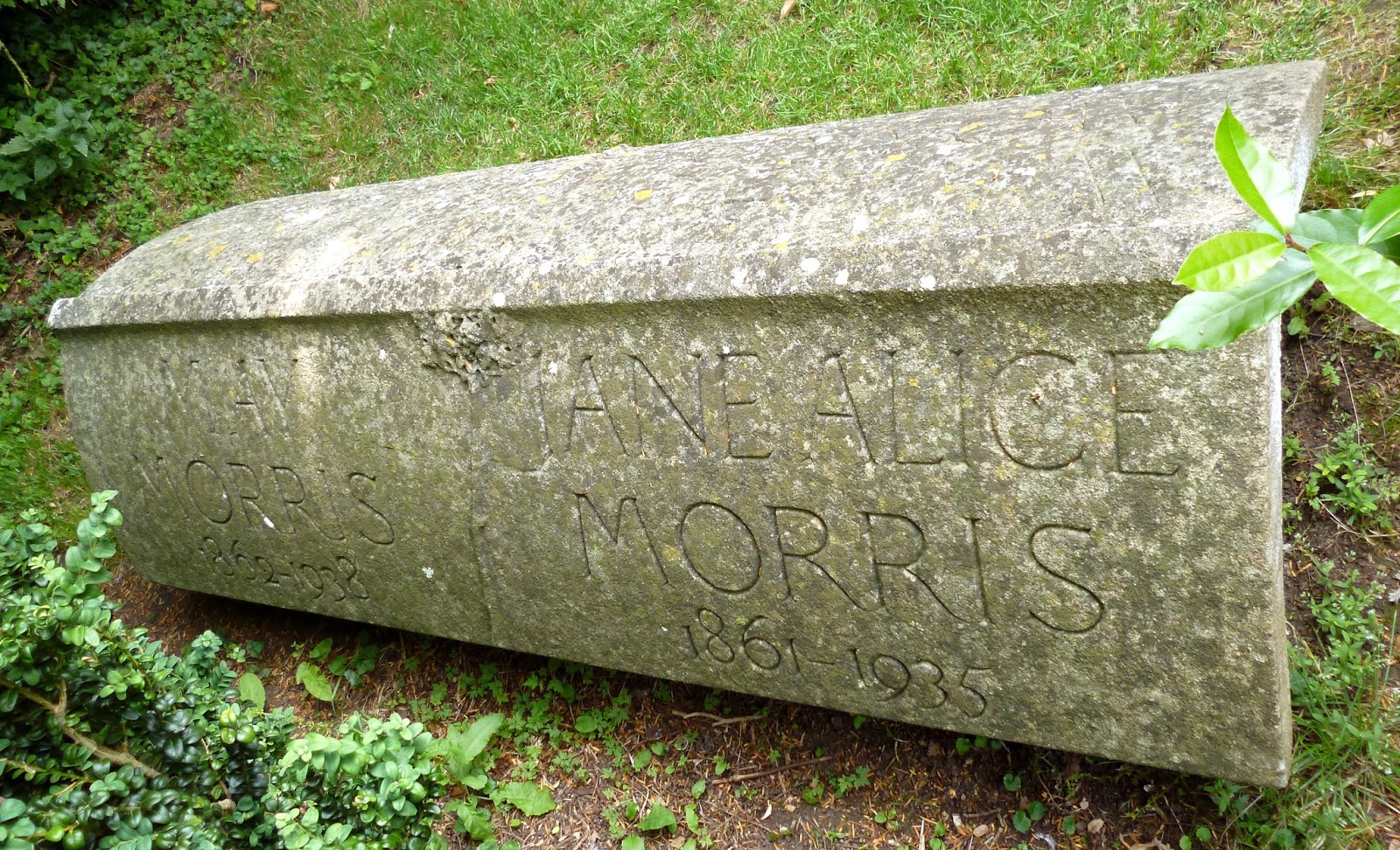
Buried in the graveyard are William Morris (1834–1896) and his wife Jane Morris (1839–1914). Morris's friend Philip Webb designed the simple but attractive tombstone, although this side is barely legible now due to weathering.
 
Also buried here are their two daughters, May (1862–1938) and Jane Alice (1861–1935). May edited her father's Collected Works.
 
Only their initials 'JAM' and 'MM' appear on these stones.

Barbara Pym in Finstock, Oxfordshire

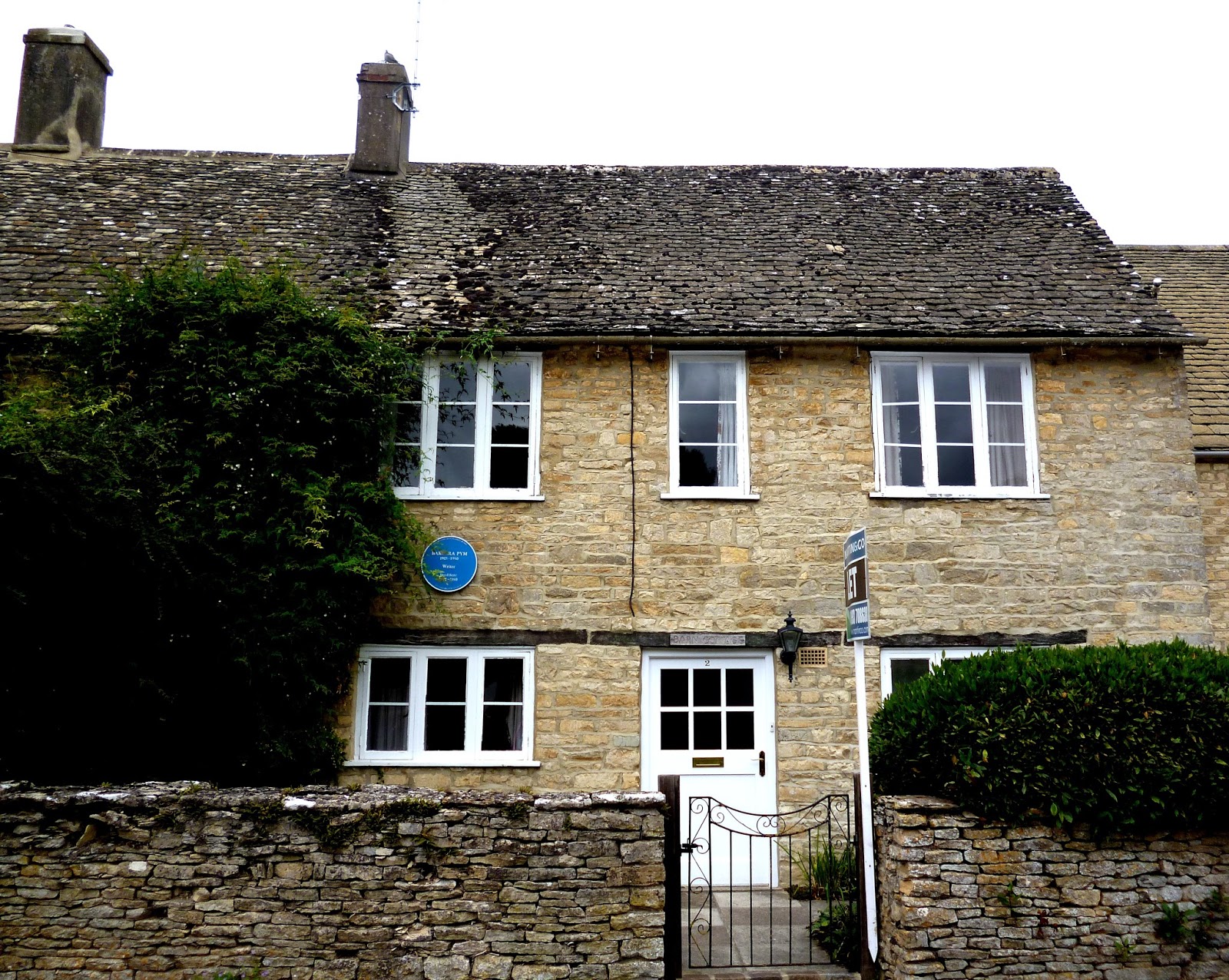
Barn Cottage, Finstock, Oxfordshire.
 
'BARBARA PYM
1913–1980
 
Writer
 
lived here
1972–1980' 

Following Barbara's sister Hilary's retirement from the BBC they bought Barn Cottage in Finstock, actually a converted wheelwright's shop. As Barbara was still working at the International African Institute in London she found cheap accommodation there and rejoined Hilary at weekends until her retirement in 1974. (My information above was gleaned from Hazel Holt's excellent book A Lot to Ask: A Life of Barbara Pym (1990).)

Holy Trinity, the church the sisters attended. (This is also where T. S. Eliot joined the Anglican Church in a secret ceremony in 1927.)

'BARBARA PYM
WRITER
1913–1980
WORSHIPPED
HERE'


'THIS LECTERN, DEDICATED ON THE 3RD JUNE 1984,
HAS BEEN GIVEN IN MEMORY OF THE WRITER
BARBARA PYM, WHO ORGANISED THE READING OF
THE EPISTLE DURING THE TIME SHE LIVED IN
FINSTOCK, 1972–1980.'


'BARBARA PYM
Writer
2nd June 1913–11th Jan. 1980
HILARY WALTON
née PYM
13th Jan. 1916–7th Feb. 2004'

I didn't know where Pym's grave was, so I asked a couple of elderly locals tending a grave if they knew. They had no idea, although in fairness one of them did know she was a writer.

Links to my other Pym posts:

–––––––––––––––––––––––––––––––––––
Barbara Pym: Some Tame Gazelle (1950)

Barbara Pym: Excellent Women (1952)

5 August 2013

Lord Berners in Faringdon, Oxfordshire


'FARINGDON FOLLY

'THIS 100FT HIGH TOWER WAS BUILT IN 1935 BY THE
14TH LORD BERNERS. IT IS THE LAST MAJOR FOLLY
TOWER TO HAVE BEEN BUILT IN BRITAIN AND WAS
ERECTED ON THE SITE OF A MEDIEVAL CASTLE AND A
CROMWELLIAN BATTERY.

'AFTER CARRYING OUT MAJOR RESTORATION WORKS TO
THE TOWER, MR. ROBERT HEBER PERCY IN 1982 SET
UP A FARINGDON FOLLY TRUST. THE PURPOSE
OF THE TRUST IS TO ENSURE THAT THE PUBLIC HAVE
USE OF, AND ENJOYMENT OF THE TOWER AND ITS
SURROUNDINGS.

'THIS PLAQUE WAS PROVIDED BY THE FARINGDON ENVIRONMENTAL TRUST 1989'
 
'Gerald Hugh
Tyrwhitt-Wilson
14th BARON BERNERS
1883–1950
Composer, Writer, Artist
Eccentric
 
lived at Faringdon House
1919–1950
and built this tower'
 
"PRAISE THE LORD / HE SELDOM WAS BORED"'
 
The rhyming couplet above is part of a short epitaph that Berners wrote for himself and seems typical of the image he wished to project. He was an accomplished composer and the writer of three volumes of autobiography and six novels, one of which – The Girls of Radcliff Hall (1932) – was a lesbian girls' school romp, a roman à clef in which young female representations of Berners, Cecil Beaton and Olive Messel appear. The title of the novel is of course a play on the name of the writer Radclyffe Hall, who published the lesbian novel The Well of Loneliness in 1928.

Berners was wilfully eccentric. As a child he is said to have thrown his mother's dog from a window in the belief that it would learn to fly – the story being that he had heard that a dog learns to swim if immersed in water. Fortunately the dog survived, although I'm uncertain if the fantail doves he later dyed in bright colours were as lucky. He also had a pet giraffe and a horse with whom he had tea.

He was a great socialite and a friend of John Betjeman and Nancy Mitford, whose character Lord Merlin in The Pursuit of Love (1945) is based on Berners.

Berners delighted in the fact that he had no reason for building Folly Tower, apart perhaps from annoying his neighbours. He commissioned his friend Lord Wellesley to build a gothic tower, knowing – another story goes – that Wellesley hated this style. Building began when Berners was abroad, and returned to find most of it finished but built in a classical style. He insisted that the remaining section be completed in gothic style, which explains the rather odd mixture that is Folly Tower.

The tower was given as a birthday present to Berners' much younger boyfriend, the extroverted 'Mad Boy' Robert Heber-Percy (1911–87), who would have preferred a horse. In turn, two years before Heber-Percy's death, he gave the tower to the people.
 
A view from the Belvedere room near the top.
 
From the top of the tower, the surrounding woodland in the foreground and the town of Faringdon in the middleground.
 
An interior view from the steps, with a model blackbird.
 
There are several blackbirds in and around the tower and they allude to another writer. Henry James Pye (1745–1813) planted the outer circle of trees, the Scots pines, on Folly Hill. He is said by many to have been the worst ever Poet Laureate, even worse than Alfred Austin. One critic of the day mocked Pye's birthday poem to King George III, with its chirpy style, in what has come to be a well-known nursery rhyme about 'four and twenty blackbirds baked in a pie'.

24 July 2010

Thomas Hughes and Kingston Lisle, Oxfordshire, and the Blowing Stone

The pub The Blowing Stone, with its inn sign of a stone with several holes set against a background of the famous white horse, obviously hides a story or two.

L. V. Grinsell's leaflet The Blowing Stone attempts to unravel some of this mystery, and he is of course right to virtually dismiss the myth that it was used by Alfred the Great to summon his men to fight the Danes: the sound made through blowing into it was thought to be heard for many miles around.

Nevertheless, the blowing stone has acquired a piece of immortality for itself. It once stood in front of a different pub called The Blowing Stone, toward the bottom of Blowingstone Hill, and this lump of sarsen stone is mentioned in Thomas Hughes's Tom Brown's Schooldays:

'At the bottom [of the hill] there is a pleasant public [house], whereat we must really take a modest quencher, for the down here is a provocative of thirst. So we pull up under an old oak which stands before the door.

"What is the name of your hill, landlord?"

"Blawing Stwun Hill, sir, to be sure."

"And of your house? I can't make out the sign."

"Blawing Stwun, sir," says the landlord, pouring out his old ale from a Toby-Philpot jug, with a melodious crash, into the long-necked glass.

"What queer names!" say we, sighing at the end of our draught, and holding out the glass to be replenished.

"Be'an't queer at all, as I can see, sir," says mine host, handing back our glass, "seeing as this here is the Blawing Stwun his self," putting his hand on a square lump of stone some three feet and a half high, perforated with two or three queer holes, like petrified antediluvian rat-holes, which lies there close under the oak, under our very nose. We are more than ever puzzled, and drink our second glass of ale wondering what will come next. "Like to hear un, sir?" says mine host, setting down Toby Philpot on the tray, and resting both hands on the "Stwun." We are ready for anything; and he, without waiting for a reply, applies his mouth to one of the rat-holes. Something must come of it, if he doesn't burst. Good heavens! I hope he has no apoplectic tendencies. Yes, here it comes, sure enough, a grewsome sound between a moan and a roar, and spreads itself away over the valley, and up the hillside, and into the woods at the back of the house - a ghost-like, awful voice. "Um do say, sir," says mine host rising purple-faced, while the moan is still coming out of the "Stwun," "as they used in old times to warn the country-side, by blawing the stwun when the enemy was acomin' - and as how folks could make un heered them for seven mile round; leastways, so I've heered Lawyer Smith say, and he knows a smart sight about them old times." We can hardly swallow Lawyer Smith's seven miles; but could the blowing of the stone have been a summons, a sort of sending the fiery cross round the neighbourhood in the old times? What old times? Who knows? We pay for our beer, and are thankful.

"And what's the name of the village just below, landlord?"

"Kingstone Lisle*, sir."'

The village (without an 'e') is about a half mile from the stone, which seems to attract a number of people: when I visited earlier today, there was a party of schoolchildren there, one of whom tried blowing into the stone and only succeeded in what his guardian called 'making rude noises'. Grinsell explains that to make a successful noise, all that need be done is to cover the hole entirely with the mouth and simply blow.

I didn't bother trying.

Kingston Lisle is also the name of the house Hughes built in his experimental school project in Rugby, eastern Tennessee, more of which I shall mention when I go there next month.
 This fascinating photo shows the blowing stone in about 1910, and was sent to me yesterday by George Zepp, of Rugby, Tennessee. Many thanks, George!