Showing posts with label New York City (NYC). Show all posts

25 August 2015

NYC #63: Story Stone, Maple Grove Cemetery (4), Kew Gardens, Queens

'In the late 19th century,
many African Americans
were buried in unmarked graves
near this stone. Hundreds of
impoverished children and adults –
taken early in life by the diseases of
the times – were brought to "common"
graves from New York City homes and
hospitals. Buried here as well, are
African-American residents of
Jamaica, Queens who helped build
our vital Community.

Day of Remembrance
September, 2005'

NYC #62: George Washington Johnson, Maple Grove Cemetery (3), Kew Gardens, Queens

'GEORGE WASHINGTON JOHNSON
(1846–1914)

THE FIRST SUCCESSFUL AFRICAN AMERICAN RECORDING STAR IN RECORDING HISTORY. ALTHOUGH BORN A SLAVE IN VIRGINIA HE WAS TAUGHT TO READ AND WRITE AND LEARNED MUSIC [.] TRAVELING TO NEW YORK CITY IN THE 1870S HE DEVELOPED A MUSICAL CAREER WITH A STRONG VOICE AND A TALENT FOR WHISTLING AND LAUGHING IN TIME WITH MUSIC. HE PERFORMED ON THE STREETS, FERRIES AND PUBLIC PLACES. ONE OF HIS EARLY SONGS WAS THE LAUGHING SONG. HE RECORDED SONGS IN 1890 FOR THE METROPOLITAN PHONOGRAPH COMPANY AND WITH THOMAS EDISON ON WAX CYLINDERS. THE EARLY RECORDINGS WERE DONE INDIVIDUALLY BY GEORGE. BEST SELLERS IN THE UNITED STATES, SELLING OVER 50,000 COPIES.

"HE NEVER THOUGHT OF HIMSELF AS A PIONEER BUT AS THE FIRST BLACK RECORDING ARTIST HE MADE HISTORY."            TIM BROOKS LOST SOUNDS

FRIENDS OF MAPLE GROVE CEMETERY – MUSICARES 2014'

NYC #61: Don Marquis, Maple Grove Cemetery (2), Kew Gardens, Queens


Don Marquis (1878–1937) was a humorist, a novelist, a poet, and a journalist who in the early part of his career was an assistant editor to Joel Chandler Harris. E. B. White found him very funny, and he was much respected by the Algonquin Round Table. His publications include the novels Danny's Own Story (1912), Cruise of the Jasper B. (1916), Pandora Lifts the Lid (1924), Off the Arm (1930), and Sons of the Puritans (1939); his short stories include Carter and Other People (1921), The Revolt of the Oyster (1922), When the Turtles Sing (1928), Chapters for the Orthodox (1934), and Sun Dial Time (1936); and his poems include Dreams & Dust (1915), Poems and Portraits (1922), Sonnets to a Red-Haired Lady and Famous Love Affairs (1922), and The Awakening (1924).

NYC #60: Martin Branner, Maple Grove Cemetery (1), Kew Gardens, Queens

Martin Branner (1888–1970) was a cartoonist most noted for the creation of Winnie Winkle, a strip character who appeared in newspapers for fifty years, and was considered a little too sexually daring by some people at the time.

NYC #59: Thomas Wolfe, Brooklyn Heights, Brooklyn

'THOMAS WOLFE
AMERICAN AUTHOR
LIVED ON BROOKLYN HEIGHTS FROM 1931 TO 1935,
AND IN THIS HOUSE, 1933 TO 1935, WHILE WRITING
OF TIME AND THE RIVER.
–––––––––––––––––––––
"GREAT GOD, THE ONLY BRIDGE, THE BRIDGE OF
POWER, LIFE AND JOY, THE BRIDGE THAT WAS A
SPAN, A CRY, AN ECSTASY – THAT WAS AMERICA."
DEDICATED ON MAY 20, 1983, BY
THE THOMAS WOLFE SOCIETY'

NYC #58: W. H. Auden, Brooklyn Heights, Brooklyn

'W. H. AUDEN
POET ('1907–1973)
–––––––––––––––––
LIVED IN BROOKLYN HEIGHTS FROM 1939 TO 1941,
FROM 1939 TO 1940 ON THE TOP FLOOR OF THIS HOUSE,
WHERE HE WROTE "NEW YEAR LETTER."
–––––––––––––––––
"AND LOVE ILLUMINATES AGAIN
THE CITY AND THE LION'S DEN,
THE WORLD'S GREAT RAGE, THE TRAVEL OF YOUNG MEN."
 
THE W. H. AUDEN SOCIETY, JUNE 25, 1996'

NYC #57: Henry Miller, Brooklyn Heights, Brooklyn

'HENRY MILLER
 
1891–1980
 
Raised in Brooklyn, the best-selling author
is noted for his imaginative, controversial novels
Tropic of Cancer (1934), which chronicles
his colorful life as an expatriate in Paris, and
Tropic of Capricorn (1939), which depicts his adult
life in New York city. Both books were banned
in the U.S. until 1961. Miller lived here
from 1924 to 1925.'
 
91 Remsen Street. What the plaque doesn't say is that Miller and his second wife June were evicted from here: in a fictionalized account of searching for this place and moving in, Miller's novel Plexus states that the place was way beyond the means of the narrator.

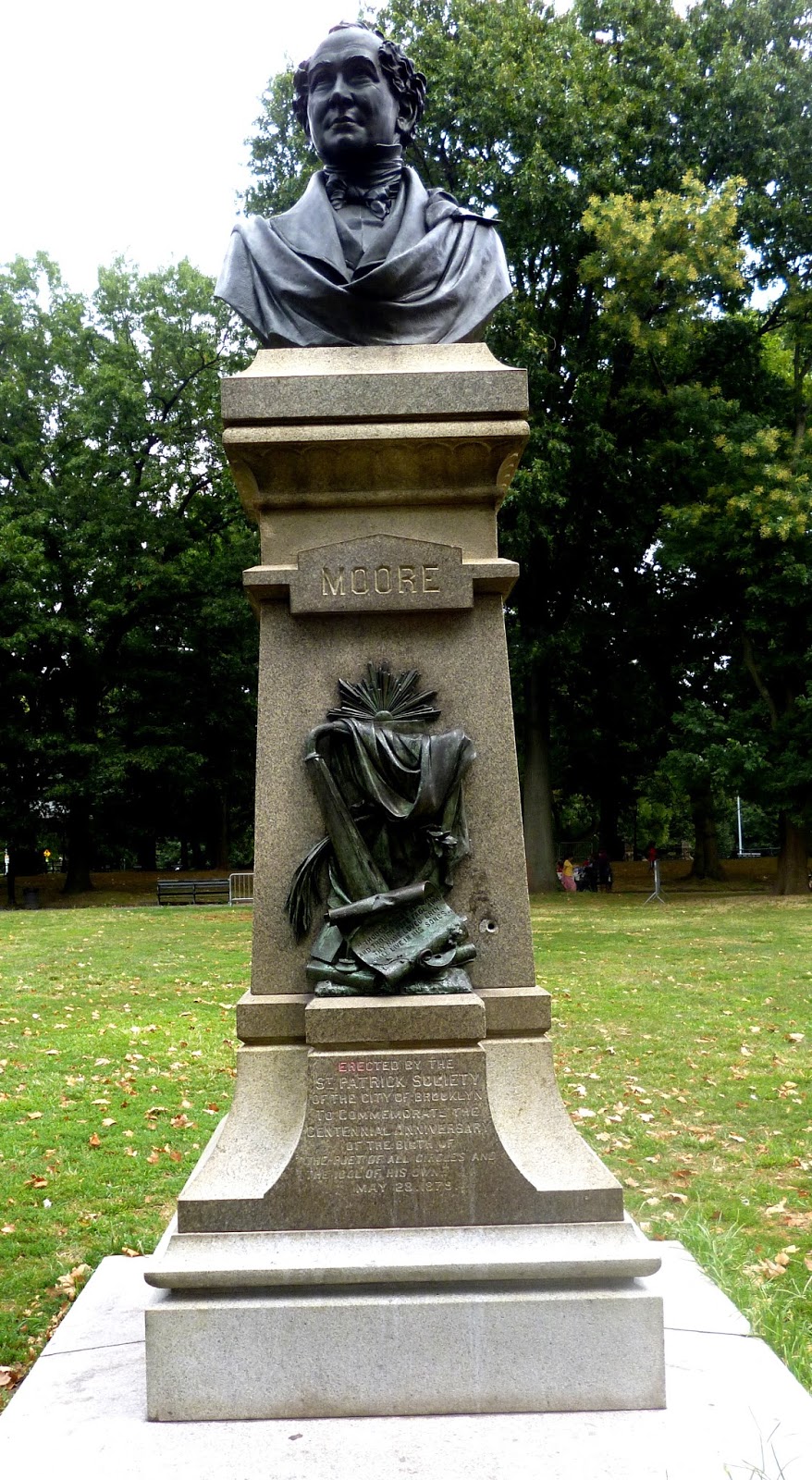
NYC #56: Thomas Moore, Prospect Park, Brooklyn

Among the representations of composers in Concert Grove, Prospect Park, is a bust on a pedestal of the Irish poet Thomas Moore (1779–1852), who was also a musician:
 
'ERECTED BY THE
ST PATRICK SOCIETY
OF THE CITY OF BROOKLYN
TO COMMEMORATE THE
CENTENNIAL ANNIVERARY
OF THE BIRTH OF
"THE POET OF ALL CIRCLES AND
THE IDOL OF HIS OWN
."
       MAY 28, 1879'

The quotation comes from Moore's friend Lord Byron's description of him, and is reproduced on Moore's family grave in Bromham, Wiltshire.

The lines on the scroll in his hand are from Moore's poem 'Oh! Blame Not the Bard.'

NYC #55: Ralph Ellison, Harlem

Just off Riverside Drive at 150th Street, Harlem, this superb memorial:

'Ralph Ellison
1914–1994


American writer
Longtime resident of 730 Riverside Drive.


His pioneering novel, Invisible Man (1952),
details the struggle of a young
African-American man in a hostile society.'


'"I am an invisible man....
I am invisible, understand, simply because
people refuse to see me."
                         –– Ralph Ellison, 1952
                            Invisible Man

Elizabeth Catlett
Sculptor
May 2003'

'"The very idea of New York was dreamlike,
for like many young Negroes of the time, I thought of
it as the freest of American cities, and considered
Harlem as the site and symbol of Afro-American
progress and hope. Indeed, I was both young and
bookish enough to think of Manhattan as my
substitute for Paris, and of Harlem as a place of Left
Bank excitement. So now that I was there in its
glamorous scene, I meant to make the most of its
opportunities"
                        –– Ralph Ellison
                        An Extravagance of Laughter, 1986'

24 August 2015

NYC #54: Edna Ferber, Manhattan

At 50 Central Park West, near West 65 Street:

'EDNA FERBER
 
1887-1968
 
The widely-read novelist, short story writer,
and playwright, best known for the novel Giant (1952)
lived here from 1923 to 1929. Ferber's fiction is
distinguished by larger-than-life stories, strong female
characters, and distinctive renderings of American
settings. Two of her novels were published while
she lived here: the Pulitzer Prize-winning
So Big (1924), and Show Boat (1926).'

NYC #53: Dante, Broadway, Manhattan

A noticeboard outside the park states:

'Dante Park is named after Italy's great poet, Dante Alighieri (1265–1321). Born to a noble Florentine family, Dante immersed himself in the study of philosophy and Provençal poetry. In 1302 Dante was banished from Florence for his political views and became citizen of Italy. While in exile, he composed The Divine Comedy, the first vernacular poetic masterpiece. It tells of the poet's journey from Hell to Heaven, presenting a changeless universe ordered by God. Through The Divine Comedy and his many other works, Dante established Tuscan as the literary language of Italy and gave rise to a great body of literature.

The park's bronze monument was dedicated in 1921 (the 600th anniversary of Dante's death) and was created by sculptor Ettore Ximenes. The New York branch of the Dante Alighieri Society and Carlo Barsotti, editor of Il Progresso (the first Italian newspaper in the United States), raised funds towards the creation of the statue.'

NYC #52: Anatole Broyard, Chelsea

'It was as if a great bomb, an explosion of consciousness, had gone off in American life, shattering everything.' This quotation is by Anatole Broyard from Kafka Was the Rage: A Greenwich Village Memoir, and refers to Broyard's impression of post-war America. The chalked signboard was outside 192 Books in Chelsea, which seems to specialize in translated books.

NYC #51: Clement Clarke Moore, Chelsea

The Clement Moore Park is at 10th Avenue and West 22nd Street, and named after the poet Clement Clarke Moore (1779–1863). This playground was on land bought by Captain Thomas Clarke – Clement's grandfather – in 1750. Moore is best known for his children's poem 'The Night Before Christmas'.

NYC #50: Bryant Park (7), Gertrude Stein

 
'GERTRUDE STEIN
1874 – 1946
 
BY
JO DAVIDSON, 1923
BRONZE CAST 1991'

NYC #49: Bryant Park (6), Goethe

'GOETHE
1749–1832
ERECTED 1932
BY THE
GOETHE SOCIETY
OF AMERICA'

NYC #48: Bryant Park (5), William Cullen Bryant

'YET LET NO EMPTY GUST 
OF PASSION FIND AN UTTERANCE IN THY LAY, 
A BLAST THAT WHIRLS THE DUST 
ALONG THE HOWLLING STREET AND DIES AWAY; 
BUT CALM FEELINGS OF CALM POWER AND MIGHTY SWEEP,
LILE CURRENTS JOURNEYING THROUGH THE WINDLESS DEEP.'
 
The quotation is a verse from Cullen's poem 'The Poet'. Thomas Hastings was the architect, Herbert Adams the sculptor.

NYC #47: Bryant Park (4), William Earl Dodge

William Earl Dodge was, er, a businessman, and a carpetbagger at that. I don't include many of this breed in my blog, although it would be a little churlish to exclude him from the other memorials in Bryant Park, and he seems slightly less objectionable for his kind, even though his abolitionist stance was nuanced. The only publication I can find that he made is probably fairly typical: Influence of War on Our National Prosperity (1865, from a Baltimore lecture).

NYC #46: Bryant Park (3), Josephine Shaw Lowell

 
The Josephine Shaw Lowell Memorial Fountain in Bryant Park, Midtown Manhattan. Lowell (1843–1905) was a strong progressive reformer and created the New York Consumers League in 1890. She published Public Relief and Private Charity (1884) and Industrial Arbitration and Conciliation (1893).

NYC #45: Bryant Park (2), Benito Juárez

'BENITO JUÁREZ
1806–1872
PRESIDENT OF MÉXICO (1858–1872)
BORN IN GUELATAO, OAXACA, OF HUMBLE ORIGINS, JUÁREZ ESTABLISHED
THE FOUNDATION FOR THE MEXICAN REPUBLIC. IN 1867, HE DEFEATED
THE FRENCH INVASION, THUS PRESERVING THE INDEPENDENCE OF MÉXICO.
GIFT FROM THE PEOPLE AND THE GOVERNMENT OF OAXACA, MÉXICO TO THE CITY OF NEW YORK.'

NYC #44: Bryant Park (1), José Bonifácio de Andrada e Silva

Bryant Park, next to New York Public Library in Midtown Manhattan, contains several monuments. This is a representation of José Bonifácio de Andrada e Silva (1882–1947), poet, naturalist, statesman and a leader of Brazilian independence from Portugal. The statue was constructed by José Otavio Correia Lima.