I shall cover the D. H. Lawrence Blue Line Trail, published by Broxtowe Borough Council, for most of this post. The blue line is much like the yellow parking restriction lines on roads, only this is on pavements, and stretches from Durban House Heritage Centre at the junction of Greenhills Road and Mansfield Road, Eastwood, to The Three Tuns pub on Three Tuns Road.
There are fourteen plaques entitled 'The D. H. Lawrence Literary Trail', all of which are gathered outside the square by Eastwood Library, and most of which don't relate to a specific feature of the Blue Line Trail. This one, however, relates to the Durban House Heritage Centre, and as with all the others, contains a quotation by Lawrence:
'These offices were quite handsome: a new, red-brick building, almost like a mansion, standing in its own well-kept grounds at the end of Greenhill Road. The waiting room was a hall, a long, bare room paved with blue brick, and having a seat all round, against the wall.
Sons and Lovers'
'Suffering the tortures of the damned'
Barber, Walker & Co. were principal colliery company owners around Eastwood, and this house was built in 1876. Lawrence frequently went there to collect his father's wages, and felt intimidated by the experience. In Sons and Lovers, Lawrence fictionalizes life in 'Bestwood' through Paul Morel, and the colliery is owned by Carston, Waite & Co. Durban House is now an information centre and exhibition house of Lawrence's life and work.
Lawrence's phoenix symbol appears in many places throughout Eastwood. This is one of a number of badges, and is next to the plaque on the pavement outside Durban House.
'Great quadrangles of dwellings on the hillsides'
The colliery company built the houses for the miners to live in, and as Lawrence writes in Sons and Lovers, these were large quadrangles. This is Princes Street, a few hundred yards up Mansfield Road from Durban House.
'The library was open in the two rooms in the Mechanics Hall, on Thursday evenings from 7.0 till 9.0. Paul always fetched the books for his mother, who read a considerable amount, and Miriam trudged down with five or six volumes, for her family. It became the custom for the two to meet in the library.
Sons and Lovers'
Miriam Leivers is in part modelled on Lawrences' girlfriend Jessie Chambers of Haggs Farm.
'The outstanding event of the week'
The Mechanics Institute was similar to an adult education college for the working classes, and had a lending library. This would have been one of young Lawrence's outlets to explore literature.
It is now a snooker and pool hall called, ahem, 'Phoenix Cue Sports. Note the picture of Lawrence next to the function room advert.
'The flat fronted red brick house in Victoria Street'
This is the first house in Eastwood where the Lawrences lived, and where David Herbert Lawrence was born on 11 September 1885, Arthur and Lydia's fourth child.
'I liked our chapel, which was tall and full of light, and yet still; and colourwashed pale green and blue, with a bit of lotus pattern. And over the organ-loft: "O worship the Lord in the beauty of holiness," in big letters.
'Hymns in a Man's Life'
'Three years savage teaching of collier lads'
This plaque is placed at the site of the former Congregational Chapel on Nottingham Road where the Lawrence family went, and where Lawrence first met Jessie Chambers. It was demolished in 1971.
Immediately behind the chapel was the British School where Lawrence went to readings and literary society meetings. And where he taught between 1902 and 1905, hence the title of the plaque.
An Iceland supermarket is now on the site.
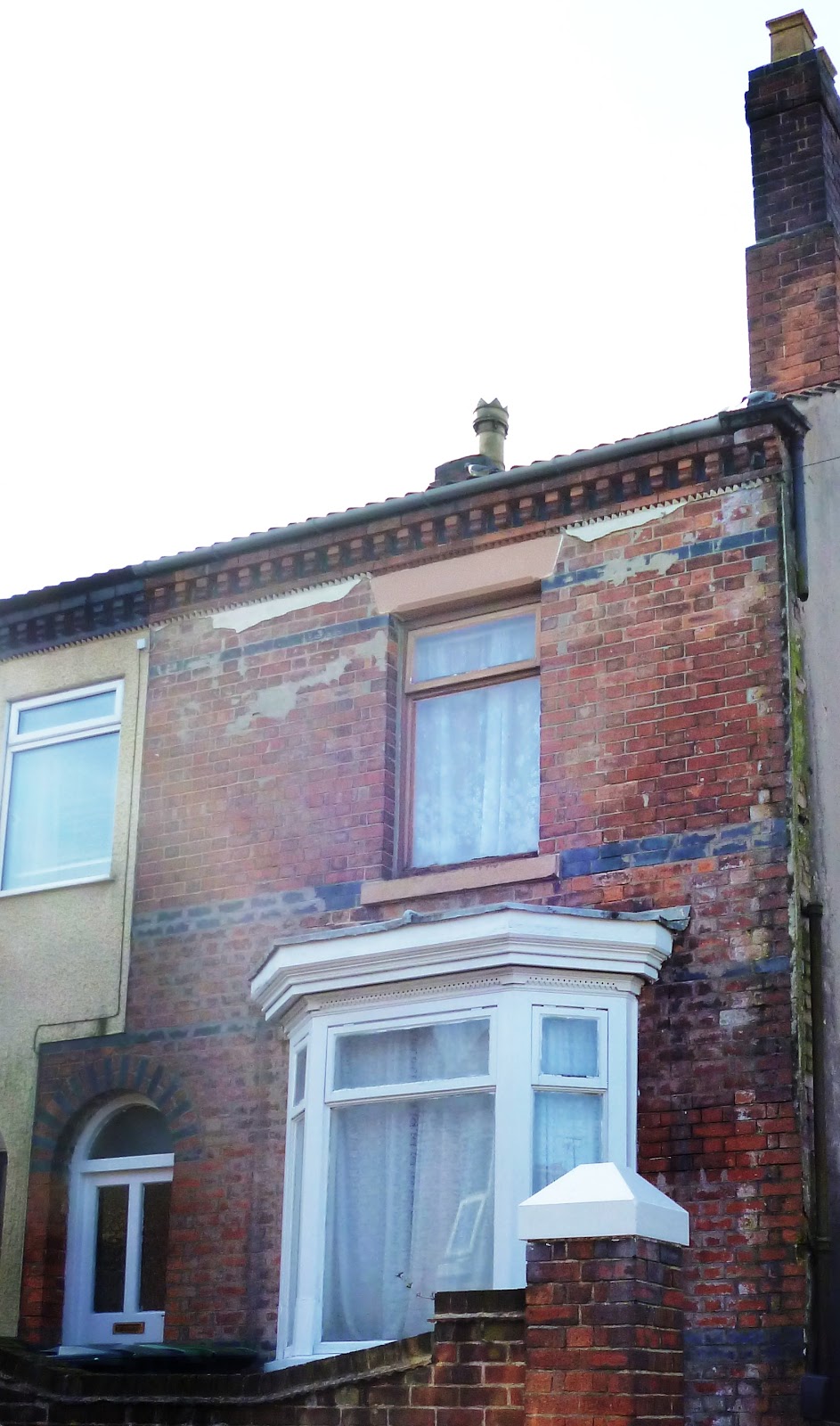
'It was a little less common to live in the Breach'
Each house move the Lawrences made in Eastwood was to more superior property. This is in 'The Bottoms' in Sons and Lovers, or the current 28 Garden Road.
'D. H. Lawrence lived here 1887–1891'.
'D. H. LAWRENCE HOUSE
A MEETING PLACE FOR
THE ARTS, INDUSTRY
AND EDUCATION
THE LAWRENCE FAMILY
LIVED HERE
1887–1891'
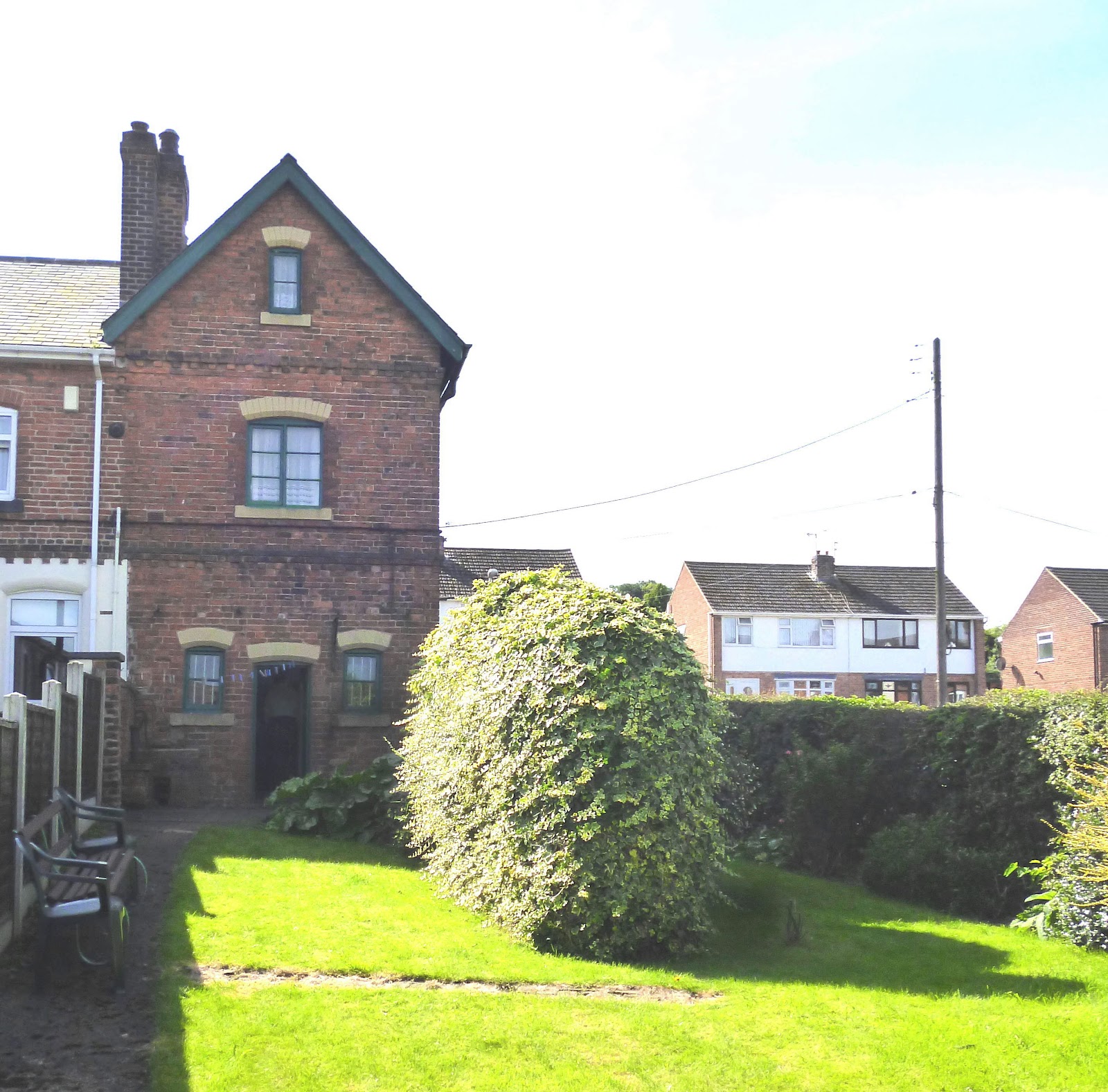
'It is finished'
The Lawrences lived here from 1905 to 1911. This was their only semi-detached house, and had a garden with a field at the back. In this house Lydia died in 1910.
'The country of my heart'
'Bleak House'
The Lawrences lived on Walker Street from 1891–1905, and although this plaque is on number 10, it is uncertain if this is the actual house where they lived: it may be number 8. In 1910 Lawrence's brother Ernest died here. This is a pretty awful shot of the house, but the sun was shining almost directly at the camera.
'Moon and Stars'
This was the name of the Three Tuns in Sons and Lovers, which was Lawrence's father's preferred pub, where he would stop off on the way home from Brinsley Colliery. It was also the site of the 'wakes' mentioned in the novel.
Yet another phoenix, this time one of a number on the railings at the junction of Nottingham and Mansfield roads.
In the background of the photo above is this structure, which one website calls the 'D. H. Lawrence Memorial', although the information bureau didn't recognize it by that name. Nevertheless, there is an obvious Lawrence connection, as there's a phoenix on the dome.
Outside Eastwood Library is Neale Andrew's 1989 relief sculpture entitled 'D. H. Lawrence 1885–1930', showing – among other things – a naked couple embracing with miners working underneath, with headstocks and a church in the background.
Also in the square by the library – another phoenix.
And in front of the phoenix, the fourteen plaques showing quotations from Lawrence. Three of them have been mentioned already, but here are the remaining eleven:
'They came near to the colliery. It stood quite still and black among the corn-fields, its immense heap of slag seen rising almost from the oats.
"What a pity there is a coal-pit here where it is so pretty," said Clara.
"Do you think so?" he answered. "You see I am so used to it I should miss it."
Sons and Lovers'
'Mrs Morel loved her marketing. In the tiny market-place on the top of the hill where four roads, from Nottingham and Derby, Ilkeston and Mansfield meet, many stalls were erected.
Sons and Lovers'
'The curtain was down [...] it represented a patchwork of local adverts. There was a fat porker and fat pork-pie, and the pig was saying: "You all know where to find me. Inside the crust at Frank Churchill's".
The Lost Girl'
'Paul [...] crept up the stone stairs behind the drapery shop at the Co-op, and peeped into the reading room [...]. Then he looked wistfully out of the window [...]. The valley was full of corn, brightening in the sun.
Sons and Lovers'
'It was a vast square building – vast, that is, for the Woodhouse – standing on the main street and highroad of the small but growing town.
The Lost Girl'
'The wide valley opened out from her, with the far woods withdrawing into twilight, and away in the centre the great pit streaming its white smoke and chuffing as the men were being turned up.
"The Christening"'
'Now Eastwood occupies a lovely position on a hilltop, with the steep slope towards Derbyshire and the long slope towards Nottingham.
"Nottingham and the Mining Country"'
'The string of coal-mines of B. W. & Co. had been opened some sixty years before I was born, and Eastwood had come into being as a consequence. It must have been a tiny village at the beginning of the nineteenth century, a small place of cottages...
"Nottingham and the Mining Country"'
'I was born nearly forty-four years ago, in Eastwood, a mining village of some three thousand souls, about eight miles from Nottingham, and one mile from the small stream, the Erewash, which divides Nottingham from Derbyshire. It is hilly country...
"Nottingham and the Mining Country"
'The church was away on the left, among black trees. The car slid on downhill, past the Miners Arms. It had already passed the Wellington, the Nelson, the Three Tunns and the Sun [...] and so, past a few new "villas," out into the blackened road between dark hedges and dark-green fields, towards Stack Gate.
Lady Chatterley's Lover'
'To me, it seemed, and still seems, an extremely beautiful countryside, just between the red sandstone and the oak trees of Nottingham, and the cold limestone, the ash trees, the stone fences of Derbyshire.
"Nottingham and the Mining Country"'.
Other blog posts I've made about D. H. Lawrence are linked below.
–––––––––––––––––––––––––––––––––––
The Breach House: D. H. Lawrence in Eastwood






 Posts
Posts


