Le Cimetiére du Père-Lachaise (or Père-Lachaise Cemetery, which somehow doesn't have the same ring to it: to translate, so often, is to remove) is a feast of past culture, and many writers and other interesting characters (a few of whom I couldn't resist including here) are commemorated in this place. It's best to begin the long, meandering, and inevitably digressive walk from the north to the south, which is downhill: the opposite way can be much more tiring, so if using the métro or bus get off at Gambetta. It took me the best part of two days to find my way around, by which time I was guiding others to graves, although I never found Anna de Noialles or Henri Barbusse, or a few others. Even with a map it's hard to find some graves, although that's part of the enjoyment — a little like finding hidden treasure.
Georges Courteline (1848—1929)
'J'étais né pour rester jeune et j'ai eu l'avantage de m'en aprcevoir le jour ou j'ai cessé de l'être'.
('I was born to remain young and I've had the advantage of noticing this the day I ceased to be so'.)
Franc Nohain (1872—1934)
'Fabuliste'.
The Columbarium is vast, and contains the urns of a number of notable people, although not knowing the numbers of some meant that I missed, for instance, George Perec: a major omission, I know. However, I found the urn of Richard Wright (1908—60), mentioned elsewhere in this blog in Tuskegee, Alabama, and Natchez, Mississippi.

The name Leïlah Mahi – presumably in the acting profession, but I'm not sure – didn't ring any bells, although I felt the need to include her because she tries so hard to be someone in this photo.
ADDENDUM 1: I've just discovered that she wrote two books, both of which were published by Louis Querelle: En marge du bonheur (1929) and La Prêtresse sans Dieu (1931). Her publisher is also rather obscure, and flourished from the end of the 1920s to the mid-thirties.
ADDENDUM 2: I'm obviously not the only one interested in her, as Didier Blonde has won the Prix Renaudot essai 2015 for Leïlah Mahi 1932, an attempt to search for the woman behind the tantalising face: she was a Syrian born in Beirut in 1890, who was single, and who lived for a time in Nice. Sounds like a necessary read. (Written 13 November 2015.)
Max Ernst (1891—1976) of course has many literary associations.
And finally (in the Columbarium at least), I have no idea who Léopold Fucker was, but he has his own Facebook page.
How could I ever forget this moment? I'm just about to take a shot of the Simone Signoret/Yves Montand grave, when a guy walks up and tells me how great Montand was and about the great humane works he did. I suspect he was waiting for someone to stop there and agree with him, as a woman stood right at the other side of me and he continued to make eulogies about Montand...(continued immediately below).


But she was on a slightly different mission, I think, and asked if either of us has noticed the grave right at the side of Signoret's and Montand's — that of the singer Francis Lemarque (1917—2002). I confessed to an absence of knowledge of Lemarque's work, but she then started singing one of his songs, which was equally unfamiliar to me, so she continued by singing another song until she convinced me that I did indeed know Lemarque's work. A wonderful moment: a guy on my left talking about the integrity of Yves Montand, and a woman on my right singing songs by Francis Lemarque. I can imagine something like this happening somewhere in the States perhaps, but in England? Please, let's not speak to anyone: let's be cold fish.
So I wander over to Marcel Proust. Not too easy to find, but why was I expecting more as well? Not even a quotation.
But quotations there certainly are at the grave of Guillaume Apollinaire. The following verses are from his poem 'Collines' and speak of his death:
'JE ME SUIS ENFIN DÉTACHÉ
DE TOUTES CHOSES NATURELLES
JE PEUX MOURIR MAIS NON PÉCHER
ET CE QU'ON N'A JAMAIS TOUCHÉ
JE L'AI TOUCHÉ, J'AI PALPÉ
ET J'AI SCRUTÉ TOUS CE QUE NUL
NE PEUT EN RIEN IMAGINER
ET J'AI SOUPESÉ MAINTES FOIS
MÊME LA VIE IMPONDÉRABLE
JE PEUX MOURIR EN SOURIANT
HABITUEZ-VOUS COMME MOI
À CES PRODIGES QUE J'ANNONCE
À LA BONTÉ QUI VA REGNER
À LA SOUFFRANCE QUE J'ENDURE
ET VOUS CONNAÎTREZ L'AVENIR.'
What I really love, though, is this calligramme, with a message (unfortunately a little difficult to read due to weathering) in the shape of a heart, which begins with the 'M' at the top right and continues down and up: 'MON COEUR PAREIL COMME UNE FLAMME RENVERSÉE': 'My heart the same as an inverted flame'.
Oscar Wilde's tomb is large and impressive, but noteworthy too by the many lipstick kisses on it. It is also covered in people's comments, which as you'd expect mainly express their enthusiasm for Wilde — 'We love you Oscar. You are in our memory', 'La passione non deve essere soffocata' (Passion mustn't be stifled'), and appropriately there's even the Wilde-sided Morrissey quotation from his famously misspelt song title 'Cemetry Gates'; the occasional one is non-committal:' 'Io non ho niente da scrivere' ('I have nothing to write about him'); and some are plain hostile: 'Hail to the freaks', and 'Motherfucker'.
Robert Ross, Wilde's executor and former lover, commissioned Jacob Epstein for the monument, the genitals of which were vandalized.
Longterm American expatriot Gertrude Stein.
And at the back of the grave, her longterm partner Alice B.Toklas (1877—1967).
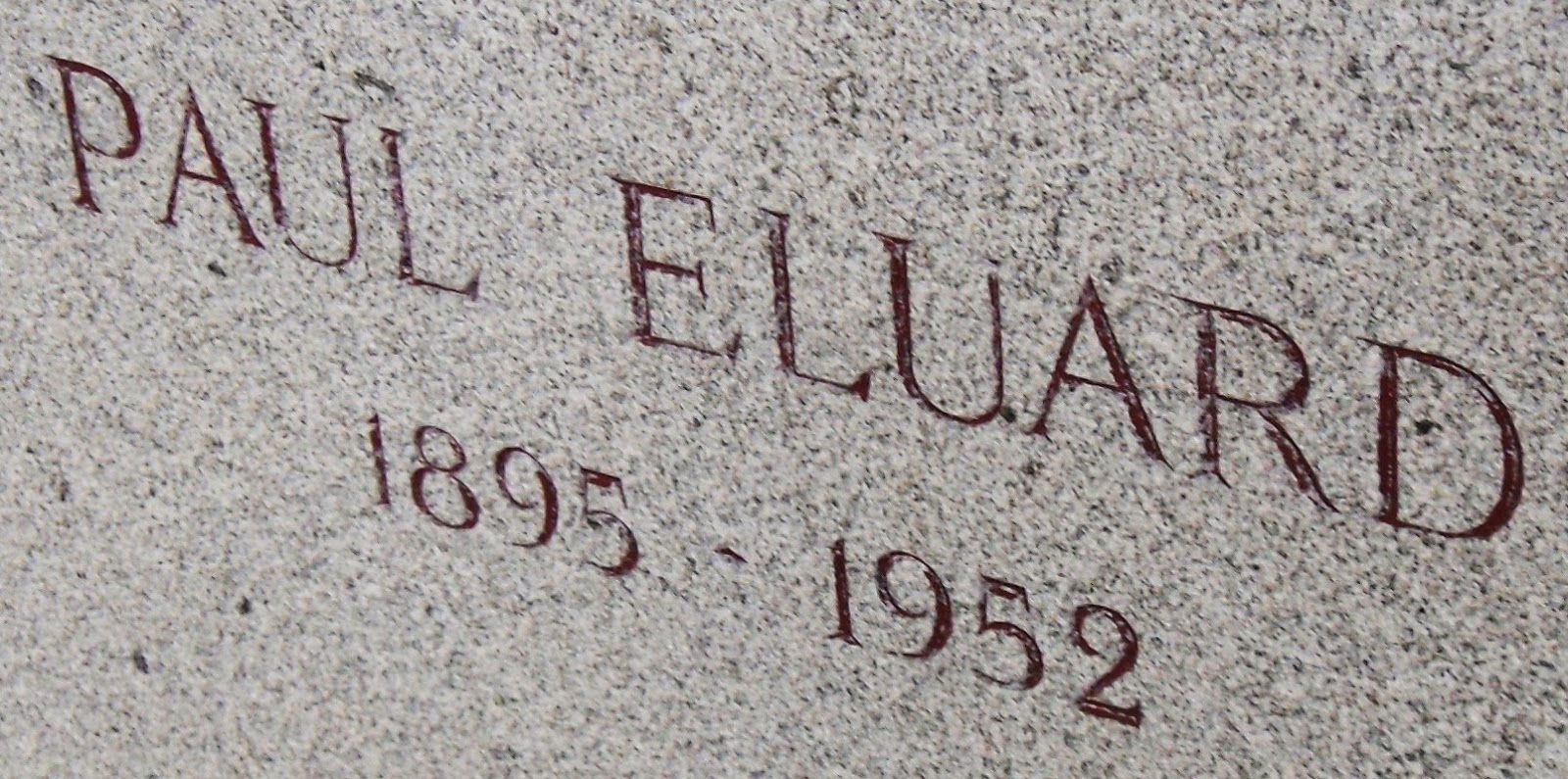
Paul Éluard (1895—1952)
I seem to remember (quite possibly incorrectly) that Éluard went through a short phase in which he used to knock at random on doors and ask if he didn't live there. I may be confusing him with another Surrealist, but if so and someone knows anything about this, please let me know by a comment or an email.
The grave of Édith Piaf (1915—63) is easy to find as it's one of the most popular in the cemetery and there is usually a crowd gathered.
And another very popular grave is that of the murdered journalist Victor Noir (1848—70), who lost his life at the age of twenty-one.
The money for this outstanding grave was raised by public subscription. Just in view on the bottom right is the amount of rubbing that people have made to his feet to bring them luck, which reminds me of similar rubbing of Montaigne's foot on his statue near the Sorbonne, and the rubbing of Dalida's breasts on her bust in Square Dalida, Montmartre.
In the case of Noir, though, the feet rubbing, along with the nose and the chin rubbing, are probably euphemistic or timid actions, as the real focus of interest is his prominent hard-on: to many people, rubbing this area is a fertility symbol.
His hat frequently contains floral tributes.
Opposite Balzac is the phallic-shaped column of Gérard de Nerval (1808—55).
And the sculptor, no doubt working with his tongue firmly in his cheek, was Dalou.
Honoré de Balzac (1799—1850) shouldn't really need a comment, but anyway I shall be making a post about the Maison Balzac in Passy.
Pierre Bourdieu (1930—2002).
The tomb of Molière (1622—73), pseudonym of Jean—Baptiste Poquelin.
The tomb of (Jean de) La Fontaine (1621—95).
The tombs of these two giants of French literature were placed together here in 1817.
Tucked away on the same street is Alponse Daudet (1840—97).
'La haine, c'est la colère des faibles'.
('Hatred is the anger of the weak'). NB. This is not on the grave, but is from a postcard I've inserted.
Frédéric Chopin (1810—49).
Miguel Ángel Asturias (1899—1974)
Among so many (usually much older) graves, the modern look of this is really striking.
'"Prix Falla" Meilleur élève des Etudes Secondaires
"Prix M. Gálvez" Meilleur thèse de l'Université
Citoyen honoraire du Monde Asiatique 1957
Prix International du Roman Paris 1962
Grande Croix de l'Ordre de Libertador Bolívar Colombie
Grand Officier de la Légion d'Honneur Paris 1966
Prix Lénine de la Paix 1966
Prix Nobel Littérature 19 Octobre 1967
Doceur Honoris Causa Université Ca'Foscari Venise 1972
Grand Prix de la Ville de Paris 1972
Né au Guatamala le 19 Octobre 1899
Mort à Madrid le 9 Juin 1974'.
One of the first of the famous graves many note if entering via the main entrance (which of course I don't recommend — see first paragraph of this post) is that of Colette (1874—1954).
Benjamin Constant (1767—1830)
The tomb of the Beaumarchais family.
I was struck by this double tomb, and the 'national poet' Pierre— Jean de Béranger's desire to be buried with his friend the prominent lawyer Jacques— Antoine Manuel, although I'd heard of neither of them.
Some bloggers are understandably eager to bring a gay reading into this, although a cursory Google wasn't fruitful. I shall definitely look again and add to this part of the post if necessary. And I won't make assumptions from observations, although I don't think the furtive single men hanging around here were looking for Anna de Noaille's grave.
The grave of Jules Vallès was more difficult to find even than Daudet's. I shall in a future post be including a house Vallès lived in Maisons—Laffitte.
'Ce qu'ils appellent mon talent n'est fait que de ma conviction'.
('What they refer to as my talent is merely the product of my conviction').
Jules Romains (1885— 1972).
Unfortunately I've read nothing of his work, but then the sheer size of the task is daunting.
Unless the weather is really bad it's probably impossible to miss Jim Morrison's grave: there's usually a crowd there (often mainly American), and the noise level is usually quite high. When I was there this time, I saw an American (a military enthusiast as it turned out) quietly sitting opposite the site reading the very good guide Permanent Parisians, which has helped me not only to find a number of graves, but also to find several cemeteries of which I was previously completely unaware. Oh, Jim Morrison: yes, there was a American woman telling a much younger bunch of women about the many times she'd seen Morrison live, and in spite of the rail fencing off the grave to prevent fans going near it, there was an empty bottle of Jack Daniels on the grave itself along with a number of other items, and a woman was gently pushing lighted candles under the railings.


As writing on this grave (as opposed to Wilde's) isn't really possible, the trees nearby are covered in comments and The Doors' lyrics.
Alfred de Musset (1819— 1905).
'MES CHERS AMIS QUAND JE MOURRAI
PLANTEZ UN SAULE AU CIMETIERE
J'AIME SON FEUILLAGE ÉPLORÉ
LA PALEUR M'EN EST DOUCE ET CHÈRE
ET SON OMBRE SERA LÉGERE
À LA TERRE OÙ JE DORMIRAI'
The words express Musset's wishes for a willow tree to be planted in the cemetery because of his great love of them.
Charlotte Améie Hermine Lardin de Musset (1819—1905) is buried next to him.
'Celle qui fut toujours la gardienne fidèle
De ta gloire ô poète, et qui pieusement
Vécut de souvenirs en ton rayonnement
Doit dormir près de toi dans la paix éternelle.'




 Posts
Posts

