Showing posts with label Nottingham (UK). Show all posts

22 March 2022

Lytisha Tunbridge in Lenton, Nottingham

'Lenton Green

Green is the new gold fine woven through our community,

cross-stitched point to point by paths, plants, seats

where we greet and watch the world go by


powered by beams of sunlight, weft with windows bright

homes, each mesh grounded with garden or balcony of our own

here we all have a slice of the sky'

This rock is in a small space in a city suburb, and I was delighted to find it. Lytisha Tunbridge, Lenton poet, has published two 'pamphlets': Every Last Biscuit (2017) and A Backpack on his Backpack (2019). She has also made several online performances, and her work is in several anthologies.

Thomas Helwys in Lenton, Nottingham


Thomas Helwys (c.1575-c.1616), born in Gainsborough, was a founder of the General Baptists. Broxtowe Hall was the family home. He married Joan Ashmore at Bilborough in 1595, and continued living in Broxtowe Hall, a place for dissenters. He wrote a number of religious works and died in prison. Thomas Helwys Baptist Church on Lenton Lane, Lenton, is named after him.

3 February 2020

'Xlylophone Man' Frank Robinson in Nottingham

'Xylophone Man'
Frank Robinson
Frank dies in July 2004 aged 72.
He played his xylophone here for 15 years,
bringing a smile to the faces of the
people of Nottingham.'

Odd, but it's now that I no longer live in Nottingham that I notice this plaque on the ground outside H&M (formerly C&A), near where he played very amateurishly on what his Wikipedia entry calls a 'small child's metallophone'. In spite of his obvious lack of trained musical skills (or maybe because of the lack) Frank was dearly loved by those who went by him in Lister Gate. The LeftLion paper got a short interview with him, where it was discovered that he'd spent all his life in Cotgave, Nottinghamshire.

2 February 2020

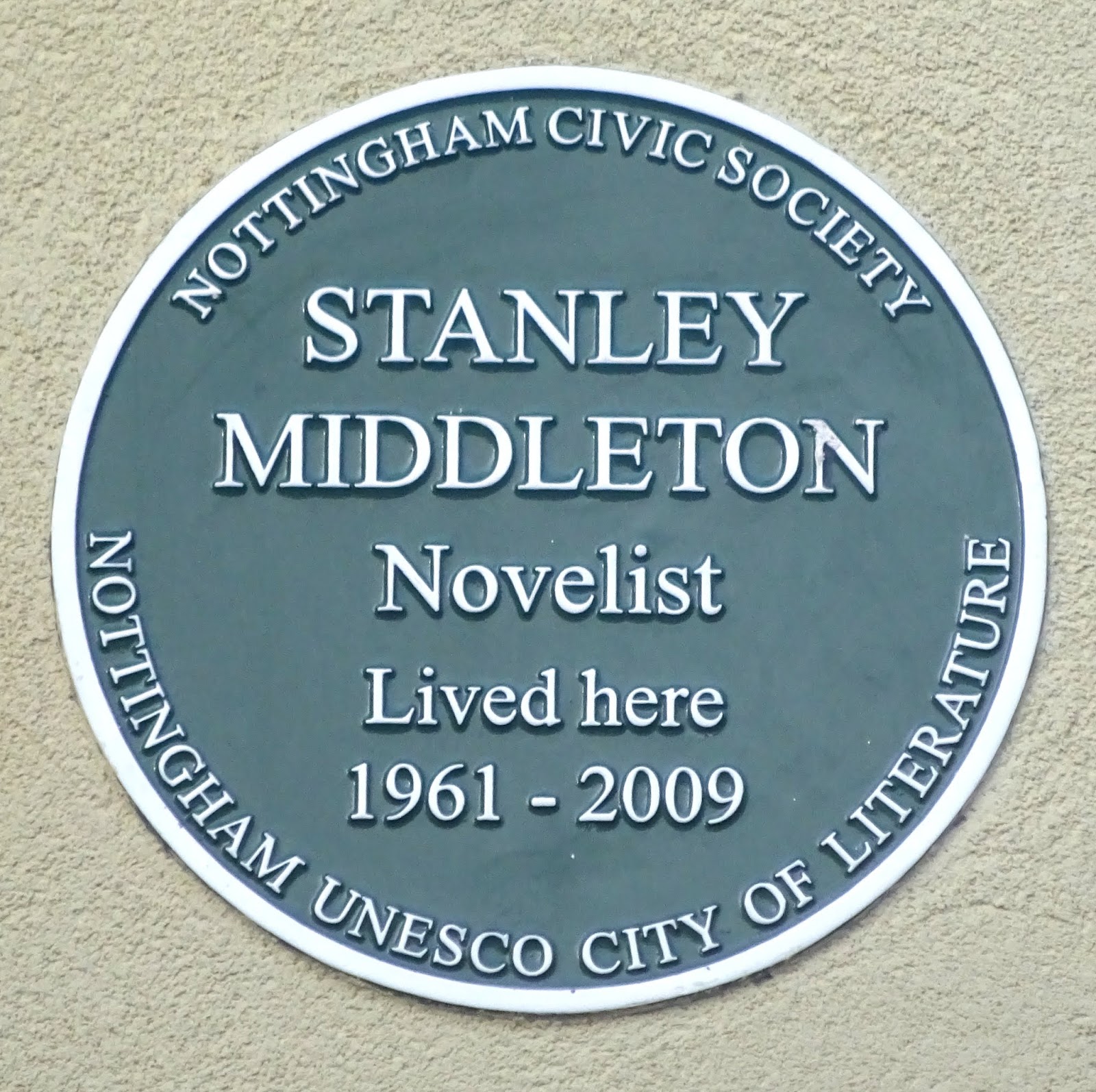
Stanley Middleton in Sherwood, Nottingham

'STANLEY
MIDDLETON
Novelist
Lived here
1961-2009'

The writer Stanley Middleton (1919-2009), who was born in Bulwell, Nottingham, spent more than half of his life at 42 Caledon Road, Sherwood, Nottingham. He was joint winner of the Booker (with Nadine Gordimer for The Conversationist) for his novel Holiday in 1974, and wrote about fifty other novels, virtually exclusively set in middle-class environments, although his origins are working class. He was very much a follower of the dreaded F. R. Leavis, whose influence casts a bleak shadow over English literature even today: Leavis essentially advocated the study of literature (mainly poetry) with no social, biographical, psychological, etc, background, which is enough to put anyone off the study of literature for life. I was a student of 'Stan Middo's', and fortunately Leavis didn't put me off, not that at the time I knew anything about him anyway.

Stan was a teacher at High Pavement Grammar School, Gainsford Crescent, Bestwood Estate, where (never having a car) he used to walk every day via Hucknall Road. He was a very affable, very human character with a dry sense of humour, although the thought of Bob Dylan winning the Nobel Prize for Literature would have left him speechless. This is a great shame, because even Salman Rushdie so wisely approved of Dylan's award. I'm pleased to see Stan has finally been awarded a plaque.

13 November 2016

Andrew Asibong: Mameluke Bath (2013)

I read somewhere that Dr Andrew Asibong's favourite writers are Kafka, Marie NDiaye and, er, Stephen King. His PhD was titled 'Metamorphosis and the Métèque', and he has an interest in Haitian culture. A reader might guess from this that a novel written by Asibong may involve horror, the outsider, sudden changes, maybe zombies and certainly a general all-round weirdness. He or she would be correct, although there's much more in Mameluke Bath, Asibong's first and only novel so far.

This novel is also very funny, sometimes staggering in its complexity, and incidentally a pop music (and to some extent film) anorak's delight. If you live in the East Midlands or have spent any time there (like Asibong who was born in the Peak District and worked at the University of Nottingham), you can also exercise the train spotting gene: Mameluke Bath recalls Matlock Bath with its Heights of Abraham (here Gallicised to the Heights of Rocamadour), and the 'truly dreadful' villages of Darley Dale and Whatstandwell (only briefly mentioned in passing) aren't even given a name change; however, although St Pauly (where much of the novel is set) might initially suggest the St Ann's area in Nottingham, it is evident that St Pauly represents Nottingham itself, with its reference to 'the oldest pub in England, or so they say' being called 'Ye Olde Road to Damascus' (Ye Olde Trip to Jerusalem) before 'yellow brick' was added between 'Olde' and 'Road' and the place turned into 'the glitziest gay bar in the East Midlands'; other references to 'proto-anarchist forest bandits of the twelfth century' (Robin Hood and his band), the Council House, Theatre Royal, Market Square, university lake, etc, loudly scream 'Nottingham'.

I'll not attempt to go into the plot, except to say that it involves Christie Smithkin, a 39-year-old PhD student at the university who, seeking to get out of her financial mess by mentoring Congolese asylum seeker Mukelenge, who already has the mentor Damon and anyway seems to know his way around the East Midlands far more than either of the others. Not too far into the book, it seemed obvious to me who Mukelenge really is: I think it's the words 'true identity' on the back cover that give him away.

Here, we have an intricate mix of immigrants 'paying' their way into the country by lice feeding from their open wounds, homosexuality (including a spirited visit to the Village in Manchester), mothers behaving (sexually) badly, and a whole lot more. It's time the tale were told.

An amazing book.

10 April 2015

Charles Bell Taylor (1829–1909), Nottingham

Here we have a clearer picture than the sculpted likeness on his gravestone in Nottingham General Cemetery – surely taken from this? – of what the ophthalmic surgeon, feminist, defender of animal rights, and writer Dr Charles Bell Taylor looked like. This picture is from Centenary of the Nottingham Medico-Chirurgical Society on March 7th, 1928.
 
Link to my previous post:

–––––––––––––––––––––––––––––––––––
Charles Bell Taylor (1829–1909)

4 March 2015

Ray Gosling: Personal Copy: A Memoir of the Sixties (1980; rep. 2010)

How can I write coherently or in any way meaningfully about Ray Gosling (1939–2013), a man best known for his former television appearances, and whose face on the cover of this book means nothing to me? Because I'm one of the 500,000 people the supremely arrogant and fascistic BBC believes are liars when they say they don't have a television receiver. And yet I certainly don't have a television receiver, because I'm convinced that virtually all that television companies throw in people's faces is tedious, childish, right-wing, time-wasting shit. Reading Ray Gosling's book, though, I'm very willing to accept that his contributions to a generally horrendous medium were extremely rare examples of fascinating television.

There aren't many dates mentioned in this autobiography – which is in part a collection of previously published articles – to pin events down, and much seems to come from the smoke of memory, so I suppose it's fitting that this re-publication comes from Five Leaves, a small publishing company which indirectly (via Nick Drake) alludes to a small reminder, a slip of paper that was used in Rizla cigarette paper packets: only one more five-skinner to go!

However, the book tries to avoid temporal digression by being divided into a number of sections, including an early one called 'The Americans', dealing with Gosling's representation of them in the war years, and they certainly seem (in Wim Wenders's words), to 'have colonised our [i.e. Europeans's, and certainly Gosling's] subconscious': there's a quotation from Jack Kerouac's The Subterraneans in Part One ('A great preamble into nothing').

But it's not the American smoke of memory from the Beat writers that Gosling's first part concludes on, but Buckminster Fuller, which amazed me, and – like a number of things in Personal Copy – sparked off recollections. There are even two chapters here on Fuller, even including a mention of '[Fuller's] own university at Carbondale, South Illinois'. Carbondale is a tiny paradise where in summer a blanket of heat enwraps you, huge multi-coloured butterflies brush your face, chipmunks scamper around, American robins are everywhere, and people jog up to you on the sidewalk and stop just to say hello, ask you what you what you've got planned for the day, and then merrily jog off. Perhaps unsurprisingly, it was where Bucky lived with his wife for ten years in the geodesic dome he'd built. I was reminded of the two occasions I'd spent in Carbondale researching Lionel Britton, two months in all, and of how on the first occasion I couldn't find Carbondale's only (and unadvertised) 'tourist attraction': Bucky's little dome, which the (at the time) director of the Special Collections Center in the Morris Library drove me to see on learning that I couldn't locate it.

Personal Copy worked on my mind like that, forcing me to peel back the layers of the onion, memory (yeah, I couldn't resist alluding to Craig Raine, as well as Iain Sinclair above) that made up my search for Buckminster Fuller: first, many years ago, by reading I Seem to Be a Verb; searching for his modest 'Call me Trimtab' grave in Mount Auburn, Cambridge, Massachusetts; the glory of his geodesic dome in Montréal; and the disappointment on learning from the Information Center that the former Black Mountain College near Asheville, North Carolina where Bucky once taught is now occupied by a religious group which doesn't allow people to visit the grounds.

Gosling doesn't say much about Leicester, where I too went to Leicester University (French for the first degree), although he didn't stick it through, his stay there was in an era before mine, and I don't recognise any of the few places he mentions. But, odd though it may seem, he's not joking when he says that this used to be a – as the expression went at the time – 'mental hospital'  although I believe its former incarnation is now largely represented by a few office buildings.

But there's much more on Nottingham, particularly the drinking spots, and I too have spent many hundreds of hours in pubs in the heart of the city. He mentions the rather bohemian nature of the (non-licensed) Kardomah café. I only just remember this place, and that it was still then populated by oddballs but mainly student types, and everyone in those days simply called it the KD to express their (usually false, I think) great familiarity with it.

A number of pubs Gosling brings up had gone in my day, although I was very surprised that he briefly mentioned Veronica, the sturdy gruff-voiced barmaid at the Albert Hotel. She must have aged considerably by the time she (begrudgingly, I thought: maybe because she knew I was underage, or perhaps she was just that way with everyone?) used to serve me pints of Younger's in the Scotch Bar at the back of the hotel. By that time she had developed a moustache, of which she seemed very proud. Gosling says nothing of barman Bert who also worked there, and who behaved in a deliberately camp manner, but I suspect Bert came after Gosling's time.

I get a strong impression – surely backed up by the lack of dates here – that Gosling's 'sixties' are more generic than date-stampable, more in the mind than held fast to any particular period. So it seems slightly odd that such an essentially anti-establishment person should say nothing of the Scheme club, held from the sixties onwards: The Scheme were a (mainly alternative) folk group with (probably only occasionally) Paul Waplington – who later became an artist – and Stephen Morris reading poetry. I believe it began downstairs at the Fox on Parliament Street (now No. 10), moved upstairs, and ended its days at the Bowling Green (now gone).

Part Two is titled 'Battle of the Slums' and is shorter than the first part. It's concerned with Gosling's role in the struggle to save parts of the working-class St Anns area in Nottingham, which was doomed to failure. The strength of this part is the affection he shows for the people who lived there, his admiration for their spirit. Initially he has a few good words to say about Ken Coates, although Coates's co-author of the book Poverty: The Forgotten Englishmen (1970) is simply recorded as Billy or Bill, and I didn't notice either a mention of Bill's surname or the name of the book itself: the name is Silburn, and his forename on the title-page is Richard. Which reminds me that I once met Bill Silburn with a couple of other students and that at the time (by way of a reference to Marshall McLuhan) he said something to the effect that the working class would die without television, which I suppose in a sense takes us back to the beginning of this rambling post.

Ray Gosling was obviously a great character, a lovable kind of anarchist, and someone who could get away with a number of things on television that he would be unable to do in these stage-managed, fame-obsessed, trivia-pursuing days in which anything goes only as long as it's glittery, beautiful, young, famous or potentially famous: in other words anything that leaves me cold and reminds me how wonderful it is, of how I've privileged myself, to live in a world without the mindless hype of television.

Oh, and the book ends in 1979, shortly after the fateful elections, when Thatcher and later her spiritual son Blair would set about destroying the country, ploughing eccentricities into oblivion in an insane rush to kill all the social progress that had been made over many years, a rush to make greed the omnipotent ruler and the world in general a much more dangerous place to live in. There could never be another Ray Gosling, and I can't help fearing that his kind is fast becoming an extinct breed.

16 February 2014

Thomas Bailey in Basford, Nottingham

Thomas Bailey (1785–1856) was a journalist and poet and the father of the poet Philip James Bailey (1816–1902). He was born in Nottingham and was the owner and editor of the Nottingham Mercury, although in his article in the ODNB Thompson Cooper says that Bailey was 'too moderate for his readers', and that the paper suffered from declining circulation as a result and folded in 1852. Basford House in Church Street, Basford, Nottingham, dates from 1730 (or perhaps earlier) and was formerly named the Manor House. It was bought by Bailey in the 1830s, and he lived here until his death, 'writing and collecting books and engravings'.

Among Bailey's writings, Cooper lists A Sermon on the Death of Byron (1824), the four-volume Annals of Nottinghamshire (1852–5), Village Reform: the Great Social Necessity of Britain (1854), and Records of Longevity (1857).


 'THIS MEMORIAL WAS ERECTED BY
THOMAS BAILEY
THE HISTORIAN, IN THE GROUNDS
BELOW, (OPPOSITE THIS CEMETERY)
TO COMMEMORATE THE PASSING
OF THE REFORM ACT, A.D. 1852:
& WAS REMOVED HERE TO MARK
THE RESTING PLACE OF HIS MUCH
ESTEEMED & VALUED FRIEND.'

The old cemetery opposite the house. Writing in Old Nottingham Suburbs: Then and Now (1914) Robert Mellors states that Bailey also erected a column in the grounds of the house to commemorate the act, but that it was removed and re-erected in the old cemetery when the house was sold. Bailey's friend, anonymously mentioned above, was R. B. Spencer. The column is no longer there.


A link to my earlier post on Philip James Bailey is below.

–––––––––––––––––––––––––––––––––––
Philip James Bailey, Nottingham

13 January 2014

Philip James Bailey, Nottingham

A plaque on a building on the corner of Fletcher Gate and Middle Pavement, Nottingham, reveals that the writer Philip James Bailey once lived there. There is also a bust of Bailey by Albert Toft at the rear entrance to Nottingham Castle – both images are on another of my posts here.

I originally put a little piece of information about Bailey on the sidebar several years ago, which I reproduce below:

Bailey was born in Nottingham and educated in Glasgow, and is usually associated with the Spasmodic school of poetry along with J. W. Marston, S. T. Dobell, and Alexander Smith. He is most noted for Festus, a huge work to which Bailey was continually adding, and which was heavily influenced by Milton's Paradise Lost. Its most famous lines are:

'We live in deeds, not years; in thoughts not breaths;
In feeling, not in figures on a dial
We should count time by heart throbs; he most lives
Who thinks most, feels noblest, acts the best.'


Thanks to Dr Rowena Edlin-White for locating Bailey's grave in Rock (or Church) Cemetery, Mansfield Road, Nottingham, and for her transcript – which can't have been an easy thing to do – which I reproduce below:

'SACRED
TO THE CHERISHED MEMORY OF
ANNIE SOPHIA
FOR 33 YEARS THE DEVOTED WIFE OF
PHILIP JAMES BAILEY
ENTERED INTO REST OCTOBER 27th 1896
“BLESSED ARE THE PURE IN HEART FOR THEY
SHALL SEE GOD”

TO THE REVERED AND BELOVED MEMORY OF
PHILIP JAMES BAILEY
(FESTUS)
WHO ENTERED INTO REST SEPTEMBER 6th 1902
AGED 86 YEARS

“DEATH IS ANOTHER LIFE. WE BOW OUR HEADS
AT GOING OUT, WE THINK, AND ENTER STRAIGHT
ANOTHER GOLDEN CHAMBER OF THE KING’S
LARGER THAN THIS WE LEAVE, AND LOVELIER.”*

PHILIP FESTUS JAMES BAILEY
ONLY SON OF PHILIP JAMES BAILEY
WHO DIED MARCH 9th 1904 AGED 62 YEARS.'
*From Festus.

5 January 2014

Five Leaves Bookshop, Nottingham (with many extensive self-indulgent preliminary digressions)

When I was studying for my MA in Literature a fellow student told me that he'd been to Waterstones in Oxford and that an American assistant had expressed interest that he'd purchased a book on the second generation Romantics, and remarked that she was studying for a PhD on 'Shelley and Music'. My friend slunk away in tongue-tied ignorance of how to react to that announcement. Although equally ignorant of Shelley and music I doubt if I'd have reacted in the same way, but then in my experience of Waterstones I've never experienced such a response to buying a book.

About ten years ago – when studying for my own PhD on the working-class anarchist novelist and playwright Lionel Britton, I ordered Melba Cuddy-Keane's Virginia Woolf, the Intellectual and the Public Sphere from Waterstones in Nottingham, as it was important for my chapter on working-class modernism, arguing that mainstream modernism has never been the elitism that some critics claim. Cuddy-Keane's book was a pretty obscure work and as the assistant handed it to me and I fished in my wallet for my credit card, he almost whispered the price of this very slim CUP book – '£27' – adding 'That's the price of education.'

Well, as a former working-class kid from a virtually bookless family – to my knowledge my father only bought one novel in his life, which was Lady Chatterley's Lover, and that was only to discover just how 'terrible', as he put it, the 'language' was – I know it's impossible to put a price on education. At the time, the arcane nature of libraries – an arcaneness protected by snooty librarians and assistants determined (I imagined) to prevent people (particularly members of the working class) from gaining access to knowledge – was a very difficult barrier to breech, although I made it through, albeit very late in the day but still (post-PhD) have a determinedly Foucauldian view of some librarians, plus an inexplicable residual fear of them.

Enter, then, independent bookshops in Nottingham in my intellectual foraging. Bux was a wonderful shop before the Broad Marsh bulldozers moved in on Drury Hill, which could have been a fine example of Nottingham's quaint past. There, I could (as a budding hippie) stock up on the latest issues of such 'underground' magazines as IT (International Times) and Oz (some time before the (harmless but considered provocative) Schoolkids issue), as well as buy, for instance, (as my interests broadened) a book called McLuhan: Hot and Cool, which influenced me in a number of ways. Unfortunately – towards Bux's end, long after its move to Lincoln Street – they found it necessary to employ a highly obvious young female store detective twirling about on a stool in the center. It felt like the end had already come.

Later – thoroughly pissed off by the library-like snootiness of the main Nottingham bookstore on Wheeler Gate, Sisson & Parker – I decided to order books from Concord Books on Woodborough Road, run by the vegetarian, pacifist, Friend of the Earth and (I seem to remember) teetotaller David Lane.

My first conversation with David was about Theodore Roszak, as David had met him, and I came to order a few of Roszak's books through Concord. Whiling away my time in Nottingham before moving on to university, I was forced at the time – in order to gain independent student status – to work for three years.

And I worked at Nottingham Central Library (then on south Sherwood Street) for eighteen months in order to acquire that status, developing all kinds of psychosomatic illnesses in the process. Some lunchtimes – maybe twice a week – I visited Concord Books and ate my sandwiches there washed down with David's crazy sanity.

On one of the last times I visited him before I left the country for a few months touring Provence in its healing sunshine, and before I began at Leicester University to study single-subject French, David was frantically trying to get through to the French Embassy to protest about some ecological catastrophe or other. I couldn't help thinking that all the phone calls wouldn't necessarily help his business's declining finances.

All this is to say that independent bookshops are vital: where, other than Concord Books, would I have bought all those books about the population explosion, the evils of Concorde (the plane), a signed copy of Richard St. Barbe Baker's My Life, My Trees, a book on the Tuparmaros of Uruguay (even though David was to some extent apolitical and saw 'left' and 'right' as largely irrelevant terms), etc.

I have little memory of Mushroom – I believe that much of the time I was living elsewhere – although I remember finding a cherished copy of Linton Kwesi Johnson's poems there.

But now – after thirteen years of independent bookshop drought – there is a new one in Nottingham: Five Leaves Bookshop, in an alley at the side of The Works (or Primark), Long Row. Created by Ross Bradshaw of Five Leaves Publications, this is a bold venture in these times, and the above publicity card lists the bookshop's specialities:

'History and landscape, politics, fiction and poetry, lesbian and gay, counterculture, psychology, weird and wonderful, international writing, magazines and journals.

Specialising in independent publishers'.

Children's books and Roma were added after this was printed (plus there's a section on the Beats). The rationale seems to be no royal family (hurrah!), no military history (hurrah!), no Jamie (hurrah!), and no celebrity biographies – ditto, although the wonderful new Mozzer book is to be stocked: see below for my coverage of it, or click on this for the same (although I'd pass on it if you're a Daily Mail reader): Morrissey's Autobiography.

I have hardly any time for venturing into Nottingham city center (like Moz, I prefer the more logical American orthography) these days, but Penny and I managed a flying visit: Penny – a very late convert to growling Leonard Cohen  was interested in the material on her ageing hero, whereas I was amazed to see a copy of Susheila Nasta's Wasifiri, a magazine that I know from years of experience can lure you into its literary web and just leave you there to fight your way out of.

I was very pleased to see several books by B. S. Johnson, one the few experimental writers so different from the usual largely boring mess of English – as opposed to British – literature (yawns such as Amis, McEwan, Mantel, etc). But missing was Jonathan Coe's Like A Fiery Elephant: The Story of B.S. Johnson: surely his best work and far more interesting than his fictional efforts?

I could go on and on, rambling, but I'll just say support British independent bookshops such as the highly commendable Five Leaves or they'll die: use somewhere else for showrooming – these kinds of places can and should educate you as they educated (and continue to educate) me.

18 October 2013

Karl Wood, George Green and Simple Films Limited at Bromley House Library, Nottingham

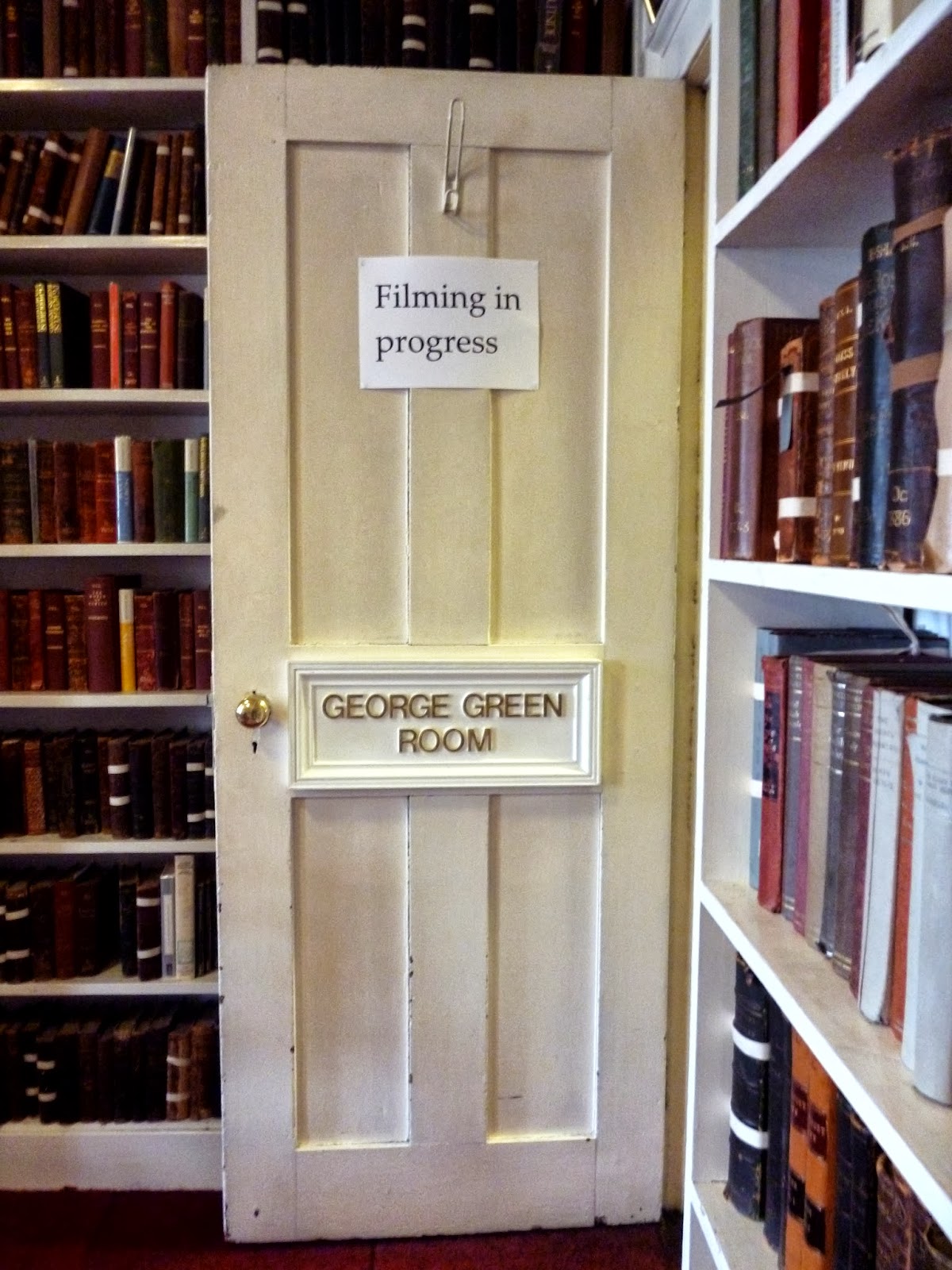
This morning I was interviewed about Karl Wood by Stuart Cresswell, the Managing Director of Simple Films Limited, Welsford, Nova Scotia, Canada, in the splendid setting of the George Green Room at Bromley House, Nottingham. Stuart and crew are on the point of completing the filming of the hour-long The Mühlendämmerungs of Karl Salsbury Wood, a part-biography of the bookish windmill artist Wood, so this was a highly appropriate background.

The George Green Room with, from left to right: Paul Allen (Camera), Stuart Cresswell, and Charley Cresswell (Sound).

I also took the opportunity to photograph a few things that had escaped my attention when I last came here in June this year. Above is a representation of the plaque in Westminster Abbey, placed there on 16 July 1993, just two days after the bicentenary of the birth of George Green, who was a member of the library from 1823 to 1833.

Mrs Jane Moth (1824–1900), née Jane Smith, was George Green's eldest daughter.

Due to building works in June I was unable to get a decent view of the garden, but now there's a view of the back of Bromley House Library unhindered by scaffolding.

The garden of Bromley House Library.

An impressive 'mean time' sundial. A page of explanation is attached to it, but this is science so I won't run the risk of making a cock-up of a précis of it.

A very enjoyable morning: I look forward to the screening of the film and thank the crew for their relaxed style and their hospitality.

Thanks also to Dr Rowena Edlin-White and Carol Barstow for making this venue possible, and to the rest of the staff there today for their enthusiastic welcome.


–––––––––––––––––––––––––––––––––––
Bromley House Library, Nottingham
Windmill Wood: A Biography of Midlands Artist Karl Salsbury Wood

12 June 2013

Bromley House Library, Nottingham

Nottingham Subscription Library was established in 1816 and moved to Bromley House on Angel Row six years later. The plaque outside tells us that the house dates from 1752: it was originally a town house built for George Smith, who was a grandson of the founder of Smith's Bank.

Bromley House Library's inconspicuous entrance. This is a Grade II* listed building.

The first floor, with its superb spiral staircase leading to the Gallery.

Up in the Gallery looking towards the garden at the back.

And a different view of that staircase.
The George Green Room, which is at the front of the building and named after the prominent Sneinton-born physicist who was a member of the library and is most noted for his paper An essay on the Application of mathematical analysis to the theories of electricity and magnetism (1828). There's a very impressive collection of (particularly 19th century, female-authored) novels here.

Back to the first floor again, and the painting in the Neville Hoskins Room is Clifton Grove by John Rawson Walker (1796–1893).
This detail is a little blurred, but the features are relatively clear. It's thought to represent the poet Henry Kirke White (1785–1806), author of Clifton Grove, a Sketch in Verse, with other Poems (1803).

Thanks to Dr Rowena Edlin-White for showing me round the remarkable Bromley House Library, which for some reason I'd just not got round to visiting before.

23 May 2013

The Grave of Photographer Samuel Bourne (1834–1912), General Cemetery, Nottingham

This is one I forgot about a few weeks ago when I was looking for (but didn't find) the Rev. Samuel Cox's grave. Samuel Bourne is most noted for the photographic work he did in India from 1863 to 1870. He married Mary Tolley in 1967 at George Street Baptist Church, Nottingham, where he later settled and where he died at their house on Clumber Road East.
 
 
'IN
LOVING MEMORY OF
SAMUEL BOURNE;
DIED APRIL 24TH 1912,
AGED 78 YEARS.

ALSO OF MARY
WIFE OF THE ABOVE,
DIED NOVEMBER 26TH 1912,
AGED 68 YEARS.'
 
I believe this is the only online photo of his grave, but please don't email me to ask where it is as I don't remember: being unsure of the dates, I wasn't certain that I'd got the right Samuel Bourne! As usual, though, I have no objection to the non-commercial reproduction of my photos as long as they're attributed to me with a link to my blog or to this blog post.

21 April 2013

The Grave of Robert Goodacre (1777–1835)

Another chance discovery in Nottingham General Cemetery:
 
'IN MEMORY OF
ROBERT GOODACRE
OF STANDARD HILL,
WHO DIED AT EDINBURGH,
NOVEMBER 25TH 1835, AGED 58.'

Robert Goodacre (1777–1835) was born in Long Clawson, Leicestershire, and was the eldest son of a tailor. He began his working life as a journeyman tailor, and it was after working as assistant to a schoolmaster in Mansfield that he established Robert Goodacre's Academy in Lower Parliament Street, Nottingham at the age of twenty.

Goodacre had a particularly strong interest in mathematics and astronomy, and the mathematician- and physicist-to-be George Green (1793–1841) became pupil number 255 at the academy in 1801 at the age of eight, to leave the following year after four terms, by which time he had probably absorbed all that Goodacre had to offer.

A few years after Green left the academy, Goodacre bought an area of land on Standard Hill from the Duke of Newcastle, and built his three-story Standard Hill Academy (with an observatory at the top) on it. In the early 1820s he left the academy and spent five years lecturing (mainly on astronomy) in the USA, where he visited twenty-four towns and cities.

He returned to the UK in 1828 to continue lecturing, and it was during a tour that he died in Scotland.

His various publications include:

An Essay on the Education of Youth (1808)

A Treatise on Book-keeping (1811)

A glossary: or, Explanation of the principal terms used in the sciences of astronomy and geography (1828).

Much of my information about Goodacre came from D. M. Cannell's George Green: Mathematician and Physicist 1793-1841: The Background to His Life and Work (London: The Athone Press, 1993; repr. Philadelphia, PA: The Society for Industrial and Applied Mathematics, 2001).

Writers and literary associations in Nottingham General Cemetery:

–––––––––––––––––––––––––––––––––––
Ruth Bryan (1805–1860)
Sarah Ann Agnes Turk (1859–1927)
Annie Matheson (1853–1924)
Josiah Gilbert (1814–1892)
Anthony Hervey (c. 1796–1850)
Charles Bell Taylor (1829–1909)
James Prior's Parents
Ann Taylor (1782–1866)
Robert Millhouse (1788-1839)
Henry Hogg (1831-74)

9 December 2012

D. H. Lawrence (misspelt) and John Harvey in Nottingham

The Peacock, Mansfield Road, Nottingham.
 
'With a history of famous clientele [the Peacock] is reputed to have been a regular watering hole of D. H. Laurence [sic] (1885–1930), the inspired son of a Nottingham miner who went on to become one of the most important and controversial writers of the 20th century [no full stop] He is probably best known for his novels 'Sons and Lovers' and Lady chatterley's Lover'. (Yes, the 'c' is lower case.)
 
Can you believe just how lazy this piece of writing is, in large letters for all to see in the prominent space where the corner entrance was? 'The inspired son [ho hum] of a Nottingham [my italics] miner'? The person or persons responsible for it at least got the dates of his birth and death right, but then we have further rubbish: 'is reputed to have been [so they're hedging their bets, right?] a regular watering hole' of the man whose name they can't even be bothered to spell correctly? Where exactly did Lawrence get this reputation for drinking, as I'd love to know the reference. His father Arthur had a few 'watering hole's' certainly, but that was a big source of family discord. Maybe the writer(s) heard his first novel was The White Peacock, and just got confused.
 
The sign continues:
 
'More recently it is believed [more bet hedging] that fictional crime writer John Harvey (born in 1938) first penned his 'Charlie Resnick' detective novels whilst a patron at the Peacock. Former University of Nottingham lecturer Harvey, also a devout Notts County fan, is responsible for immortalising Nottingham and inner city life through this jazz loving Polish investigator.'
 
I don't know much about John Harvey, but at least his name and his character's name are spelt correctly. I don't think we're supposed to understand that he wrote books in the pub, although the first sentence could be interpreted that way.
 
So what do we learn from this? The Peacock's spreading its colourful fan with some exaggeration of course, but – and no matter how badly it may be done – a part of Nottingham's literary history is mentioned on a pub wall, which I suppose is all right (sort of). Nottingham, of course, has an impressive literary history. At the moment they're trying to raise enough money for a memorial to Alan Sillitoe – see the link below.
 
(In 2008 a statue was unveiled in Nottingham dedicated to, er, a football manager: it's a question of cultural priorities, you understand.)
 
–––––––––––––––––––––––––––––––––––
The Alan Sillitoe website

Clara Green in Nottingham

'IN
MEMORY OF
CLARA GREEN,
DAUGHTER OF THE LATE
GEORGE GREEN, M.A.
OF CAIUS COLLEGE, CAMBRIDGE;
AND FORMERLY OF SNEINTON;
DIED 6TH. MARCH 1919;
AGED 79 YEARS.'
 
The Church (Rock) Cemetery, Mansfield Road, Nottingham. Clara Green was the mathematician George Green's last surviving offspring and the owner of Green's windmill in Sneinton, Nottingham. She died intestate and her property passed to the Crown. Below is a link to a post I made about her father.

–––––––––––––––––––––––––––––––––––
George Green in Sneinton, Nottingham

2 December 2012

Ruth Bryan (continued)

 
This sketch of Ruth Bryan (1805–60), 'Ruth the Gleaner', was drawn from memory by Margaret Lacey. This is taken from the frontispiece of the book whose title-page is shown below, and I am once more grateful to Rowena Edlin-White for sending it me, along with almost all of the additional information that I include here.

The Field of Boaz: Gleanings by Ruth Bryan (London: The Society of SS. Peter & Paul, 1927) is a version of the diary of Ruth Bryan (a Calvinist) which was heavily edited by Frederic Spurr (a Baptist). The Lacey family was well known to Bryan, and Anglo-Catholic Thomas Alexander Lacey (1853–1931) wrote the Preface to this book which was published nearly seventy years after her death. Lacey had been appointed canon residentiary of Worcester Cathedral in 1918, and caused quite an uproar by denying that the Bible is the word of God.

General Cemetery records state that Ruth's father (who died in 1823) and her mother (who died in 1846) were buried with her.

Ruth Bryan died at 18 High Pavement, Nottingham, probably on the site of the old police station next to the Galleries of Justice.

Below is a link to an earlier post I made about Ruth Bryan after discovering her grave.
–––––––––––––––––––––––––––––––––––
Ruth Bryan (1805–1860)

19 November 2012

Jake Bugg, Nottingham, and the Singer-Songwriter

On the cover of the current issue of the NME (17 November 2012) is Jake Bugg, an 18-year-old singer-songwriter from Nottingham, and there are six pages about him inside, followed by four pages about singer-songwriters through the decades. What's going on?

Bugg comes from Clifton, Nottingham, a working-class estate to the south-west of a city not especially noted for its musical talent. But last month Jake Bugg's first album made it to the top of the UK album charts, and he looks set for much bigger things.

His musical influences are eclectic, and he mentions Don McLean, The Beatles, Jimi Hendrix, Artic Monkeys, Bob Dylan, Johnny Cash, Nirvana, The La's, Nick Drake, even Jean-Michel Jarre, and he's well aware of popular music's roots: he's looking forward to visiting the South because of such Mississippi Delta musicians as Robert Johnson, Skip James, Son House (his knowledge of the man probably not just via Jack White), etc. Self-consciously – and already (in)famously – he sees his aim as 'keep[ing] that X Factor shit off the top of the charts', which is of course a short way of stating that his interests lie in the authenticity of the music, not in the commercial engineering of taste so prevalent today. To say just a few words about Bugg's fresh, melodic songs:

'Trouble Town' is about life in a drab place, tower blocks, unemployment benefit, the only refuge coming through the popping of hemp seeds. It begins and ends with:

'Stuck in speed bump city
Where the only thing that's pretty
Is the thought of getting out'.


I'm sure many Nottinghamians – young and old – must have the same feelings, but not too many people have the wherewithal to physically transcend their environment: Jake Bugg's exit ticket was bought with no ordinary talent, sheer hard work and dedication, and (for an 18-year-old in particular) considerable musical literacy.

The 'Two Fingers' video is set against grim Nottingham buildings and the title is an indication of the content, and incidentally a reminder that the middle finger of dismissal or contempt isn't yet used throughout England. The track mentions returning to Clifton to see old friends, to 'skin up a fat one', hide from 'the Feds' and drink White Lightning (a strong English cider which I believe has been discontinued). The final line of this track is 'I left it behind', and physically he may have.

The singer-songwriter article takes the reader on a whistlestop tour: from Dylan, Leonard Cohen and Joni Mitchell, through Tracy Chapman, Tori Amos, and Elliott Smith, to the virtually barren noughties, perhaps to a more promising future.

(However, I'm very surprised that the NME mentions Cat Stevens, especially his, er, 'breezy, smart folk-pop': this is the man who supported the Rushdie fatwa and later very unconvincingly tried to deny it. Conversely, why no word of singer-songwriter Natalie Merchant (who disowned her cover version of Stevens' 'Peace Train'?). And what, NME, are you doing bothering to name Billy Bragg, a singer who wrote a few good songs in the Kinnock days but since about 1997 (when he voted for Tony Blair) seems to have been mired in considerable political confusion.)


There's hope for the future: I love the way Lucy Rose's 'Bikes' video (her idea) turns gender 'round and round and up and down', for instance, but I think Jake Bugg is the main guy to watch: he has great talent, and he shows great promise. So many writers have just that first novel in them, so many singers just that first album in them, but I think he could well last, and hope he doesn't yield to the temptation to hoover his talent away up his nose.

Which reminds me: the NME cover shows Bugg drinking what looks like coke (and there's certainly no alcohol in it as it's against the law under the age of 21 in the US) in Nick's Famous Coney Island, which – rather misleadingly – is not in Coney Island, Brooklyn, but the other side of the country in Portland, Oregon.

Just an afterthought: Jake Bugg's music is by no means all government housing gloom and spliffs: check out the beautiful acoustic 'Country Song':

–––––––––––––––––––––––––––––––––––
'Country Song' – Jake Bugg

17 September 2012

William Booth Birthplace Museum, Sneinton, Nottingham


William Booth (1829–1912), the founder of the Salvation Army, was born in this house in Notintone Place, Nottingham. This is now a museum not open at specific times, so I took advantage of the Heritage Open Day last week to visit it for the first time. 
This bust of William Booth is the first thing that greets the visitor in the entrance hall.
 
This room was perhaps the parlour, and, like several other rooms, has been furnished to give an idea of how a lower middle class household such that of Samuel and Mary's – the parents of William – would have looked. Here, guests would have been entertained and games played.
 
The kitchen.
 
Perhaps this would have been the nursery, the bedroom and playroom for the Booth children.
 
Perhaps the bedroom where William Booth was born.
 
In William's childhood his father Samuel was downwardly mobile and bankrupt by 1842. At 13 (two years before his conversion to Methodism) William was obliged to begin earning a living, and started by working for the pawnbroker Francis Eames.
 
William married Catherine Mumford (1829–90), who was to be known as 'mother of the Army', in 1855.
 
In a display cabinet in the museum is William's influential book In Darkest England and The Way Out (1890), which compared the social situation of industrial Britain to Africa.
 
In London, on a central reservation in Mile End Road near the Blind Beggar pub in Whitechapel, there are two monuments to Booth within less than 200 yards of each other.
 
'WILLIAM BOOTH
FOUNDER
AND
FIRST GENERAL
OF
THE SALVATION ARMY
 
COMMENCED THE WORK
OF
THE SALVATION ARMY
ON MILE END WASTE
JULY 1895.'
 
 
'HERE
WILLIAM BOOTH
COMMENCED THE WORK OF THE SALVATION ARMY
JULY 1865.'
 
 'THIS STATUE WAS UNVEILED BY
GENERAL ARNOLD BROWN L. H. D.
ON 10th APRIL 1979, IN WHICH
YEAR THE 150th BIRTHDAY
OF WILLIAM BOOTH WAS
INTERNATIONALLY CELEBRATED.'
 
Below are two more posts of mine on William Booth.
 
–––––––––––––––––––––––––––––––––––
William Booth in Sneinton, Nottingham, England

William Booth in Abney Park Cemetery, Stoke Newington