Showing posts with label Lamartine (Alphonse de). Show all posts

11 August 2022

Voltaire and Lamartine in Pont-de-Veyle, Ain (01)

Pont-de-Veyle has literary associations. Augustin de Ferriol d'Argental probably had the château built, which is now the mairie. His sons Antoine de Ferriol and Charles-Augustin were friends of Voltaire from their schooldays, and that friendship continued.

In 1824 Louis Augustin de Parseval bought the château. His brother Amédée was a close friend of Lamartine, and to this day a room in the former château is called 'La Salle de Lamartine'.

11 August 2021

Nathalie Blanchet in Saint-Gengoux-le-national (71), Saône-et-Loire (71)


Nathalie Blanchet (1833-1923) was an aspiring young poet who was born, lived and died in this building. She came to the attention of Lamartine when she wrote to him, expressing her appreciation of his poetry and enclosing examples of his own. Lamartine was impressed, invited her to see him and became her friend.

25 July 2020

Alphonse de Lamartine and François Dumont in Bussières (Saône-et-Loire (71))

L'Église de la Conversion-de-Saint-Paul in Bussières. François Dumont (1767-1832) was curé of Bussières and Milly for forty years and was a friend of Alphonse de Lamartine who was inspired by him and based Joselyn – in one of his most famous poems of the same name – on Dumont.


Lamartine erected this stone by the sepulchre of Dumont at the side of the church in Bussières.

This plaque opposite the chancel very briefly mentions the story of the very long narrative poem Jocelyn, of how a young female aristocrat at the time of the Revolution disguises herself as an adolescent male and disturbs the heart of the priest.


The former rectory where Abbé Dumont was born, lived and died, and whom Lamartine immortalised in Jocelyn.

Château de Pierreclos, which is now a hotel, and has some Lamartinian connections. But I won't go into those now as this post is supposed to be about Bussières.

Finally, I couldn't resist this shot of the Rue des Roses Trémières (hollyhocks) in Bussières. Yes indeed: OK, I have particularly fond memories of hollyhocks.

17 July 2020

Alphonse de Lamartine in Saint-Point (Saône-et-Loire (71))

On his son's marriage to the English painter and sculptor Marianne Birch (Elisa de Lamartine) in 1820, Pierre de Lamartine gave him the Château de Saint-Point (also known as Château Lamartine), and Lamartine added a keep and crenelations to it.  On Lamartine's death in 1869 it passed to his niece, Valentine de Cessiat. It is now in private hands.


The plaque notes that Lamartine lived and worked in the castle, receiving such distinguished guests as Hugo, Nodier, Liszt and Sand.

Lamartine is buried in the family vault by the castle wall in the churchyard of L'Église Saint-Donat in Saint-Point.


In 1990 a plaque was erected in Mitterand's administration by the monument to celebrate the bi-centenary of Lamartine's birth.

Alphonse de Lamartine in Milly-Lamartine (Saône-et-Loire (71))

The romantic poet and politician Alphonse de Lamartine (1790-!889) was born in Mâcon and died in Paris. He spent the first ten years of his life in Milly (now Milly-Lamartine), which gave him many lasting experiences, influencing his work. In 1816, in Aix-les-Bains, he met a young married woman, Julie Charles, and her death from tuberculosis in 1817 marked a turning point in his life. Méditations poétiques was published to great success in 1820, and included in the collection is 'L'Isolement', his elegy to Julie which contains the famous line 'Un seul être vous manque et tout est dépeuplé'. He sold the Milly property in 1860.

The entrance to Lamartine's childhood home.

The house is only open to the public a few hours a week.

This plaque mentions that Lamartine remembers the house in Les Confidences and the famous poems 'Milly ou la Terre natale' and La vigne et la Maison'.


The monument stands on a hill, the Mairie on one side, vineyards on the other.


Lamartine was a strong opponent of slavery. He was also a strong advocate of non-violence and a keen supporter of vegetarianism: he detested meat.


The monument emphasizes Lamartine's love of Milly.

4 June 2019

Alphonse de Lamartine in Mâcon, Saône-et-Loire (71)


It's not easy to capture a decent shot of Lamartine's statue in the centre of Mâcon, although this post replaces the one I formerly made, where the images were even worse than these. I translate from the description near Lamartine's monument in Mâcon:

'Alphonse de Lamartine was born in Mâcon on 21 October 1790 and died in Paris on 28 February 1869. A poet and a politician, he was one of the greatest figures in French romantic poetry.

'Alphonse de Lamartine was born into a family of minor nobility, monarchist, and Catholic in religion. He spent his childhood and adolescence in south Burgundy, where he received a literary education and devoured history books and philosophical essays. As a young man he led a lazy, womanising life and lost a great deal of money on gambling. In 1820 he married Mary Elisa Birch, a young English woman.

'Alphonse de Lamartine, the poet. In 1820 he published Méditations, his first collection of poems, which was a great success. He then published other poems such as Nouvelles méditations poétiques and La Mort de Socrate in 1823, and in June 1830 Harmonies poétiques et religieuses after being elected to the Académie française the year before.

'Alphonse de Lamartine, the politician. In 1820 he worked as a diplomat in Naples, Rome and Florence before giving it up to pursue a political career. He supported the July monarchy but failed to be elected député. He then travelled to the east, visited Greece, Lebanon and the holy Christian places. In 1833 he was elected député and remained one until 1851. His royalism changed to republicanism and he made noted speeches. He left politics after a heavy defeat in the presidential election which brought Louis Napoléon Bonaparte to power in December 1848.
'Crippled by debts, he wrote historical compilations in order to live: Cours familier de littérature (1856–69), Le Tailleur de pierre de Saint-Point (1851) and Graziella (1852). His last important poem, La Vigne et la maison, was written in 1857.

'Alphonse de Lamartine died in 1869 and lies in the family vault at Saint-Point castle.' 

Obviously very proud of its heritage, Mâcon has a number of markers indicating that this is Lamartine's town.

18 November 2016

Alphonse de Lamartine, 7e arrondissement

82 rue de l'Université.


'DANS CET HÔTEL
LAMARTINE A RÉSIDÉ
DE 1837 À 1853
C'EST ICI QUE LE PEUPLE DE PARIS
VINT L'ACCLAMER LE 25 FÉVRIER 1848
APRÈS SON DISCOURS SUR LE DRAPEAU
TRICOLORE.'

8 October 2016

Alphonse de Lamartine, 7e arrondissement, Paris

'DANS CET HÔTEL
LAMARTINE A RÉSIDÉ
DE 1837 À 1853
C'EST ICI QUE LE PEUPLE DE PARIS
VINT L'ACCLAMER, LE 25 FÉVRIER 1848
APRÈS SON DISCOURS SUR LE DRAPEAU
TRICOLORE.'

82 rue de l'Université. Lamartine's famous speech was given at the Hôtel de Ville.

6 October 2014

Square Lamartine, 16th arrondissement, Paris

The notes in French below are taken from a paragraph at the entrance to the square, and the English is my translation of them.


'Square Lamartine

1862

En 1860, le poète Alphonse de Lamartine (1790–1869), ruiné par sa trop grande prodigalité, accepta, à contre-cœur, d'habiter un chalet de l'avenue Henri-Martin, cadeau de la Ville de Paris. Une statue (1951), œuvre de Paul François Niclausse (1879–1958), le représente.'

'In 1860 the poet Alphonse de Lamartine (1790–1869), ruined by his huge extravagance, reluctantly accepted to live in a chalet on avenue Henri-Martin, a gift from the town of Paris. A statue (1951), the work of Paul François Niclausse (1879–1958), represents him.'

'Un monument (1904) de Jean-Baptiste Champeil est dédie au compositeur français Benjamin Godard.'

'A monument (1904) by Jean-Baptiste Champeil is dedicated to the French composer Benjamin Godard.' (Unfortunately with pigeons here.)


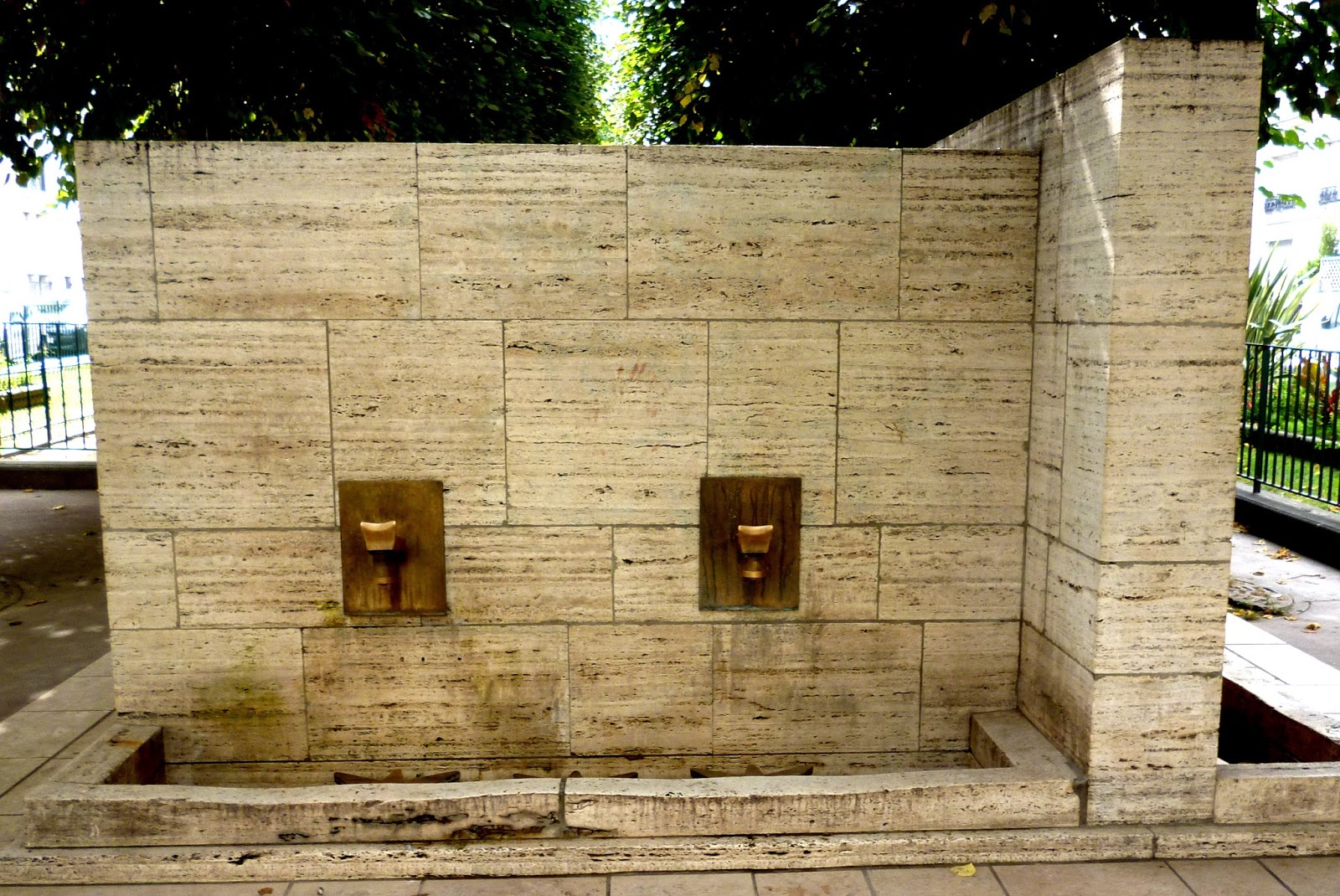
'La fontaine, située devant le square, alimenté par un puits artésien creusé en 1861, servait, à l'origine, à alimenté les riviéres et les lacs du bois de Boulogne. Son eau, provenant de la nappe phréatique albienne, aurait des vertus thératpeutiques.'

'The fountain in front of the square, fed by an artesian well dug out in 1861, originally served to feed the rivers and lakes of the Bois de Boulogne. Its water, coming from an Albian water table, had therapeutic qualities.'

'PUITS
ARTÉSIEN
DE
PASSY
FORÉ EN 1855'

Yes, work began on the well in 1855, but it wasn't actually completed until 1861.