André Cayatte was a lawyer before becoming a film director, and his films – if not concerned with courtroom dramas – often appeal to social injustices, sometimes with popular actors. Cayatte was against the death sentence not only because of its juvenility, its loi du talion (eye for an eye, tooth for a tooth) mentality, but because it failed to recognise anything but black and white reasoning, or other perhaps far more hidden, complicated circumstances. Severing the head of a person, turning that person into two, dehumanises not only the guilty party but also the people responsible for that decision and the people carrying out their orders to do it.
Cayatte better illustrated his ideas in Nous sommes tous des assassins (We Are All Murderers) (1951), which in spite of gaining many converts to his cause still left thirty years before the death penalty was lifted in France. This film is not a courtroom drama but a take on kidnapping leading to murder in a familial situation.
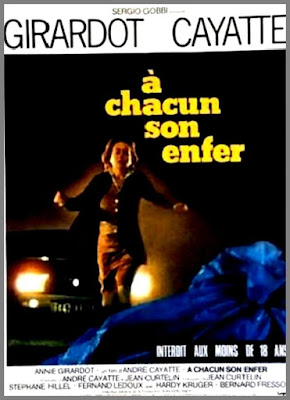
Madeleine (Annie Girardot) and Bernard Girard (Bernard Fresson) have had their young daughter kidnapped for a large ransom, which they pay via instructions on a walkie-talkie, the instructions to which Madeleine follows in her car, leading to her collecting her daughter, although she is dead. Commissaire Bolar (Hardy Krüger), a rather inhumane cop, tells Madeleine that the killer is in her own block of flats, and Michel (Stéphane Hillel), Madeleine's son, admits to her that he killed his younger sister out of hate, she was only his half-sister of Madeleine's later marriage. Result: his mother doesn't drive them to the cop shop, but to oblivion: memories of Cayatte's previous Verdict (1974).



 Posts
Posts

