The first person to build at the Vallée-aux-Loups was André—Arnoult Acloque, a brewer and soldier of the national guard who wanted to live closer to his uncle. He built a small one-storey house there, but was forced to sell up with the fall of the monarchy in 1792.
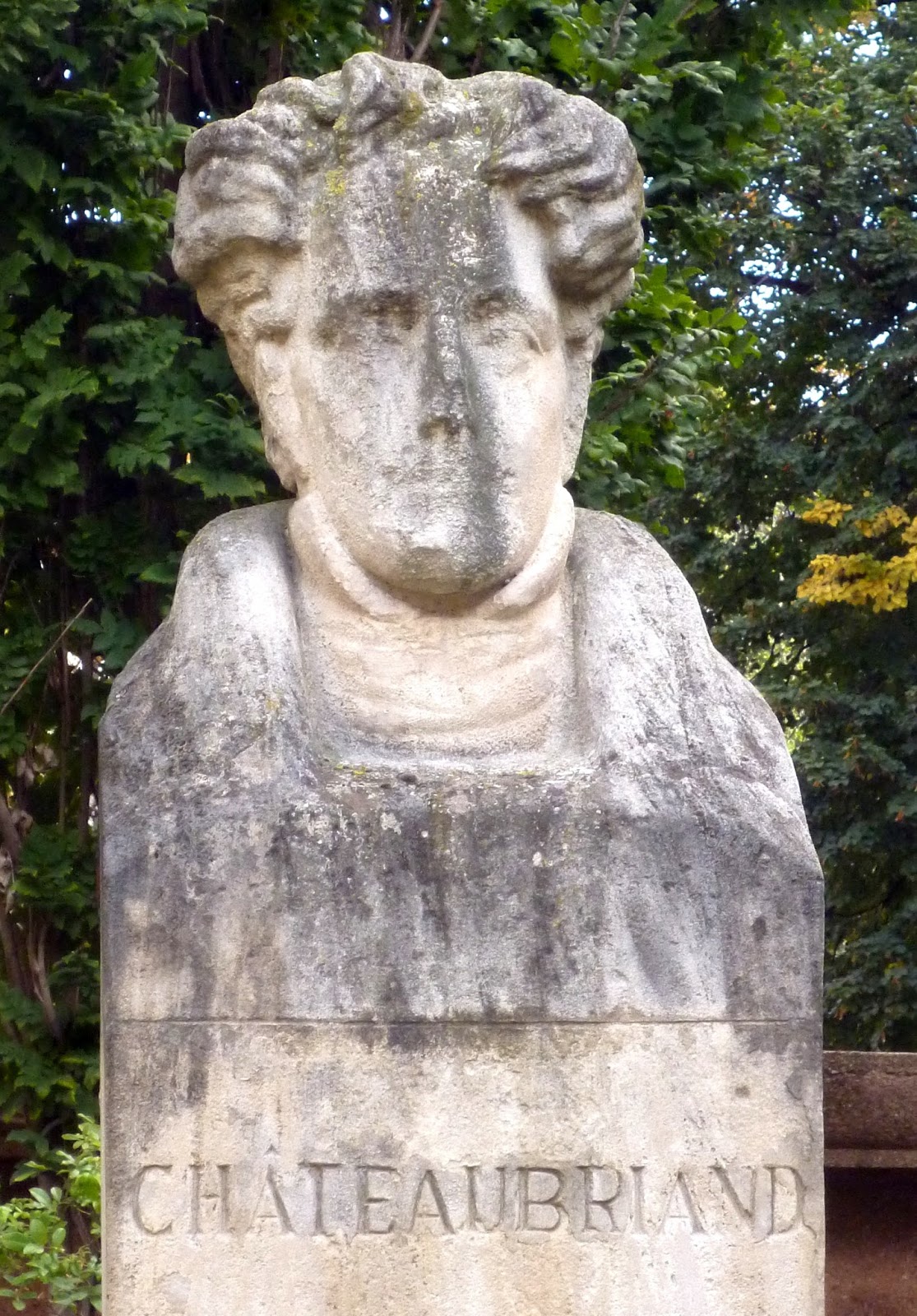
Retreating from Paris (as he'd wished for a few years before) after an article in the Mercure de France, in which he compared Napoleon to Nero, François—René de Chateaubriand and his wife Céleste bought La Vallée-aux-Loups in 1807 pretty much as Aclocque had left it. Chateaubriand began transforming the former inhabitant's 'gardener's house', and this is what it looks like today.
The portico with caryatids, recalling Chateaubriand's journey to Greece.
Aclocque had built a pavilion in the grounds, which Chateaubriand named 'Tour Velléda' from his book Les Martyrs. It is here that he began Mémoires d'Outre—Tombe.
Chateaubriand also occupied himself with the garden, which he wanted to serve as a memory of the places he'd visited. This was essentially an English garden, with for instance cedars reminding him of the east and catalpas of North America. Above is a cedar planted by him.
Above is an example of a very well preserved 18th century ice house with an underground tank 5.5 meters across and six meters in depth, giving 150 tonnes of ice.
After the fall of the Empire things had begun to look politically promising for Chateaubriand with the publication of his De Buonaparte et des Bourbons in 1814, but two years later, after writing a post scriptum to his De la monarchie selon la Charte, his work was seized, he was struck off the list of ministers of state and his pension withdrawn. He was forced to sell La Vallée-aux-Loups between 1817 and 1818. The Montmorency wing here is named after Matthieu de Montmorency, who was the next owner of the property.
The La Rochefoucauld wing. After Montmorency died in 1826, it became his daughter Elizabeth's, who was married to Sosthènes de la Rochefoucauld, Duke of Doudeauville, who appears to be best known for the mockery he received by lengthening the skirts of dancers at the Opéra and for puritanically covering up the particular anatomical parts of statues that obviously offended him. A digression: that has no direct relation to the La Rochefoucauld wing.
Sosthènes's property passed to his two sons in 1841, although it wasn't until 1849 that 'Sosthènes II' fully came to the property as the single owner of it. A rich and very active social networker of the day, Sosthènes' II soon added a wing on the opposite side to the Montmorency wing, sandwiching Chateaubriand's original property.
The house was opened to the public in 1987.
This plaque lists the works Chateaubriand wrote while he lived here between 1807 and 1818.
'CHATEAUBRIAND
VÉCVT ICI DE 1807 À 1818
ORNA LA DEMEVRE
PLANTA LE PARC
ÉCRIVIT
LES MARTYRS
L'ITINÉRAIRE DE PARIS À JÉRVSALEM
LE DERNIER ABÉCÉNERAGE
MOÏSE
COMMENCA LES ÉTVDES HISTORIQUES
LES MÉMOIRES D'OVTRE-TOMBE'
'LA VALLÉE-AVX-LOUPS, DE TOVTES
LES CHOSES QVI ME SON ÉCHAPPÉES,
EST LA SEVLE CHOSE QVE JE REGRETTE'
MÉMOIRES D'OVTRE-TOMBE




 Posts
Posts

