Showing posts with label Truffaut (François). Show all posts

3 February 2022

François Truffaut's L'Amour en fuite | Love on the Run (1979)

Unfortunately, L'Amour en fuite is a most unsuccessful end to the five-part Antoine Doinel series, as Truffaut himself realised. After (in order) Les Quatre cents coups, Antoine et Colette, Baisers volés and Domicile conjugal, this is a very thin story of divorce, pursued love and former love held together by the past. And the past is represented in scenes from the films which preceded this. Of its kind, this is one autobiographical story too many.

Interestingly though, Jean-Pierre Jeunet seems to have taken a few cues from this for Amélie Poulain, and I can't help thinking that there's an element of autism in Doinel too.

7 January 2022

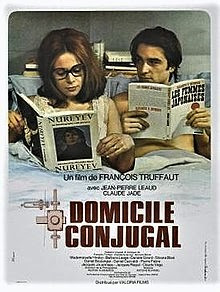
François Truffaut's Domicile conjugal | Bed and Board (1970)

This is the fourth film in the Antoine Doinel series, and of course he hasn't grown up, or maybe doesn't want to grow up, or is an insensitive Aspie. Antoine (Jean-Pierre Léaud as always) is now married to Christine (Claude Jade): he works for a florist, and she teaches violin. And she's proud to be married, although he still exhibits the same immaturity/awkwardness/Asperger sydrome traits as in previous films.

Christine becomes pregnant and Antoine begins to work (by default and misunderstanding) in Paris for an American research company: Antoine's main job is showing foreign visitors the hydraulics of miniature boats. There's a clash: Christine wants to call the child Ghislain, although Antoine officially registers him as 'Alphonse', after (it seems) Daudet (or could it be Benjamin Constant's nouvelle?. And then Antoine falls for, and has a relationship (largely instigated by Kyoko (Hiroko Berghauer)) with a Japanese visitor. As in Baisés volés, they also exchange messages while the other is there, and soon Christine has had enough because she realises what's going on.

But then it's not long before Antoine too has has enough of Kyoko's speechlessness and various 'foreign' ways, and at a restaurant with Kyoko, bored with her because she says nothing to him, Antoine phones Christine three long times. He returns to find Kyoko gone with an insulting note, and goes back to Christine and Alphonse, or Ghislain.

Odd things to note in the film: at Christine's parents Antoine mentions their 'striglias' plants, which he says are often confused with 'oubiglias': neither of these plants exist, although his parents-in-law don't react; nor do they to react to Antoine telling them that Mothers' Day is a Nazi invention. There is also a scene in which a distinct caricature of Jacques Tati waits at a métro platform and then boards a train. Maybe not the best of the saga, but still interesting.

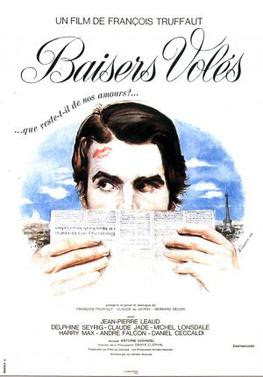
François Truffaut's Baisés volés | Stolen Kisses (1962)

The third part of the Antoine Doinel story begins and ends with the Charles Trenet song 'Que reste-t-il de nos amours ?', which contains the words 'baisés volés'. Antoine (Jean-Pierre Léaud) has left the army, is in love with Christine (Claude Jade) and for a short time gets a job working at night in a hotel  reception. Until, that is, he's duped by a private detective into uncovering an adultery, meaning that he has been indiscreet and opened a door he shouldn't have: it's difficult to tell if it's a mixture of immaturity, difficulty with handling social situations, shyness, awkwardness, or something else. Doinel was created more than sixty years ago, and perhaps today he'd be diagnosed at a minor level on the autistic spectrum. Certainly a number of his problems in these more enlightened times could be put down to Asperger syndrome.

So he's now set on as a private investigator, although he isn't good at that either. Engaged to seek out exactly what shoeshop owner Monsieur Tabard's (Michael Lonsdale's) problems are with people, his stalking is so evident that a woman tells a cop she's got a guy following her. Plus, Antoine has fallen in love with Tabard's wife Fabienne (Delphine Seyrig), and of course although he never openly confesses this to her, everyone (apart from Tabard who has his own problems) is aware in the shop of Antoine's love.

Balzac, as might be expected with Truffaut, is in there, and the book in question is Le Lys dans la vallée, which Fabienne realises. She visits Antoine when he's in bed, tries to put him straight on the novel, and tries to ease his sexual problems in a few hours. Result: Fabienne is forgotten and Antoine is once again free to be with Christine. But, of course, he can't directly communicate his feelings to get the thing going.

Antoine is now a TV repairer, Christine (much like most of Doinel's women) has to be the one to make the first move, and she takes advantage of this by sabotaging her own TV, or rather her parents' TV while they're away. And they end up in bed. Over breakfast, it's difficult to use words, so (again directly but not directly, even Aspie-like) the couple pass a number of post-its to each other, instantly reacting by writing back. The viewer doesn't see these notes because they're private, but it's clear from their faces that he's asked her to marry him and she's agreed.

6 January 2022

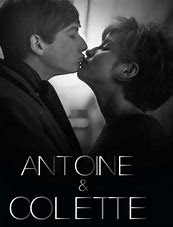
François Truffaut's Antoine et Colette (1962)

Antoine et Colette is the second – but short (thirty-minute) – appearance of Antoine Doinel (Jean-Pierre Léaud) after the first feature Les Quatre cents coups (1959) and before the other three features: Baisés volés (1968), Domicile conjugal (1970) and L'Amour en fuite (1978). Antoine et Colette was part of a series of five shorts by different directors gathered as 'L'Amour à 20 ans': it was originally entitled 'Paris'. It is of course autobiographical and Jean-Pierre Léaud is to some extent modelled on Truffaut.

There is even a self-referential scene here taken from Les Quatre cents coups, where Antoine's very young friend René Bigey (Patrick Auffay) – with the equally young Antoine hiding – is caught misbehaving and smoking by his father M. Bigey (Georges Flamant). But the film begins with a view of Paris streets, and then to a seventeen-year-old Antoine waking up to Guy Béart singing on the radio:

Le matin, je m'éveille en chantant

Et le soir, je me couche en dansant*.

Antoine (like Truffaut) has had parent problems and leads an independent existence, working in a record factory. This has its advantages as he is given free tickets to free concerts, and invites his friend René (still Patrick Auffay) along with him to one. And it's there that he sees Colette (Marie-France Pisier) and can't stop looking at her. And soon they start going out.

Antoine meets Colette's mother (Rosy Varte) and her step-father (François Darbon), he appeals to them, and they are soon inviting him to dinner. Antoine is very happy with this arrangement, and soon moves into a room opposite Colette. However, he is young for his age, a little shy and perhaps rather wimpish: Colette is soon tiring of him and begins to go out with the more rugged and self-assured Albert (Jean-François Adam).

The concluding music, sung by George Delerue, has the same title as this the series of films: 'L'Amour à 20 ans'.

*In Jamais la même chose : Chroniques 2015 - 2017 François Morel says of Guy Béart, who died in 2015, that when people like him die, a person tends to 'faire son Perec', and continues by listing things he (mainly) remembers about Béart in imitation of Perec's 'Je me souviens...' fashion. The problem is that in his second line Morel has him going to bed not dancing but singing!

1 January 2020

François Truffaut's Jules et Jim (1962)

Jules (Oskar Werner), an Austrian, and Jim (Henri Serre), a Frenchman but whose forename is pronounced with a 'd' sound as in English, are friends in pre-World War I France, and meet and fall in love with Catherine (Jeanne Moreau). This brilliant French classic is so well known that I shall spare readers the details of the rest of the plot, which has echoes in many subsequent films. No, I merely list some of the moments in this film which particularly affect me, most of them I'm sure of which appeal to many other people too: to me a work of art is not really the sum of its parts, but made up of moments, many of which remain with us long after we've forgotten other moments, even the plot. One such example in another film is Bo Widerberg's Elvira Madigan, where we see the red wine slowly leaving the down-turned bottle, as the relationship of the lovers flows out of them. But I digress – my Jules et Jim moments:

–– Catherine (as 'Thomas') wearing a checked cap and moustache, passing off as a man when 'another' asks 'him' for a light, and then winning the race on the bridge by cheating.

–– The trio finding fascinating but – importantly – financially worthless objects on their walk through the woods.

–– Catherine casually jumping into the river and being retrieved by a very concerned Jules et Jim.

–– Albert (Serge Rezvani/Cyrus Bassiak) playing his unforgettable 'Le Tourbillon de la vie' to the equally unforgettable song by Jeanne Moreau. Legendary.

–– Catherine killing both herself and Jim in a car in Limay, Mantes-la-Jolie (Yvelines).

–– Jules walking away in Père Lachaise after seeing the ashes of Catherine and Jim put in their pigeon holes in the external part of the columbarium, walking past the grave of George Courteline.

A beautiful movie.

29 December 2019

François Truffaut's La Peau Douce | The Soft Skin (1964)

I'm not too sure how many films Truffaut made with femmes fatales in them – and L'Homme qui aimait les femmes (1977) must certainly be included as a collection of such women – but there must be a fair number, and La Peau douce is definitely in that number. As an example of a triangular love relationship ending fatally, it reminded me more of La Femme d'à côté (1881) than its slightly earlier Jules et Jim (1962).

A successful writer who has just written a book on Balzac and money and is on a promotion tour, Pierre Lachenay (Jean Desailly) meets air hostess Nicole (Françoise Dorléac) on his way to Lisbon and that's it. Of course his wife Franca (Nelly Benedetti) and his young daughter Sabine (Sabine Haudepin, who also played in Jules et Jim ) know nothing of it, at least not yet. And so the series of lies to everyone begins.

Pierre has taken a number of photos of Nicole, plus some of them together, and left the photo shop receipt in his pocket. Meanwhile Nicole has refused to live with Pierre, so it's the end of the story. But not for Sabine, who knows he's now at a regular restaurant, and goes to meet him with a rifle. Bang.

28 December 2019

François Truffaut's Vivement Dimanche ! | Finally Sunday (1983)

This film is based on Charles William's novel The Long Saturday Night (1962), also known as Confidentially Yours. So three years after Le Dernier Métro (1980) we have le dernier Truffaut, in black and white and starring Jean-Louis Trintignant as estate agent Julien, with his improbable secretary Fanny Ardant as Barbara, the young woman who loves him unbeknown to him, but whose sleuthing skills will in the end get him exculpated from the murders of his wife and her lover. But not without more murders, more trauma, anonymous telephone threats, Barbara posing as a prostitute warding off the johns, etc.

This convoluted thriller is a tribute to American film noir, particularly Hitchcock, John Huston and Howard Hawks, to some extent a satire of the genre, and not without its absurdities, perhaps notably when we have the guilty party smoking two cigarettes without realising, and Barbara pretending by telephone to be the wife of commissaire Santelli (Philippe Morier-Genoud). Not Truffaut's best by a long shot, but worth it for the antics of the brilliant Fanny Ardent.

Hey, I didn't even say a word about the crap title translation!

20 December 2019

François Truffaut's L'Homme qui aimait les femmes | The Man Who Loved Women (1977)

Bertrand Morane (Charles Denner) is in aeronautics and obviously quite comfortable as he has an apartment with a close view of the Tour Eiffel. He stars among a cast of women in this slightly strange but highly enjoyable film about a man in Montpellier who is horrified by dragueurs or tail-chasers, he just loves women, and in his early forties still can't get enough of them. And he goes out of the way to try to get them, such as – in the beginning, after a scene set in the present in which many of his past conquests throw a handful of dirt on his coffin – running into a post in a car park and claiming a woman did it just because he liked the look of her legs and wants her address.

It's not just the idea of women that explains his never-ending thirst, but more that no one woman can satisfy him. He's tried marriage, even got tangled up with Véra (Leslie Canon), but this is not enough for him. One of his readers at the publishing house he's sent his typescript 'The Man Who Loved Women' to is smitten and persuades the other readers and the publisher to release the book. And she's the one who comments on the troupe of women passing his grave: he dies not of a heart attack, or violent Véra getting revenge on him, but simply getting run down after chasing a girl across the street – and, very sick in hospital, reaching out for a nurse and falling from his bed. An interesting twist on Truffaut's many femmes fatales.

24 November 2019

François Truffaut's La Sirène du Mississippi (1969)

Truffaut adapted this film from William Irish's thriller Waltz into Darkness (1949), which would have been a good title for this film.1 But if you're going to use another title, why not give a proper translation of 'Sirène' here: not as 'mermaid', which suggests a pleasant creature, but as 'Siren', which indicates that you're dealing with danger: this is about another of Truffaut's femmes fatales. When Louis Mahé (Jean-Paul Belmondo) meets 'Julie Roussel' (Catherine Deneuve) in Réunion off the boat from New Caledonia he is in serious trouble, expecially as he is immediately smitten by this beautiful young woman he is to marry when he expected to find a rather plain woman: they had been corresponding following a small ad in a newspaper.

'Julie' lies about the photo she sent Louis (which is a lie in itself as she never sent it), and Louis admits that he too lied about being the foreman of a cigarette factory and plantation when he's in fact the owner. They're swiftly married, Louis (without even thinking) puts his wife's name on his personal and business account, and by the time Berthe (Nelly Borgeaud), the real Julie's sister, wonders why she's not heard from her, the false Julie has run off with Louis's money. Berthe and Louis hire a private detective, Comolli (Michel Bouquet) to trace 'Julie'.

Louis flies to France and by chance – one of those remarkable coincidences frequently found in films – discovers she's working in a night club in Antibes. Louis finds her – her real name is Marion Vergano – and is prepared to kill her but she wins him all over again, relating her poor childhood, telling him her lover Richard killed Julie, and she has no more money. Hiring a house for them near Aix-en-Provence Louis – in another of those coincidences – runs into Comolli, gives him the slip, but when he turns up at the hired house determined to find Marion, Louis is forced to kill him. Louis and Marion flee to Lyon, Louis briefly returning to Réunion to buy himself out. At a café in Lyon though they discover from a newspaper that a flood has uncovered the body and they are being sought: a small ad in a paper began the relationship, and it seems that a front page headline will end it. And they can't return to their accommodation to retrieve the money as the place is crawling with cops.

They escape to a chalet2 where Marion – the two of them having almost no money left – begins to kill Louis with rat poison, which he realises and tells her he's not worried about dying for her, whereupon she relents and the audience last sees them walking from the chalet in the snow, presumably towards Switzerland.

1 In 1968 Truffaut had adapted Irish's novel The Bride Wore Black (1940): this time a literal translation.

2 The chalet is the same one used in Tirez sur le pianist (1960) in Le Sappey-en-Chartreuse, Isère. It was also used in Bertrand Blier's Buffet froid (1979).

12 November 2019

François Truffaut's La Femme d'à côté | The Woman Next Door (1981)

It's difficult for the viewer – and it was probably equally difficult for Truffaut himself – to figure out if Mathilde (Fanny Ardent) is a femme fatale or if both Mathilde and her lover Bernard (Gérard Depardieu) are both fated. Personally I go for the femme fatale idea, but it is in any case an extraordinary coincidence that brings the two former lovers back together, as neighbours.

Seven or eight years before, Bernard had a stormy but deeply intense relationship with Mathilde, although both are now married (Bernard to Arlette (Michèle Baumgartner) and Mathilde to Philippe (Henri Garcin). And now Mathilde wants to resume the affair, and after avoiding her Bernard capitulates, and the pair meet in the daytime in a hotel.

Neither Mathilde's nor Bernard's partners have any suspicions (Mathilde even having spoken about an affair with a 'manic depressive' to Bernard) of the former relationship, until Bernard explodes at a garden party, so bringing the affair into the open. Mathilde is subsequently hospitalised owing to a nervous breakdown, and when she recovers Philippe and Mathilde leave their property. But then Mathilde returns at night and blows both of their skulls off the planet during a final sex episode. Truffaut is obsessed with women, or should that be sex?

10 November 2019

François Truffaut's Une belle fille comme moi | Such a Gorgeous Girl Like Me (1972)

Truffaut's Une belle fille comme moi is a film in which Camille Bliss (Bernadette LaFont) is interviewed in prison by Stanislas Prévine (André Dussollier), a man writing a thesis on women murders. Camille manipulates him so much that he believes her, is attracted to her, and in spite of his secretary (who is obviously in love with him) believes what she says.

From Camille's words recorded on Stanislas's tape recorder the viewer is taken via a series of flashbacks through her childhood with her brutish father, her marriage to Clovis Bliss (Philippe Léotard), her relationship with the rodent exterminator Arthur (Charles Denner), with the singer Sam Golden (Guy Marchand) and the blackmailing lawyer Me Murene, all of whom she has a sexual relationship with.

 Finally, Stanislas discovers that she isn't guilty of the murder of the religiously obsessed Arthur, so she is free to go and become a famous singer. Stanislas imagines that she is his, although Camille frames him for the murder of Clovis –and Stanislas ends in jail.

One of Truffaut's femmes fatales, and this black comedy is a delight to watch.

9 November 2019

François Truffaut's Les Mistons | The Brats | The Kids (1958)

Maurice Pons published a series of stories in 1955, out of which came Truffaut's short. Les Mistons (translated as The Brats, The Kids or The Mischief Makers) is under eighteen minutes long, and features Bernadette (Bernadette Lafont), Gérard (Gérard Blain), five pre-adolescents and the voice-over by Michel François. This short concerns five schoolboys following Bernadette as she leaves her bicycle by a tree to bathe (during which time they smell the saddle), they watch her kiss Gérard and follow the lovers to various places such as the arena in Nîmes. She later learns of his death. Elements in this film obviously predate Truffaut's later films.

Bernadette Lafont became a nouvelle vague muse, she played in Chabrol's Le Beau Serge (1957) with her husband, and then in Chabrol's Les Bonnes Femmes (1960). She also worked with many other demanding directors, including Truffaut, Edouard Molinaro, Costa-Gavras, Louis Malle and Jean-Daniel Pollet.

21 October 2019

François Truffaut's Tirez sur le pianiste | Shoot the Pianist (1960)

Tirez sur le pianiste wasn't the first of the nouvelle vague films, but it was certainly one of them, if one of the most influential. And an innovation is that it, although of course influenced by American cinema (B movies and noir), it is a mixture of genres: film noir, love story, gangster, even a bit of (subdued) comedy. The main characters are Charlie Kohler/Édouard Saroyan (Charles Aznavour), Léna (Marie Dubois), Thérèse Saroyan (Nicole Berger) and Clarisse (Michèle Mercier), and the main themes in a way could be said to be women (or womanhood) and shyness.

The mood is set when Charlie's brother Chico, pursued by gangsters, runs into a lamp post and wounds his head. He then seeks out Charlie who's working as a pianist in a dive bar. And here we have the absurd blending in, with Boby Lapointe singing incomprehensible words (for those unfamiliar with him) from both his songs 'Marcelle' and 'Framboise', the second to cover up for Charlie as he deals with his brother's problems.

Charlie occasionally has a free ride with his prostitute neighbour Clarisse, who represents the sensual side of a relationship. But it's Léna (the representative of romantic love) who knows about Charlie's true identity, who is aware of his being a classical pianist previously, but who receded into anonymity after his wife tragically killed herself. She wants Charlie to go back to the true performer he was but he has problems with his timidity, and tries to overcome it by buying secondhand books on it.

Slowly they become a couple, but in a crazy twist he kills the jealous Plyne in self defence and is taken by Léna to the chalet where Chico is holed out. But the bungling gangsters come, Léna is killed in the snow in a scene pre-figuring La Sirène du Mississippi, and Charlie is again left to a fate of playing mechanically in the dive bar, his expressionless face ironically expressing a great deal. A classic haunting film with haunting music, one of Truffaut's more remarkable in spite of its underrated ranking.

20 October 2019

François Truffaut's Les Quatre Cents coups | The 400 blows (1960)

In the vanguard of the nouvelle vague cinema mentioned below in Godard's film À bout de souffle, Les Quatre Cents coups was the first of the films starring Jean-Pierre Léaud in François Truffaut's Antoine Doinel saga, which was followed by the twenty-minute short Antoine et Colette (1962), and then the feature length films Baisers volés (1968), Domicile conjugal (1970) and L'Amour en fuite (1979).

In large part autobiographical, Les Quatre Cents coups (in spite of its very weird English translation) is a reference to leading a wild life: Antoine is brought up in a rather run-down flat with dysfunctional parents (his mother is far from motherly and is having an affair), his school is run on painfully traditional lines where learning by rote is the order of the day, and the main person he relates to is Rémy, his schoolmate who lives in rather more fortunate circumstances, but has a rebellious nature that chimes with Antoine's.

Antoine plays truant, indulges in petty theft, has a healthy disrespect for authority, sleeps out in Paris one day, lies to his French teacher that his mother has died, visits the cinema as much as he can, tells the truth when he says he's learned a Balzac passage by heart but is disbelieved by his French teacher. And finally he steals a typewriter but is discovered in the act of returning it and is denounced by his father. His punishment: ending up, at thirteen years of age, in a military-style youth centre, from which he escapes, runs, runs, until he reaches the sea and...what next? To be continued.

11 May 2018

Henri Pierre Roché: Jules et Jim (1953)

I've already written below about Henri Pierre Roché's Deux Anglaises et le continent, but this is his prevous (and first of only two) novel. François Truffaut's film of the novel is far better known, and generally considered to be a major work of the French cinema: Serge Rezvani's (or Cyrus Bassiak's) playing of his song 'Le Tourbillon de la vie', sung by Jeanne Moreau, is  perhaps the most memorable moment, although this isn't in the novel.

The novel also has many others scenes, is a constant sexual coming and going of the main characters Jules (a German based on the writer Franz Hessel), his writer friend the author Henri Pierre Roché, and the femme fatale Kathe here is to some extent a representation of Franz's wife Helen Hessel (née Helen Grund).

Kathe sees life as a constant holiday, although she appears to be a kind of manic depressive, obsessed by suicide, ridden by despair: she sees suicide as an irresistible being, a sort of praying mantis (vide the end of Patrice Leconte's film Le Parfum d'Yvonne).

Trauffaut's film has some beautiful moments, but I couldn't find many in the original novel.

10 May 2018

Henri Pierre Roché: Deux Anglaises et le continent | Two English Girls (1956)

Henri Pierre Roché's two published novels – 'Victor' was to be a third but is unfinished – are Deux Anglaises et le continent (1956) (translated as Two English Girls) and Jules et Jim, both of which were turned into films by François Truffaut. They were of very long gestation, and Jules et Jim was published when Roché was seventy-four: both of them are autobiographical, and in this book Claude is based on Roché himself, Muriel on Margaret Hart and Anne her sister Violet Hart.

Like Jules et Jim, the story involves a threesome – here largely over a ten-year period –although in Deux Anglaises (which begins in 1899 and is told in the form of letters and diaries) there are two females instead of two males. Claude is the Frenchman who at first visits the sisters' family, and he decides to ask Muriel to marry him, which she refuses, saying that she'd prefer them to have a brother-sister relationship.

It's actually far more complicated than this, as Muriel is the puritanical, religiously obsessed sibling, and she's very confused about love, fluctuating between loving Claude and not loving him. She sees the Maître-moi of Claude coming to the fore, as opposed to his Vrai-Moi: a simple analysis of the terms would be that Maître-moi is the Freudian superego, Vrai-Moi the id.

Parental guidance decides on a year of the couple not seeing each other, although before the end of this period Claude has decided that he will not marry, although this distresses Muriel, who remains 'faithful'to him, or to her idea of who she is. She also remains faithful to her religion, although she has harboured feelings of guilt about sexual impurity over a number of years: owing to lack of sufficient space one holiday, as an eight-year-old she once spent every night for a week sleeping with a girl of the same age and they had naked cuddles, fondly exploring each others' bodies; and guiltily, Muriel has often masturbated as it helps her to sleep, although she knows that it's, er, harmful.

To cut a long story short, Claude beds both Anne and Muriel, although they both marry someone else, and Claude seems to be left on his own. A novel exploration of the nature of love, whatever that is.

21 September 2017

Paris 2017: Cimetière de Montmartre, 18e arrondissement #2 Jeanne Moreau


Actor Jeanne Moreau (born 1928) only died on 31 July 2017. I, a lover of her films, particularly Truffaut's Jules et Jim in which she sings Serge Rezvani's 'Le Tourbillon de la vie', and Buñuel's Le Journal d'une femme de chambre, just had to see her grave.

13 September 2017

Paris 2017: Cimetière du Montparnasse: #12: Helen Hessel


Helen Hessel (1886–1982) was born in Berlin, where she died, although she was a journalist who made her career in France. She married Franz Hessel, and her relationship with her husband and Henri-Pierre Roché (1879–1959) was fictionalised by Roché in his novel Jules et Jim (1953), which was adapted to film by François Truffaut in 1962.

9 September 2017

Paris 2017: Cimetière du Montparnasse: #10: Jean Itard

Jean Itard (1774–1838) was a doctor who is now largely known for his work in child psychiatry, more specifically for attentions to Victor de l'Aveyron, a relationship made famous by Truffaut's film L'enfant sauvage (1970). But he wrote many articles on other subjects, such as deafness and dumbness, and stuttering. The anchor on his tomb could represent hope or stability, or both.

18 September 2016

Cimetière de Montmartre (continued): #5: François Truffaut

'FRANÇOIS TRUFFAUT
1932 – 1984'

The tickets left on François Truffaut's grave speak volumes about his popularity. But how could I have missed this, the grave of the director of Jules et Jim, Les  Quatre Cents Coups, Baisés volés, L'Enfant sauvage, L'Argent de poche, L'Homme qui aimait les femmes, Le Dernier Métro, etc, etc.