Showing posts with label French Swiss literature. Show all posts

23 September 2018

Joël Dicker: Le Livre des Baltimore (2015)

I just looked at the popular French website babelio.com for comments on Joël Dicker's Le Livre des Baltimore (2015), read a few of the amateur reviews (514) to this follow-up to his hugely successful La Verite sur l'affaire Harry Québert (2012, with 1571 reviews) and breathed a silent sigh. I enjoyed Harry Québert to some extent, although the several hundred pages were a bit daunting, but the 600-page Le Livre des Baltimore went back to the boîte à lire only half-read: enough is enough, or too much. Harry Québert made it to the first selection of the Goncourt novel, garnered the Prix Goncourt des lycéens as well as the Grand Prix de l'académie française 2012, and yet I ask myself why. Both of these books, and it appears the latest Dicker, La Disparition de Stéphanie Mayer, are not only set in the US, not only about a mystery with many twists and turns, not only bear the markings of a young adult novel, but are also so obviously made to be filmed, causing Frédéric Beigbeder to remark that Dicker wrote the same book three times: make as much money as possible seems to be the ruling instinct with the Swiss Dicker. And yet to me 'real' novels are written from the intellect, not with the bank account in mind. OK, all writers have to survive and make some compromises, but we're not talking about that here. I got bored with Le Livre des Baltimore halfway through, read Marie NDiaye's very short play Hilda (1999) in a very brief time, ditched Dicker permanently, and was struck by the effect Hilda was having on me: my conclusion is that Marie NDiaye is a brilliant writer, Joël Dicker merely brilliant at writing best sellers. The difference between the two is enormous. (Oh, by the way, Babelio doesn't give Hilda a single review, although Les Éditions du minuit contains several professional reviews of it. There must be a moral in there somewhere.)

My other post on Joël Dicker:
––––––––––––––––––––––––––––––––––––
Joël Dicker: La Vérité sur l'Affaire Harry Kleber

31 July 2018

Joël Dicker: La Vérité sur l'Affaire Harry Quebert | The Truth about the Harry Quebert Affair (2010)

Joël Dicker's second novel La Vérité sur L'Affaire Harry Quebert (translated quite literally as The Truth about the Harry Quebert Affair) reminds me (merely thematically) a great deal of Rostand's Cyrano de Bergerac, and not a little of Nabokov's Lolita. But then, this 855-page novel is also a detective story, a mystery, whodunnit, a love story, and a kind of hymn in praise of writing. On the back cover of the poche edition, Bernard Pivot says that you're hooked by the twists, red herrings and coups de théâtre as soon as you stick your nose inside it. It also scooped le Prix Goncourt des lycéens for 2012. So, is it so brilliant, worth ploughing through all those pages for?

I had serious doubts, so have avoided the book until it fell into my hands free of charge. Indisputably, this book is written with dollars in mind: OK, France has a long love story with America, and even Sartre loved Hollywood cartoons. But this novel seems to be specifically written with screenplay mode in mind, easy on the language, easy on the violence, only hints of paedophilia to disturb the peace.

And yet there is so much here, as I suppose you'd expect from such a huge book: a fifteen-year-old girl changed from a nymphomaniac into a beaten child, then transmogrified into a schizophrenic mother-killer; the obvious suspect soon released from jail to make way for many other suspects; obvious villains turned into not exactly saints but hugely worthy citizens; everything is turned around, expectations are continually mocked.

There's a left-wing current running throughout this novel, and I'm pleased that the really bad guys in the end are the cops. But great literature? Do me a favour: this is a great book to read in idle moments, but it is definitely not a wonderfully written book: it's a good read, certainly a page-turner, but Joël Dicker's novel is not a book full of wonderful insights and ideas: it's just a beach/airport read. And far too long at that.

My other post on Joël Dicker:
––––––––––––––––––––––––––––––––––––
Joël Dicker: Le Livre des Baltimore

14 April 2018

Blaise Cendrars: L'Or, La merveilleuse histoire du général Johann August Suter (1925)

One translation of Blaise Cendrars's book is called Gold: The Marvellous History of General John Augustus Sutter:  the 't' doubles in English. I've not read of Cendrars's motives for writing this fictionalised biography, but he was a lifelong friend of Auguste Suter, the Swiss sculptor, and the novel is written with great admiration for the man.

Sutter wasn't exactly a globetrotter like Cendrars, although the book takes us from his leaving his wife and family in Switzerland to emigrate to the United States, where he becomes an immensely rich businessman, but then ironically loses it all in the gold rush.

The story charts the progress of the penniless, theiving Sutter through France to the coast, where he boards a boat for North America, gets through Ellis Island, spends four years in New York learning how to survive, then greatly risks his life travelling across the continent to California, to San Francisco, or Yerba Buena as it was in the early nineteenth century, when it belonged to Mexico.

Land is dirt cheap, and Sutter buys up a large area of it, builds farms on it, maintains a number of workers, becomes a multi-millionaire, and is highly respected by all. But then when gold is discovered on his property all hell lets loose, he strives to keep his land and his business but the ruthless mob of gold seekers – coming from all parts of the country and as word spreads all parts of the world – don't respect him at all and destroy all he has, including killing two of his sons after his family leaves Switzerland to join him: his wife dies very soon after she arrives.

The latter part of Sutter's life is spent in law cases, in trying to gain some of the money he considers is rightfully his, and for much of the time he lives in poverty. He dies a broken man.

1 December 2017

Albert Cohen: Belle du seigneur (1968)

Of Jewish origin, Albert Cohen (1895–1981) was of Swiss nationality, born in Corfu. Winner of the Grand Prix de l'Académie FrançaiseBelle du seigneur (1968) is generally considered his masterpiece and one of the greatest Francophone books of the twentieth century. It is  the third part of a tetralogy: first came Solal (1930), then Mangeclous (1938), and the original Belle du seigneur, at 1300 pages, was too long for Gallimard, so Cohen excised a large part and with it made the final volume: Les Valeureux (1969).

Brilliant Belle du seigneur certainly is, although it is no easy read, and not just because of its dense 845 pages. It is written in different styles, and there are a number of chapters or sections filled with unparagraphed, unpunctuated stream of consciousness. I wouldn't  hesitate to put this tome among a group of other 'unreadable' door-stoppers such as Josuah Cohen's Witz, David Foster Wallace's Infinite Jest, William Gaddis's The Recognitions, Jean-Pierre Martinet's Jérôme, James Joyce's Ulysses, Lionel Britton's Hunger and Love, Alexander Theroux's Laura Warholic, and Marguerite Young's Miss MacIntosh, My Darling.

Albert Cohen's novel is a book of strong satire on the various diplomatic positions within the Société des Nations, the preening and posturing, the fawning and the frivolity of it all. It can be very funny, pitiless to the pathetic, filled with representations of sexual passion, but death always lurks behind the scenes, or is even a major player at the heights of apparent life.

Essentially, though, this is a love story doomed to failure. Here, the rakish big shot at the SDN, the Jew Solal, falls in love with Ariane, the bored wife of the unbearably sycophantic m'as-tu vu Adrien Teume, promotes him and runs off with his wife. Adrien tries to kill himself, fails and continues working. Meanwhile, Solal has lost his nationality, and therefore his job and entire status, but carries on regardless living in a sexual fantasy land with Ariane at an expensive hotel in the south of France. But you can't escape your own consciousness, nor the fact that love is evanescent, and the dangerous games that Solal and Ariane are playing will lead inevitably to mutual suicide. You might say that Romeo and and Juliette are hoist with their own petards, but this is much more Joycean and Proustian than Shakespearean.

In this mammoth novel Albert Cohen is often funny when talking about death, from the 'joyeux futurs cadavres' ('joyful future corpses') to Solal and Ariane being 'enterrés vivants dans leur amour' ('buried alive in their love'); he sees the insanity of tourism: whyever should they go to Venice only to see themselves?; he is acutely aware of the malice behind the social smile; the madness of being jealous about a dead affair; the vacuousness of having nothing to do in your home but use a spirit level on items of your furniture, just to check; or the despair that leads you to kiss your own hand in order to give yourself the appearance of companionship.

Belle du seigneur may be tedious to the point of being unspeakably boring at times, but isn't that true of life itself? Albert Cohen has drawn a true picture of life, and this work should be recognised as the vital literary work of art that it is.

My other Albert Cohen post:
––––––––––––––––––––––––––––––––––––
Albert Cohen: Mangeclous | Naileater

18 August 2017

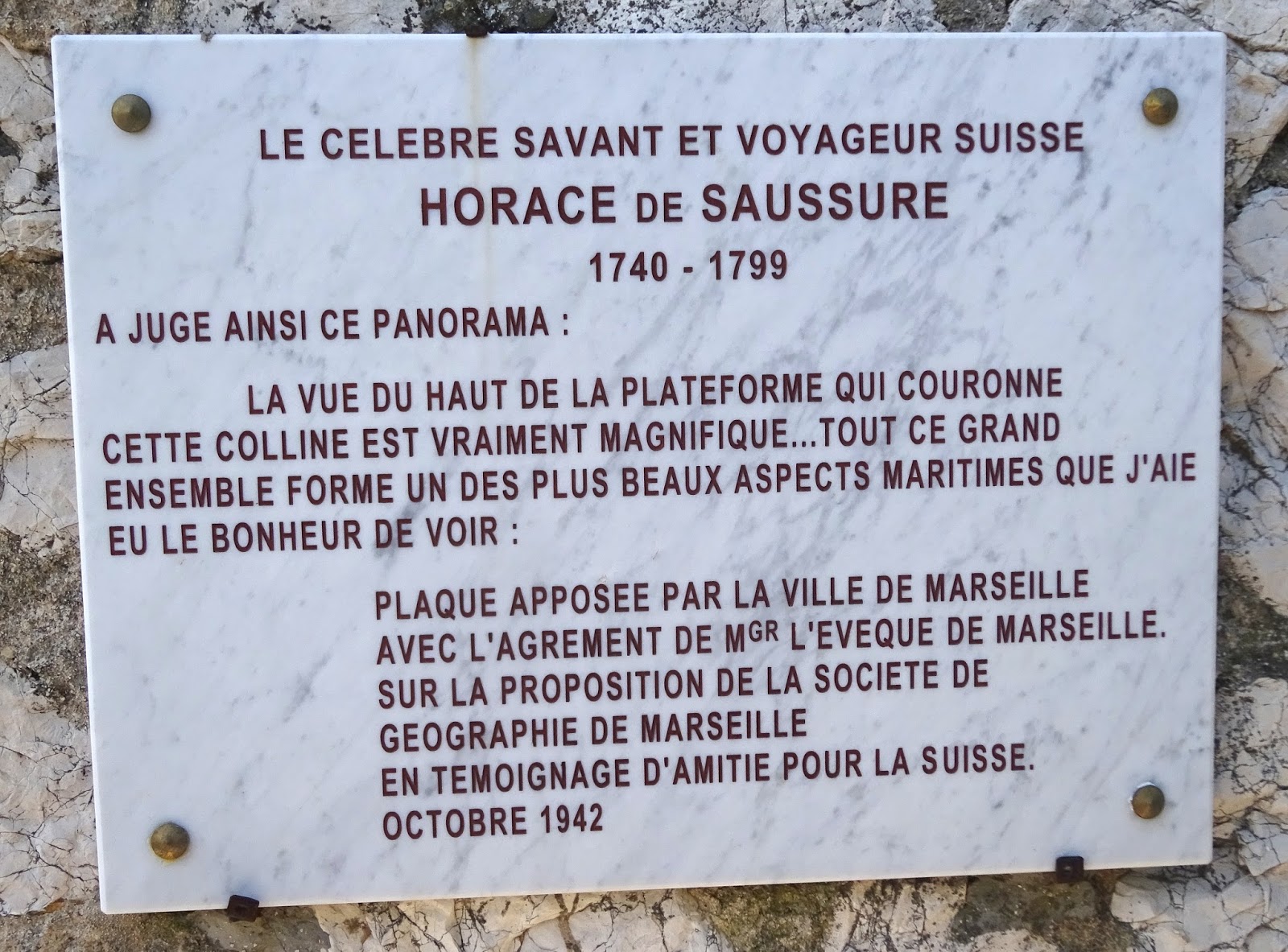
Horace de Saussure in Marseille, Bouches-du-Rhône (13)

Horace de Saussure (1740–99) was a Swiss naturalist, geologist and pioneer mountain climber who conducted most of his work in the Alps, around Mont Blanc. This plaque is outside Notre-Dame-de-la-Garde, near the Frédéric Mistral and Théodore Aubanel memorials.

6 May 2016

Albert Cohen: Mangeclous | Naileater (1938)

Charles Dickens on acid, with strong hints of Rabelais. That's my impression of the huge (only 421 pages, but it seems much bigger) novel Mangeclous (1938), which itself is only the second episode of a tetralogy by Albert Cohen (1895–1981), the other novels being Solal (1930), Belle du Seigneur (1968) and Les Valeureux (1969). The only other book of Cohen's I'd read before this is the autobiographical Le Livre de ma mere (1954), which made me cry; this, however, made me laugh: it's a riotous, digressive, insane, hyperbolic, wholly unbelievable novel full of much-larger-than-life characters who don't seem to belong anywhere outside of a comic book, and yet make it their business to appear to belong everywhere. Albert Cohen has performed a tour de force.

This is the story, for want of a better word, of five Jews in Cephalonia (Cohen was in fact born in Corfu) who are French-speaking, or at least speak a kind of French, although they look and behave like no other known group of people.

Mangeclous is the main character, and the English translation of this book has a literal title translation: Naileater. Mangeclous is only his nickname, and his real name is Pinhas Solal, although no one calls him that: as a child, he was once so hungry that he swallowed a dozen screws, so the (surely slightly – and intentionally – incorrect?) name has stuck to him forever after. On leaving the womb he was hungry, but on receiving nothing went back inside for the lovely milk, but was pulled back by forceps and in the process developed a gulley in his skull in which he now keeps cigarettes and pencils, etc.

Mangeclous is many things, but perhaps a liar in particular, as he sees lying as a great asset. He calls himself a lawyer, although he doesn't quite have the training. And he delights in otherwise embroidering on reality: you might say he has the gift of the gob. He virtually never bathes, usually goes about barefoot, and has green fungal growths between his toes and has been known to put his feet on the table, play with the moss and roll it into balls.

He's married to a huge woman who sits on a chamberpot and is obsessed with pharmaceuticals, and has three young children who talk like characters from centuries old books and whom he doesn't feed much, until he reads the occasional article about rickets and then force-feeds them. He's an atheist Jew when it suits him to be so, and comes up with the paradoxical sentence 'Je ne Lui pardonnerai jamais de ne pas exister' (I'll never forgive Him for not existing.') (This reminded me of the earlier Dipychus of Arthur Hugh Clough, tolling the glory of a non-existent God: 'Ting, ting, There is no God; ting, ting', and also the later Endgame of Samuel Beckett: 'The bastard! He doesn't exist!')

The other main characters in the Solal family (the 'Valeureux') are the very small and shy dry-swimming Salomon; the one-armed Mattathias, who is avaricious, has developed a squint from looking sideways into dark alleys to make sure no one has dropped anything there and who walks around with a magnet to attract metal objects people may have dropped; the quiet and courageous Michaël; and the older Saltiel, who receives the letter that will lead the five (with hope) on a journey to fortune in Geneva via Marseilles.

And this also leads to many other digressions, on the boat going, then to Scipion (a compulsive teller of tales about the women who can't resist him) following the group to Switzerland and him bumping into Jérémie and the pair posing as ambassadors from Argentina, and Solal finally meeting up with the motley band, who go camping and...well, that's the kind of book it is. It loses itself, its readers lose it, but then surely that's the idea.

My other Albert Cohen post:
––––––––––––––––––––––––––––––––––––
Albert Cohen: Belle du seigneur

21 April 2016

Agota Kristof: C'est égal: nouvelles (2005)

This is a collection of twenty-five forgotten short stories written over some years following Agota Kristof's exile from Hungary to Switzerland in 1956, and there are a few hints here of her most well-known work, La Trilogie des jumeaux, or The Twins Trilogy.

This is no comfortable read. The atmosphere a number of the stories is often of strangeness,  surrealism, anguish, unfulfilled hopes, anxiety, the futility of life, and (desire for) murder, madness, although not suicide. There is paradox, and irony. And there is also an odd anonymity: virtually none of the characters has a name.

The back cover of this edition cites 'Mon père' as 'certainly the most autobiographical' of the collection, although there are beyond any doubt more 'hidden' autobiographical factors at work here: Kristof, for instance, didn't like marriage, and there are three marriages in three stories in particular which stand out outright failures.

Right from the beginning, 'La Hache' plunges us into a murder, in which a woman has summoned a doctor, telling him her husband has fallen on an axe at the side of the bed in his sleep, although the doctor's first thought is to send for an ambulance for the woman herself, who has obviously used the weapon on her husband. In 'L'Invitation' it's the wife's birthday and the husband says that although she'll have to wait until the end of the month to receive a present he can afford, he'll just invite some of his friends round for a meal and drinks, and he'll do all the work for a change. The wife says she'd rather he take her to a restaurant than he bring his friends round, but this is not to be: the wife does all the cooking, in fact everything while her husband and friends have a great time feasting and drinking. At three in the morning the party is over, and as the narrator ironically says, 'The chums have left, the husband snores on the lounge sofa, exhausted, poor thing.' Time for the wife to clear everything away, but before she does the washing up she takes a long look at herself in the mirror.

This is disturbing stuff.

My other posts on Agota Kristof:

–––––––––––––––––––––––––––––––––––
Agota Kristof: La Preuve | The Proof
Agota Kristof: Le Grand cahier | The Big Notebook
Agota Kristof: Le Troisième mensonge |The Third Lie

1 May 2015

Jacques Chessex: L'Ogre | The Tyrant (1973)

Charles-Ferdinand Ramuz is seen as one of the founders of French Swiss literature, so it's perhaps unsurprising that his surname is mentioned in passing in French Swiss writer Jacques Chessex's L'Ogre (translated as The Tyrant). Like Ramuz's Jean-Luc Persécuté (1908), L'Ogre is a tale of jealousy, madness and suicide.
 
There are some autobiographical similarities between L'Ogre and Chessex's life, although it was Chessex's father who killed himself when his son was twenty-two, whereas Jacques died in 1909 of a heart attack while defending his positive position on Polanski during a talk: in L'Ogre, it's the protagonist Jean Calmet who kills himself as a result of his father Paul's (mainly) psychological abuse of his son.
 
Dr Paul Calmet is a respected general practitioner who is a tyrant at home, and four of his children soon leave, with the exception of the youngest – in French the benjamin  who is named Jean-Benjamin, to Jean's disgust. Jean becomes a teacher of Latin literature in a lycée in Lausanne, but who even after the death of his father – the eponymous Ogre, of course – is incapable of forgetting the dreadful psychological legacy he's saddled with: in fact it grows much worse and he begins hallucinating, finding it difficult to comprehend that Paul Calmet is in fact dead.
 
Jean – who is thirty-nine years old – goes to the local Café de l'Evêché every day, and many of his students go there too. It is there that he meets the nineteen-year-old Thérèse Dubois, whom he calls 'la Fille au Chat', and with whom he has a sexual relationship. Although it's not a full sexual relationship because Jean suffers from a kind of impotence because he sees his father watching him and mocking him and so is incapable of performing. He has never had a regular sexual relationship with anyone before, having mainly resorted to masturbation and prostitutes, such as the fifty-five-year-old Pernette Colomb. And his sexual problems most probably stem from when he was a timid nineteen-year-old virgin with a seventeen-year-old girlfriend Liliane, whose virginity was given up to his father, and on one occasion Jean even surprises them at it.
 
And on another occasion at the Café de l'Evêché Jean suddenly breaks down in full view of many lycée students and la Fille au Chat and collapses on the table, causing some damage to glasses as well as a cut to his chin. This doesn't bother la Fille au Chat, who comforts him in her bed, but head teacher Grappe has received complaints about the behaviour of his otherwise model teacher and subjects him to a gruelling interview. But it's not in Jean's nature to reveal any of his problems to anyone, and anyway Grappe – who could almost, the head believes, be Jean's father – thinks that Jean's father was a wonderful man. How do you overturn local legends? Well, you don't because it's too difficult, especially if you're not given to talking about your problems.
 
Conclusion? Suicide is of course extreme, but  some choose it.
 
La Fille au Chat understandably sees herself as a free spirit because she's still in her teens, and it's also understandable that she should want to enjoy a more conventional sexual relationship with Marc, who's virtually her own age. But then, Jean is Marc's teacher and has to see his 'rival' every day. It's not easy, particularly if you can't get it up and can't explain why. So a frustrated and jealous Jean has a few days off school, although he doesn't know that these are his last days.
 
In fact he doesn't know he's going to die until the moment comes when he wakes up and he slits his wrists at home. And it takes twenty-five minutes for him to die from loss of blood, and the final pages quite graphically describe the death and I can understand that some readers chose to look away, not read anymore. I can also understand why this book – a very powerful scream of the outsider – won the prix Goncourt in 1973.

17 April 2015

C. F. Ramuz: Jean-Luc persécuté (1908; repr. 2008)

Charles Ferdinand Ramuz (1878–1947) spent a little time in the earlier half of his life in Paris and to a lesser extent in Germany, although in 1914 he returned permanently to French-speaking Switzerland (La Suisse romande), where he was born in Lausanne and died just three or four kilometres away in Pully.

Ramuz was therefore born in the canton of Vaud, although he was commissioned in 1907 to write a book on life in Varais – a canton adjacent to Vaud – in collaboration with the painter Edmond Bille, which resulted in the publication Le Village dans la montagne (1908). Ramuz spent various periods in Varais between September 1907 and the autumn of 1908 writing this, and a bi-product was that he began to write a fictional book which was to become Jean-Luc persécutée.

Jean-Luc persécutée is set in mountainous Varais. But unlike other fictional French Swiss works set in alpine areas there is no romantic nostalgia here, no picturesqueness: this is a depiction of Hell.

Ramuz's novel is intense and violent and to some extent reverses norms, particularly sexual ones. Essentially this is the ageless story of a sexual triangle, a book that the back cover suggests has the impact of a Greek tragedy. I can't argue with that, although it's a little unusual that a back cover should so precisely reveal the end in the beginning: the husband Jean-Luc burns to death in a barn his wife Christine and her child by her lover Augustin and then throws himself off a precipice. Surely this is the ultimate spoiler?

Well, not exactly because I'm sure Ramuz himself wouldn't have minded spoilers: what matters is not what happens, but how.

So, to the how. This is a very powerful novel, although I appreciated the first of its thirteen chapters the most. Here, Jean-Luc leaves his wife and baby Henri to see a man about a goat, but the man is ill so Jean-Luc calls off the project for the time and walks home. But his wife isn't there and the more he investigates her absence the more he worries and then he begins to trace her footsteps in the snow. For me it's the description of the minute, almost forensic details that lead Jean-Luc to his (secretly) discovering his wife in the hayloft with Augustin that make this a highly unusual read, written – like the other chapters in a very fresh style considering when it was written.

And the gender reversal that will play such an important part in the book is also notable right at the beginning, setting up this – as the back cover will have it – 'Aeschylean' tragedy. Christine comes right out with the fact that Jean-Luc was aware right from the beginning, before their marriage two years before, that she preferred Augustin but that her parents didn't approve because he hadn't enough money, and that she'd never concealed from Jean-Luc that she'd still 'kiss' Augustin (a seasonal hotel worker) even when married. Obviously stunned, Jean-Luc goes back to his mother.

But he returns to Christine, even though he's not too sure why, and when he breaks his leg they become close again, although she continues to see Augustin on his return to the area and eventually Jean-Luc throws her out and keeps Henri. But he begins to drink a great deal, abandoning his child to friends and neighbours. He starts to sell his property to drink more, Henri is discovered accidentally drowned in a stream, and Jean-Luc begins a descent into insanity: he walks around with his imagined child in his arms, talking to it and caring for it, until he 'loses' it.

Christine now has a child by Augustin, but Jean-Luc shuts his wife and her baby in a hayloft and sets fire to it. Imagining that his child has returned to him, he evades his pursuers by jumping off a cliff: 'his head cracked like a nut'.

13 January 2014

Blaise Cendrars: Cimetière des Batignolles #4


'ÉMILE LAMBERJACK
1869 – 1912
–––––
BLAISE CENDRARS
1887 – 1961'

The novelist, poet and adventurer Blaise Cendrars was born Frédéric Louis Sausers in Switzerland. We had some problems finding his grave here, but then he is buried with the Lamberjack family. The reason for this is that he died without any money and so was buried in the grave of a friend.

Émile Lamberjack is interesting in his own right: in Auto Racing Comes of Age: A Transatlantic View of the Cars, Drivers and Speedways, 1900-1925 (2012), Robert Dick gives a little of his biography. Lamberjack had been a professional racing cyclist and exporter of Michelin products who married embroiderer Virginie Bossu. They divorced but continued to live together in the same household, until June 1912 when Lamberjack started moving his own furniture out and Bossu shot him dead. Surprisingly, she was acquitted due to the stresses of Parisian life, which caused a public outcry.