Showing posts with label Pubs. Show all posts

13 January 2013

Stalybridge Station Buffet Bar, and no Q for another pub

This is a timewarp very far removed from St Pancras. They have a good selection of cask beers, but as I was driving I had a coffee, which was large and came on a tray with a jug of milk: a bargain at £1.50.
 
'This Victorian Buffet Bar is unique
and is authentic in detail since
being rebuilt in 1885.
 
Unveiled by Councillor Eileen Shorrock
on 16th July 1994.'
 
One of the four rooms.
 
And a few yards down the road is another pub with a blue plaque.
 
'The Q Inn
The public house with the shortest name
in the United Kingdom.
Certified by the
Guiness Book of Records 1995
 
Unveiled by Councillor
J. Alan Whitehead
Mayor of Tameside
30th May 1995'
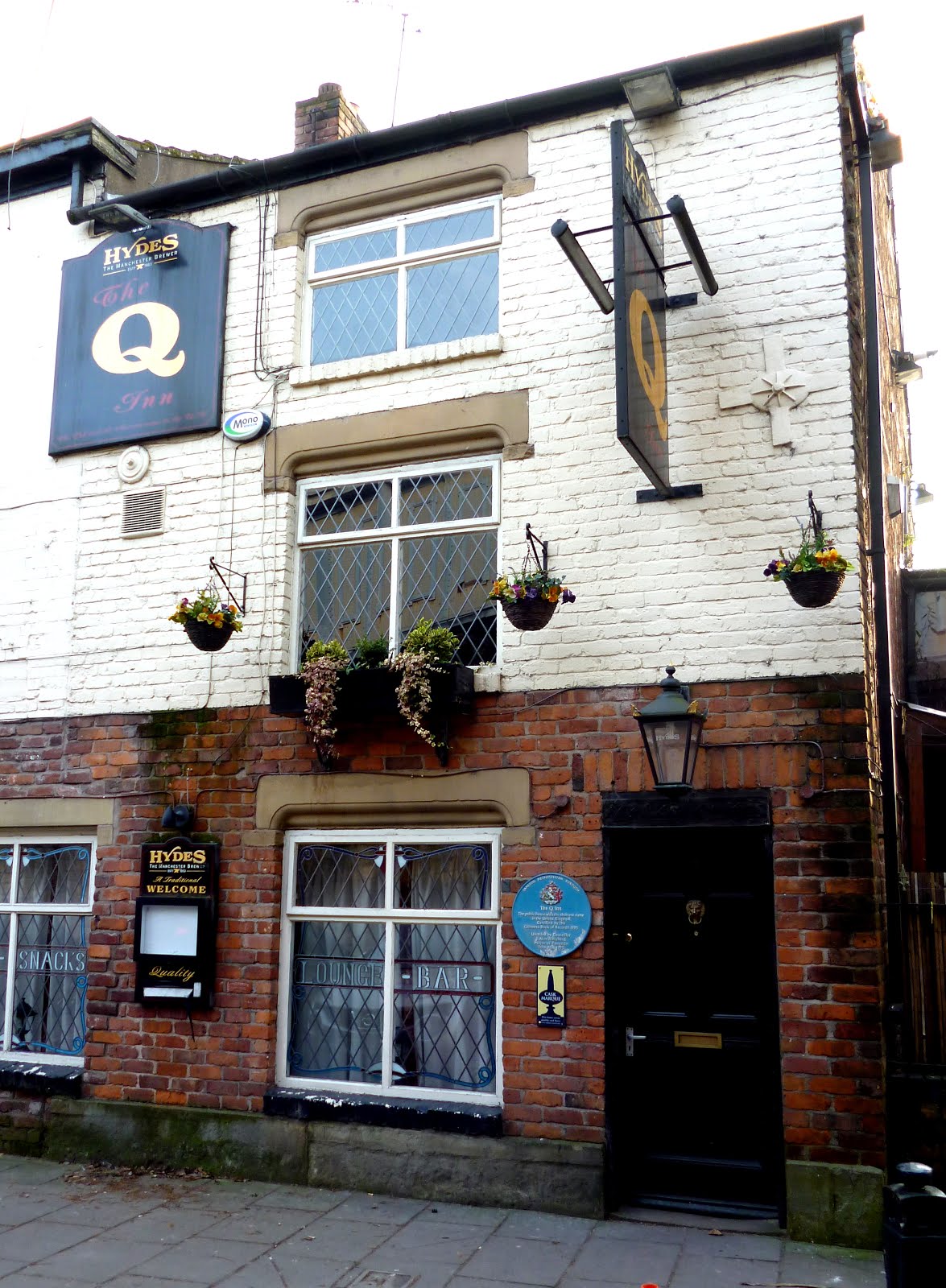
 
Unfortunately, the pub has now closed down.

18 July 2011

Sir Walter Scott and Peveril of the Peak, Manchester

The Peveril of the Peak is a Grade II listed building in Great Bridgewater Street, Manchester, which was rebuilt in about 1900: the previous pub was built in 1829. A number of places on the internet state that its name comes from the Manchester to London stagecoach of the same name, although this is at odds with the inn sign.

I'm no costume historian, but this, I'm sure, isn't Sir Walter Scott's Sir Geoffrey Peveril from the 17th century, aka Peveril of the Peak from his 1823 novel of the same name. In fact, the more I look at it, the more it seems easily a few centuries before that. Anyway, this guy wouldn't know a stagecoach from a jetplane, and the building to our right, judging from a reconstruction I've seen, is almost certainly Peveril Castle in Derbyshire. So maybe William Peveril, the original owner, who of course wasn't Scott's Peveril of the Peak, but...

And the tilework is lovely.

Hardys Well and Lemn Sissay's Poem

Hardys Well is a pub just south of the Curry Mile, Wilmslow Road, Rusholme, Manchester.

Lemn Sissay believes that 'poetry is central to what we do', and that poetry should be seen on the street in the same way as sculpture is. One evening, talking to his friend Mark Atwood in this pub, the manager challeged him to write a poem  on the wall.

The result is below: quite a masterpiece of street art in the pub garden, complete with benches and old red phonebox. The only thing is, by the look of the abundant vegetation around the locked gate, I strongly suspect that the pub is now closed. If this is the case, it's a bit of a blow to Lemn Sissay's idea of poems as landmarks.

'HARDYS WELL
WAIT WATERLESS WANDERER. WHOEVER WALKS
TO THE WELL WILL WADE INTO A WONDEROUS WORLD.
A WORLD WHICH WILL WAKEN THE WILTING
WALLPAPER OF WORK AND WORRY. WELL? WORRY
WILL WAIT WHILE WELLS WAND WHIRLS A WARM-
HEARTED WACKINESS INTO A WEARY WEEK.
WHEREAFTER WAVES AND WATERFALLS OF
WONDERMENT WILL WASH ALL WEAKNESS. A WAY?
WELL? A WORLD WIDE WEB OF WHOLEHEARTED
WHOLESOME WISDOM AND WIT WAITS WIPE AWAY
WORRIES. WELLS WORKS WONDERS FOR WRINKLES.
WHY WAIT. WHY WONDER. WHY WORRY. WHY
WAIN. WHY WHITTLE. WHY WITHER. WALK IN. WELL.
WHAT ARE WE WAITING FOR. IT'LL DOUBLE YOU. AT
HARDYS WELL.'
LEMN SISSAY

ADDENDUM: Lemn Sissay has now won the vote for Chancellor of the University of Manchester. Phew! I'm very pleased to say he easily beat the horrendous Peter Mandelson: we don't want dinosaurs, especially hypocrites like the architect of New Labour!

Links to my other posts of Lemn Sissay public poems are given below:

–––––––––––––––––––––––––––––––––––
Lemn Sissay's Poetry in Shudehill, Manchester
The Art of Michael Visocchi and Lemn Sissay in London
Lemn Sissay's 'Flags', Tib Street, Manchester
Lemn Sissay's 'RAIN'

Lady Carolina Nairne and The Lass O' Gowrie, Manchester

The Lass O' Gowrie is in Charles Street, Manchester, in an area formerly known as 'Little Ireland', although legend has it that the first landlord was Scottish and homesick, and named the pub after his favorite poem, by Lady Carolina Nairne (1766-1845), who was born in Gask, Perthshire.

The Lass O' Gowrie

'Twas on a simmer's afternoon,
A wee afore the sun gaed down,
A lassie wi' a braw new goun
Cam' owre the hills to Gowrie.
The rosebud washed in simmer's shower,
Bloomed fresh within the sunny bower;
But Kitty was the fairest flower,
That e'er was seen in Gowrie -
To see her cousin she cam' there;
And oh! the scene was passing fair,
For what in Scotland can compare
Wi' the Carse o' Gowrie?
The sun was setting on the Tay,
The blue hills melting into gray,
The mavis and the blackbirds lay,
Were sweetly heard in Gowrie.
- O lang the lassie I had wooed,
And truth and constancy had vowed,
But could nae speed wi' her I lo'ed,
Until she saw fair Gowrie.
I pointed to my fither's ha'
- Yon bonnie bield ayont the shaw,
Sae loun that there nae blast could blaw:-
Wad she no bide in Gowrie?
- Her faither was baith glad and wae;
Her mither she wad naething say;
The bairnies thocht they wad get play
If Kitty gaed to Gowrie.
She whiles did smile, she whiles did greet;
The blush and tear were on her cheek;
She naething said, and hung her head,
But now she's Leddie Gowrie.
 
Perhaps a very rare example of a full poem on an exterior pub wall? See the next post.

31 May 2011

Inman Square, Cambridge, Massachusetts

Inman Square is in Cambridge, but away from the center, and describes the area around the junction between Inman, Cambridge, and Hampshire Streets.

Ryle's is on Hampshire Street, and is mentioned several times in David Foster Wallace's Infinite Jest, notably by this quotation:

'Ryle's Jazz Club's upscale pub-type bar, guys in tweed caps and briar pipes in mouths at angles taking all day on a pint of warm stout.'

There's another of these Bukowski Tavern dive bars (which are affectionately known as 'Buk's') in Boston, but this is on Cambridge Street and is everything you might expect with a name like this. Shame about the cars in the way, though.

Lorem Ipsum Books, also on Cambridge Street, has the right idea by telling people to read instead of watching TV.

9 February 2009

Pubs of Nottingham and Nottinghamshire Associated with Literature

The White Horse, Ilkeston Road, Nottingham, famous as the pub where a scene in the film of Alan Sillitoe's novel Saturday Night and Sunday Morning took place, in which the character Arthur Seaton (played by Albert Finney) gets very drunk.

ADDENDUM: This is what has happened to the pub – it's now the white Horse Café:


The Chesterfield Arms in Bingham, Nottinghamshire, which remembers the Earls of Chesterfield, who owned much of the land in the area. The fourth Earl, Philip Stanhope, is noted for his Letters to his Son.

Byrons on North Sherwood Street, in the centre of Nottingham, showed the most famous Lord Byron - the poet - on its inn sign. The pub, once a Shipstone's tied house, has now been demolished. It stood very near to where the Dolphin Brewery was.


Gatsby's on the corner of Huntingdon Street and Convent Street, Nottingham, is now known as The New Gatsby's, which is a gay bar, and the title no doubt is intended to evoke the heady atmosphere of Long Island, New York, where much of F. Scott Fitzgerald's The Great Gatsby (1925) is set. This was originally known as the Central Tavern after Nottingham's Central Market, which stood opposite the pub. Before Gatsby's, it was called Niche in another incarnation.

27 February 2008

A Few Interesting Features of Nottingham Pubs – Mainly Non-Literary!

This photo shows one of several speakers in the former Smoke Room of the Vale Hotel, Woodthorpe, Nottingham. Of note is the 'HB' (Home Brewery) logo. The pub is on the corner of Mansfield Road and Thackerays Lane, and is Grade II listed.

The above photo shows the Piano Lounge of the Five Ways on the corner of Valley Road and Edwards Lane, Sherwood, Nottingham. It was a Warwicks and Richardsons tied house, and is now a Grade II listed building. This was one of Alan Sillitoe's favourite pubs when he re-visited the area.

Once a Home Ales pub on Lower Parliament Street, Nottingham, the Stag and Pheasant had some interesting tilework. The pub was demolished several years ago.

16 January 2008

James Prior, Forest Folk and Blidworth

The Forest Folk, Blidworth

Lushai cottage in Bingham, Nottinghamshire, was for a time the home of the novelist James Prior Kirk, who just wrote under the name of James Prior. Prior was born in 1851, and has with some hyperbole been called the Thomas Hardy of the Midlands. But like Hardy, Prior set some of his novels in the area where he was born.

Prior was the son of a hat manufacturer, and like many sons in his position at the time, his father wanted him to join the legal profession. After a few years, though, he abandoned this in favour of teaching, farming, and then working for his father.

With the cousin he married in 1886, he moved to Radcliffe on Trent for a short time before settling down in the nearby town of Bingham, where he died. Whereas he had previously written plays and short stories, he now began to write novels. By 1910 he had written all six: Renie (1895), Ripple and Flood (1897), Forest Folk (1901), Hyssop (1904), A Walking Gentleman (1907), and Fortuna Chance (1910). Prior earned a minor reputation as a novelist, and the young teacher D. H. Lawrence read his works with some interest in Croydon. Prior, though, said that the two authors lived in different worlds.

James Prior is remembered for Forest Folk more than any other work, and although now long out of print, it went through several editions. It is set in the Luddite era, and is a working-class take on the late Victorian New Woman. Prior died in 1922, and in 1926 the Forest Folk pub was built in Blidworth to commemorate his achievement; it had a stained glass window and a small lobby area dedicated to the novelist. More significantly, it is a very rare example of a pub named after a book rather than a writer, although it was demolished a few years ago to make way for a shopping complex.

---------------------------------------------------------------------------

Almost twenty years ago, my (ex-)wife and I began capturing many photos of the county's pubs in an attempt to record a heritage that we realized would soon fall to the bulldozer. When I sold my Carlton Road house a few months ago, I had little time to move things before I went on a research trip in southern Illinois for several weeks. Therefore I gave away many of the possessions of mine that had long been gathering dust, and I had intended to do this with the several hundred pub photos I had taken. Thinking that the Nottingham branch of the Campaign for Real Ale (Nottingham CAMRA) would appreciate these, I offered to donate them to them, writing an email to the secretary to their most recent address as given in the then latest version of their newsletter. I received no acknowledgement whatsoever of my email from Nottingham CAMRA: the degree of this rudeness is scarcely credible. However, I still have the photos, and in future I shall be posting some of them to this blog, beginning with more Nottingham and Nottinghamshire's literary pubs.

My James Prior posts:
–––––––––––––––––––––––––––––––––––
James Prior's Forest Folk (dissertation): Introduction
James Prior's Forest Folk (dissertation): Chapter One
James Prior's Forest Folk (dissertation): Chapter Two
James Prior's Forest Folk (dissertation): Chapter Three
James Prior's Forest Folk (dissertation): Conclusion
James Prior (1851–1922) in Bingham
James Prior's Parents' Grave, Nottingham
James Prior: Three Shots from a Popgun (1880)
The Forest Folk memorial window
James Prior plaque, Blidworth