Showing posts with label Genet (Jean). Show all posts

26 February 2015

Dominique Fernandez: La Gloire du paria (1987)

Dominique Fernandez's La Gloire du paria (lit. 'The Glory of the Pariah') is set in 1986, at about the time when AIDS was creating havoc in the developed world but also when very little was known about it. Wildly distorted media scares called it a 'plague' and perhaps inevitably represented the gay community as largely responsible for the phenomenon.

Bernard Morin (45) is a novelist from a staunch middle-class background: his father is a teacher of French in a lycée, and his mother is a well-read worker in a bookshop in the quartier Latin. For three years he has lived with in Paris with Marc Lavergne (25), a law student from a more modest background with a father who works in an office and a friendly Sicilian mother.

Marc has grown up in an era of tolerance whose his parents have – although certainly not as readily as he thinks – accepted the fact that he is gay. Bernard, though, has grown up in an age when homosexuality was taboo, something to hide, but essentially something illegal.

It is the difference between the two main characters' background experience of homosexuality which creates the tension and the interest in the novel, which begins at the time of the death of Jean Genet. Genet's death is symbolic, being the end of the days when homosexuality was associated with the outsider, the outcast, the criminal, the worship of the underworld.

It is just such a backcloth from which Bernard comes, and which he misses with considerable nostalgia. His partner Marc never knew the days of the thrill of illegality, never experienced the multiple revolutions of Paris (and beyond) in 1968, never enjoyed the casual sex of the period. Because of this, Marc accepts that Bernard regularly feels the  need to go out at night, to experience vicariously – on the street, in the metro, etc – the closeness with other men that he once enjoyed much more directly: this is a monogamous relationship.

And then Bernard (against the advice of his friend Xavier Laronde) decides to write a play about AIDS, but before it's completed he is diagnosed as having the disease, and can't complete it. Suddenly all his friends – with the exception of Laronde (and apart of course from Marc) find petty excuses not to visit Bernard on his deathbed.

Bernard's mother has previously visited Marc when her son was well, and reveals that she has known all the time that he is gay, that she pointed him towards Proust and works by Gide, although very near the beginning of the novel the reader knows that Bernard has written off imaginary attempts to question his parents (for instance) about the nature of Balzac's character Vautrin. It is almost as if he wanted his parents to disown him for his sexual persuasion. And sure enough the near-blind mother doesn't want to see her son again, although not because of any disgust but because she realises that Bernard is actually happy being a pariah.

When Bernard is diagnosed as having AIDS and close to death, Marc wonders – not with retrospective jealousy, as he's not that kind of person – if his partner had in fact been unfaithful during his night-time journeys. Then  Nicole, the former wife of Robert – the 'friend' of Bernard's who deliberately avoids sitting in the front rows at theatres to miss any (imagined AIDS-related) spittle hitting him, and who for the same reason has his wife sit between him and Bernard at Les Deux Magots – tells Marc she's discovered the truth.

Some years earlier Robert had badly injured Bernard's thigh in an accidental shooting incident, and Bernard as a result had to have two blood transfusions: one of which was contaminated with the AIDS virus. All of Bernard's friends have been deserting him, but this of course 'proves' that he was 'innocent', doesn't it? Marc, Nicole insists, must reveal this evidence to Bernard, as the friends who've deserted him will realise he's not a screw-around gay, won't they?

Well, perhaps, but that is the worst possible scenario, as Marc – unlike Nicole – knows Bernard and how he has always prided himself on his pariah status, knows how the re-demonising of homosexuality has brought a kind of fresh blood into his veins. Marc has also discovered about friendship, about the nature of hypocrisy, and prefers to give his dying lover the lethal injection, and knows that there's just enough poison in the syringe to take them off together at exactly the right time.

La Gloire du paria is an original novel about the nature of friendship and love, and the ugliness of the hypocrisy that so often rears its head when things get difficult.

7 January 2014

Abdellah Taïa: Le Rouge du Tarbouche (2004)

Abdellah Taïa's Le Rouge du tarbouche (literally 'The Red of the Fez') is a collection of short, largely autobiographical stories set in Barbès in north Paris and in the author's native Morocco. Many of them are strangely haunting, having an almost surreal quality.

'Massaouda et le serpent' is about Taïa's aunt Massaouda, for whom it was torture to get up and sit down, but was a comical spectacle for the family as she was playing and exaggerating her ills. He ironises: 'Almost paralysed and still very active', and calls her 'deliciously talkative'. At the end of the month, when everyone is broke and the fridge is bare, she lifts up her djellaba and tells her nephew to bring Saïd the fishmonger '[S]o he can fuck me. [...] I'll open my legs for him for five dirhams! Anyway, it won't be the first time.' She was a great laugh, and it was especially funny as she didn't realise that Saïd was gay. She prepared Taïa and his brother – who were both young at the time – for the future, for life. She never married and was tri-colored: the blue of her tatoos, red hair, and yellow clothes. Some said she was mad, some that she was from another world.

In 'De Jenih à Genet' the author speaks of his mother's cousin Malika in Larache, but especially of her son Ali, with whom he seemed to be in love – certainly fascinated by. It's Ali who takes him to the grave of 'Saint Jehih' and whose exoticism increases when he speaks a strange language: French. But 'Saint Jehih' is in reality Jean Genet, called 'Saint Genet' in Sartre's book about him: Mohamed Al-Katrani lived in Larache and died in a car crash, and Genet insisted on being buried near him. Ali is moved to tears and hugs Taïa, and this is the last time they will meet.

'Le Maître' – partly concerning studying Maupassant's Bel-Ami and his character Georges Duroy – establishes Taïa's enchantment with the world of books as it does with his fascination for mustaches: George's 'confirmed his virility and revealed his beauty', and we remember the man with the mustache in 'Invitations' with whom Taïa shared his complimentary cinema ticket to see Angel Heart, a man who invites him to tea in a café after as a kind of return for the favor, and has something to say but daren't say it, perhaps Taïa is too young. The short story is also about Taïa's teacher, M. Kilito, who also has a mustache, who writes an autobiographical third person narrated book titled La Querelle des images, in which the protagonist is called Abdallah, and thus Kilito unwittingly becomes Taïa's authorial mentor.

'Voyeur à la rue de Clignacourt' describes the early days of Taïa in Paris, in an appartment in the 18th arrondissement, seriously interested in cinema, and the story starts with a mention of Hitchcock's Rear Window, moving to the narrator as a voyeur, watching out of the window the people who live in the building he's in, taking photos of them, imagining names for them, imagining their lives. He concludes that we can't live entirely alone, that we need people in some way, that even if we are in exile we need the Other, as he has exiled himself from his family but found another special 'family' with which he communicates in silence through his window.

Specific references to homosexuality appear in 'Une nuit avec Amr', in which Amr describes his Egyptian family's reaction to his 'femininity' hounding him and eventually confessing to them that he likes men: he leaves his family to their prejudices.

The title of the book comes from a short story of the same title when Taïa is meeting Alain near the Barbès-Rochechouart métro, and in order to be recognised by him he's wearing a fez. An old man – a Moroccan Arab – asks him if his fez is a from Fès or Marrakech. Taïa tells him it was bought in Rabat, whereupon the man tells him it's just a cheap industrial red made in Casablanca. When the narrator shrugs him off, he vows he'll never grow old, as old people like the rude man only destroy others' dreams. When Taïa briefly returns home after two years he discovers the eternal cliché – that you can't go home again: he must return to Paris in hopes of fulfilling his dreams.

23 November 2011

Les Deux Magots, St Germain des Près, 6th arrondissement, Paris, France: Literary Île-de-France #35

'"Histoire de Paris

Les Deux Magots

Ouvert en 1813, "Les Deux Magots" a connu très tôt les faveurs du monde littéraire : à l'origine magasin de nouveautés, l'un des premiers à Paris, il est cité par Balzac et Anatole France. Un café lui succède en 1881, bientôt fréquenté par Verlaine, Mallarmé et Wilde. En 1914, l'établissement prend l'aspect qu'on lui connaît aujourd'hui, et devient l'un des rendez-vous de l'élite intellectuelle. Les surréalistes en font leur quartier général : Jean Giraudoux, Paul Morand et Jacques Chardonne s'y croisent, ainsi que Joyce et Hemingway. En 1933, quelques habitués, dont Bataille, Leiris et Philippon, fondent le Prix des Deux Magots, pour la première fois décerné à Raymond Queneau. Les intellectuels d'avant guerre, les plus grands noms des Lettres, des Arts et du Spectacle fréquentent ses célèbres terraces : Camus, Genet, Giacometti sont présents, Jean-Paul Sartre et Simone de Beauvoir s'y installent chaque jour pour écrire.'

'"History of Paris

Les Deux Magots

Opening in 1813, "Les Deux Magots" experienced the favors of the literary world from very early on : originally a novelty shop — one of the first in Paris — it is mentioned by Balzac and Anatole France. A café followed it in 1881, soon to be patronized by Verlaine, Mallarmé and Wilde. In 1914 it took on the appearance that we know today, and became one of the meeting places of the intellectual élite. The surrealists made it their general quarters: Jean Giraudoux, Paul Morand and Jacques Chardonne crossed paths here, as well as Joyce and Hemingway. In 1933 some regulars, such as Bataille, Leiris and Philippon, established the Prix des Deux Magots, which in the first year went to Raymond Queneau. The pre-war intellectuals, the greatest names in letters, arts and spectacle : Camus, Genet, Giacometti were here, and Jean-Paul Sartre and Simone de Beauvoir sat down here every day to write.'

15 August 2011

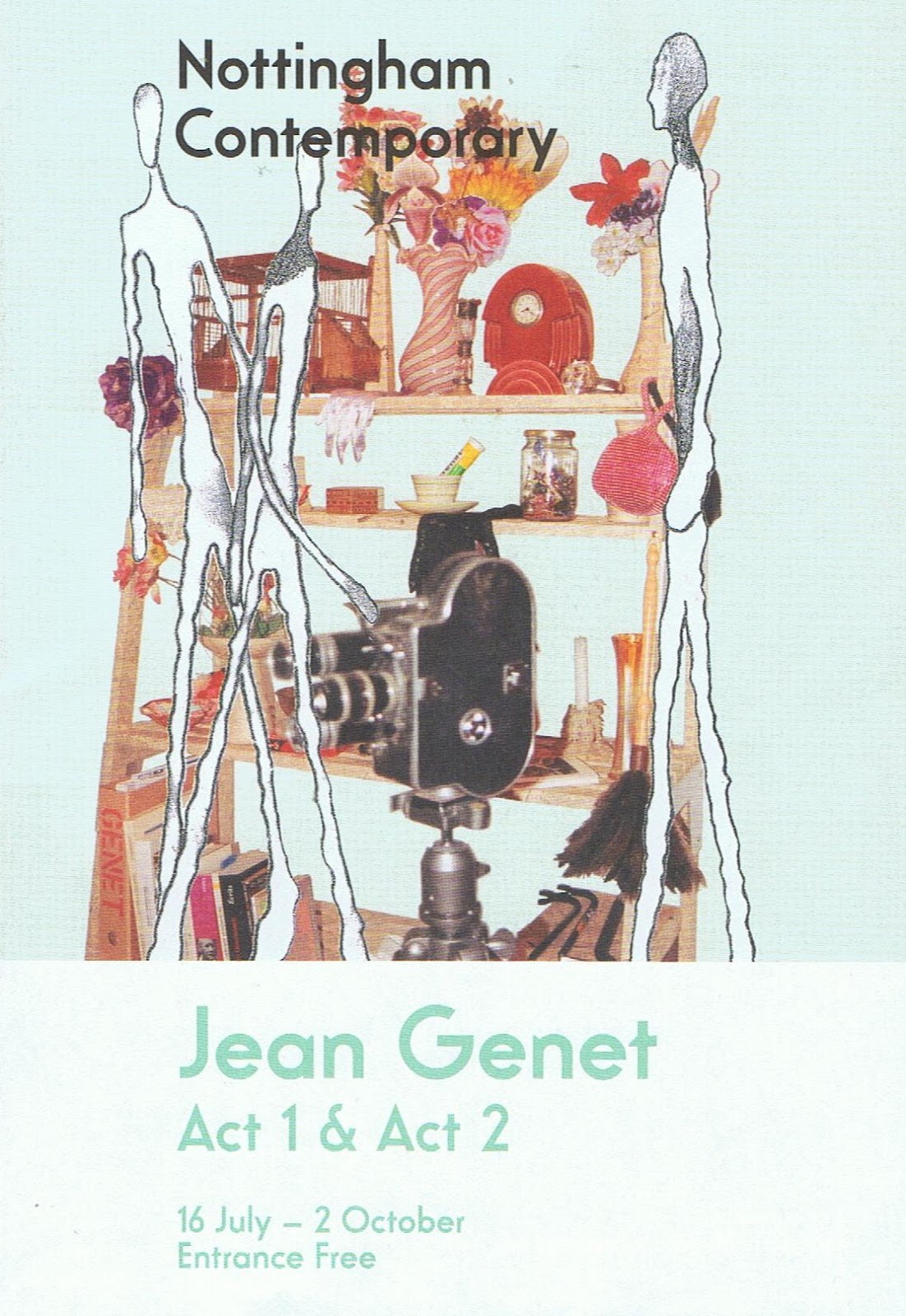
Jean Genet in Nottingham


The art gallery Nottingham Contemporary's summer (16 July 2011 – 2 October 2011) exhibition is entitled 'Jean Genet' as it is inspired by the French rebel writer, and it is in two 'Acts'.

Act 1 features work by Marc Camille Chaimowicz, and also includes sculptures (notably Man Pointing) and the portrait of Genet by Alberto Giacometti. Others works shown in Act 1 are by Tariq Alvi, Lukas Duwenhögger, Mathilde Rachet, and Wolfgang Tillmans.

Act 2 concentrates on Genet's later politically involved years, and features the film Nervus Rerum by The Otolith Group, which moves round Jenin refugee camp on the West Bank with readings from Genet's Prisoner of Love (Captif amoureux) and Fernando Pessoa's O Livro do desassossego (The Book of Disquiet). Lili Reynaud–Dewar's walls speak passages from Prisoner of Love and L'Ennemi déclaré (The Declared Enemy), with books by north African writers displayed, such as Nabile Farès's Le champ  des oliviers and Tahar Ben Jelloun's Harrouda. Act 2 also features work by André Acquart, Emory Douglas (Black Panther graphic work), Latifa Echakhch, Mona Hatoum, Glenn Ligon, Abdul Hay Mosallam, Gil J. Wolman, Akram Zaatari, and Carole Roussopoulos.