Showing posts with label Carroll (Lewis). Show all posts

8 August 2015

NYC #1: Alice in Wonderland

Immediately north of the Conservatory Water in Central Park, and commissioned by George Delacorte, is Alice in Wonderland by José de Creeft dating from 1959. The sculpture was designed from John Tenniel's book illustrations, although (according to the Central Park web site) Alice's face is a representation of Creeft's daughter Donna, and the Mad Hatter is 'a caricature of George Delacorte'. Taking decent photos of this wonderful creation is frustrating on a sweltering New York day because kids of any age (i.e. regular tourists) must satisfy their (to me incomprehensible) desire to be photographed climbing on a work of art and grinning inanely. This artwork reminded me of Make Way for Ducklings! in Boston, the Peter Pan sculptures in Kensington Gardens and Oamaru, New Zealand, and the Dr Seuss sculptures in Springfield, Massachusetts, all of which I've made posts of, and all of which I may get round to providing with links in the near future.

 
At the time the only thing in my head was to take the photos while the poseur(se)s changed, but looking back now I can't prevent Jefferson Airplane's 'White Rabbit' from invading my consciousness.

Googling, I find that there is indeed a strong resemblance between the Mad Hatter and the sponsor George Delacorte.

'One pill makes you larger and one pill makes you small...'

Bad trip, man, but then that Cheshire Cat's enough to give anybody one.

But those mushrooms don't look very magic to me. 'Go ask Alice'. I'm sure Lewis Carroll wouldn't have known.

Around the sculpture are seven plaques, six bearing Carroll quotations:

'ALICE IN WONDERLAND
IN MEMORY OF MY WIFE
MARGARITA DELACORTE
WHO LOVED ALL CHILDREN
GTD'

'TWINKLE, TWINKLE, LITTLE BAT!
HOW I WONDER WHAT YOU'RE AT!
UP ABOVE THE WORLD YOU FLY,
LIKE A TEA-TRAY IN THE SKY.'

(Carroll's parody of June Taylor's 'Twinkle, Twinkle, Little Star.')

'THEY TOLD ME YOU HAD BEEN TO HER,
AND MENTIONED ME TO HIM:
SHE GAVE ME A GOOD CHARACTER,
BUT SAID I COULD NOT SWIM.'

'BEAUTIFUL SOUP, SO RICH AND GREEN,
WAITING IN A HOT TUREEN!
WHO FOR SUCH DAINTIES WOULD NOT STOOP?
SOUP OF THE EVENING, BEAUTIFUL SOUP!'

 'TWEEDLEDUM AND TWEEDLEDEE
AGREED TO HAVE A BATTLE
FOR TWEEDLEDUM SAID TWEEDLEDEE
HAD SPOILED HIS NICE NEW RATTLE.'
 
'TWAS BRILLIG, AND THE SLITHY TOVES
DID GYRE AND GIMBLE IN THE WABE;
ALL MIMSY WERE THE BOROGROVES,
AND THE MOME RATHS OUTGRABE.'
 
'SPEAK ROUGHLY TO YOUR LITTLE BOY,
AND BEAT HIM WHEN HE SNEEZES:
HE ONLY DOES IT TO ANNOY,
BECAUSE HE KNOWS IT TEASES.'

21 April 2014

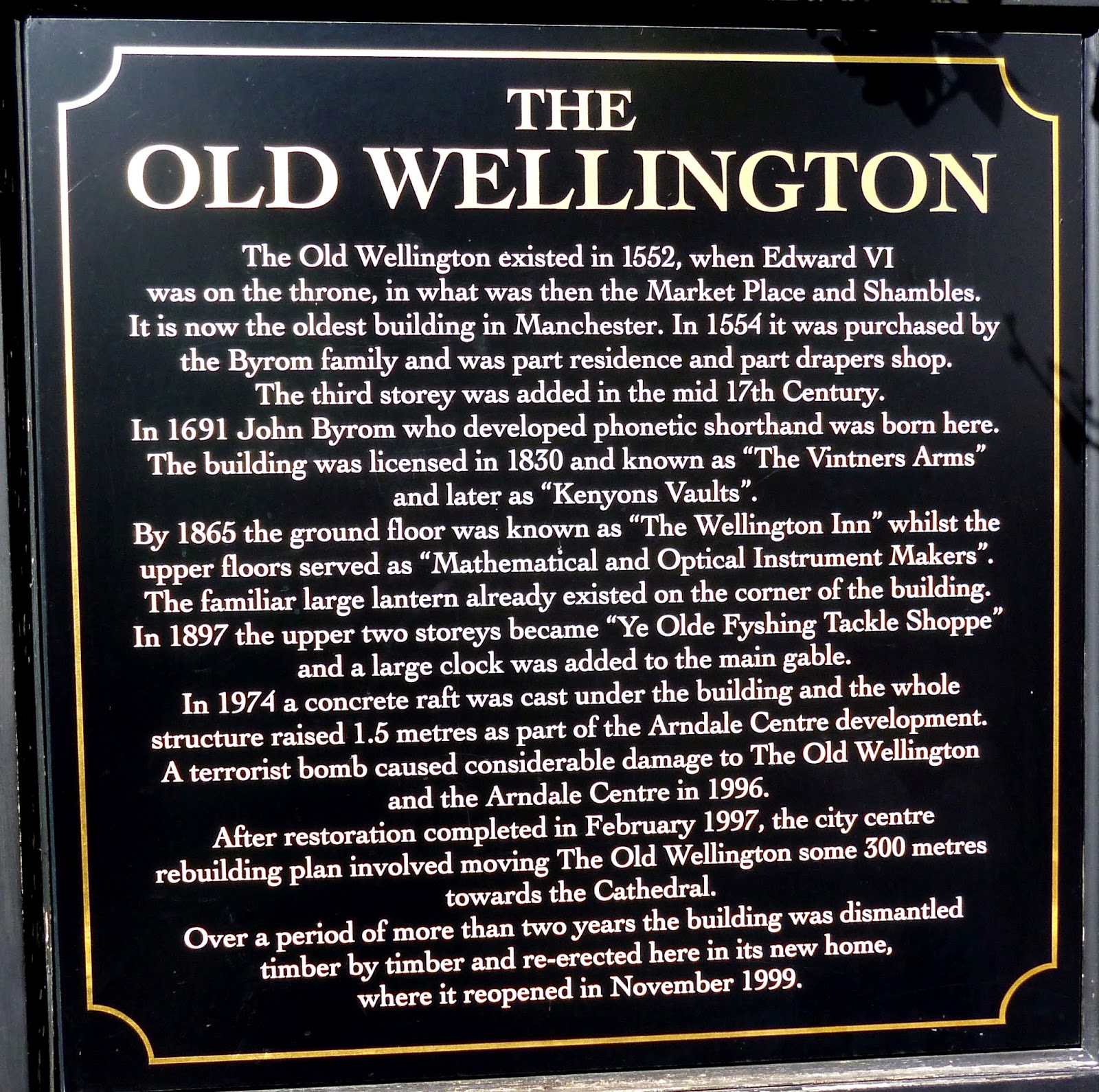
John Byrom in Manchester

 
'THE
OLD WELLINGTON
The Old Wellington existed in 1552, when Edward VI was on the throne, in what was then the Market Place and Shambles. It is now the oldest building in Manchester. In 1554 it was purchased by the Byrom family and was part residence and part drapers shop.
The third storey was added in the mid 17th century.
In 1691 John Byrom who developed phonetic shorthand was born here.
The building was licensed in 1830 and known as 'The Vintners Arms'
and later as 'Kenyons Vaults'.
By 1865 the ground floor was known as 'the Wellingont Inn' whilst the upper floors served as 'Mathematical and Optical Maker'.
The familiar large lantern already existed on the corner of the building.
In 1897 the upper two storeys became 'Ye Olde Fyshing Tackle Shoppe' and a large clock was added to the main gable.
In 1974 a concrete raft was cast under the building and the whole structure raised 1.5 metres as part of the Arndale Centre development.
A terrorist bomb caused considerable damage to The Old Wellington and the Arndale Centre in 1996.
After restoration completed in February 1997, the city centre rebuilding plan involved moving The Old Wellington some 300 metres towards the Cathedral.
Over a period of more than two years the building was dismantled timber by timber and re-erected in its new home, where it reopened in November 1999.'
 
Most sources give John Byrom's birth as 1692, and give his place of birth as Kersal Cell in Broughton, Salford. He was also a notable poet, although he is probably best remembered for coining the expression 'Tweedle-dum and Tweedle-dee' in relation to an argument concerning Handel and Bononcini: this was of course popularised as two identical characters in Lewis Carroll's Through the Looking-Glass (1871).

Byrom died in 1763, spending his later years in Stockport.

2 May 2012

Isaac Watts in Stoke Newington, London

'The gateway to
ABNEY HOUSE
Which stood here 1700–1843

ISSAC [sic] WATTS
Hymn-writer and poet
stayed here
1734–1748'

Watts was known as 'the father of hymnody', and is perhaps most remembered for 'Against Idleness and Mischief' (aka 'How Doth the Little Busy Bee')* and 'O God Our Help in Ages Past'.

Abney Park was one of the ‘magnificent seven’ garden cemeteries of London, and is now a memorial park originally laid out by Lady Mary Abney and Isaac Watts. Watts's statue is in a central part of the park, in front of Abney Park Chapel.

'IN
MEMORY OF
ISAAC WATTS D.D.
AND IN TESTIMONY OF THE HIGH AND
LASTING ESTEEM IN WHICH HIS
CHARACTER AND WRITINGS ARE HELD IN
THE GREAT CHRISTIAN COMMUNITY BY
WHOM THE ENGLISH LANGUAGE IS SPOKEN.
OF HIS PSALMS AND HYMNS IT MAY
BE PREDICTED IN HIS OWN WORDS,

"AGES UNBORN SHALL MAKE HIS SONGS
THE JOY AND LABOUR OF THEIR TONGUES."

HE WAS BORN AT SOUTHAMPTON
JULY 17 1674. DIED NOVEMBER 25 1748
AFTER A RESIDENCE OF 36 YEARS IN THE
MANSION OF SIR THOMAS ABNEY, BART.,
THEN STANDING IN THESE GROUNDS.'

'THIS MOUNT
WAS A
FAVOURITE RETIREMENT
OF THE LATE
ISAAC WATTS, D.D.'

Abney Park did not become a cemetery until 1840. Isaac Watts was buried in Bunhill Fields with other non-Conformists.

*The words of 'Against Idleness and Mischief':

'How doth the little busy bee
Improve each shining hour,
And gather honey all the day
From every opening flower!


How skilfully she builds her cell!
How neat she spreads the wax!
And labours hard to store it well
With the sweet food she makes.

In works of labour or of skill,
I would be busy too;
For Satan finds some mischief still
For idle hands to do.

In books, or work, or healthy play,
Let my first years be passed
That I may give for every day
Some good account at last.'

Lewis Carroll parodies 'Against Idleness and Mischief' when Alice, in Alice in Wonderland, trying to remember a well-known verse, says:

'How doth the little crocodile
Improve his shining tail,
And pour the waters of the Nile
On every golden scale!


How cheerfully he seems to grin,
How neatly spread his claws,
And welcome little fishes in
With gently smiling jaws!'


In Hunger and Love, Lionel Britton suggests that Watts's expression 'For idle hands to do' is about masturbation, and I'm sure that he is in part correct.