Showing posts with label Byrom (John). Show all posts

21 April 2014

John Byrom in Manchester

 
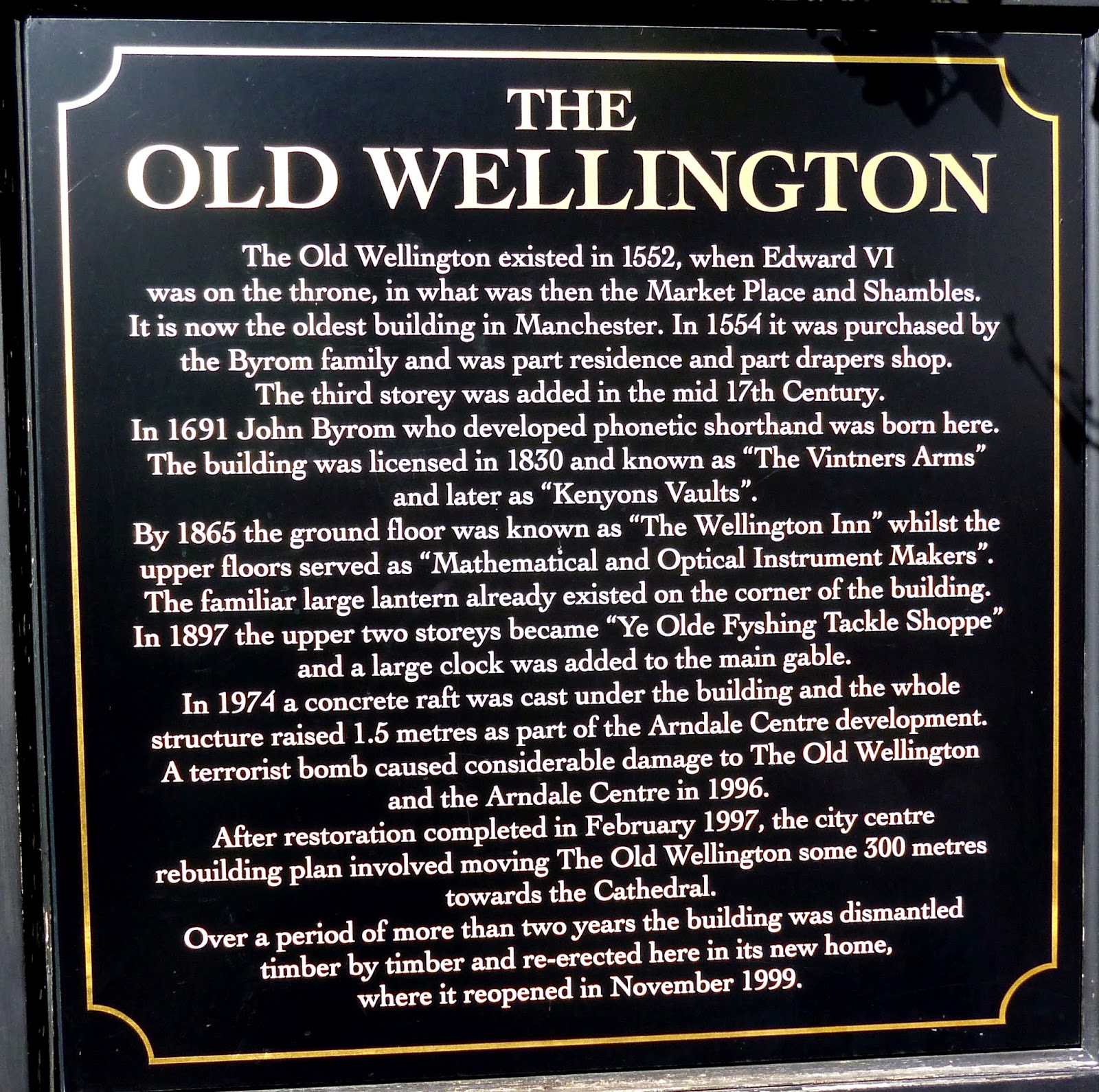
'THE
OLD WELLINGTON
The Old Wellington existed in 1552, when Edward VI was on the throne, in what was then the Market Place and Shambles. It is now the oldest building in Manchester. In 1554 it was purchased by the Byrom family and was part residence and part drapers shop.
The third storey was added in the mid 17th century.
In 1691 John Byrom who developed phonetic shorthand was born here.
The building was licensed in 1830 and known as 'The Vintners Arms'
and later as 'Kenyons Vaults'.
By 1865 the ground floor was known as 'the Wellingont Inn' whilst the upper floors served as 'Mathematical and Optical Maker'.
The familiar large lantern already existed on the corner of the building.
In 1897 the upper two storeys became 'Ye Olde Fyshing Tackle Shoppe' and a large clock was added to the main gable.
In 1974 a concrete raft was cast under the building and the whole structure raised 1.5 metres as part of the Arndale Centre development.
A terrorist bomb caused considerable damage to The Old Wellington and the Arndale Centre in 1996.
After restoration completed in February 1997, the city centre rebuilding plan involved moving The Old Wellington some 300 metres towards the Cathedral.
Over a period of more than two years the building was dismantled timber by timber and re-erected in its new home, where it reopened in November 1999.'
 
Most sources give John Byrom's birth as 1692, and give his place of birth as Kersal Cell in Broughton, Salford. He was also a notable poet, although he is probably best remembered for coining the expression 'Tweedle-dum and Tweedle-dee' in relation to an argument concerning Handel and Bononcini: this was of course popularised as two identical characters in Lewis Carroll's Through the Looking-Glass (1871).

Byrom died in 1763, spending his later years in Stockport.

17 July 2013

James Crossley and Eleanora Atherton: St Luke's, Kersal Moor #5

'In Loving Memory
of
JAMES CROSSLEY,
PRESIDENT OF THE CHETHAM SOCIETY,
F.S.A.
BORN AT THE MOUNT, HALIFAX;
MARCH 31ST 1800
DIED AT STOCKS HOUSE, CHEETHAM;
AUGUST 1ST 1883.'
 
James Crossley (who has been called 'Manchester's Dr Johnson') was an author and bibliophile, and also a solicitor and a business partner of Thomas Ainsworth, the son of the novelist William Harrison Ainsworth who was a lifelong friend.
 
Crossley established the Chetham Society in 1843 to edit and publish works of local history, and many titles were published. He was responsible for the publication of a very successful hoax: Fragment on Mummies, which was said to be by Sir Thomas Browne.
 
I learned about the existence of this grave (and the other below that I've made posts on) from an online publication on St Paul's Churchyard, which I link here. This publication also mentions that he asked to be buried as closely as possible to Eleanora Atherton, and his wish was granted.

Eleanora Atherton (1782–1870) was a philanthropist who lived in Manchester and is thought to have given about £100,000 to charity between 1838 and 1870. She supported the work of the Chetham Society, including the donation of the library of one of her ancestors, the philosopher and poet John Byrom.

Below are links to other posts in the series:
 
–––––––––––––––––––––––––––––––––––
Edwin Waugh: St Paul's, Kersal Moor #1
Samuel Oldham Lees: St Paul's, Kersal Moor #2
Robert Angus Smith: St Paul's, Kersal Moor #3
William Edward Armytage Axon: St Paul's, Kersal Moor #4