On the rue d'Auteuil in Québec city are a series of monuments to writers, installed there at different periods of the present century. The busts of Pushkin and Nelligan testify to the friendship between Saint Petersburg and Québec city.

 Émile Nelligan (1879–1941), about whom I made a post here.
The bust contains a sonnet in which it is (quite possibly incorrectly) dated as 1899, the same year of Nelligan's entry into a mental hospital. The poem tells of a golden ship being wrecked, although of course it is really Nelligan himself who is mentally wrecked.
'Le Vaisseau d'or
C'était un grand Vaisseau taillé dans l'or massif.
Ses mâts touchaient l'azur sur des mers inconnues;
La Cyprine d'amour, cheveux épars, chairs nues,
S'étalait à sa proue, au soleil excessif.
Mais il vint une nuit frapper le grand écueil
Dans l'Océan trompeur où chantait la Sirène,
Et le naufrage horrible inclina sa carène
Aux profondeurs du Gouffre, immuable cercueil.
Ce fut un Vaisseau d'Or, dont les flancs diaphanes
Révélaient des trésors que les marins profanes,
Dégoùt, Haine et Névrose, entre eux ont disputés.
Que reste-t-il de lui dans la tempête brève ?
Qu'est devenu mon coeur, navire déserté ?
Hélas ! Il a sombré dans l'abîme du Rêve !'

 Alexandre Pouchkine (Eng: Pushkin) (1799-1837).
'Mon nom ? Mais qu’est-il donc pour toi ?
Il mourra, comme sur la grève
Meurt l’écho que le flot soulève;
Comme un bruit, la nuit, dans un bois.
C’est un signe incompréhensible
Que ton carnet aura gardé,
Tel, sur une tombe, gravé,
Un grimoire en langue illisible.
Mon nom ? Tu l’auras oublié
Dans les remous, les aventures.
Sur ton âme il n’aura laissé
Aucune trace tendre ou pure.
Mais un jour triste, dis-le bien
À voix haute, avec nostalgie;
Tu diras : quelqu’un se souvient,
Un coœur où vit encore ma vie…'

 Dante Alighieri (1265–1321)
'O lumière qui tant t'élève
au-dessus des pensées mortelles, reprête un peu
à mon esprit de ce que tu semblais
et rends ma langue si puisssante
qu'une étincelle de ta gloire
puisse arriver aux génerations futures'
Translation on the plinth of the bust from The Divine Comedy.
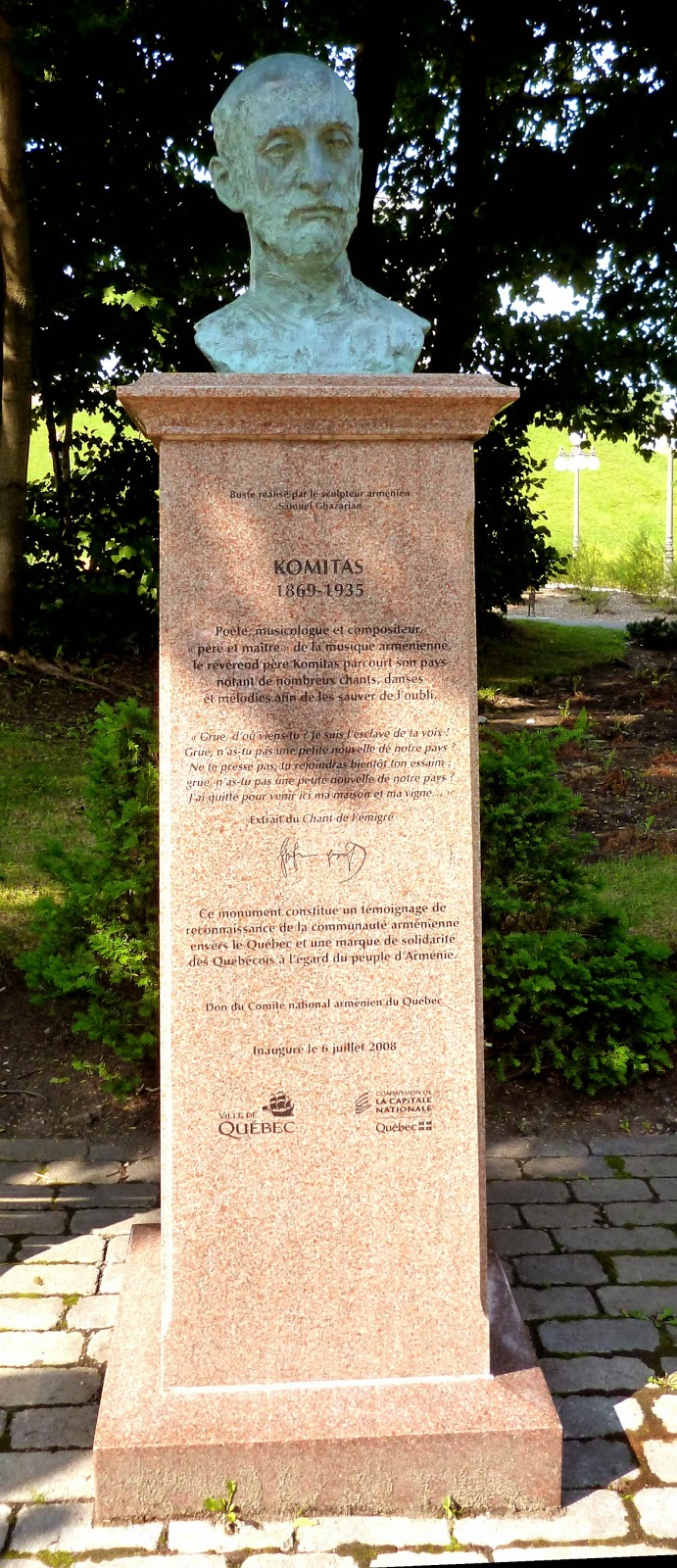
 The poet and musical composer Komitas (1869–1935) is described here as the 'father and mother' of Armenian music, and notes that he scoured his country in order to save songs, dances and melodies from oblivion. The words below, an extact from Chant de l'émigré, are addressed to the crane bird, asking if it has news of their mutual country.
'Grue, d'où viens-tu ? Je suis l'esclave de ta voix !
Grue, n'as-tu pas une petite nouvelle de notre pays ?
Ne te presse pas, tu rejoindras bientôt ton essaim ;
grue, n'as-tu pas une petite nouvelle de notre pays ?'

 The Confucian scholar and poet Nguyễn Trãi (1380–1442) was recognised by UNESCO as the person most representative of Vietnamese culture.

 Taras Chevtchenko (1814–61), who was also named Schevchenko in English, was an important poet, a painter and a great supporter of Urkainian culture. The bust was erected in 2014 to commemorate the 200th anniversary of Chevtchenko's birth.
'Que notre esprit, que notre chant
Ne meure, ni s'éteigne.
C'est là que réside notre gloire,
La Gloire de Ukraine !'
I also have a link to another monument of him in Paris here.

The bust contains a sonnet in which it is (quite possibly incorrectly) dated as 1899, the same year of Nelligan's entry into a mental hospital. The poem tells of a golden ship being wrecked, although of course it is really Nelligan himself who is mentally wrecked.
'Le Vaisseau d'or
C'était un grand Vaisseau taillé dans l'or massif.
Ses mâts touchaient l'azur sur des mers inconnues;
La Cyprine d'amour, cheveux épars, chairs nues,
S'étalait à sa proue, au soleil excessif.
Mais il vint une nuit frapper le grand écueil
Dans l'Océan trompeur où chantait la Sirène,
Et le naufrage horrible inclina sa carène
Aux profondeurs du Gouffre, immuable cercueil.
Ce fut un Vaisseau d'Or, dont les flancs diaphanes
Révélaient des trésors que les marins profanes,
Dégoùt, Haine et Névrose, entre eux ont disputés.
Que reste-t-il de lui dans la tempête brève ?
Qu'est devenu mon coeur, navire déserté ?
Hélas ! Il a sombré dans l'abîme du Rêve !'
'Mon nom ? Mais qu’est-il donc pour toi ?
Il mourra, comme sur la grève
Meurt l’écho que le flot soulève;
Comme un bruit, la nuit, dans un bois.
C’est un signe incompréhensible
Que ton carnet aura gardé,
Tel, sur une tombe, gravé,
Un grimoire en langue illisible.
Mon nom ? Tu l’auras oublié
Dans les remous, les aventures.
Sur ton âme il n’aura laissé
Aucune trace tendre ou pure.
Mais un jour triste, dis-le bien
À voix haute, avec nostalgie;
Tu diras : quelqu’un se souvient,
Un coœur où vit encore ma vie…'
'O lumière qui tant t'élève
au-dessus des pensées mortelles, reprête un peu
à mon esprit de ce que tu semblais
et rends ma langue si puisssante
qu'une étincelle de ta gloire
puisse arriver aux génerations futures'
Translation on the plinth of the bust from The Divine Comedy.
'Grue, d'où viens-tu ? Je suis l'esclave de ta voix !
Grue, n'as-tu pas une petite nouvelle de notre pays ?
Ne te presse pas, tu rejoindras bientôt ton essaim ;
grue, n'as-tu pas une petite nouvelle de notre pays ?'
'Que notre esprit, que notre chant
Ne meure, ni s'éteigne.
C'est là que réside notre gloire,
La Gloire de Ukraine !'
I also have a link to another monument of him in Paris here.


 Posts
Posts

