Showing posts with label Voltaire. Show all posts

11 August 2022

Voltaire and Lamartine in Pont-de-Veyle, Ain (01)

Pont-de-Veyle has literary associations. Augustin de Ferriol d'Argental probably had the château built, which is now the mairie. His sons Antoine de Ferriol and Charles-Augustin were friends of Voltaire from their schooldays, and that friendship continued.

In 1824 Louis Augustin de Parseval bought the château. His brother Amédée was a close friend of Lamartine, and to this day a room in the former château is called 'La Salle de Lamartine'.

3 February 2012

Véronique Ovaldé: Ce que je sais de Vera Candida (2009)

Women are the key characters in Ce que je sait de Vera Candida (lit. 'What I Know of Vera Candida') – which was originally to be called Vies amazones – although men are often central to the action. Rosa Bustamente lives in Vatapuna – a village on an island and part of an unnamed country in South America – and made her living as a prostitute up to the age of forty, when she turns to catching flying fish to sell at the market. When a conman named Jeronimo begins to build a palatial house near her cabin, where she lives alone, she partly persuades herself, partly is persuaded, into visiting him with a view to selling her property. It doesn't take the lecherous Jeronimo long to get her into bed, but his callous reaction to her pregnancy means she immediately finishes with him.

Violette is the result of the relationship, but she's a very slow girl who soon grows up addicted to the local firewater, gets pregnant (probably by the mayor's son) at fifteen, and soon dies under mysterious circumstances very early in the book.

Violette's daughter is Vera Candida, who is brought up by Rosa and firmly taught to avoid the mistakes of previous generations of women, to avoid succumbing to men, but at fifteen Vera is raped by Jeronimo, and the pregnant girl flees to mainland Lahomeria without telling anyone.

Then begins the second (and longest) section of the book, dealing with Vera and her daughter Monica Rose as they move from a home for single mothers (run by a woman who was married to a Nazi) to a crummy flat, and then to longterm security and warmth with the journalist Itxaga, who's the only decent male in the book, and who's been in love with Vera for some time.

And then, at nearly forty and after eighteen years with Itxaga, she learns she has terminal stomach cancer and returns to Vatapuna, where if he's alive she'll kill the man who made her life a nightmare, who thrust his cock into her mouth and then raped her. But just as she's missed seeing her grandmother alive again, Jeronimo has already hanged himself.

This is a book of love and hate, of beauty and the beast, of strength and weakness, of sickness and health, of tenderness and brutality, enhanced by a strange hypnotic power that often – breathlessly but rhythmically – sweeps through the novel in very long sentences punctuated by many commas, translating thoughts and actions. Compelling.

(Addendum: see below for Robert Hughes's comment on me missing the obvious: Voltaire's Candide.)

My review of another book of Ovaldé's:

–––––––––––––––––––––––––––––––––––
Véronique Ovaldé: Les Hommes en général me plaisent beaucoup (2003)

1 December 2011

The Panthéon, 5th arrondissement, Paris, France: Literary Île-de-France #44

'Histoire de Paris

Le Panthéon

Guéri en 1774 d'une grave maladie, Louis XV décide la construction d'une église dédiée à sainte Geneviève. Soufflot en est l'architecte. Le chantier, commencé en 1764, fut très long, et l'édifice faillit s'écrouler sous la Révolution. En 1791, on transforme l'église en Panthéon destiné à recevoir la dépouille des grands hommes : Voltaire et Rousseau y sont transférés en grande pompe. Rendu au culte sous le premier Empire, le Panthéon retrouve définitivement sa vocation à la mort de Victor Hugo, en 1885. Depuis 1907, y repose également une femme : il s'agit de Marcelin Berthelot. Morts le même jour, ils ont ainsi choisi de rester unis dans la tombe.'

'History of Paris

The Panthéon

Cured of a serious illness in 1744, Louis XV decided to build a church dedicated to Saint Geneviève. The architect was Soufflot. The workshop was begun in 1764 and was very long, and the building almost fell under the revolution. In 1791 the church became The Panthéon, destined to receive the remains of great men: Voltaire and Rousseau were moved here with great ceremony. Returning to religious usage under the First Empire, the Panthéon finally found its vocation as a necropolis with the death of Victor Hugo in 1885. Since 1907, a woman has also rested here: Marcelin Berthelot's wife. Both died the same day, and they both remain united in the same grave.'

Albert Bartholomé's 'Monument to Jean-Jacques Rousseau' (1907).

To the left of the central group is Music, to the right Glory.

The central group depicts Philosophy between Nature and Truth.

Jean-Jacques Rousseau.

Alphonse-Camille Terroir's 'To Diderot and the Encyclopédistes' (1913).

Two standing female figures with the inscription 'L'Encyclopédie prépare l'idée de la Révolution' ('L'Encyclopédie prepares for the idea of revolution').
To the left: Truth.

To the right: Strength.

Bottom center: the profile of Diderot on the tomb.

In the crypt are a number of other tombs. This is Rousseau's, which was brought here in 1794.

And next to him, Voltaire's statue and tomb.

Here there are the tombs of three writers.

Alexandre Dumas (1802—70).

Victor Hugo (1802—85).

Émile Zola (1840—1902). Zola's remains were moved from Montmartre Cemetery to the Panthéon in 1908, when Alfred Dreyfus was present. And the close of the ceremony, anti-Dreyfusard Louis Grégori fired his revolver at Dreyfus, who was only slightly injured in the arm.

Aimé Césaire was buried in his native Martinique, but a wall here is dedicated to him.

'AIMÉ CÉSAIRE
POÈTE, DRAMATURGE, HOMME POLITIQUE MARTINIQUAISE (1913—2008)
DÉPUTÉ DE LA MARTINIQUE (1915—99) ET MAIRE DE FORT-DE-FRANCE (1945—2001)
INLASSABLE ARTISAN DE LA DÉCOLONISATION, BÂTISSEUR
D'UNE "NÉGRITUDE" FONDÉE SUR L'UNIVERSALITÉ DES DROITS
DE L'HOMME "BOUCHE  DES MALHEURS QUI N'ONT POINT DE
BOUCHE", IL A VOULU DONNER AU MONDE, PAR SES ÉCRITS ET
SON ACTION "LA FORCE DE REGARDER DEMAIN"
"J'HABITE UNE BLESSURE SACRÉE
J'HABITE DES ANCÊTRES IMAGINAIRES
J'HABITE UN VOULOIR OBSCUR
J'HABITE UN LONG SILENCE
J'HABITE UNE SOIF IRRÉMÉDIABLE"

Voltaire in Châtenay-Malabry, Hauts-de-Seine (92), France: Literary Île-de-France #42

Although often said to have been born in Paris, Voltaire himself declared on several occasion that he was born in Châtenay-Malabry (Voltaire's parents having stayed in the town the same year as his birth), and this small town in Hauts-de-Seine clearly proclaims this.

Le Voltaire at 1 place Voltaire has a bar-café that also exploits the person it sees as its famous son.

And on the roof is a statue niche with a bust of Voltaire that was erected here in the first half of the 19th century.

At the crossroads on the principal street there's a really impressive bust of Voltaire, with a fountain.

On the back of it is a quotation of Voltaire's, stating that the best work he'd perflormed was in doing a little good:

'J'AI FAIT
UN PEU DE BIEN
C'EST MON
MEILLEUR OUVRAGE
VOLTAIRE
1694—1778'

25 November 2011

Place des Vosges, 4th arrondissement, Paris, France: Literary Île-de-France #38

Victor Hugo moved into the second floor of the Hôtel Rohan-Guéménée, 6 Place des Vosges, with his wife and four children in 1833. This was to be his longest stay in one place, and he left in 1848.

And I think they tend to over-emphasize the point, but:

'VICTOR HUGO
HABITA DANS CET HÔTEL
DE 1833 À 1848'

There's a great deal of information about Louise Michel in the museum, such as a booklet in the anteroom that reproduces a verse from Hugo's poem 'Vito Major', written after the fall of the Commune, in which he praises her hatred for inhumanity and her care for children, seeing a great tenderness beneath her anger:

'Ta bonté, ta fierté de femme populaire,
L'âpre attendrissement qui dort sous ta colère,
Ton long regard de haine à tous les inhumains,
Et les pieds des enfants réchauffés dans tes mains.'

The letters between them were many. The anarchist and the republican evidently had their differences, but they both believed in justice, equality, freedom for children and women, and a free and non-religious education system.

Two examples of Michel's novels are shown in the museum, La Misère (1882) and Les Mépriseés, both of which were co-written with Victoire Marguerite Tinayre (1831—95), writing as 'Jean Guêtré'. Tinayre led free schools in the Second Empire and took part in the Commune when she was the school inspector for the 12th arrondissement. La Misère was a popular success, and concerns the question of prostitution, a theme also taken up in Les Mépriseés, which was heavily influenced by Hugo's Les Misérables.

Madame Paul Mauride by Jean-Auguste Dominique Ingres. Mauride was a republican who visited Michel in her prison in Versailles.

The marble bust of Hugo is by David d'Angers (alias Jean-Pierre David), and was made in 1938. The two had met in 1927, and Hugo dedicated two poems to him.

During Hugo's exile in Guernsey, his mistress Juliette Drouet lived in La Farrue, a house close to Hugo's family, for seven years before moving to rue de Hauteville in 1864, the very place where Hugo had spent his first year in exile. It was called Hauteville Fairy, and Hugo took care of the décor.

These two photos show a reconstruction of Drouet's Salon chinois at Guernsey, which was installed here for the inugural ceremony of the museum in 1903. It is, entirely, a work of Hugo's imagination.

A reconstruction of Hugo's salon, rue de Clichy.

Next door, there's a plaque to remind that Théophile Gautier once lived there:
'LE POÈTE
THÉOPHILE GAUTIER
A VÉCU DANS CETTE MAISON
DE 1828 À 1834'

A little further along is another plaque, telling of the birth of Madame de Sévigné:
'DANS CET HÔTEL
EST NÉE
LE 6 FÉVRIER 1626
MARIE DE RABUTIN CHANTAL
MARQUISE DE SÉVIGNÉ'

Beyond the Place des Vosges, at 62 rue St-Antoine, is L'Hôtel de Sully. Here in 1725, when Voltaire was dining, a servant entered to tell him that someone wanted to see him outside. It was Guy-Auguste de Rohan-Chabot, who had insulted Voltaire for not using his real name, Jean François-Marie Arouet. Rohan-Chabot's servants beat him up with sticks. Voltaire never got his revenge.

Today, the hôtel is home to the national archives.

My Victor Hugo posts:
–––––––––––––––––––––––––––––––––––
Victor Hugo's Hauteville House, Guernsey
Victor Hugo, Place des Vosges
Victor Hugo in Bièvres
Victor Hugo in Candie Gardens, St Peter Port, Guernsey
Émilie de Putron in Foulon Cemetery, Guernsey

18 November 2011

6th and 7th arrondissements, by the Seine, Paris, France: Literary Île-de-France #29

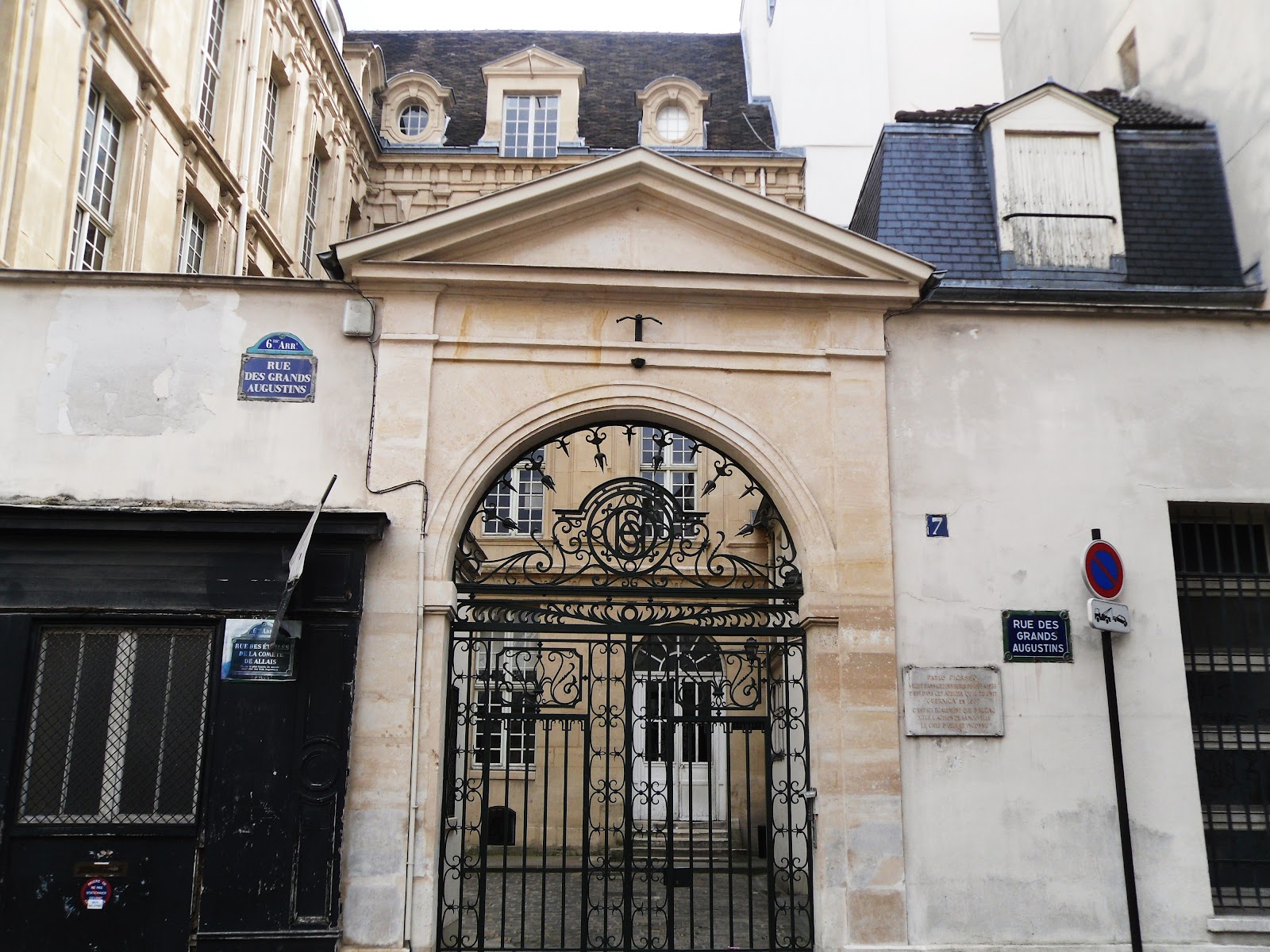
7 rue des grands Augustins.

'PABLO PICASSO

VÉCUT DANS CET IMMEUBLE DE 1936 À 1955
C'EST DANS CET ATELIER QU'IL PEIGNAIT
"GUERNICA" EN 1937'

'PABLO PICASSO
LIVED IN THIS BUILDING FROM 1936 TO 1955
IT IS IN THIS WORKSHOP THAT HE PAINTED
"GUERNICA" IN 1937'.

'C'EST ICI ÉGALEMENT QUE BALZAC
SITUE L'ACTION DE SA NOUVELLE
"LE CHEF D'OUEUVRE INCONNU"'.

'IT IS HERE TOO THAT BALZAC
SITUATED THE ACTION OF HIS SHORT STORY
"THE UNKNOWN MASTERPIECE"'.

In rue de Seine, at the back of the Institut de France, is a small enclosed grassy area with a bust and a statue of two noted French writers:

The more evident is Voltaire.


Although Montesquieu is hiding there.
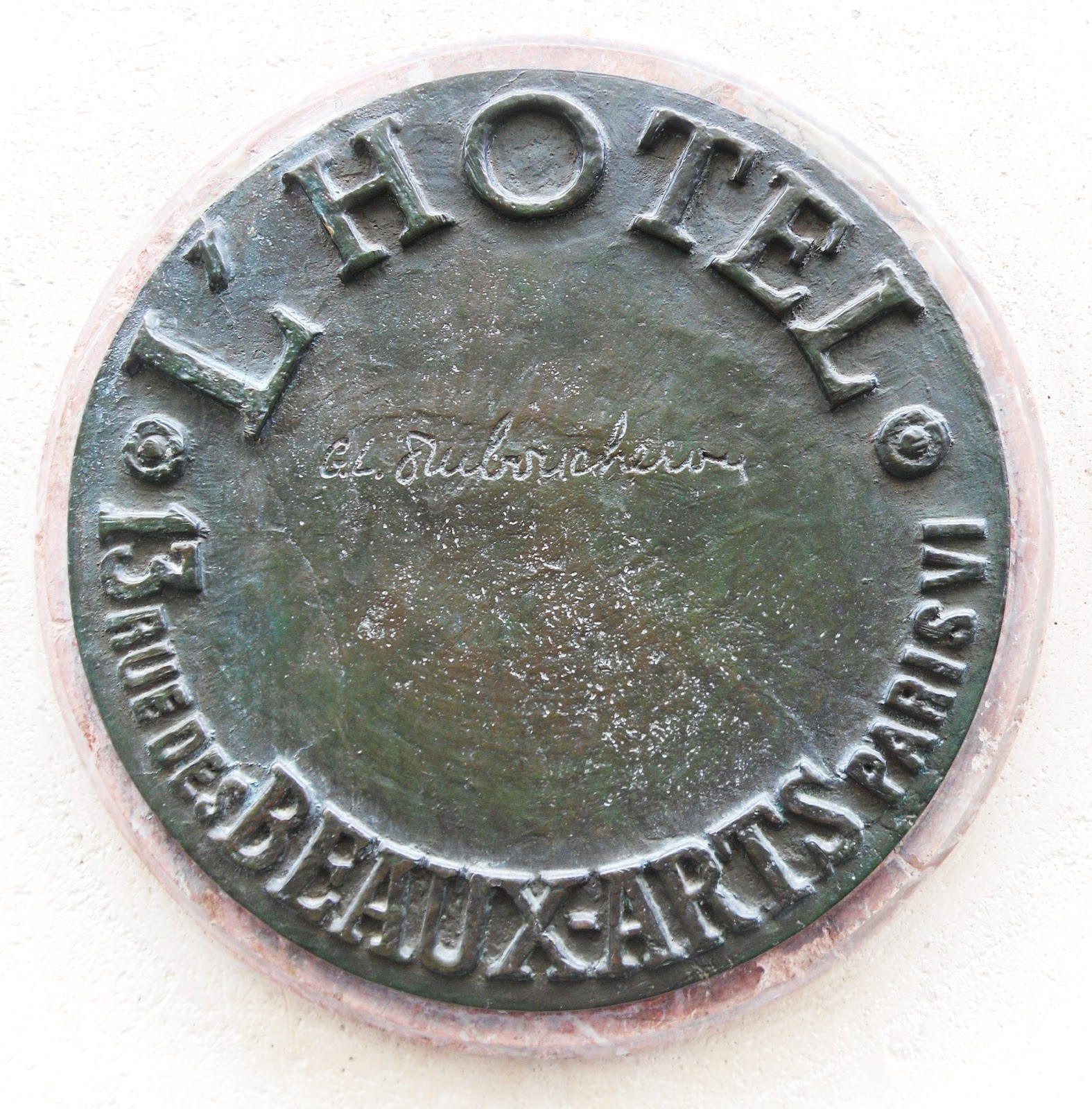
L'Hôtel, rue des Beaux-Arts, 6th arrondissement.

Oscar Wilde (1854—1900).

'OSCAR WILDE
Poète et Dramaturge
NÉ À DUBLIN
LE 15 OCTOBRE 1856
EST MORT DANS CETTER MAISON
LE 30 NOVEMBRE 1900'

'OSCAR WILDE
Poet and Playwright
BORN IN DUBLIN
15 OCTOBER 1856
DIED IN THIS HOUSE
30 NOVEMBER 1900'
 
'ICI VÉCUT

JORGE LUIS BORGES
1899 — 1986
Écrivain Argentin
LORS DE SES FRÉQUENTS SÉJOURS
À PARIS DE 1977 À 1984'

'HERE LIVED
JORGE LUIS BORGES
1899 — 1986
Argentinian Writer
DURING HIS FREQUENT STAYS
IN PARIS FROM 1977 TO 1984'

At 19 quai Malaquais, a barely visible sign around the scaffolding:

'ANATOLE FRANCE
NÉ LE 16 AVRIL 1844
QUAI MALAQUAIS NO. 19
HABITA DANS CET HÔTEL
DE 1844 À 1853'

And at 19 Quai Voltaire:

'ICI 
CHARLES BAUDELAIRE
JEAN SIBELIUS
RICHARD WAGNER
OSCAR WILDE
ONT HONORÉ PARIS
DE LEVR SÉJOVR'

'L'AURORE GRELOTTANTE EN ROBE ROSE ET VERTE
S'AVANÇAIT LENTEMENT SUR LA SEINE DÉSERTE
ET LE SOMBRE PARIS, EN SE FROTTANT LES YEUX,
EMPOINGNAIT SES OUTILS, VIEILLARD LABORIEUX'.

CHARLES BAUDELAIRE
"Le CRÉPUSCULE du MATIN"
LES FLEURS du MAL'

Le Voltaire, the house where Voltaire died.

'VOLTAIRE
NÉ À PARIS
LE 21 NOVEMBRE 1694
EST MORT
DANS CETTE MAISON
LE 30 MAI 1778'