
Showing posts with label Malta. Show all posts
Showing posts with label Malta. Show all posts
15 January 2012
Dun Karm in Msida, Malta
Libellés :
Dun Karm,
Malta,
Maltese Literature,
Msida,
Psaila (Carmelo)


15 May 2010
Robert Altman's Popeye (1980) Film Set, Sweethaven, Anchor Bay, Malta
Libellés :
Altman (Robert),
Anchor Bay (Malta),
Malta,
Movies,
Popeye,
Sweethaven

 The village Sweethaven in Anchor Bay created for Robert Altman's film Popeye has been preserved and turned into a museum. Critically, Popeye was seen as Altman's Heaven's Gate, and the director never made another big budget film of the like, although it was extremely popular with the general public.
 Two interior views of the General Store.
 The Post Office.
 The Barber Shop.
 Inside the café-bar, Tipsy & Sons Winery.
 The Sweethaven logo of the wine on sale there.
 And the tranquil Anchor Bay, which the village looks out onto.
13 May 2010
Achille Mizzi, Malta
Libellés :
Malta,
Maltese Literature,
Mizzi (Achille)
 There are a number of poems by and reviews of Achille Mizzi's work here both in English and Maltese.
12 May 2010
Ġużè Ellul Mercer, Dingli, Malta
Libellés :
Dingli,
Malta,
Maltese Literature,
Mercer (Ġużè Ellul)
 This wonderfully expressive statue in Dingli, Malta, is a representation of Ġużè Ellul Mercer (1897-1961), who was born in Msida, and who, among many other things, was a playwright, poet, novelist and Labour politician. The written work he is perhaps best known for is the novel Leli ta' Ħaż-Żgħir (1949) (Shadows of the Truth, trans. 2003 by Godwin Ellul). It is thought to be the first psychological novel in the Maltese language.
Mercer was buried in unconsecrated ground because of his politics - in the largest cemetery in Malta, the Addolorata, which is between Luqa airport and Paola. He was in fact buried in what is called the misbla, or rubbish dump, in a very simple grave. The Msida Maltese Labour Party later paid for a marble tomb.


11 May 2010
Rużar Briffa, Valletta, Malta
Libellés :
Briffa (Rużar),
Malta,
Maltese Literature,
Valletta
 One of the works of the romantic poet Rużar Briffa (1906-63) is called 'Fil-Barrakka ta' Fuq' ('At Upper Barrakka') and it is appropriate that there should be a plaque commemorating him in the Upper Barrakka Gardens in Valletta.
As a medical student - later a specialist in dermatology and venereology - he was friends with fellow student and future novelist Ġużè Bonnici, and they used to discuss literature together. Briffa admired Keats, Dante and D'Annuncio.
His wife Louisette said that he dreamed of 'beautifying' patients, and this idea is reflected in some of his work: he was known as 'The Poet of Beauty'. Louisette donated her husband's manuscripts to the University of Malta, which has copied some examples to a CD-ROM, and here are several images of the manuscripts. Also, there's a 5 minute 29 seconds documentary in Maltese on Briffa.
Giovanni Pietro Agius de Soldanis, Victoria, Gozo, Malta
Libellés :
De Soldanis (Giovanni Pietro Agius),
Gozo,
Malta,
Maltese Literature,
Victoria
.jpg) Also known as Gian Piet, Giovanni Pietro Agius de Soldanis (1712-70) was born in Victoria (then called Rabat), Gozo, and was a writer and a historian. His bronze statue stands in Villa Rundle gardens, Victoria, and remembers an author probably best known for two books: one about Gozo: Gozo antico e moderno, sacro e profano; and one about the development of the Maltese language: Della lingua punica presentemente usata da' Maltesi ovvero Nuovi Documenti, li quali possono servire di lume all'antica lingua etrusca (1750).
Also known as Gian Piet, Giovanni Pietro Agius de Soldanis (1712-70) was born in Victoria (then called Rabat), Gozo, and was a writer and a historian. His bronze statue stands in Villa Rundle gardens, Victoria, and remembers an author probably best known for two books: one about Gozo: Gozo antico e moderno, sacro e profano; and one about the development of the Maltese language: Della lingua punica presentemente usata da' Maltesi ovvero Nuovi Documenti, li quali possono servire di lume all'antica lingua etrusca (1750).
Ninu Cremona, Victoria, Gozo, Malta
Libellés :
Cremona (Ninu),
Gozo,
Malta,
Maltese Literature,
Victoria

 The statue of Ninu Cremona (1880-1972) outside the Ninu Cremona Lyceum, Fortunato Mizzi Street, Gozo.
Cremona was also known as Anthony Cremona and Is-Sur Nin and was born in Victoria, Gozo. Orphaned at an early age, he spent three years with an uncle in Tunis, later returning to the Jesuits' College on Gozo, then to the Seminary in Floriana, Malta, where he met Dun Karm (see below). He worked as a government clerk, then as a sanitary officer.
The statue of Ninu Cremona (1880-1972) outside the Ninu Cremona Lyceum, Fortunato Mizzi Street, Gozo.
Cremona was also known as Anthony Cremona and Is-Sur Nin and was born in Victoria, Gozo. Orphaned at an early age, he spent three years with an uncle in Tunis, later returning to the Jesuits' College on Gozo, then to the Seminary in Floriana, Malta, where he met Dun Karm (see below). He worked as a government clerk, then as a sanitary officer.In 1928 he was employed by the government with responsibility for translations and publications.
He was partly responsible for establishing the Għaqda tal-Kittieba tal-Malti (The Maltese Writers Society), later called Akkademja tal-Malti (The Maltese Academy), and was Vice-President and editor of Il-Malti, the organ of the Writers Society. More importantly, he helped to concretize Maltese orthography.
He wrote many books, but is most noted for his play Il-Fidwa tal-Bdiewa (The Farmers’ Liberation).
Roger Scicluna, Gozo, Malta
Libellés :
Gozo,
Malta,
Maltese Literature,
Scicluna (Roger)
 Roger Scicluna was a 20th century romantic poet who is very little known, and his almost total absence from the internet is a strong indication of this. However, like Pisani, he was a Gozitan who spent most of his life on the island. The very unusual thing, though, is that he chose to write in English as opposed to Maltese, probably as a result of extensive reading in his father's large English library.
After working as an accountant, Scicluna became an English teacher at the Archbishop's Seminary.
He published two poetry books - A Book of Verse (1937), and Fifty Sonnets (1938), and was strongly influenced by Wordsworth's nature poetry, which he adapted to a Gozitan setting. Other influences were Keats, Leopardi, and Edward Young. The images below are of places in Gozo that Scicluna names three of his poems after:
 'Sonnet to Xlendi Bay'.
 'Dawn on Rambla Bay in Gozo'.
 'Sonnet to Marsalforn Bay'. This photo was taken from Xagħra.
28 March 2010
Mary Meylak (1905-75), Gozo, Malta
Libellés :
Gozo,
Malta,
Maltese Literature,
Meylak (Mary),
Victoria

 In 2005, the centenary of the birth of Mary Meylak (or Meilak), the first woman poet in the Maltese language, a mass was held in her honor in St George's Baslilica, St George's Square, Gozo, Malta. Attending were the President of Malta, Dr Edward Edward Fenech Adami, and the Bishop of Gozo, Mgr Nicholas J Cauchi, headed the congregation. Meylak - who preferred that name to Meilak - was of the parish of St George.
After mass, a bronze plaque of Meylak mounted on a large marble tablet was unveiled on the opposite side of the square to the basilica. The proposal to erect the monument, which joined a pre-existing one of Monsignor Giuseppe Farrugia, was encouraged by Meylak's nephew, Canon Joe Mejlak, and the bronze likeness was made by artist Joseph Chetcuti, and the marble and engraving by A.F. Ellis (Marble) Works Ltd of Gozo. The image represented is of the Romantic poet in her youth, and the plaque bears some of her verses.
Dun Karm (Carmelo Psaila), Żebbuġ, Malta
Libellés :
Dun Karm,
Malta,
Maltese Literature,
Psaila (Carmelo),
Żebbuġ
Dun Karm (1871-1961) was born Carmelo Psaila in Żebbuġ, Malta. He was the national poet of Malta and has been called 'the Bard of Malta'. He became a priest at 23, then worked as a seminary lecturer and diocesan grammar-school teacher, and retired in 1936 after 15 years as Assistant Director at the National Library in Valletta.
He also wrote an English-Maltese dictionary, and his poetry has been translated into English, Spanish and French.
He wrote the lyric to Robert Samut's music Innu Malti ('Hymn of Malta'), which is the national anthem, and is considered instrumental in Maltese being adopted as the national language, which was in 1932.
 A painting of Dun Karm by E. Caruana Dingli.

 Dun Karm's statue stands in the market place at Żebbuġ.
 Dun Karm was born on Triq il-Parroċċa.

 The house of his birth bears a plaque.


 Malta shows great appreciation for its poets, and the streets above commemorate Dun Karm. The street below, the equivalent of 'Poetry Street', would perhaps be unimaginable in England.

Below is a link to a photo taken in Msida several years ago.
–––––––––––––––––––––––––––––––––––
Dun Karm in Msida, Malta
He also wrote an English-Maltese dictionary, and his poetry has been translated into English, Spanish and French.
He wrote the lyric to Robert Samut's music Innu Malti ('Hymn of Malta'), which is the national anthem, and is considered instrumental in Maltese being adopted as the national language, which was in 1932.
 A painting of Dun Karm by E. Caruana Dingli.
 Dun Karm's statue stands in the market place at Żebbuġ.
 Dun Karm was born on Triq il-Parroċċa.
 The house of his birth bears a plaque.

 Malta shows great appreciation for its poets, and the streets above commemorate Dun Karm. The street below, the equivalent of 'Poetry Street', would perhaps be unimaginable in England.
Below is a link to a photo taken in Msida several years ago.
–––––––––––––––––––––––––––––––––––
Dun Karm in Msida, Malta
Ġorġ Pisani, Gozo, Malta
Libellés :
Gozo,
Malta,
Maltese Literature,
Pisani (Ġorġ),
Victoria
Ġorġ Pisani (1909-99) was born in Victoria, Gozo, his father being a successful wine merchant.
During adolescence he became a novice with an order of Capuchin Francisan friars, studied literature and theology there, and began writing poetry seriously, having some poems published in the Maltese Capuchin Franciscan magazine The Immaculate.
Pisani left the order to become a teacher, and in 1935 became the first headteacher of the Liceo on Gozo. During the war he worked for the Department of Information as a translator and as a co-editor of Information Service Bulletin.
After the war he returned to teaching at the Liceo while still working for the Department of Information, and is seen as one of the pioneers of Gozitan broadcasting.
In The Literature of Malta: An Example of Unity in Diversity, Arnold Cassola says that he gained the title 'Il-poeta ta' l-istorja u l-preistorja ('The poet of history and pre-history'), although he believes that this is too limited a description, as 'Pisani is trying to highlight the collective symbology and imagery of the Maltese and Gozitan society of today, thus bringing out that link of continuity which connects the past to the present.' He therefore sees Pisani's poetic work as 'a pilgrimage into the hazy past, having the present as a clear point of departure, rather than departing from the past to get to our days.'
Cassola also states that at the same time as Gozo is a deeply Catholic country, it retains its links with the pagan past. Il-Ghid taż-Żgħożija is perhaps badly translated as 'The Easter Sugar Youth', but - faute de mieux - it will have to suffice. This is title of the opening poem of a collection published in 1945, and it begins almost in bacchanalian fashion:
'Let’s all drink lost
In a dream of enjoyment,
Before the loss forever
Of the spark of youth.
Wine is inviting us
To joy and revelry,
In its contentment we forget
Sorrow and all worry.'
But as the poem celebrates youth and the energy of pagan times, linked with the past is also the progress that now exists in the present, and will continue into the future. And of course the red of the wine also has Christian associations. Gozo is noted for its wine, a drink which retains a profound importance among the people of the island.
In all, Pisani published eight books of poetry, six plays, a collection of short stories, and two novels.
Two years after his death, a bronze statue of him was placed in Main Gate Square, by the bus terminal in Victoria. In his left hand is a copy of Il-Ghid taż-Żgħożija. It is the work of the Gozitan artist Alfred Camillieri Cauchi.


.jpg)
During adolescence he became a novice with an order of Capuchin Francisan friars, studied literature and theology there, and began writing poetry seriously, having some poems published in the Maltese Capuchin Franciscan magazine The Immaculate.
Pisani left the order to become a teacher, and in 1935 became the first headteacher of the Liceo on Gozo. During the war he worked for the Department of Information as a translator and as a co-editor of Information Service Bulletin.
After the war he returned to teaching at the Liceo while still working for the Department of Information, and is seen as one of the pioneers of Gozitan broadcasting.
In The Literature of Malta: An Example of Unity in Diversity, Arnold Cassola says that he gained the title 'Il-poeta ta' l-istorja u l-preistorja ('The poet of history and pre-history'), although he believes that this is too limited a description, as 'Pisani is trying to highlight the collective symbology and imagery of the Maltese and Gozitan society of today, thus bringing out that link of continuity which connects the past to the present.' He therefore sees Pisani's poetic work as 'a pilgrimage into the hazy past, having the present as a clear point of departure, rather than departing from the past to get to our days.'
Cassola also states that at the same time as Gozo is a deeply Catholic country, it retains its links with the pagan past. Il-Ghid taż-Żgħożija is perhaps badly translated as 'The Easter Sugar Youth', but - faute de mieux - it will have to suffice. This is title of the opening poem of a collection published in 1945, and it begins almost in bacchanalian fashion:
'Let’s all drink lost
In a dream of enjoyment,
Before the loss forever
Of the spark of youth.
Wine is inviting us
To joy and revelry,
In its contentment we forget
Sorrow and all worry.'
But as the poem celebrates youth and the energy of pagan times, linked with the past is also the progress that now exists in the present, and will continue into the future. And of course the red of the wine also has Christian associations. Gozo is noted for its wine, a drink which retains a profound importance among the people of the island.
In all, Pisani published eight books of poetry, six plays, a collection of short stories, and two novels.
Two years after his death, a bronze statue of him was placed in Main Gate Square, by the bus terminal in Victoria. In his left hand is a copy of Il-Ghid taż-Żgħożija. It is the work of the Gozitan artist Alfred Camillieri Cauchi.


.jpg)
21 March 2010
Herbert Ganado Gardens, Floriana, Malta
Libellés :
Floriana,
Ganado (Herbert),
Malta,
Maltese Literature
The Herbert Ganado Gardens remember the writer of the same name, and are in Floriana just outside of Valletta, Malta. Ganado (1906-75) is in some respects the exact opposite of Manwel Dimech. He was born in Floriana and was a lawyer as well as an editor and an author. He studied at the Liceo and the University of Malta, and became a lawyer in 1931. He also became the head of Catholic Action, a group of lay Catholics trying to encourage the influence of Catholism.
The Catholic newspaper Lehen is-Sewwa began in 1928, but was in severe financial trouble within five years, and looked to Catholic Action for support. Ganado became its third editor and increased the scope of the paper, including far broader subjects, and turned it into a daily.
However, Ganado wrote a series of articles supporting Francisco Franco during the Spanish Civil War, and it was of course assumed by the British colonial powers in Malta that he had fascist sympathies, and - an odd similarity with Dimech here - he was exiled to Africa (Uganda in this case).
His best known written work is Rajt Malta Tinbidel, (trans. My Century, which is a four-volume book of his memoirs.


The Catholic newspaper Lehen is-Sewwa began in 1928, but was in severe financial trouble within five years, and looked to Catholic Action for support. Ganado became its third editor and increased the scope of the paper, including far broader subjects, and turned it into a daily.
However, Ganado wrote a series of articles supporting Francisco Franco during the Spanish Civil War, and it was of course assumed by the British colonial powers in Malta that he had fascist sympathies, and - an odd similarity with Dimech here - he was exiled to Africa (Uganda in this case).
His best known written work is Rajt Malta Tinbidel, (trans. My Century, which is a four-volume book of his memoirs.


Samuel Taylor Coleridge in Malta
Libellés :
Coleridge (Samuel Taylor),
Malta,
St Antonio,
Valletta
Coleridge went to Malta both because of the better climate and to try to cure himself of his addiction to opium.
 He arrived 18 May 1804 on the merchant ship Speedwell - carrying 84 cannons to be delivered to Trieste - and walked up the long, steep, narrow Old Bakery Street in Valletta. Photos here give a vague idea of what this walk would have been like. Coleridge's friend Dr John Stoddart was the King's Advocate there, and he had encouraged him to go to Malta. At the top of Old Bakery Street was Casa de St Foix, where Stoddart lived.


 Coleridge first stayed at the Casa de St Foix, which looked out onto Marsamxett harbor.
He met the governor of Malta, Sir Alexander Ball, 20 May. Ball's aim was for Britain to permanently occupy Malta and Sicily in order to control sea routes, and sometime in June he had enrolled Coleridge to help him in his secret endeavors. His job was to write papers such as 'The French in the Mediterranean', which was sent to Nelson, and others - 'Algeria', 'Malta', 'Egypt' and 'Sicily' - were sent to Downing Street. Some weeks before this, Ball had become convinced about Coleridge's ability, and installed him in his palace on a salary 6 July. He began to eat well exercise well, and in general help to alleviate his addiction.
 Ball's summer residence - now the President of Malta's official residence - was at St Anton(io), some miles inland from Valletta.
 The chapel near the entrance to the palace.
 The statue outside the palace.
 And some photos of the extensive palace gardens, where Coleridge delighted in the plants and the wildlife, such as the lizards.
.jpg)


 The Public Secretary of Malta died 18 January 1805, and Coleridge accepted the job of acting Public Secretary while Ball awaited the official new one, receiving a salary of £600 a year.
Initially Coleridge was very happy, but as rumors came of problems in the home he had left in England, he dosed himself at night with opium and spirits, began having sexual fantasies and became preoccupied with unconventional erogenous zones. But the many pages of his Notebooks on many other subjects continued, as did his public duties.
However, he learned at the end of March of the death of his friend John Wordsworth, William's brother, and was ill for two weeks.
It is probably while in San Antonio that Coleridge wrote this poem to 'Asra' (Sara Hutchinson), which he lost and re-wrote later:
THE BLOSSOMING OF THE SOLITARY DATE-TREE
I
Beneath the blaze of a tropical sun the mountain peaks are the Thrones of Frost, through the absence of objects to reflect the rays. `What no one with us shares, seems scarce our own.` The presence of a ONE,
The best belov`d, who loveth me the best,is for the heart, what the supporting air from within is for the hollow globe with its suspended car. Deprive it of this, and all without, that would have buoyed it aloft even to the seat of the gods, becomes a burthen and crushes it into flatness.
II
The finer the sense for the beautiful and the lovely, and the fairer and lovelier the object presented to the sense ; the more exquisite the individual`s capacity of joy, and the more ample his means and opportunities of enjoyment, the more heavily will he feel the ache of solitariness, the more unsubstantial becomes the feast spread around him. What matters it, whether in fact the viands and the ministering graces are shadowy or real, to him who has not hand to grasp nor arms to embrace them ?
III
Hope, Imagination, honourable Aims,
Free Commune with the choir that cannot die,
Science and Song, delight in little things,
The buoyant child surviving in the man;
Fields, forests, ancient mountains, ocean, sky,
With all their voices--O dare I accuse
My earthly lot as guilty of my spleen,
Or call my destiny niggard ! O no ! no!
It is her largeness, and her overflow,
Which being incomplete, disquieteth me so!
IV
For never touch of gladness stirs my heart,
But tim`rously beginning to rejoice
Like a blind Arab, that from sleep doth start
In lonesome tent, I listen for thy voice.
Belovéd ! `tis not thine ; thou art not there!
Then melts the bubble into idle air,
And wishing without hope I restlessly despair.
V
The mother with anticipated glee
Smiles o`er the child, that, standing by her chair
And flatt`ning its round cheek upon her knee,
Looks up, and doth its rosy lips prepare
To mock the coming sounds. At that sweet sight
She hears her own voice with a new delight ;
And if the babe perchance should lisp the notes aright,
VI
Then is she tenfold gladder than before!
But should disease or chance the darling take,
What then avail those songs, which sweet of yore
Were only sweet for their sweet echo`s sake?
Dear maid ! no prattler at a mother`s knee
Was e`er so dearly prized as I prize thee:
Why was I made for Love and Love denied to me?
Coleridge left Malta 4 September 1805.
 This backstreet is tucked out of the way in Gżira, although I'm not aware of any of the man's connections with the town. In general, though, Coleridge is not publicly remembered in Malta - perhaps because he was in fact a spin doctor working for the British, dispensing propaganda in order to win support from the Maltese?
 He arrived 18 May 1804 on the merchant ship Speedwell - carrying 84 cannons to be delivered to Trieste - and walked up the long, steep, narrow Old Bakery Street in Valletta. Photos here give a vague idea of what this walk would have been like. Coleridge's friend Dr John Stoddart was the King's Advocate there, and he had encouraged him to go to Malta. At the top of Old Bakery Street was Casa de St Foix, where Stoddart lived.

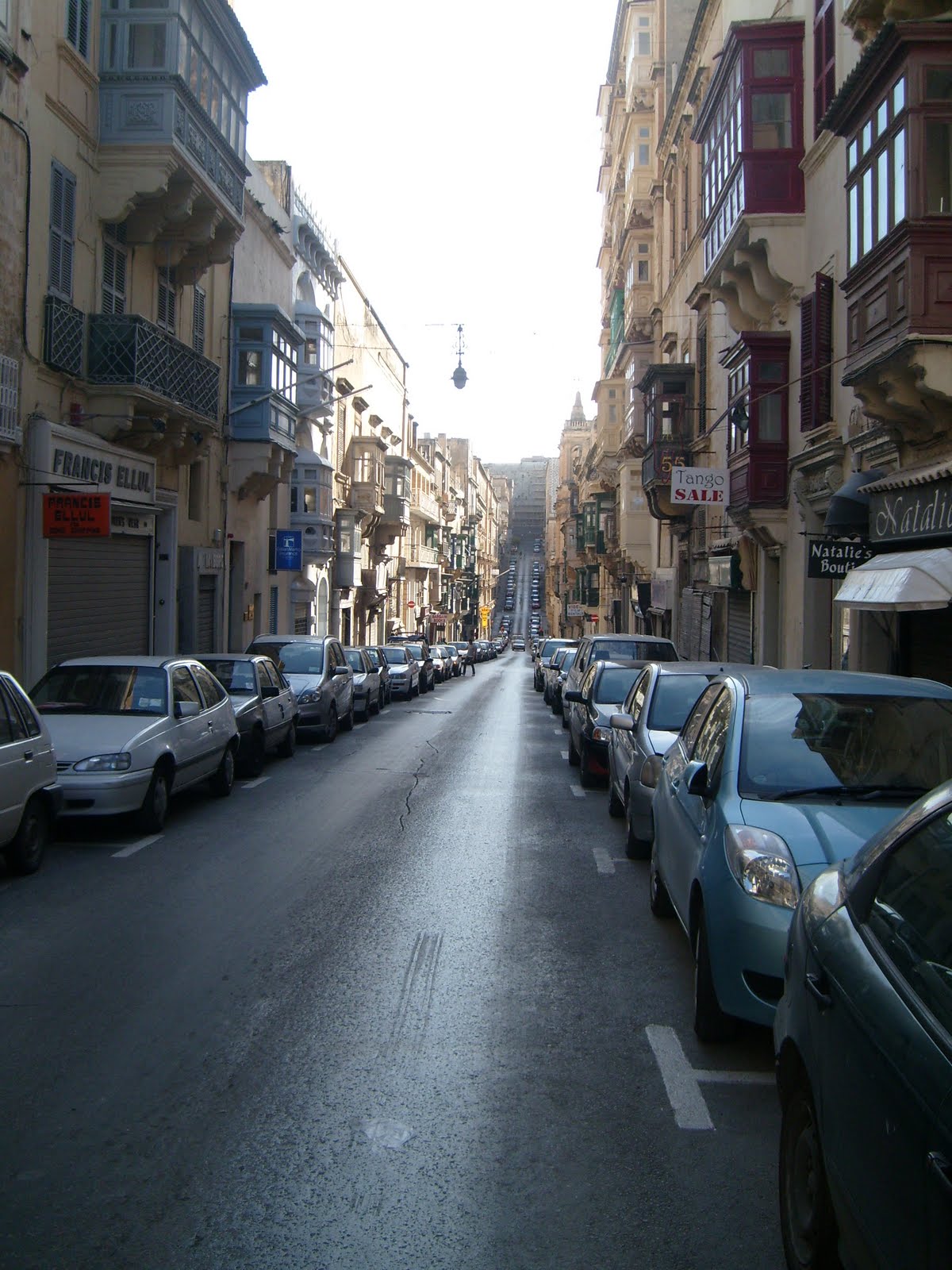
 Coleridge first stayed at the Casa de St Foix, which looked out onto Marsamxett harbor.
He met the governor of Malta, Sir Alexander Ball, 20 May. Ball's aim was for Britain to permanently occupy Malta and Sicily in order to control sea routes, and sometime in June he had enrolled Coleridge to help him in his secret endeavors. His job was to write papers such as 'The French in the Mediterranean', which was sent to Nelson, and others - 'Algeria', 'Malta', 'Egypt' and 'Sicily' - were sent to Downing Street. Some weeks before this, Ball had become convinced about Coleridge's ability, and installed him in his palace on a salary 6 July. He began to eat well exercise well, and in general help to alleviate his addiction.
 Ball's summer residence - now the President of Malta's official residence - was at St Anton(io), some miles inland from Valletta.
 The chapel near the entrance to the palace.
 The statue outside the palace.
 And some photos of the extensive palace gardens, where Coleridge delighted in the plants and the wildlife, such as the lizards.
.jpg)


 The Public Secretary of Malta died 18 January 1805, and Coleridge accepted the job of acting Public Secretary while Ball awaited the official new one, receiving a salary of £600 a year.
Initially Coleridge was very happy, but as rumors came of problems in the home he had left in England, he dosed himself at night with opium and spirits, began having sexual fantasies and became preoccupied with unconventional erogenous zones. But the many pages of his Notebooks on many other subjects continued, as did his public duties.
However, he learned at the end of March of the death of his friend John Wordsworth, William's brother, and was ill for two weeks.
It is probably while in San Antonio that Coleridge wrote this poem to 'Asra' (Sara Hutchinson), which he lost and re-wrote later:
THE BLOSSOMING OF THE SOLITARY DATE-TREE
I
Beneath the blaze of a tropical sun the mountain peaks are the Thrones of Frost, through the absence of objects to reflect the rays. `What no one with us shares, seems scarce our own.` The presence of a ONE,
The best belov`d, who loveth me the best,is for the heart, what the supporting air from within is for the hollow globe with its suspended car. Deprive it of this, and all without, that would have buoyed it aloft even to the seat of the gods, becomes a burthen and crushes it into flatness.
II
The finer the sense for the beautiful and the lovely, and the fairer and lovelier the object presented to the sense ; the more exquisite the individual`s capacity of joy, and the more ample his means and opportunities of enjoyment, the more heavily will he feel the ache of solitariness, the more unsubstantial becomes the feast spread around him. What matters it, whether in fact the viands and the ministering graces are shadowy or real, to him who has not hand to grasp nor arms to embrace them ?
III
Hope, Imagination, honourable Aims,
Free Commune with the choir that cannot die,
Science and Song, delight in little things,
The buoyant child surviving in the man;
Fields, forests, ancient mountains, ocean, sky,
With all their voices--O dare I accuse
My earthly lot as guilty of my spleen,
Or call my destiny niggard ! O no ! no!
It is her largeness, and her overflow,
Which being incomplete, disquieteth me so!
IV
For never touch of gladness stirs my heart,
But tim`rously beginning to rejoice
Like a blind Arab, that from sleep doth start
In lonesome tent, I listen for thy voice.
Belovéd ! `tis not thine ; thou art not there!
Then melts the bubble into idle air,
And wishing without hope I restlessly despair.
V
The mother with anticipated glee
Smiles o`er the child, that, standing by her chair
And flatt`ning its round cheek upon her knee,
Looks up, and doth its rosy lips prepare
To mock the coming sounds. At that sweet sight
She hears her own voice with a new delight ;
And if the babe perchance should lisp the notes aright,
VI
Then is she tenfold gladder than before!
But should disease or chance the darling take,
What then avail those songs, which sweet of yore
Were only sweet for their sweet echo`s sake?
Dear maid ! no prattler at a mother`s knee
Was e`er so dearly prized as I prize thee:
Why was I made for Love and Love denied to me?
Coleridge left Malta 4 September 1805.
 This backstreet is tucked out of the way in Gżira, although I'm not aware of any of the man's connections with the town. In general, though, Coleridge is not publicly remembered in Malta - perhaps because he was in fact a spin doctor working for the British, dispensing propaganda in order to win support from the Maltese?
Subscribe to:
Posts (Atom)


 Posts
All Comments
Posts
All Comments