Showing posts with label Clouzot (Henri-Georges). Show all posts

13 March 2022

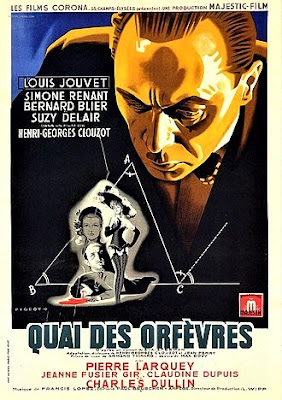
Henri-Georges Clouzot's Quai des Orfèvres (1947)

Henri-Georges Clouzot's Quai des Orfèvres is based on Stanislas-André Steeman's policier novel Légitime défense, and was the director's first film after his four-year prohibition following Le Corbeau (1943). The setting is very much the French music-hall world, with Jenny (Suzy Delair) the wife of Maurice (Bernard Blier), who is also her piano accompanist. And being set in this world, it is also a film of jealousy.

Without going too far into the complicated plot, Maurice is insanely jealous of the lecherous rich old man Brignon (Charles Dullin), who Jenny sees as a stepping stone out of music-hall parochialism and into the cinema. But unfortunately, Maurice has been heard yelling death threats to Brignon, which doesn't help when Brignon is found murdered and Inspector Antoine is called in to sort the matter out. Nor does it help Maurice's case that he went out to kill the already dead Brignon when he knew that he had invited Jenny to see him on the same night, and that Jenny thinks she killed him with a champagne bottle to thwart the old man's sexual advances.

And, Maurice's alibi hanging by a thread, he is inevitably arrested but attempts suicide. Then Jenny admits to murder, but so does the lesbian Dora (Simone Renant) who is in love with Jenny. But as Antoine says, he's in a similar position to Dora: they're both unscuccessful with women, and anyway he thinks he knows the real killer. Police treatment of its suspects is very far from depicted in a noble light in this film, but at least the real killer is found in the end: Paolo (Robert Dalban), the ferrailleur who came to burgle Brignon on the same night, but, seeing him injured by the champagne bottle, shoots him dead. Time for a reconcilation between Jenny and Maurice. I think the importance of this film in the history of French cinema in general has been a little overrated.

Henri-Georges Clouzot's La Terreur des Batignolles (1931)

With a script by Jacques de Baroncelli (Folco de Baroncelli's younger brother), this is Clouzot's first film, a fifteen-minute short made ten years before his first feature. And it contains a number of twists within that short time, the first giving the appearance of a film noir when in fact it's a comedy.

The burglar, the self-styled 'Terreur des Batignolles', is in fact hardly a terror, and his cowardice is soon witnessed by, on his having broken into a bourgeois appartment, his fear of a kitten. And then he's surprised when a couple in evening dress – Marianne (Germaine Aussey) and Robert (Jean Wall) – come in, so he hides behind a curtain. But Marianne noticed his feet – bootless as he has them round his neck so as not to make a noise – and they decide to play a game on him.

They pretend to be in a suicide pact, and as Robert closes the window and uses draught excluders for the door, the burglar is so frightened when Robert turns on the gas that he reveals himself. And here another twist is made as Robert robs him of the money in his wallet and Marianne takes his ring. As the burglar makes his exit there's another twist: the couple in evening dress are in fact burglars and Robert begins working on the safe. And La Terreur des Batignolles even finds that his watch has been stolen.

12 March 2022

Henri-Georges Clouzot's Les Diaboliques (1955)

Les Diaboliques is a kind of thriller with a horror-type ending and is a regular feature in most best French film lists. It was inspired by the novel Celle qui n'était plus (1952) by Pierre Boileau et Thomas Narcejac, and part of it (the 'murder' especially) is set in Niort, where Clouzot was born.

Essentially, there are four important characters here: Nicole (Simone Signoret), who works as Latin teacher in a private boarding school run by the tyrannical Michel Delassalle (Paul Meurisse), who is Nicole's lover and is married to the English teacher Christina (Véra Clouzot, the director's wife). The other person is Commissaire Fichet (Charles Vanel), on whom the eponymous detective in the American series Columbo (Peter Falk) is widely thought to be based.

Both Nicole and Christina detest Michel, who is not only violent towards them but callous towards his students, providing them with substandard food: this is ironic, though, as the money which oils the school's machinery comes from the very rich Christina. So they (or rather Nicole with the Catholic Christina's hypocritical agreement) decide to kill Michel: he is lured to Niort where he is put to sleep with a drug in his whisky which Nicole provides, and then (with Christina watching on) Nicole drowns him fully clothed in the bath. All that remains with the two women is to cart the body back in the school laundry basket and dump him in the school swimming pool.

But there's a problem: Michel has of course disappeared from school but even after the pool is drained he is not there: consternation for his women, and even more so when the suit he was wearing is delivered fully laundered by an outside firm. And to complicate things even further, there are reports of sightings of him in the school, even (it seems) in a new school photograph. Clearly, this is a case for Commissaire Fichet, who intervenes and carries out his own investigations, much to the fear of Nicole and Christina.

Christina has a weak heart and any disturbance can upset her, and it's hardly surprising that when she hears strange noises in the school late at night that she is very much alarmed. But her death blow comes when she sees her husband in the bath, rising as if from the dead and removing his false 'eyes of death': many viewers were stunned by this, so Christina's fatal collapse is understandable. And just as the two lovers Michel and Nicole prepare to celebrate their new fortune (Michel inheriting his late wife's wealth), Fichet immerges from the shadows to reveal that the sentence will be between fifteen and twenty years' imprisonment, depending on the skill of the lawyer.

31 October 2021

Philippe Jaenada: La Serpe (2010)

Philippe Jaenada's La Serpe is a book of 635 tightly-filled pages, and although it would be impossible to read it seriously at one sitting, it's very easy to pick it up from where you left off without forgetting anything. Essentially (and only essentially) it follows on from Jaenada's interest in faits divers, particularly outstanding events which happened some time ago, in this case the 1941 savage triple murder by sickle of Henri Girard's father Gérard, his maiden aunt Amélie, and a servant in the Château d'Escoire near Périgueux. The evidence against Henri seems overwhelming: he's the only person in the château to have survived; he's always running out of money and 'borrowing' from his rich family; he's the only heir (but for how long: is his father about to remarry?); he's said to be violent; he's said to hate his father and aunt; who else could have got into the building ?; he recently borrowed a sickle (the murder weapon) from tenant farmer neighbours and it was recently sharpened; etc. What more evidence could anyone want to prove him guilty and sever his head from his body? And yet the brilliant lawyer Maurice Garçon comes along and Henri is found innocent: it's taken nineteen months, in which the imprisoned Henri has had to endure freezing conditions, sharing one water outlet and one toilet facility with a great number of other prisoners, fighting off bed bugs and fleas and so on, but at least he not only retains his head but – in a later life as Gérard Arnaud (his father's first name and the name his mother was born with) – he becomes a successful writer.*

What Jaenada does is re-tell the story, but in an idiosyncratic way which includes a great number of digressions: about his research on the story; what he finds through Googling; going to Périgueux for ten days and staying at a Mercure hotel with a receptionist who looks a bit like Pauline Dubuisson (a 'true story' murderer in his 2015 novel La Petite Femelle); information about his own family; how many whiskies he has before dinner (and how he gets a better measure after the first one: you leave a one euro tip)), and where; we get a multitude of digressions and digressions are very much part of the book, part of Jaenada's writing: this book would in fact be very much reduced, almost be without the sense of humour which carries it and makes it irresistable without those digressions. Even the joke about the hopelessly drunk cop in Pigalle who has an adventure with a prostitute and mistakes his wife for her is par for the course, it's all part of this wonderful reading experience. Since reading Babouillec, I question how many people don't realise they're aspies, or at least – if the internet isn't turning us all into aspies – maybe it's hugely magnifying the aspie element in those of us who were already partly there?

That's not my (or Jaenada's) final word though, as he re-visits the trial in the local archive department, sifts though trial statements and finds glaring lies, omissions and faults, finds the trial already weighted to find Henri guilty, nibbles and bites his way through the insane idea of sickle-as-weapon-used-by-Henri (an intelligent man) and many other apparent givens, he examines much other 'evidence' used against Henri, and more or less comes to the conclusion that it couldn't possibly have been him. So who? Ah, that's the unanswered question.

If I didn't read another Jaenada book, I think I'd be making a mistake.

*Georges Arnaud's first novel, Le Salaire de la peur, was first published in 1950 and released in film version directed by Henri-Georges Clouzot in 1953.

28 November 2019

Henri-Georges Clouzot's Le Salaire de la peur | The Wages of Fear (1953)

This is one of the classics of French cinema, and perhaps one of the most well-known French films abroad. Adapted from a novel by Georges Arnaud, this film is set in a central American country, although Clouzot's choice of Guatemala was rejected by the main actor Yves Montand, as was Spain, and Montand refused to work on the film in a country under the yoke of Franco's régime. The film was therefore shot in the rather less hot Camargue and the bambouseraie of Gard.

The introduction – which involves outlining the main characters, showing the setting and Mario (Montand) flirting with the barmaid Linda (Véra Clouzot). Four men are chosen by the Southern Oil Company (SOC) to drive two trucks loaded with nitroglycerine over more than 300 miles of hazardous road to put out an oil well fire: the reward is great ($2000), but the chemical mustn't exceed a certain temperature or be bumped in any way or there will be an enormous explosion.

The men chosen in the end are Mario, Jo (Charles Vanel), Luigi (Folco Lulli) and Bimba (Peter Van Eyck). And so begins the journey, fraught with danger, such as a frail wooden bridge, a huge rock in the middle of the road, and a deep pool of oily water. The tension and the suspense are enormous and the atmosphere is expertly directed by Clouzot.

On the way Luigi and Bimba's truck explodes, and the oily water is touch and go, Mario arrives at the fiercely burning oil well with Jo, who has not survived the water. So Mario leaves with his cheque, (too) confidently and too happy, recklessly driving back to Linda, but misses a turn and ends his life thrown out of the burning lorry.