Showing posts with label Mottram In Longdendale (Greater Manchester). Show all posts

17 May 2020

John Frederick La Trobe Bateman in Mottram in Longdendale, Tameside, Greater Manchester


'JOHN FREDERICK LA TROBE BATEMAN
(1810-1889)
Pioneer - Water Engineer Extraordinaire

Brought water to the taps of Tameside and Manchester by constructing
the six mile long chain of Longdendale Reservoirs from 1848.

At the time these became the largest reservoirs constructed
in the world and Europe's first major conservation scheme.

Completed in 1877, these waters have never run dry.
This plaque is located on the deepest air shaft over
Mottram Tunnel measured at some 200ft below.'

'La Trobe' was Bateman's mother's surname.  He worked on many water supply systems in many parts of the country, and also in Buenos Aries, Naples, Constantinople and Colombo. His Wikipedia entry says 'In 1855 he wrote a paper for the British Association, On the present state of our Knowledge on the Supply of Water to Towns, enunciating the nature of the problem, outlining previous measures, enumerating sources from which towns could be supplied, and discussing their merits. In 1865 he published a pamphlet On the Supply of Water to London from the Sources of the River Severn, a scheme he designed and surveyed at his own expense. A royal commission in 1868 reported in favour of the project, a gravitation scheme to convey 230 million gallons of water a day to the city.'

L. S. Lowry in Mottram in Longdendale, Tameside, Greater Manchester


The painter L. S. Lowry (1887-1976) lived at The Elms on Stalybridge Road, Mottram in Longdendale, Tameside, Greater Manchester from 1948 until his death. His statue was installed at the junction of Stalybridge Road and Hyde Road in 2005. At the time of making this post, Lowry now wears a mask.

11 May 2020

The Mottram Frog Stone, Roe Cross, Mottram in Longdendale, Tameside, Greater Manchester

'The Mottram Frog Stone
During the construction of
Mottram Deep Cutting (1814-1826), a
stonemason split a piece of stone and discovered
the outline of a frog or toad. It is believed that it
crawled into a cavity in the stone through a
small crack, then fed on insects until it was
too large to escape. Sucessive generations
have marked the stone to
keep the story alive.'

This plaque couldn't be a traditional red one (for history) because it's a part of folklore, an unfounded tale that nevertheless is part of the fabric of the area. The stone itself is said to be regularly repainted, although when I came along it wasn't too recognisable as a frog.

14 July 2014

Ralph Bernard Robinson in Glossop, Derbyshire


'RALPH BERNARD ROBINSON.
DIED DECEMBER 2ND 1900,
AGED 72 YEARS.
ALSO MARGARET, HIS WIFE,
DIED DECEMBER 16TH 1905,
AGED 72 YEARS.
ALSO WALTER G. ROBINSON,
THEIR SON, DIED MAY 3RD 1896
IN HIS 4TH YEAR.'

The grave of R. B. Robinson is in the Roman Catholic section of Glossop Cemetery, and is another example of a writer mentioned by Thomas Middleton in Poets, Poems, and Rhymes of East Cheshire (1908).  Middleton regrets how little read the 'Mottram poet and historian' Robinson's short book Longdendale: Historical and Descriptive Sketches of the Two Parishes of Mottram and Glossop (1863) was, and adds that he was born in Mottram in 1829, first winning fame as a poet.

Robinson's early book Woodbines (1851) contains, reckons Middleton, 'some pretty pieces', but he seems most interested in the long and ambitious 'Melandra', which speaks of Melandra Castle and Mouselow Castle, and is 'full of interest, containing as it does much of the local Arthurian romance'.

Middleton knew Robinson towards the end of his life, when he was 'a tall old man, with dreamy eyes, and hair white as snow. [...] Mr. Robinson was brim full of anecdote. [...] Then we chatted on the scheme for the excavation of Melandra Castle, which was becoming popular about that time, and in this fashion the evening passed along. I met him often after that; he came to see me several times at Hyde, and it was with regret that I heard of his death.'

Robinson moved from Mottram to Glossop, at first working as a schoolmaster and then as a librarian at Glossop Town Hall.

12 January 2013

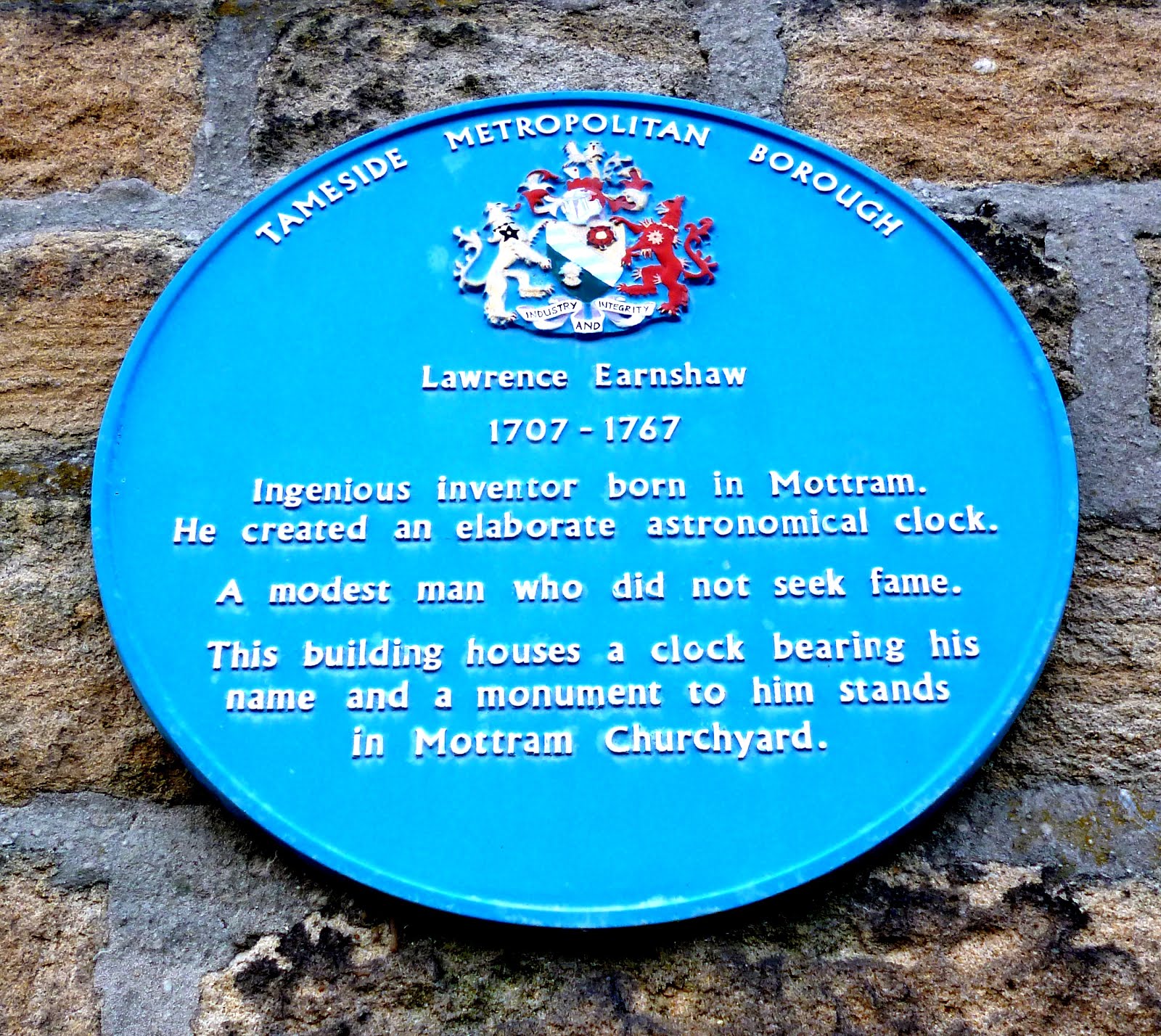
Lawrence Earnshaw in Mottram in Longdendale, Tameside

On the wall of the Court House, Market Place, Mottram in Longdendale:
 
'Lawrence Earnshaw
1707–1767
Ingenious inventor born in Mottram.
He created an elaborate astronomical clock.
A modest man who did not seek fame.
This building houses a clock bearing his
name and a monument to him stands
in Mottram Churchyard.'
 
Lawrence Earnshaw's monument at Mottram. There are four different inscriptions around the base:
 
'LAWRENCE EARNSHAW
MOTTRAM
DIED MAY 12TH 1767
AND WAS BURIED IN THE
ADJOINING CHURCHYARD.'
 
'A SELF-TAUGHT GENIUS AND
OF HUMBLE BIRTH HIS TALENTS
AS AN INVENTOR ANITCIPATED
BY MANY YEAR THE DISCOVERIES
OF OTHER EMINENT MEN.'
 
'BY HIS SKILL IN GEOMETRY
AND
ACQUIREMENTS AS A MECHANICIAN
HE DESIGNED AND CONSTRUCTED
AN ASTRONOMICAL CLOCK
REGISTERING THE REVOLUTIONS
OF THE HEAVENLY BODIES AND
THE FLOW OF THE TIDES.'
  
'A CENTURY AFTER HIS DECEASE
THE ADMIRERS OF HIS GENIUS
AND WORTH
ERECTED THIS MEMORIAL.
A. D. 1867.'
 
'JOHN EATON
ASHTON'
 
The Hyde poet James Leigh mentions Earnshaw's memorial in this verse from one his dialect poems in Glimpses of Sunlight and Other Poems:
 
'Bu' come, we'll have a look through t' yard
Th' owd ancient burial-greaund
Wheer Mottram's dead for ages
Ha'n slept so snug an' seaund;
We'll visit Earnshaw's Monument
(Neglected in his day
This cenotaph ne'er mark'd his worth
Till years had pass'd away).'
 
Below is a link to an online article on Earnshaw in the Tameside Citizen, with several more verses from Leigh's poem:
 
 –––––––––––––––––––––––––––––––––––
'A Tribute to Lawrence Earnshaw'

12 November 2012

L. S. Lowry and Harry Rutherford in Tameside


The bronze statue of the painter L. S. Lowry, installed in 2005 at Jollys Corner at the junction of Hyde Road and Stalybridge Road, Mottram in Longdendale, Tameside.

At the side is a pictorial map of Mottram.

One of the pictures is a Lowryesque representation of Lowry's former house round the corner at 23 Stalybridge Road.


'LAWRENCE STEPHEN LOWRY 1887–1976
The famous North Country artist L. S. Lowry
lived here from 1948 until his death in 1976.
The paintings of Lowry document the lives
of ordinary people in the industrial
communities of the North West.'

And the house itself. Lowry was buried in his parents' grave in Southern Cemetery, Chorlton, which has been made famous of course through The Smiths' song 'Cemetry Gates' [sic], although when I went there I didn't realize Lowry was buried there.

Lowry's house was named 'The Elms', and the inscription is just about legible on either side of the door here.

And just three miles to the west of the Lowry statue, at the side of the entrance to Hyde Town Hall, is a slightly ambiguous plaque dedicated to another 'Northern School' painter.

'HARRY RUTHERFORD 1903–1985
The artist Harry Rutherford lived here, keeping
a studio next door. Rutherford liked to paint
popular entertainments – music halls, theatres,
pubs, the circus and the cinema and sketched
for his own television programmes
in the 1930s and 1950s'

'This blue plaque to Harry Rutherford is a replica.
The original may be seen at his former home at
17 Nelson Street, Hyde.

The plaque was unveiled on 20th November 1993
by Sir George Kenyon, DL, BSc, LLD,
a close friend of the artist.'

And here is the plaque at Nelson Street, shadowed by scaffolding from the house next door to it.


A previous blog post I made about Lowry's work is linked below.

–––––––––––––––––––––––––––––––––––
L. S. Lowry in Nottingham, England