Showing posts with label Klapisch (Cédric). Show all posts

31 December 2021

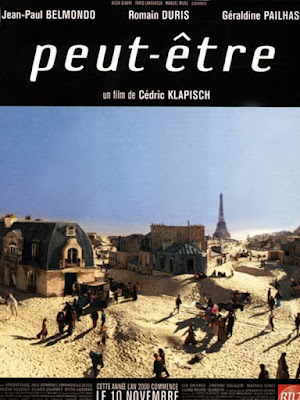
Cédric Klapisch's Peut-être (1999)

The ideas behind this film struck me as highly interesting, although having seen it on YouTube I'm glad I didn't bother to buy this, the worst Cédric Klapisch film – out of eight more – that I've seen. I've no idea how much it cost for this film to be made, although it must have been a tiny fraction of Klapisch's previous feature, Un air de famille: surely his best film to date.

It's New Year's Eve 1999 and the young Arthur (Romain Duris) is watching a sci-fi film before going to a fancy dress party where everyone will be wearing clothes and make-up that they imagine will be worn in the future. Interestingly, and digressively, he seems to live opposite 57 rue de Turbigo, where there is a huge angel undoubtedly made more famous by Agnès Varda's short film Les dites Cariatides. But anyway, he's concerned that his companion Lucie (Géraldine Pailhas) has stopped taking the pill.

At the party he has sex with Lucie in the bathroom, and he withdraws, causing the audience to see a trail of sperm flying out of harm's way. And Lucie's angry as she doesn't understand why her partner didn't come inside her: well, he's just not ready for a family, yeah? It's more complicated than that.

Taking a post-coital piss, Arthur notices a problem with the bathroom roof, and investigates. This leads to another bathroom, then to other rooms, and soon he finds himself leaving the building and into a timewarp, into another world. A world largely covered by sand (some of this was filmed in Douz, Tunisia) but still in part recognisable as the Paris he's not in fact left in geographical terms. This is a kind of post-apocalyptic, or maybe global climatic France in 2070, when the sand invades, covering the past as when the Roman empire was buried by its future. Along with simple solar-powered vehicles, horse-drawn ones can be seen, and there are camels and ostriches: this is a world where low-tech and high-tech meet in harmony. And where Arthur will meet his aged son Ako (Jean-Paul Belmondo) and his grandchildren and great-grandchildren.

The idea is interesting, and it's one which could have been used subtly and intelligently. Unfortunately it degenerates fantastically: save the future, save your future by having sex. Sorry, but I'm not in any way convinced: this to me reads like a Catholic tract which the Pope couldn't have objected to! All the same, this is not the worst ever pro-Catholic film: the truly loathsome Énorme directed by Sophie Letourneur, which encourages men to break the law and create unwanted pregnancies, is horrific!

24 November 2020

Cédric Klapisch's Casse-tête chinois | Chinese Puzzle (2013)

So, the third part of Cédric Klapisch's film trilogy, following on from L'Auberge espagnole and Les Poupées russes, with Xavier (Romain Duris) once more in the lead role, with the faithfuls Wendy (Kelly Reilly), Martine (Audrey Tautou), Isabelle (Cécile de France), but this time based in New York. Again, Xavier is in a mess (but much more unbelievable this time) but he's helped out by, er, Hegel and Schopenhauer.

Isabelle has moved to Brooklyn, where she lives with girlfriend Ju (Sandrine Holt), and Wendy is leaving Xavier (with their two children) for the American John (Peter Hermann), one of the reasons for the separation surely being that Xavier has agreed to trying (by artificial insemination) to get Isabelle pregnant so that she and Nancy can have a child. The almost penniless Xavier (who is nevertheless now a published novelist) decides that he must leave for New York too as he wants to be closer to his children. One of the more subtle jokes is that Xavier initially stays with Isabelle and Ju, although he's looking for a flat; Nancy asks where, and Xavier says he wants to be near to his children, and Wendy lives on 6th avenue near the main entrance to Central Park: he doesn't have a clue why Isabelle has a strange look, but he'll no doubt find out, and anyway Ju finds him a crummy place in Chinatown.

At less than two hours this movie moves really fast, also pulling in Xavier playing hero to an ever-grateful Chinese cab driver who rigs it up for him to marry Nancy (Li Jun Li); two visits from Martine from France; Xavier's father trying to find a symbol of his wife's and Xavier's mother's love in a paving stone; immigration officials questioning Xavier and Nancy not unlike Georges Fauré (Gérard Depardieu) in Peter Weir's Green Card (1990), and pursuing Xavier and Nancy to his flat when Isabelle and a young female baby sitter are having sex: the escape of the two naked women onto the roof recalls the naked Xavier chasing a naked girlfriend in Les Poupées russes; and so on.

In the end Martine agrees to move from Paris and live with Xavier in New York. Yes, with her two kids in a crummy flat with no fear of immigration officials returning? Pure fantasy, as the computer graphics have suggested, but an adorable film.

Cédric Klapisch's Les Poupées russes | Russian Dolls (2005)

This is a few years on from L'Auberge Espagnole, the first part of Cédric Klapisch's trilogy, and again we have Xavier Rousseau (Romain Duris), Wendy (Kelly Reilly), Martine (Audrey Tautou), Isabelle (Cécile de France) and William (Kevin Bishop) plus two new characters of significance: Natacha (Evguenya Obraztsova) and Celia Shelburn (Lucy Gordon). A number of things have changed, and instead of the setting being Barcelona, Les Poupées russes is set in Paris, London and Saint Petersburg, with probably more dialogue in English than French.

This second part is a little more episodic, played more for comedy, and contains some flashy experimental camera work. The main interest is again Xavier, who not only has trouble finding a permanent job but has temporarily shelved his plans to write a novel for more pragmatic writing – such as being ghost writer for celebrities, and in addition he's found work writing the screenplays of a slushy TV mini-series. At thirty he still has no steady girlfriend, only a succession of brief flings (including with model Celia Shelburn, who's biography he's helped her with), but then a stable love life demands a stable personality, and he doesn't seem to have one yet.

Xavier still sees (even sleeps with) his ex, Martine, who is now a single mother; and he also sees a great deal of his lesbian friend Isabelle (cue for transvestite humour, etc). In London he runs into William, who's wildly in love with Natacha, has learned Russian, and is going to be married there shortly. Oh, and he also comes to meet William's sister Wendy again, kicks out her abusive boyfriend and, well, takes his place.

All the group meet up at Natasha's parents in Saint Petersburg: cue for local colour, dancing, drinking, use of various languages, etc. But then Celia, who's in Moscow for a few days, calls him up and asks him to join her. As he's taking the train Wendy – who's seen through his lie and knows he's meeting Celia – tells him he's the love of her life. But he still takes the train, realises Celia's as childish as him, but it seems too late and Wendy feels she can no longer trust him.

But then the wedding – slowly – eases them back together. And that's how they'll have to take it: easily.

23 November 2020

Cédric Klapisch's Poisson rouge (1994)

In 1993 '3000 scénarios contre un virus' (lit. '3000 screenplays against a virus') was launched as a cultural educational preventative measure against AIDS. In fact over 4000 short screenplays were received from students in lycées as possible ideas for film shorts, of which 31 were used by directors, mostly working on a voluntary basis, with the actors doing the same. To a background of first Prokofiev's 'Peter and the Wolf' and then of The Breeders' 'Noaloha', Valeria Bruni-Tedeschi acts. She is walking away, carrying a minimum of her belongings, which include a bowl with a goldfish in it. She is obviously distressed, but even more so when in the busy traffic she receives a jolt, drops the bowl, and retrieves the goldfish from the edge of the road. Dashing into a chemist's across the road, she jumps the queue and – desperate – explains the situation, that the fish is dying without water. The chemist produces a condom which a customer blows up, water is poured into it and the goldfish too. The motto: 'Un préservatif peut sauver la vie': 'A condom can save a life'. In just over three minutes, Cédric Klapisch has done more than many filmmakers take hours to say. The idea was from Jérôme Bettochi (aged 19) of Bessoncourt (90).

Cédric Klapisch's Ni pour, ni contre (bien au contraire) | Not For, or Against (Quite the Contrary) (2003)

This was a surprise film release from director Cédric Klapisch, as it is a film policier, but what surprises me more is the title, faithfully translated in the same way in English, although surely this must be one of the most clumsy titles on record, particularly with its words in parentheses? OK, the title alludes to the dilemmas of the protagonist, but relevant or not it's still a mess as a title. The film itself though, in spite of a number of professional critics writing otherwise, certainly isn't a mess.

Katy (Marie Gillain) works as a television camera operator but lives in a faceless HLM with little success of escaping her relatively poor surroundings: pathetically, she buys scratchcards in the very slim hope of improving her material situation. Until, that is, she chances upon the crook Jean (Vincent Elbaz), who wants her to film a hold-up for him. At first dubious, as she's entering a milieu foreign to her, she rapidly succumbs to the lure of potential wealth from illegal acts.

So she's introduced to the rest of the gang, a motley bunch aspiring for riches by whatever violent means they get them: there's the Armenian Lecarpe (Simon Abkarian), running a kebab house with his wife; there's Mouss (Zinedine Soualem), an aspiring choreographer working on strippers in a nightclub; and then there's the rather disturbed young Loulou (Dimitri Storoge): not exactly too promising a mob.

But Jean manages to seduce her with his apparently easy gunpoint hold-ups of jewellers and she soon fits into the scheme of things. More importantly, she performs her own hold-ups of jewellers on the quiet. Then comes the final raid, which will pay enough money for them all to live luxuriously for the rest of their lives. But it depends on her playing prostitute to the director of the bank, and she doesn't do prostitution: yeh, she's being used.

She does kill the director though, but fails to have the alarm silenced. However, an amount of money is salvaged from this, although (through her cunning, her intelligence and her betrayal) Caty manages to escape to an American 'paradise', the gang either dead or (in Jean's case) inside. Trouble is, that last long shot of her in her penthouse reveals that she has no idea of where to go from then on. Earlier in the film she mentions the word 'L'argent' and one of her new buddies adds '...ne fait pas le bonheur' ('Money doesn't buy you happiness'). So where is there to go now?

20 December 2019

Cédric Klapisch's Ce qui nous lie | Back to Burgundy (2016)

Cédric Klapisch's Ce qui nous lie is a title in keeping with the director's principal theme of exploring the nature of relationships, such as familial ones in his earlier Un air de famille (Family Resemblances). The significance of this title (lit. 'What ties us') is unfortunately lost in both the Quéquois title (Retour en Bourgogne) and the English (Back to Burgundy), where the emphasis is on a wine area rather than relationships. The setting is rural Burgundy, where a family owns a thriving vineyard. When their father is dying, brother and sister Jérémie (François Civil) and Juliette (Ana Girardot) greet the return of Jean (Pio Marmaï), although initially Jérémie is full of anger because Jean didn't return for their mother's funeral. The tension is eased, though, when Jean reveals that his wife Alicia (María Valverde) was giving birth to his son at the time. (Jean has been gone for ten years to travel round the world, finally settling to a new life in Australia with his wife and son.)

This is also a time when Jean, as his father is dying and when he discovers (to his great surprise) that his father loved him. With their father dead there is an inheritance problem to solve, and Jean is initially in favour of selling the plantation and the house in part to pay off his debts in Australia. There's a great deal of grape sucking to decide if it's ready for the vendange, a great deal of wine drinking and not a little drunkenness, but in the end blood is thicker than wine and a compromise is reached, meaning that the family still maintains control of the plantation, Jean rents out his share to his siblings, and everyone is content with the situation. It's interesting to compare this with Air de famille.

4 December 2019

Cédric Klapisch's Ma part du gâteau | My Piece of the Pie (2011)

Cédric Klapisch recognises that he's left-wing, but also that his films don't make a similar forceful kind of political statement as Ken Loach and Robert Guédiguian.

Pretty Woman is mentioned by a number of reviewers, the Roy Orbison song of the same name is among the string of records played in Ma part du gâteau, and in an interview Klapisch mentions that film, along with Les Intouchables, as movies which illustrate enormous class divides.

Pretty Woman is evidently the more appropriate film to compare Ma part du gâteau with, as it depicts a very rich man making money out of money, confronted an attractive woman of very low social standing, although that is perhaps where the similarities end: Ma part du gâteau doesn't end in the pair getting together but in them separating; Stéphane (Gilles Lellouche) is a ruthless businessman with scarcely any redeeming human features, whereas Richard Gere's businessman has; furthermore, Pretty Woman was over twenty years before Klapisch's film, and the fictional woman in cinema has moved on, evolved.

A frequent criticism made of Ma part du gâteau is that it is caracatural, whereas Klapisch stronogly disagrees: the film was released a little after the sub-prime scandal, and Klapisch states that the guilty rich bankers should have been punished for causing the scandal to begin with: the world really is made up of extremes of rich and poor, and France (Karin Viard), who is an unemployed forty-two-year-old from Dunkirk who finds work as a femme de ménage to Stéphane, of course represents the 99% of the French population, Stéphane the rich 1%. The two groups very rarely meet, and of course never on equal terms.

The politics of the film are obviously the main point of interest, but it is also interesting to see the differences in psychology. Stéphane is obviously highly successful at his job, indeed so successful that he neglects the outside world: he can't keep a woman, he can't look after his child, in fact he's nothing more than a callous child himself. France, on the other hand, in spite of an earlier suicide attempt, is a mature woman determined to survive in a hostile world which is nevertheless still capable of working-class solidarity, and is determined to do the best for her children.

Endings are often difficult, but at least this film avoids any amorous happy end. And on the way to that end there are some very amusing moments, such as France (on two separate occasions) bursting into song when she's ironing: a tremendous performance by Karin Viard and a very engrossing screenplay by Klapisch.

27 November 2019

Cédric Klapisch's Un air de famille | Family Resemblances (1996)

Un Air de famille began as a play by Agnès Jaoui et Jean-Pierre Bacri, which is no doubt evident from the claustrophobic atmosphere of this film. Au Père tranquille is the rather shabby café-restaurant where the Ménard family – the mother (Claire Maurier) and her children Henri (Jean-Pierre Bacri), who owns the café, Betty (Agnès Jaoui), Philippe Ménard (Wladimir Yordanoff) and his wife Yolande (Catherine Frot) meet every Friday. This particular Friday is Yolande's birthday.

Missing here is Henri's wife Arlette, who has left him for a while, although it's some time before this will be revealed. But it's clear that Henri, who no doubt it's too much given to good moods, is in an even worse one today. The self-obsessed Philippe isn't in a good mood either: the successful member of the family, he's just appeared on television and worried endlessly about whether he didn't smile enough, wore the wrong tie, etc. His wife Yolande comes across as downtrodden, her mother-in-law dotes on Philippe, and she criticises Betty for (at thirty) not being married and for using language 'unbecoming' of her – needless to say, Betty is the rebel of the family secretly having a relationship with Denis (Jean-Pierre Darroussin), Henri's flunky.

There are a number of amusing moments, such when Yolande lets her hair down (well, kicks off her shoes) and delightedly – almost sexually enjoys a dance with Denis, her husband having scornfully refused; when Henri visits Arlette in the apartment block where she's staying and the kids gathered outside join in his cries of 'Arlette!' to her; when towards the end Betty joins Denis in passionate embrace and Yolande realises that their relationship is far deeper than she had thought, and sees Denis as her 'brother-in-law', the 'son-in-law' of the mother; and many more instances of verbal humour.

The film ends shortly after Henri receives a phone call from Arlette, and he says that he's going to be a better person. The viewer suspects that this will be pretty hard to do, as Cédric Klapisch has depicted quite a gloomy view of relationships in this surprisingly gripping movie. The only overdone elements perhaps are the repeated scenes of an ironically very happy childhood with Dalida singing 'Come prima' (and incidentally, Klapisch himself playing the happy father).

2 November 2019

Cédric Klapisch's L'Auberge espagnole (2002)

L'Auberge espagnole* is the first of three films Cédric Klapisch has directed including the same group of people, and was followed by Les Poupées russes (2005) and Casse-tête chinois (2013). It plunges us into a polyglottal universe in which several nationalities live with each other in Barcelona.

Xavier Rousseau (Romain Duris) would like to be a writer, although (much to the annoyance of his girlfriend Martine (Audrey Tautou)), he leaves for Barcelona to study economics for a year as an Erasmus scholar: a friend of his father's says a knowledge of Spanish will enable him to get a job at the Ministère des Finances. He finds himself sharing accommodation with other students: the Belgian Isabelle (Cécile de France), the English Wendy (Kelly Reilly), the Spanish Soledad (Cristina Brondo), the Italian Alessandro (Federico D'Anna), the German Tobias (Barnaby Metschurat) and the Danish Lars (Christian Pagh).

Trouble emerges when Wendy's boyfriend William comes to stay for short time with them: he is not only obviously immature, but part of that immaturity is clear from his steriotypical attitudes to those of other nationalities. Klapisch is depicting the problems many face in a multicultural world. However, William redeems himself later, when all the inmates draw together, but that's another story.

Xavier is at first attracted to Isabelle until he discovers she's lesbian, although she gives him lessons in seduction, and Xavier is soon in a love affair with Anne-Sophie (Judith Godrèche), the wife of a doctor who initially put him up for a few days until he found lodgings. Later, Martine breaks up with him, as does Anne-Sophie, and of course he's miserable.

At the end, Xavier (whose Spanish has made great improvements) is set on at the Ministère des Finances but he takes flight almost as soon as he gets there: he knows where his vocation lies. To be continued.

*The expression Auberge espagnole means a place where you only get what you bring to it, or a situation or idea in which a person believes what they want to believe.