Showing posts with label Stalybridge (Greater Manchester). Show all posts

25 April 2014

Samuel Hill in Stalybridge, Tameside

'SAMUEL HILL
 
POET, LOCAL HISTORIAN,
LOVER OF THE LANCASHIRE DIALECT.
BORN IN KING STREET, STALYBRIDGE, 1864.
LIVED IN THIS HOUSE FOR MANY YEARS
AND HERE DIED, 24TH DECEMBER, 1909.
 
COMMEMORATION OF STALYBRIDGE CENTENARY
5TH MARCH 1957'

Samuel Hill's Bygone Stalybridge: Traditional, Historical, Biographical (1907) – a book which the author sold from his home at 78 Hamilton Street, Stalybridge – states that among other books he wrote were: Old Lancashire Songs and their Singers (1899), Lancashire Poets and their Poems (1900), Foirewood, or Splinters an' Shavin's fro' a Carpenter's Bench (1902), Little Spadger's Dog, and other Sketches (1906), and Local Poets of the Past [date not given].

The book includes a chapter titled 'Local Literary Men', which contains information on several writers linked to Stalybridge: John Jones, Thomas Kenworthy, George Smith, Joseph Rayner Stephens, William Chadwick, and Samuel Laycock.

15 May 2013

Joseph Rayner Stephens in Stamford Park, Stalybridge

 
 'JOSEPH RAYNER STEPHENS
BORN 1805 DIED 1879'

'SCATTER THE SEED! THE SEED OF TRUTH
BELIEVING IT WILL GROW.
LOOK ON THE WILDERNESS IN RUTH
IT WAS NOT ALWAYS SO.
A GARDEN ONCE, IT MAY AGAIN,
A LOVELY GARDEN BE.
IT WANTS THE SUN IT WANTS THE RAIN,
OF GODLIKE CHARITY.
WE WORK AND WAIT, WE TOIL AND TRUST,
SURE THAT THE END WILL COME
THIS WILDERNESS OF EVIL MUST, BE CLOTHED WITH HEAVENLY BLOOM.
             J.R.S.'
 
 'ERECTED
BY THE FACTORY WORKERS OF
LANCASHIRE AND CHESHIRE,
IN THANKFUL REMEMBRANCE
OF A LONG LIFE SPENT
IN THEIR SERVICE
1888'
 
 'AN EARNEST ADVOCATE
OF THE TEN HOURS BILL;
AN ABLE DEFENDER OF
TRADES UNIONS
AND DETERMINED OPPONENT OF
THE NEW POOR LAW.
––––––––
"THE ONLY TRUE FOUNDATION OF
SOCIETY IS THE SAFETY, THE SECURITY
AND THE HAPPINESS OF THE POOR, FROM
WHOM ALL THE OTHER ORDERS OF SOCIETY
ARISE."
DEFENCE AT CHESTER.'
 
This, then, was erected 125 years before the present government (with the almost total approval of the 'opposition') gave what amounted to a state funeral for a former premier who undid most of the things that people such as Joseph Rayner Stephens had worked hard for. My disgust is inexpressible.

14 May 2013

Jethro Tinker in Stamford Park, Stalybridge


'JETHRO TINKER
BORN
25TH SEPTEMBER 1788
DIED
10TH MARCH 1871.'

 
 'OUR LOCAL
LINNAEUS'
 
 'FIELD NATURALIST
FROM
EARLY YOUTH
TO OLD AGE'
 
 'ERECTED BY THE FRIENDS
AND
ADMIRERS OF
NATURAL HISTORY
1874'

14 January 2013

Jethro Tinker and John Bradbury in Millbrook, Stalybridge

At the entrance to Stalybridge Country Park, Millbrook, are two plaques remembering local men of note:

'Jethro Tinker
1788–1871
 
An ardent naturalist who recorded much
of Stalybridge's flora. Born at North
Britain Farm, The Brushes.
 
Unveiled by Councillor
George Hatton
16th November
1995.'
 
Tinker, the son of a weaver who later also became village schoolteacher in Mottram in Longdendale, spent all his life in the Stalybridge area. He first worked as a shepherd around Hollingworth, but later became a weaver in Stalybridge, where he progressed to manager of Cheetham Mill. He made many local journeys collecting natural history specimens and became an amateur authority on the subject. He died at 82 and a memorial (vandalized in 1997) was erected in Stamford Park. N. Dennis and Elaine R. Bullard wrote the article 'Jethro Tinker (1788-1871): Field Naturalist', which was published in the Naturalist in 1981.
 
'John Bradbury
1768–1825
 
A botanist and explorer of repute.
Born at Souracre Fold, Stalybridge.
 
Unveiled by Councillor
George Hatton
16th November
1995.'
 
Bradbury is most noted for his travels in the USA, particularly in the Midwest and the West, where he documented species of plants and sent seeds back to his son in England. He published Travels in the Interior of America, in the years 1809, 1810, and 1811; including a description of Upper Louisiana, together with the states of Ohio, Kentucky, Indiana, and Tennessee, with the Illinois and Western territories [etc.] (1817).

13 January 2013

Jack Judge in Stalybridge

 
 This statue in Stalybridge intrigues me.
 
'JACK JUDGE
accompanied by a WWI soldier
 
Inspired to compose the famous marching song
"It's a Long Way to Tipperary"
He was the first to sing it publicly in 1912
at the Grand Theatre in Stalybridge,
the town of its conception.
 
Unveiled 16th December 2005
by Councillor Frank Robinson'

'It's a long way to Tipperary' was certainly a 'marching song' in that World War I soldiers used it while marching, although I'm aware of no evidence that it was conceived as such, so the existence of the soldier apparently 'helping' Judge to compose the song is very fanciful.
 
The truth seems to be that the army simply adopted a completely non-military song to sing as they marched. Judge is said to have claimed that he made a five-shilling (25 pence) bet at the New Market Inn*, Corporation Street, Stalybridge, that he couldn't write an original song in 24 hours. On his way home he was inspired by a drunk he passed, and the result was that he wrote a song about an Irishman homesick in London. It appears that one or more of Judge's relatives came from Tipperary.
 
* The pub no longer exists.

The First General Strike of 1842, and Joseph Rayner Stephens, Stalybridge

This is the portico of Stalybridge Town Hall, all that remains of the original structure. It bears two interesting plaques:
 
'THE FIRST GENERAL STRIKE, 1842
 
Originated in this area, beginning as a movement
of resistants to the imposition of wage cuts
in the mills, also known as the "Plug Riots"
it spread to involve nearly half a million
workers throughout Britain and represented
the biggest single exercise
of working class strength
in nineteenth century
Britain.'
 
'JOSEPH RAYNER STEPHENS
1805–1879
Trained in the Ministry, Joseph Rayner Stephens
came to Ashton in 1832. He became an important
Chartist Leader who campaigned against
the Poor Law and for factory reform.
His greatness was in his instinctive reaction
to human distress and social injustice.
In later life he lived in Stalybridge
where he established a People's
School and is buried in
St John's Church,
Dukenfield.'

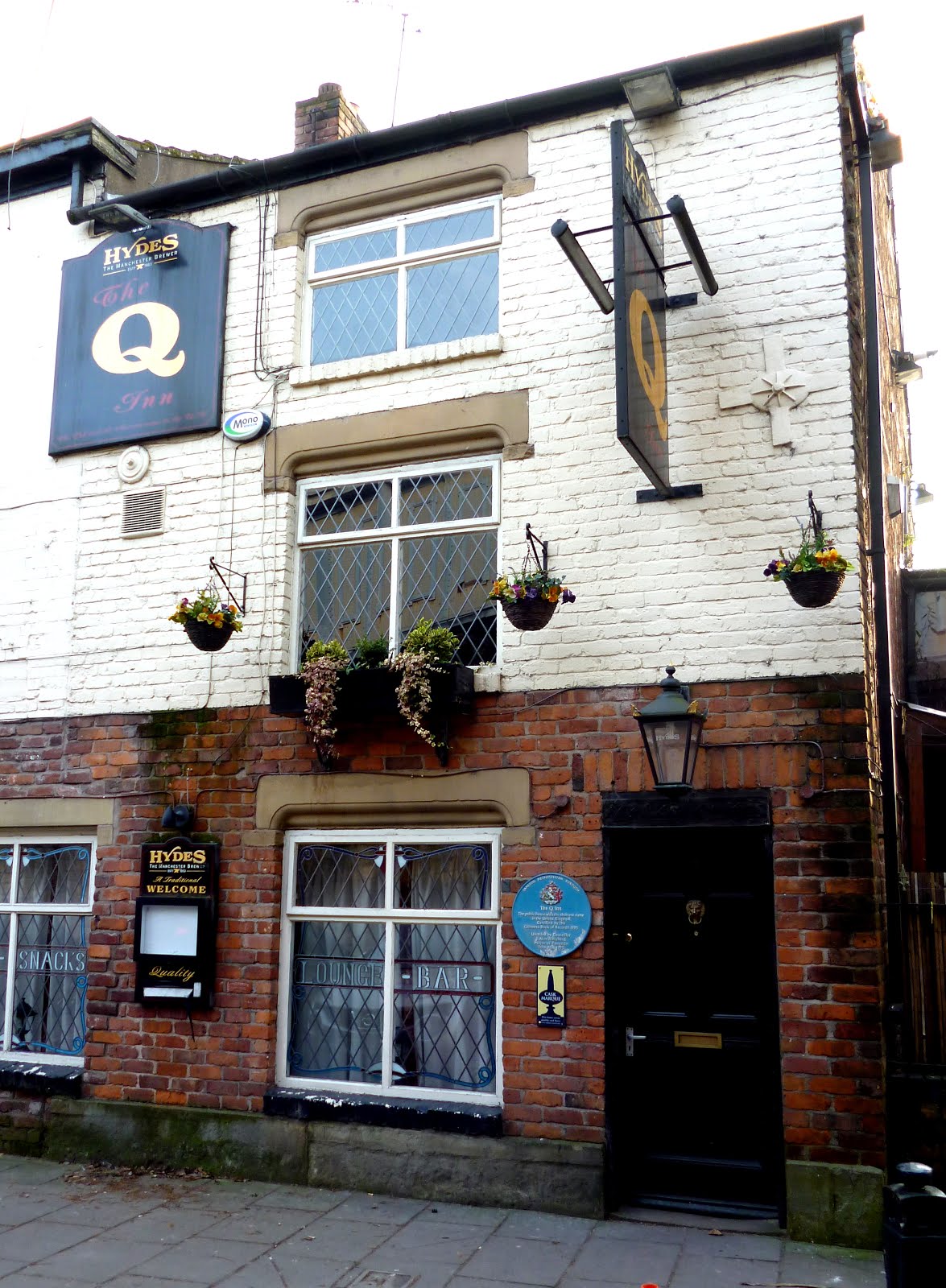
Stalybridge Station Buffet Bar, and no Q for another pub

This is a timewarp very far removed from St Pancras. They have a good selection of cask beers, but as I was driving I had a coffee, which was large and came on a tray with a jug of milk: a bargain at £1.50.
 
'This Victorian Buffet Bar is unique
and is authentic in detail since
being rebuilt in 1885.
 
Unveiled by Councillor Eileen Shorrock
on 16th July 1994.'
 
One of the four rooms.
 
And a few yards down the road is another pub with a blue plaque.
 
'The Q Inn
The public house with the shortest name
in the United Kingdom.
Certified by the
Guiness Book of Records 1995
 
Unveiled by Councillor
J. Alan Whitehead
Mayor of Tameside
30th May 1995'
 
Unfortunately, the pub has now closed down.

Beatrix Potter's Relatives in Gee Cross and Stalybridge, Greater Manchester

In the churchyard of Hyde Chapel, Gee Cross, Greater Manchester, is the family grave of the Potter family – Beatrix Potter's parents and paternal grandparents.

'In loving memory of
EDMUND POTTER
DIED 26TH OCTOBER 1883
AGED 81 YEARS.'

Also of JESSY POTTER [née Crompton]
WIDOW OF EDMUND POTTER
DIED 9TH SEPTEMBER 1891
AGED 90 YEARS.

[...]

also of RUPERT POTTER
2ND SON OF THE ABOVE EDMUND POTTER
DIED 8TH MAY 1914 AGED 81 YEARS.
ALSO OF HELEN POTTER [née Leech], WIFE OF THE ABOVE
RUPERT POTTER
DIED DECEMBER 20TH 1932 AGED 93 YEARS.'

And in Stalybridge:

'BEATRIX POTTER
(1866–1943)

Renowned children's story writer author
and artist of the famous Peter Rabbit book.

Beatrix's maternal grandparents John and Jane [née Ashton] Leech
bought the Gorse Hall Estate after their marriage and
built the Gorse Hall Mansion which was demolished in 1910.

Born in London, Beatrix in later life made several visits
to her grand parents and recorded her fond memories
of the place.

Unveiled by John Heelis OBE, great nephew
of Beatrix Potter's husband, William Heelis
on 23rd November 1999.'

Beatrix  Potter's mother Helen Leech was born at Gorse Hall. In 1909 George Harry Storrs of Gorse Hall was stabbed to death there by an attacker who remains unknown. His wife Maggie had the building demolished the following year and the hilly grounds now serve as an area for walks.