11 December 2012

Edgar Wallace in Essex Street: London #46

 
Edgar Wallace is usually thought of foremost as a crime writer, and perhaps secondly as a journalist. As a large sign on the Edgar Wallace pub in Essex Street notes, Wallace was associated with nearby Fleet Street for a long time: he began at the age of eleven by selling newspapers in Ludgate Circus, where there is a bronze plaque with his likeness, although it escaped my memory on my last visit to London.
 
Almost directly across the street from the pub is a plaque which states:
 
'ESSEX STREET
was laid out in the grounds
of Essex House by
NICHOLAS BARBON in 1675

Among many famous lawyers
who lived here were

Sir ORLANDO BRIDGEMAN c.1606-1674
Lord Keeper.

HENRY FIELDING 1707-1754
Novelist and

BRASS CROSBY 1725-1793
Lord Mayor of London.

JAMES SAVAGE 1779-1852 Architect
has his office here.

PRINCE CHARLES EDWARD STUART
stayed at a house in the street
in 1750.

Rev. THEOPHILUS LINDSEY 1723-1808
Unitarian Minister
founded Essex Street Chapel here
in 1774.

Dr. SAMUEL JOHNSON
established an evening club at
the "Essex Head" in 1783.'

Below is a link to a previous blog post I made concerning Wallace:
 
–––––––––––––––––––––––––––––––––––
Hannen Swaffer and Edgar Wallace

William Mompesson in Eakring, Nottinghamshire

William Mompesson (1638 or 1639 –1709) was an Anglican clergyman from Yorkshire who became Rector at Eyam (pronounced 'Eem') in Derbyshire in 1664. The bubonic plague came to the village in 1665, reputedly in a box of cloths containing infected fleas. Mompesson isolated the village to prevent further spread, and his wife was one of the many people who died in the village.

In 1670 Mompesson became the Rector of Eakring, although tradition has it that the villagers didn't welcome him because of his association with the 'plague village' and he therefore had to preach outside at Pulpit Ash. However, a plaque in front of the parish church claims that he preached outside because the church was in such poor repair that it was dangerous to use. Mompesson's Cross is about a half mile from Eakring village.

'NEAR THIS SPOT STOOD
PULPIT ASH WHERE
MOMPESSON PREACHED
ON COMING TO EAKRING
AS RECTOR IN 1970 A.D.
AFTER LEAVING EYAM
IN DERBYSHIRE WHICH
HAD BEEN DECIMATED
BY THE PLAGUE.'

 A small cross lies on the ground inside the enclosure and is inscribed 'In loving memory of Cyril Hayes', although I have no idea of its significance.

Anna Seward was born in Eyam and wrote a poem of the same name, and William Howitt published a book, The Desolation of Eyam, in 1827.

ADDENDUM: The prolific Anonymous left a comment to the effect that Cyril Hayes of Bilsthorpe was born in Eakring and requested that his ashes be spread here. If it was me who inadvertently deleted the comment or Anonymous himself or herself, though, is a mystery.

Alexander Payne's About Schmidt (2002)

I resolved to watch more of director Alexander Payne's films after seeing The Descendants. Both films concern self-discovery, and both involve the discovery of a wife's adultery and the death of the wife.
 
Jack Nicholson has in earlier films portrayed rebels or other kinds of outsiders, and he's very much an outsider in About Schmidt, although as an actuary in a large insurance company (in Payne's home town Omaha, Nebraska) he's conformed to the work ethos all his working life. But now he's retired he has to confront himself, and he soon discovers his alienation, and his alienation from himself in particular, as he doesn't know who he is. And because he doesn't know who he is he has nowhere to go – not even inside himself, as he lacks interiority.
 
So it's hardly surprising that the double whammy of retirement swiftly followed by the death of his wife of more than forty years comes as an existential crisis: work has shielded him from knowing himself for decades, and his wife has taken care of things outside work: take these two rocks away and the self crumbles.
 
Schmidt is a likeable character though – his sponsoring of the six-year-old Ndugu from Tanzania stems from genuine empathy, but also conveniently provides the audience with a voiceover that reveals his thoughts as he reads out the letters he either writes to the child or plans to write to him; these are also a kind of therapy.
 
Schmidt's self-deception is pathetic: he tells himself he can dissuade his daughter from marrying her waterbed salesman boyfriend; he mistakes the concern for his welfare by the wife of another Winnebago owner as romantic; he fools himself that two students in the refectory of his alma mater are interested in his conversation, etc.
 
He not only lies to himself but to others – he tells his wife he's helped his successor out at work when the new guy on the contrary seems pretty self-sufficient; he distorts the truth to Ndugu to make himself appear less of a failure; but more successfully, he lies absolutely at his daughter's wedding reception by praising the groom and his vulgar, dysfunctional (but friendly) family and so avoids a potentially messy situation; but on the way back he rehearses a letter to Ndugu in which he calls his son-in-law a 'nincompoop'.
 
It's not easy confronting yourself, but it's even less easy when you mask the truth from yourself by self-deception, and shovel all the blame onto other people. Anyway, he has no self respect, so how can he climb out of the hole he's dug for himself? And all this time he's been writing (or thinking about writing) about his problems to a six-year-old therapist who can't even read or write. It's hardly surprising that – helpless, friendless – he breaks down crying at the end.
 
But we still feel sorry for him, and we identify with his problems. That must say a hell of a lot both about Payne's direction and Nicholson's acting.

10 December 2012

Roland Dorgelès and Joachim-Raphaël Boronali (aka Lolo the Donkey) in Montmartre, France

I was reading about Roland Dorgelès and his amazing painting spoof when I suddenly remembered I had a photo of the famous bistro the Lapin Agile, in rue des Saules, Montmartre, that I hadn't used. The Lapin Agile is particularly noted for its clientèle over the years, such as Max Jacob, Picasso, Francis Cargo, and Pierre Mac Orlan.
 
And Roland Dorgelès too, who with friends here in 1910 cooked up a plot to cock a snook (or faire un pied de nez if you like) at modern art (and Picasso in particular): he would display a new work of art at the annual Salon des Indépendants exhibition: a painting by an Italian called Joachim-Raphaël Boronali, the creator of a new movement called 'excessivisme'.
 
In reality 'Boronali' was invented by Dorgelès, and the canvas (Et le soleil s'endormit sur l'Adriatique, or 'And the sun set on the Adriatic' to translate more or less literally) was painted by a donkey called Lolo that Dorgelès had borrowed from local Montmartre character Frédéric Gérard (or le Père Frédé): with a paintbrush tied to his tail, Lolo created the masterpiece by wagging it when a carrot was dangled in front of him.
 
A link to my brief post on Dorgelès's grave in Saint Vincent cemetery, Montmartre, is below.
 
 –––––––––––––––––––––––––––––––––––

David Town and Paul Bagshaw's 4 Days (2003)

4 Days is filmed in Southport and directed by David Town and Paul Bagshaw, two former teachers who moved into the video industry. The cast is almost exclusively made up of amateurs from Southport, Lancashire. I had a few doubts before watching this very obscure feature film, but was pleasantly surprised.
 
The story is a family drama involving three generations in which the father is in a battle to win control over his father's leisure industry empire in Southport. In the process, his son is kidnapped by (it transpires) men working for the grandfather, who is really a kind of evil godfather. The result of the battle is unknown as the murder (and I think we have to assume there was one) takes place off-screen: only a gunshot is heard.
 
There's a little wooden acting largely disguised by self-effacing head gestures and clever evasive camera movements, but that doesn't spoil a rather compelling film.
 
After 4 Days and The Mirror, Bagshaw (who began Channel 10 in 1989) decided that stories taken from real life were more effective, and The Secret (2007) is based on a situation he encountered when teaching, where a mother had to tell her 17-year-old son that she was in fact his grandmother and his sister his mother.

9 December 2012

D. H. Lawrence (misspelt) and John Harvey in Nottingham

The Peacock, Mansfield Road, Nottingham.
 
'With a history of famous clientele [the Peacock] is reputed to have been a regular watering hole of D. H. Laurence [sic] (1885–1930), the inspired son of a Nottingham miner who went on to become one of the most important and controversial writers of the 20th century [no full stop] He is probably best known for his novels 'Sons and Lovers' and Lady chatterley's Lover'. (Yes, the 'c' is lower case.)
 
Can you believe just how lazy this piece of writing is, in large letters for all to see in the prominent space where the corner entrance was? 'The inspired son [ho hum] of a Nottingham [my italics] miner'? The person or persons responsible for it at least got the dates of his birth and death right, but then we have further rubbish: 'is reputed to have been [so they're hedging their bets, right?] a regular watering hole' of the man whose name they can't even be bothered to spell correctly? Where exactly did Lawrence get this reputation for drinking, as I'd love to know the reference. His father Arthur had a few 'watering hole's' certainly, but that was a big source of family discord. Maybe the writer(s) heard his first novel was The White Peacock, and just got confused.
 
The sign continues:
 
'More recently it is believed [more bet hedging] that fictional crime writer John Harvey (born in 1938) first penned his 'Charlie Resnick' detective novels whilst a patron at the Peacock. Former University of Nottingham lecturer Harvey, also a devout Notts County fan, is responsible for immortalising Nottingham and inner city life through this jazz loving Polish investigator.'
 
I don't know much about John Harvey, but at least his name and his character's name are spelt correctly. I don't think we're supposed to understand that he wrote books in the pub, although the first sentence could be interpreted that way.
 
So what do we learn from this? The Peacock's spreading its colourful fan with some exaggeration of course, but – and no matter how badly it may be done – a part of Nottingham's literary history is mentioned on a pub wall, which I suppose is all right (sort of). Nottingham, of course, has an impressive literary history. At the moment they're trying to raise enough money for a memorial to Alan Sillitoe – see the link below.
 
(In 2008 a statue was unveiled in Nottingham dedicated to, er, a football manager: it's a question of cultural priorities, you understand.)
 
–––––––––––––––––––––––––––––––––––
The Alan Sillitoe website

Clara Green in Nottingham

'IN
MEMORY OF
CLARA GREEN,
DAUGHTER OF THE LATE
GEORGE GREEN, M.A.
OF CAIUS COLLEGE, CAMBRIDGE;
AND FORMERLY OF SNEINTON;
DIED 6TH. MARCH 1919;
AGED 79 YEARS.'
 
The Church (Rock) Cemetery, Mansfield Road, Nottingham. Clara Green was the mathematician George Green's last surviving offspring and the owner of Green's windmill in Sneinton, Nottingham. She died intestate and her property passed to the Crown. Below is a link to a post I made about her father.

–––––––––––––––––––––––––––––––––––
George Green in Sneinton, Nottingham

8 December 2012

Samuel Pepys in the City: London #45


'SITE OF THE
NAVY OFFICE
IN WHICH
SAMUEL PEPYS
LIVED AND WORKED
DESTROYED BY FIRE
1673'
 
The above plaque is at the west side of Pepys Street near Seething Lane.
 
'SAMUEL PEPYS
DIARIST
1663–1703
ERECTED BY
THE SAMUEL PEPYS CLUB
AND PUBLIC SUBSCRIPTION
1983'
 
Pepys's bust is in Seething Lane Gardens. Pepys and Sir William Penn are said to have buried their wine and parmesan cheese in the Navy Office gardens to protect them from the fire of London in 1666. The horns are unintentional.
 
The Hung Drawn & Quartered pub in Great Tower Street is named after Pepys's famous black-humoured remark shown on the wall:
 
'"I went to see
Major General Harrison
Hung Drawn and Quartered.
He was looking as cheerful
as any man could
in that condition."
 
Samuel Pepys
13th October 1660'
 
Thomas Harrison was one of the signatories of King Charles I's death warrant and a leader of the Fifth Monarchists. Harrison was executed at Charing Cross.

Harry Cole in Southwark: London #43

'Harry Cole
Voluntary Worker,
Policeman, Writer
Attended this school
1934–40
 
Voted by the People'
 
The Charles Dickens Primary School was mentioned in another post a few months ago, showing the plaque to Dickens on the wall through the wire fence. But there's a second plaque on the building dedicated to a much more obscure writer: Harry Cole, the policeman writer who used to work at Carter Street Police Station in Walworth Road. He worked there for thirty years, retiring in 1983.

Cole wrote a series of books based on his experiences: Policeman's Progress (1980), Policeman's Lot (1981), Policeman's Patch (1982), Policeman's Patrol (1983), Policeman's Prelude (1984), etc.

7 December 2012

Francine Prose: Goldengrove (2008)

(FORENOTE: Francine Prose was among 203 other scarcely believably mean-spirited  writers such as Kamila Shamsie, Peter Carey, Michael Ondaatje, Joyce Carol Oates, Rick Moody, Teju Cole, Rachel Kushner and Taiye Selasi in objecting to Charlie Hebdo receiving the Pen America freedom of speech courage award last May. As I've already written this post I won't throw a childish tantrum and delete it, but I shall certainly not be reading any (more) books by any of the people who objected: in literature, there are few things worse than a hopelessly ignorant, narrow-minded author. For once, I find myself in agreement with Salman Rushdie, who said of these writers: 'I hope nobody ever comes after them'. Quite: their behavior is shameful. The full list of writers who objected (interestingly called a 'list of shame' by one person) is here. The comments are well worth reading too. (Written on the first anniversary of the Charlie Hebdo killings, 7 January 2015.)

Francine Prose's Goldengrove is set in about 2003 and narrated by a woman – now married with children – telling of a tragic event and its aftermath that occurred when she was thirteen years old.1 The title is taken from Gerard Manley Hopkins's poem 'Spring and Fall: To a Young Child', which is the epigraph:

'Margaret, are you grieving
Over Goldengrove unleaving?
Leaves, like the things of man, you
With your fresh thoughts care for, can you?
Ah! as the heart grows older
It will come to such sights colder
By and by, nor spare a sigh
Though worlds of wanwood leafmeal lie;
And yet you wíll weep and know why.
Now no matter, child, the name:
Sorrow's springs are the same.
Nor mouth had, no nor mind, expressed
What heart heard of, ghost guessed:
It is the blight man was born for,
It is Margaret you mourn for.'

The narrator is Nico, named by her hippy parents after Nico of Velvet Underground fame, who also (somewhat unhippyishly, surely?) named their older daughter Margaret and her father's bookstore Goldengrove after the poem.

The English paperback edition cover quotes from Sarah Churchwell's review of the book in the Guardian as '[One] of the great coming-of-age novels', which I probably can't deny, although most people's coming-of-age experiences aren't anything like as traumatic as Nico's. Near the beginning of the novel Margaret – who is four years older than Nico – drowns following a heart attack, and the remaining three family members are left with their grief. And grief is very much the main theme of the book: Nico's mother copes by taking increasing quantities of prescription drugs, her father attacks his long-gestating book on eschatology with renewed zest, and at first Nico thinks she's found help in Margaret's boyfriend Aaron.

Nico keeps her relationship with Aaron (who is the same age as Margaret) from her parents – as indeed Margaret was forced to do –because her father thinks he has 'a screw loose'. Aaron is grieving for Margaret too, and initially Nico believes that they can both gain from each other by working through their grief together, but it appears that her father's diagnosis was correct, and that the loss of Margaret has unhinged him more: he sees a kind of double of her in Nico.

Time is the real healer in the end, of course.

This is a thoughtful, intelligent novel with some lovely one-liners, some of which seem far too clever for a thirteen-year-old – in fact they seem more like the esprit de l'escalier2 of the older narrator.

1 Yes, it's about 2003 and online buying is mentioned, emailing is mentioned, and yet the reader is expected to believe that two teenagers from middle-class US families do not have cell phones? The plot creaks in a few places due to this rather glaring anachronism.

2 I really can't bring myself to write the ugly English translation of that expression, which is used on several occasions in the novel.

6 December 2012

Jean-Dominique Bauby: Le Scaphandre et le papillon / The Diving Bell and the Butterfly (1997)

Le Scaphandre et le papillon (translated into English as The Diving Bell and the Butterfly) is a remarkable book by any standard. It was written by a man who had a massive stroke that left him in a coma for weeks and when he awoke found he was a victim of 'locked-in syndrome', being fully conscious but completely paralysed with the exception of his left eyelid. In this autobiographical work, the former journalist expresses his gratitude to his 'guardian angel' Sandrine, the speech therapist who devised an alphabet beginning with the most common letter and ending with the least common, by means of which he could communicate if a third party constantly ran through the alphabet until a blink signified the appropriate letter intended; this is how dictation of the book was achieved, and how Bauby managed to transcend the 'diving suit', or 'space suit', in which he felt trapped in on himself.

Le Scaphandre in part relates the 44-year-old's days at the hospital at Berck-sur-Mer on the Côte d'Opale, Pas-de-Calais (62). It is a succession of visits: doctors, psychologists, nurses, a kinesthesiologist, his children, etc. Most of all it's a series of dreams, fantasies, and memories of his past life told not with self-pity but with great perception and, surprisingly, not a little comic skill.

Bauby died of pneumonia on 9 March 1997, two days after the publication of this book. Due to his efforts, ALIS, the Association du Locked-In Syndrome, was formed the same month.

My post on Jean-Dominique Bauby's grave:

––––––––––––––––––––––––––––––––––––
Jean-Dominique Bauby: Cimetière du Père-Lachaise

5 December 2012

Karl Wood update

Carlton le Morland windmill, Lincolnshire
 
I've just added several photos to my biography (linked below), the most notable being the photo postcard Tom Sunderland gave me of the 1923 (or thereabouts) choir outing to Cleethorpes, Lincolnshire, in which a dapper Karl Wood makes a very rare appearance. I shall also get round to including the footnotes I left out.
 
It seems almost a lifetime ago that I initially carried out research for Karl Wood's biography, and my intention was to write another edition. However, for a number of reasons (the main one being the sheer lack of lives I can fit into one), I shall have to merely add things online in due course: the advantages of this are that far more people will be able to read this online (the potential readership being vast), and of course the internet is a wonderful palimpsest – things can be added and corrected ad infinitum.

Since Windmill Wood a large number of people have written to me, often only making a brief comment on their experience of Wood in the Gainsborough area, but it all adds up, and I shall be making a long post incorporating these observations, probably in a quite loose as opposed to structured fashion, although I shall certainly add a few short articles – one on Wood in Lincoln Prison, the other on Wood in Nottingham – that I published in small circulation magazines some years ago. That will not be for several more months as I have a busy schedule early next year, but it will certainly be in 2013.

–––––––––––––––––––––––––––––––––––
Windmill Wood

4 December 2012

'James Britton the Radical', by Robert Hughes

We often see the 'secret ballot' as an inalienable part of the tradition of British democracy.

The Chartists in the great agitation of 1848 had this innovation as one of their six aims, and although it was rejected at the time it was eventually provided for by the Ballot Act of 1872 when Gladstone and his Liberals had supremacy in Parliament.

Among the reasons for the failure of the Charter, quite apart from the widespread fear of its revolutionary nature, were the pages and pages of signatures in the same handwriting, and the many patently absurd names such as 'Victoria Regina'.

Whilst it must be noted that the demands of the Charter have all subsequently been enacted, it would be too easy to dismiss the concerns of those who opposed it at the time.

The 'secret ballot' was seen by its opponents as un-British in its furtiveness, and a gift to revolutionaries and malcontents. In particular, it robbed an employer, a customer or a landlord of the opportunity to exert a direct sanction on respectively his employee, supplier or tenant: pressure of course to vote in accordance with his wishes rather than those of the voter.

It can certainly be argued that the extension of the franchise to independent-minded voters, exercising their ballot in secret, broadened the political freedom held by Englishmen. Others indignantly disputed this however, as their own traditional freedoms were clearly curtailed.

A good ‘A’ level or even Degree level question might then be: “Ballot Secrecy in public decisions is a mixed blessing. Discuss.”

A series of records recently released on Ancestry.com shows electoral registers for certain areas, and occasionally polling records which tell us for whom our ancestor actually voted.

There is just one example to hand at the moment for my own ancestors of the relevant period: James Britton was the great-grandfather of the interesting 1930s writer Lionel Britton, featured frequently on this blog.

He seems to have been a leathercutter and manufacturer of gunpowder pouches, working in the Jewellery District of Birmingham as it is now known. Family legend has him as ‘an ironmonger, but a gentleman ironmonger!’

His only known son John James Britton describes him as ‘Gentleman’, (marriage certificates in 1858 and 1882).

James married a Quaker girl, Ruth Catherine Waddams (1798-1862), but in the Parish church of Handsworth. What this suggests is that he had some strong adherence to the Anglican faith, and his son John James not only is baptised at the same place at the unusually late age of 16, (was it his own choice?), but is buried with very pronounced Anglican symbolism at Halford in Warwickshire, in 1913. (See other parts of this blog).

Religion and politics correlated hugely in the early nineteenth century, (remember when the Church of England was supposed to be the ‘Tory Party at prayer’?), but manufacturers in the rapidly growing cities of the North and Midlands were notably Radical as their voice was neglected in the old system where some hilltop in Wiltshire with no actual voters gave the owner two seats in Parliament while a huge city like Birmingham had none. What about James then?

He voted for Sir Gray Skipwith and Charles Holte Bracebridge.

Skipwith was born and raised in Virginia, where Sir Grey Skipwith, the 3rd baronet of Prestwould, Leicestershire, had settled after selling his English property to a follower of Cromwell in 1652, and he was descended through his mother from Pocahontas the American Indian Princess.

One of the first Indians in Birmingham?

http://www.historyofparliamentonline.org/volume/1820-1832/member/skipwith-sir-gray-1771-1852

Other references:

http://www.chapelhouse.eu/

http://www.ampltd.co.uk/digital_guides/nightingale_parts_1_to_4/contents-of-reels-part-1.aspx

http://thepeerage.com/p15166.htm

It might be a stretch to suppose that these guys were the wild foaming Radicals…but what about the opposition? It seems pretty clear that they were the Tories.

James Britton might have voted according to what he had for breakfast and whether he liked it, or whether it was raining as he went to the polling place: we have all heard of ‘floating voters’!

Also note that of the two Cadburys on the same page as James, one split his vote across what appear to have been party lines. We expect Cadburys to be straight-down-the-line Radicals in that era, so this is one for Cadbury scholars.

The Cadbury family were prominent Quakers and here is a gentleman in trade, apparently an Anglican, but married to a woman from a Quaker family. Was his decision finely balanced as was that of one of the Cadburys? Or was he firmly of one persuasion?

If anyone should find further evidence of James Britton’s voting record or any clues as to his sympathies in general, please post it here!

Note that this was a poll for the County Constituency of North Warwickshire, and it was won fairly narrowly by the Tory pair.

Presumably there was also a poll for the new constituency of Birmingham, which would have been won handily by the Radicals. Also, we would logically assume that Birmingham voters had two votes in the same General Election. Plural voting was not addressed until considerably later.

2 December 2012

Ruth Bryan (continued)

 
This sketch of Ruth Bryan (1805–60), 'Ruth the Gleaner', was drawn from memory by Margaret Lacey. This is taken from the frontispiece of the book whose title-page is shown below, and I am once more grateful to Rowena Edlin-White for sending it me, along with almost all of the additional information that I include here.

The Field of Boaz: Gleanings by Ruth Bryan (London: The Society of SS. Peter & Paul, 1927) is a version of the diary of Ruth Bryan (a Calvinist) which was heavily edited by Frederic Spurr (a Baptist). The Lacey family was well known to Bryan, and Anglo-Catholic Thomas Alexander Lacey (1853–1931) wrote the Preface to this book which was published nearly seventy years after her death. Lacey had been appointed canon residentiary of Worcester Cathedral in 1918, and caused quite an uproar by denying that the Bible is the word of God.

General Cemetery records state that Ruth's father (who died in 1823) and her mother (who died in 1846) were buried with her.

Ruth Bryan died at 18 High Pavement, Nottingham, probably on the site of the old police station next to the Galleries of Justice.

Below is a link to an earlier post I made about Ruth Bryan after discovering her grave.
–––––––––––––––––––––––––––––––––––
Ruth Bryan (1805–1860)

The Plaques on Exeter Bridge, Derby, England

On Exeter Bridge over the River Derwent in Derby, England, are four impressive plaques dedicated to people associated with the city.

'WILLIAM HUTTON
HISTORIAN.
BORN FULL STREET, DERBY,
SEPTEMBER 30TH 1723.
DIED SEPTEMBER 20TH 1815.'

'HERBERT SPENCER
PHILOSOPHER.
BORN EXETER ROW, DERBY,
APRIL 27TH 1820.
DIED DECEMBER 8TH 1903.'

'ERAMUS DARWIN
PHYSICIAN, BOTANIST
AND POET.
BORN NEWARK [ELSTON], DECEMBER 12TH1731.
 DIED APRIL 18TH 180[2].'

'JOHN LOMBE
1694–1722.
PIONEER OF THE SILK INDUSTRY IN DERBY.
LIVED IN FULL STREET'.'

At the age of seven, the poet and historian William Hutton went to work in Lombe's silk mill a few hundred yards to the north of Exeter Bridge, which now houses a museum.

Hutton is also remembered by a statue on the former Boot's building on the corner of St Peter's Street and Thorntree Lane in Derby.

30 November 2012

Rimbaud and Verlaine in Camden Town: London #43

'THE FRENCH POETS
PAUL VERLAINE
AND
ARTHUR RIMBAUD
LIVED HERE
MAY–JULY 1873'

A simple plaque on 8 Royal College Street, Camden Town, records the brief stay here of the self-destructive lovers. Unfortunately I took a photo of the adjoining house instead of this, so I'll have to include a shot of the actual one next time I pass this way.

My Arthur Rimbaud posts:
–––––––––––––––––––––––––––––––––––
Yanny Hureaux: Un Ardennais nommé Rimbaud
Arthur Rimbaud and the Vilains bonhommes, Paris 6e
Rimbaud's 'Le Bateau ivre' sculpture, Paris 6e
Arthur Rimbaud, Parc Balnéaire du Prado, Marseille
Arthur Rimbaud in Charleville-Mézières cemetery
Arthur Rimbaud in Roche
Arthur Rimbaud quotations, Charleville-Mézières
Arthur Rimbaud memorial, Charleville-Mézières
Arthur Rimbaud murals in Charleville-Mézières
Rimbaud and Verlaine in Camden Town
Arthur Rimbaud museums in Charleville-Mézières
Arthur Rimbaud in Attigny
Arthur Rimbaud and Hervé Tonglet in Charleville-Mézières

29 November 2012

James Prior (1851–1922) in Bingham

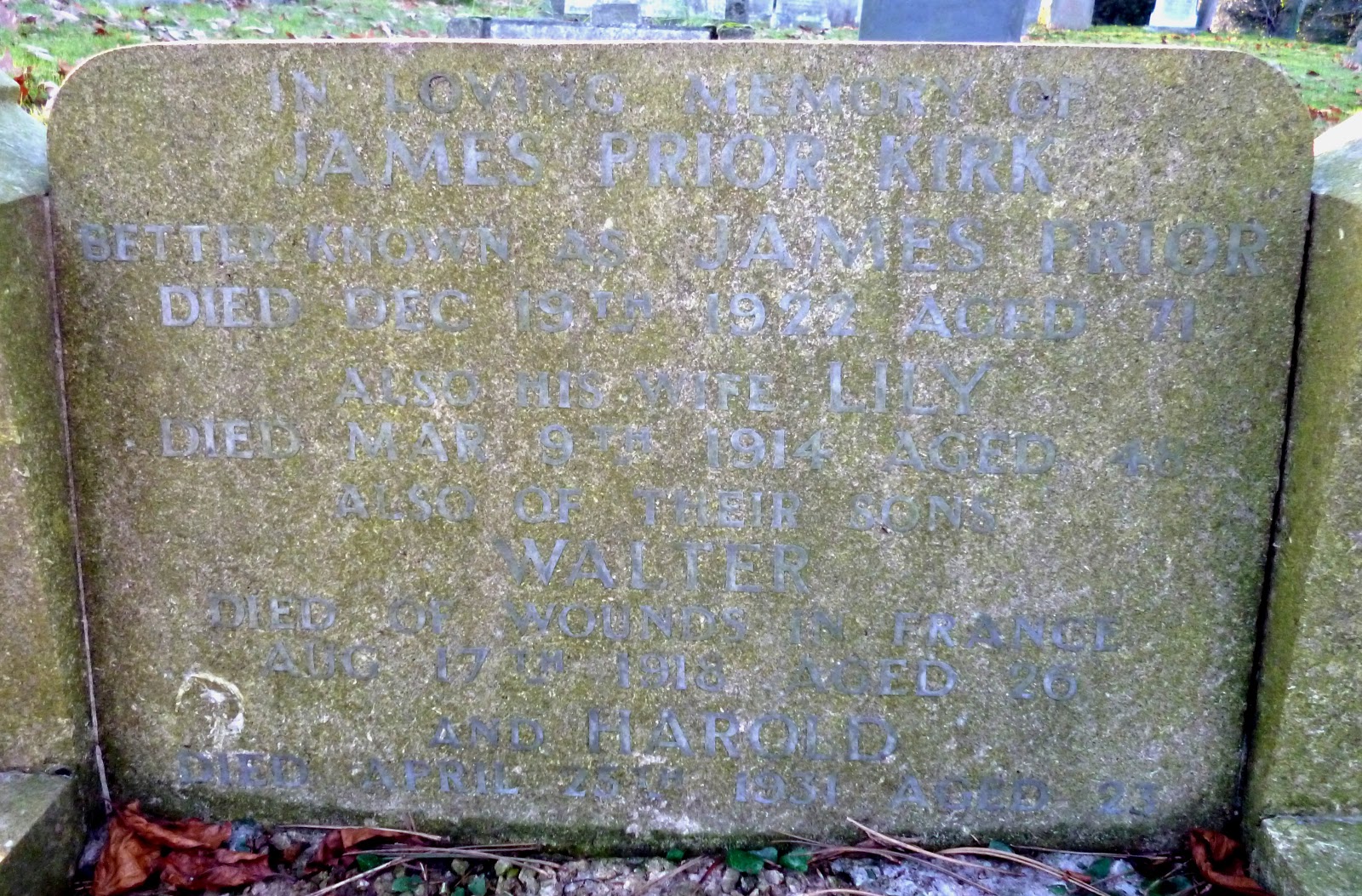
Finally, I located the grave of the novelist James Prior, most noted for Forest Folk* (1901), in Bingham Cemetery, Nottinghamshire.


'IN LOVING MEMORY OF
JAMES PRIOR KIRK
 BETTER KNOWN AS JAMES PRIOR
DIED DEC 17TH 1922 AGED 71
ALSO HIS WIFE LILY
DIED MAR 9TH 1914 AGED 48
ALSO OF THEIR SONS
WALTER
DIED OF WOUNDS IN FRANCE
AUG 17TH 
1918 AGED 26
AND HAROLD
DIED APR 25TH  1931 AGED 23'

2001 not only marked the centenary of Forest Folk, but also 150 years since the birth of James Prior. To my knowledge there was not a single mention of this from Nottinghamshire County Council, Bingham Town Council, or any local history societies. When I found Prior's grave yesterday I had to spend some time cleaning it up: I am as yet (29 November 2012) aware of no other photo of Prior's grave.

James Prior, with the exception of early D. H. Lawrence, is probably the only regional writer from Nottinghamshire in the early 20th century, and yet not even his adopted home of Bingham seems to appreciate his achievements. There is an organization called Bingham Heritage Trails Association, but virtually the only (extremely limited) information it gives on Prior on its website is from a Nottinghamshire County Council webpage.

Lushai Cottage in Fisher Lane is where the Kirk family lived at the beginning of their stay in Bingham in 1891. This photo is one I took for my book Hidden Nottinghamshire (Wilmslow: Sigma Leisure, 1998), an example of my, er, juvenilia.

My MA of 2000 contains a little previously unpublished biographical material on James Prior and is viewable in full on this blog: it was posted in consecutive chapters in October 2012 and is the only long study ever made of Prior's work, although almost all of it concentrates on Forest Folk. It may still contain a number of minor typos as I had to re-type it and remember a few lost pages.


(Walter Kirk was in fact buried in Huon Military Cemetery, Le Treport, Seine-Maritime (76), France.)

* The pub The Forest Folk in Blidworth, named after the novel, was built in 1927 and was demolished some years ago. The entrance room had a small area (including a window) commemorating James Prior.

In August 2011, it was announced that a planter and plaque would be placed at 'Forest Folk Corner' to mark the site. Well, it's not exactly a plaque but it's at least something.

A commemorative plaque in Bingham (where James Prior lived for over 30 years) would be recognition of the important part that the man played in the county's literary history.

My James Prior posts:
–––––––––––––––––––––––––––––––––––
James Prior's Forest Folk (dissertation): Introduction
James Prior's Forest Folk (dissertation): Chapter One
James Prior's Forest Folk (dissertation): Chapter Two
James Prior's Forest Folk (dissertation): Chapter Three
James Prior's Forest Folk (dissertation): Conclusion
James Prior (1851–1922) in Bingham
James Prior's Parents' Grave, Nottingham
James Prior: Three Shots from a Popgun (1880)
The Forest Folk memorial window
James Prior plaque, Blidworth

27 November 2012

George Orwell in Kentish Town: London #42

 
'GEORGE
ORWELL
1903–1950
Novelist and
Political Essayist
lived here'
 
For a few months in the second half of 1935 George Orwell, either at the suggestion of A. R. Orage (according to Michael Sayers) or Mabel Fierz (according to Michael Shelden) moved into the top part of 50 Lawford Road, Kentish Town, with Sayers and Rayner Heppenstall.* Orwell had the largest bedroom because he paid the largest part of the rent. He got on well with Sayers, but on one occasion Heppenstall – who could be a rather difficult character, Fierz later claimed – came in very drunk and provoked Orwell to thump him on the nose and attack him with a shooting stick. The following morning Orwell (in whose name the property was let) ordered that Heppenstall pack and go. Although the two made good their differences a year later later, Heppenstall had the last word five years after Orwell's death by writing an article called 'The Shooting Stick'.

*Gordon Bowker, 'Michael Sayers: Writer Whose Career Never Recovered from Being Blacklisted in the United States', Independent, 22 July 2010; Michael Shelden, Orwell: The Authorised Biography (London: Heinemann, 1991).

26 November 2012

Elizabeth Bowen in Regents Park: London #41


'ELIZABETH
BOWEN
1899–1973
Writer
lived here
1935–1952'
 
This blue plaque was unveiled as recently as March 2012, at 2 Clarence Terrace, Regents Park. The Anglo-Irish novelist wrote The Death of the Heart (1938) and The Heat of the Day (1949) here.

Arthur Conan Doyle's Sherlock Holmes: London #40

 
'221b
SHERLOCK
HOLMES
CONSULTING DETECTIVE
1881–1904'
 
221b Baker Street is the address of the fictional Sherlock Holmes and Watson, created by Arthur Conan Doyle (1859–1930). The building was built in 1815 and is listed.
 
In the stories, Mrs Hudson is the landlady of 221b. The restaurant is next door to the museum.
 
A huge copy of the 2009 UK first class postage stamp commemorating the 150-year anniversary of Conan Doyle's birth.
 
And around the corner on Marylebone Road, in the shadow of the dome of a much larger London attraction just visible on the bottom left, is the statue of Sherlock Holmes. It was commissioned by the Sherlock Holmes Society of London in 1999, and sponsored by Abbey National plc to commemorate its 150-year existence.
 
I didn't join the museum queue, but a link to a rather dramatic nine-minute video clip is below:

––––––––––––––––––––––––––––––––––
The Sherlock Holmes Museum

Wilkie Collins and Elizabeth Barrett Browning: London #39


'WILLIAM
WILKIE
COLLINS
1824–1889
NOVELIST
lived here'
 
Wilkie Collins lived at 90 Gloucester Place (now 65) from 1867 to 1888. Michael Sadleir unveiled this plaque in 1951. Along with many other authors he is buried in Kensal Green Cemetery (although his grave continues to elude me).
 
'ELIZABETH BARRETT
BROWNING
(1806–1861)
– POET –
LIVED HERE'
 
Barrett Browning lived at 99 Gloucester Place from 1835 to 1838, before moving to 50 Wimpole Street, which her father had bought. She was buried in the Protestant Cemetery in Rome.