23 February 2022

Robert Guédiguian's Les Neiges de Kilimandjaro | The Snows of Kilimanjaro (2011)

Michel Marteron (Jean-Pierre Darroussin) is in his fifties, a welder and union representative for a company having difficulties and which has to shed twenty of its workers. Raoul (Gérard Meylan) is his brother-in-law, fellow worker and childhood friend who can't understand why Michel has unnecessarily included his name in the list of twenty: but Michel is a man of principal and doesn't believe that, as union representative, it should confer privileges on him. He draws his name out and joins the unemployed.

Michel's wife is Marie-Claire (Ariane Ascaride), a home help to the elderly who resigns herself to living with a 'hero', like Spiderman in the Strange comics her husband used to read as a child. Soon after, their thirtieth wedding anniversary is celebrated, with friends and relatives – the pair are grandparents – buying them plane tickets to Tanzania, home of course of Kilimanjaro. (Although Pascal Danel's 1966 song 'Les Neiges du Kilimandjaro' is played there, this film has no relationship to Henry King's 1952 film of the same name, and therefore no relationship to Hemingway's short story on which that film was based.) A substantial sum of money is also included: Michel's old-school politics and integrity are obviously appreciated in post-industrial L'Estaque.

Shortly after, armed robbers break into a belote session at Michel and Marie-Claire's with Raoul and his wife Denise (Marilyne Canto), taking credit cards and Michel's presents. In the scuffle, Michel's shoulder is dislocated and the act traumatises Denise. Via the old comic book that was taken in the robbery, Michel tracks the culprit down and the police arrest him: it's laid off young worker Christophe Brunet (Grégoire Leprince-Ringuet).

Michel undergoes a process of self-examination: is he becoming one of the bougeoisie himself, relaxing on his pre-retirement pay, betraying his own former class? Marie-Claire points out that he's not really bourgeois. Christophe's gun turns out to be a toy and this is his first offence. Raoul doesn't want anything to do with retracting his complaint, and although Michel does, Christophe will still be tried and of course imprisoned.

With the money, Christophe – who has been looking after his fatherless younger brothers – has paid off the family's debts and bought food provisions: he is indeed in a far more precarious situation than Michel. The young brothers risk being claimed by the social services and Michel and Marie-Claire take them in temporarily: the ending is a happy reconciliation of everyone – perhaps a little too sentimental and unbelievable – but a point is being made here. Guédiguian is passionately concerned for the disappearing world of workers' friendship and solidarity, as opposed to the forces of global capitalism which incessantly strive to rule by dividing the working classes. Already, the comfortable retirement cushion that Michel and his generation are now benefitting from is being pulled out from beneath the grasp of younger generations.

22 February 2022

Emmanuel Mouret's Changement d'adresse | Change of Address (2006)

David (Emmanuel Mouret) is a French horn player and teacher who's moved to Paris and finds accommodation sharing a flat with Anne (Frédérique Bel). Just a friendly arrangement of course, as she's got someone in her life, although has she? And when they end up in bed together it's by accident, naturally: they've both forgotten about it by the morning, as they tell each other.

Anyway, David is in love with a nineteen-year-old student of his who's learning the French horn: Julia (Fanny Valette), who lives with her mother (Ariane Ascaride), who's surprised she's not got a boyfriend. But of course David's working on this, and although Julia's responses to his attempts to get her interested in him have proved a little lukewarm, Anne's parents have a place in Deauville where they can spend a weekend. And things look good for David: she doesn't seem to mind there's only one bed, and they're getting on well at the seaside.

Until, that is, restauranteur Julien (Dany Brillant) rescues Julia's handbag from a thief, they invite him back for a drink and he starts massaging Julia's shoulders, and David has that everything's lost look and spends the night out in the cold just smoking: it's a bit like in Vénus et Fleur with Fleur spending the night out on the beach when Vénus is screwing the local lothario, only Fleur was, er, full of happiness at the time with Bonheur. When he returns in the morning, Julien has just left and Julia is in love.

Of course, Julia expects Julien to phone him, but he doesn't. On the rebound, she gets with David (and they get a similar look from Anne when she sees it happening) and – much to mother's contentment, they start living together until, that is, David bumps into Julien. Now Julien – who by chance is the stocky guy who plays Rudolph the aggressive boyfriend in Fais-moi plasir ! – hasn't phoned Julia because he couldn't. And although he's not aggressive like Rudolph, he's lost his business because of the way he feels about Julia, and is really desperate to find her: can David help? David is the same kind of bumbling, stuttering, hesitant awkward guy as in other films he's played in, and obviously doesn't want to admit that he lives with her. But in the end, leaving Julien and Julia for five minutes in Luxembourg, he makes his exit from the jardin as the gates are being locked.

His loss is his gain: Julien (now of course united with Julia) finds him another flat, and what do you know Anne is looking for one two, and doesn't care that there's only one bed: it's not just a case of will-they-won't-they as much as how will they. I'd called this Emmanuel Mouret absurd-lite: the absurdities aren't missing, but are far more subdued than, say, the later Fais-moi plaisir ! And increasingly, Mouret brings to mind Truffaut: here particularly with the scene of David and Julia reading in bed reminding me of Domicile conjugal, the twist being that David's magazine is upside down.

Robert Bresson's Les Dames du Bois de Boulogne (1945)

Les Dames du bois de Boulogne is a modern update inspired by a part of Diderot's late eighteenth-century work Jacques le Fataliste et son maître, in which Hélène (Maria Casarès) fails to get revenge on her lover Jean (Paul Bernard) for no longer being interested in her. In Hélène's place will come cabaret dancer – a part-time prostitute – Agnès (Élina Labourdette).

Hélène starts her plan by paying off the debts of Agnès and her mother Madame D. (Lucienne Bogaert) and sets them up in an apartment in Port-Royal, then arranges a meeting in the Bois de Boulogne, at the side of the Grande Cascade. And Jean falls for Hélène's plan by falling for Agnès. But, on marrying Agnès, he doesn't flinch on being triumphantly told by Hélène that he's married a tramp. Times change.

Robert Bresson's Affaires publiques (1934)

In Keith Reader's book Robert Bresson (2000), he mentions that Jean Sémolué, in Bresson ou l'acte pur des métamorphoses (1993), calls Bresson's first feature Les Anges du péché 'Bresson avant Bresson'. In recognition of this quotation, Reader's first chapter is called 'Bresson Before Bresson', in which he mainly covers the first two features Les Anges du péché and Les Dames du Bois de Boulogne, after very briefly saying a few words about the oddity which is Affaires publiques (which didn't initially have a definite article).

Affaires publiques is set in the imaginary République de Crogandie with the Chancelier (the Moldavian clown Béby) inaugurating several ceremonies and Marcel Dalio playing four parts. Reader mentions Chaplin and Keaton as influences, although certainly Max Linder was a major influence on Chaplin himself. Included in the short are dancing girls, a plane crash, arsonist firemen, a yawning statue which sends the audience to sleep, and a bottle of champagne which refuses to break in the launching of a ship.

This is all so contrary to what we have come to know as Bressionian austerity, but then what would we expect from 'Bresson avant Bresson'? Sémolué also (on the surface slightly paradoxically) added that the earliest Bresson was already Bresson, in other words that – much like the plane – Bresson was ready to take off.

21 February 2022

Jean Renoir's The Southerner | L'Homme du sud (1945)

The Southerner is the fourth of the six films Renoir made during his stay in America, and of course is in American English and played by American actors. Sam Tucker (Zachary Scott), his wife Nona (Betty Field) and family move to a tenant farm in Texas after share-cropping: they almost give up when they see state of the farmhouse, but and determined to make a go of cotton farming.

Their difficulties are many: along with the constant hard work, they are beset with problems from the neighbouring farmer Henry Devers (J. Carrol Naish) and his strange nephew Finley (Norman Lloyd): Devers has had a hard time over the years and views any competition with resentment and jealousy. The Tuckers' son is also affected by malnutrition partly from lack of calcium: the general store owner Harmie (Percy Kilbride) helps out with this by providing a cow.

When Sam catches 'Lead Pencil', a catfish Devers has been trying to catch, and lies that Devers caught it, things are patched up neighbourhood-wise. But when Harmie marries Sam's mother (played by Blanche Yurka), they return to the farm to find all the cotton ruined in a huge rainstorm. Sam is ready to give up, but his family is ready to soldier on, so the farming battle continues.

The film at the time received mixed reception: Oscar nominations but criticism in the Deep South for its treatment of 'white trash', and hostile reception from the KKK.

Emmanuel Mouret's Laissons Lucie faire (2000)

Again, I'm reminded of both Rohmer and Woody Allen in this Emmanuel Mouret film. Here we have Lucie (Marie Gillain), who sells swimming costumes on the beaches of Marseille and lives with Lucien (Emmanuel Mouret), who doesn't do anything much but would like to be a gendarme. And then he doesn't make it to be a gendarme but becomes a secret agent with his cover being the bourgeois layabout he is.

Of course, secret agents have to remain very strictly secret, as does Lucien unless he uses the stupid password 'Il fait beau', which of course leads to (very minor) hiccups. And then he meets Jennifer (Dolores Chaplin) who wants him to initiate her into love techniniques, but he scares her off by accident when trying to cure her hiccups. Then Lucie becomes attracted to Bernard (Arnaud Simon), and although Lucien's lied to her about sleeping with someone else so as not to blow his cover, she doesn't respond to his overtures in the end.

Of course, there are subterfuges, evasions, misunderstandings, confusion in general, especially with Lucien being – as can only be expected of the main Mouret character – awkward, shy, etc. But in spite of himself he seems to be a good secret agent, although he now changes his cover: selling swimming costumes on the beaches with Lucien.

19 February 2022

Robert Guédiguian's Mon père est ingénienur | My Father Is an Engineer (2004)

Natacha (Ariane Ascaride) and Jérémie (Jean-Pierre Darroussin) (who also play Mary and Joseph here) are doctors: they met as adolescent communists in Marseille studying Russian – saying 'My father is an engineer' being difficult to pronounce for Jérémie – and they went their separate ways, Jérémie going international but Natacha staying in Marseille.

But when Jérémie returns to her mother (Pascale Roberts) and father (Jacques Boudet) Natacha is catatonic, and a major part of this film is spent in flashbacks over a long period, until we come to the racism of Natacha's married comrade Vadino (Gérard Meylan), who is distressed to the point of not inconsiderable violence at the thought of his fourteen-year-old daughter becoming emotionally involved with an Arab boy of the same age.

And then we see not the savage rape, but the effects of the rape by Vadino on Natacha, and we understand why she has become what she has become. Jérémie carries her in his arms, and perhaps we have a new beginning.

18 February 2022

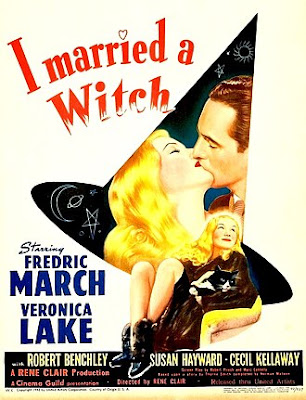
René Clair's I Married a Witch (1942)

This film is one from René Clair's American period. In 1690, in New England, the witch Jennifer (Veronica Lake) and her father Daniel (Cecil Kellaway) are about to be burned at the stake, but before that they throw a curse on judge Johnathan Wooley (Frederic March) and his descendants. A tree is placed where they are buried to imprison their spirits.

Several hundred years later lightning strikes the tree and they are freed, in the form of smoke. They find Wallace Wooley (also Frederic March), the latest in line, in the middle of an election campaign in which he's candidate. He's engaged to Estelle (Susan Hayward) and Jennifer wants to prevent the marriage so she takes on human form and contrives to burn a building and get Wallace to save her from it.

As her atttempts to seduce him fail, she concocts a love potion for him but by mistake drinks it herself, falls madly in love with Wallace and no longer wants the curse to takes its course. But her father has other ideas, and turns against his daughter.

The TV programme Bewitched was largely inspired by this film.

17 February 2022

Jean-Jacques Beineix's Diva (1981)

Jean-Jacques Beineix's first feature, Diva, is seen by many critics as one of the first – if not the first – films of the Cinéma du look, of outsiders in Mitterrand's France, alternative cultures often seen in such films in the underground, and there's a notable chase sequence in the métro here. Raphael Bassan, in La Revue De Cinéma (1989), originally coined the term.

And the Cinéma du look has often been used to describe films that have more style than content, although Phil Powrie, in his book Jean-Jacques Beineix (2001), argues from a theoretical standpoint of Melanie Klein rather than Freud, that this is a mistaken position to take, and that Diva is very strong in content: interestingly, often, there's more interest in French cinema from English or Americans than Francophones, but then I suppose it's a question of sheer number coupled with the Anglophone world's fascination with French cinema.

I won't waste time talking about the plot, and this is in a sense a policier with a difference, but it was the first appearance for Dominique Pinon (as Le Curé), although Richard Bohringer (here as Gorodish, a kind of father figure to Jules (Frédéric Andréi)) had made a few minor cinematic appearances before.

I've only seen this twice, once completely ignorant, but I strongly suspect that this is a far more important movie than many have given it credit for.

Jean-Jacques Beineix's Le Chien de Monsieur Michel (1977)

Jean-Jacques Beineix made this humorous fifteen-minute film, his first, four years before his next, which is his first feature Diva. Monsieur Michel (Yves Afonso) tells the local butcher (Jean-Pierre Sentier) that he needs some scraps for his dog, and the butcher obliges. But then Michel fries them for himself: he doesn't have a dog. And so this continues, although his neighbours are suspicious as they've never seen a dog, so to rectify this he makes frequent barking noises.

But he makes a mistake by leaving 'paw prints' on the communal stairs which infuriate the neighbours. Later he says he'd had to have the dog put down, but they club together to buy him an Alsatian, although the dog doesn't take too kindly to sharing his food. This received first prize in the 1978 Festival de Trouville, and was nominated for a César for best short.

16 February 2022

Alain Resnais's L'Amour à mort | Love Unto Death (1984)

Resnais believes that meeting a loved one is very important in life, and mentions a peasant expression from the Ardèche: 'Quand on a du bien on a du mal', or 'Where there is good there is bad'. He says that the important thing is to make things last as you're surrounded by dangers, the most extreme being death, and he questions how can love be intensified. Resnais also calls himself an 'athée mystique', an expression he retained from the German poet Stefan George.

Elisabeth (Sabine Azéma) is living with the (older) archaeologist Simon (Pierre Arditi) when he dies one night, as witnessed by Dr Rozier (Jean Dasté). But he isn't dead at all and, as it were, comes to life.

Death permanently arrests time. But Simon and Judith (Fanny Ardant) – now married to Simon's best friend Jérôme (André Dussollier) – didn't achieve this in their failed young suicide pact. Instead, Elizabeth has to come to this conclusion after Simon's second death: he's too haunted by his former death to make sense of a second life, so Elizabeth joins him.

13 February 2022

Quentin Dupieux's Rubber (2010)

Comic horror. A post-modern film within a film about the non-reality of film? A scathing comment not just on the cinematic experience but an attack on the audience itself? Maybe not.

The French Wikipédia entry for Quentin Dupieux, aka musician and DJ Mr Oizo (a pun, of course, on oiseau) states that he said 'il n'y a rien de plus beau dans l'art que de ne pas réfléchir' ('nothing is more beautiful in art than not thinking'), and the beginning bears this comment out. After Le Comptable (the 'accountant' Jack Plotnick) hands out binoculars to spectators watching the making of the film, Lieutenant Chad (Stephen Spinella) reels off a list of things in films which are done for no reason, saying by extension that this film has no meaning: just relax and enjoy the experience, which is surely what cinema – life itself? – is all about.

This film concerns a car tyre which slowly comes alive and begins to learn what's happening around it, at first falling down before it learns how to roll properly, then making its way along towards the road. The name is Robert and he discovers he can squash a plastic bottle in his way by just rolling over it, but he has to develop psycho-kinetic powers by breaking a bottle, then blows up a rabbit and a crow he doesn't like the look of before he continues to the road, his natural habitat. He makes his progress towards psychopathic killer status by blowing the head off a motorist who's had the effrontery to drive him off the road, but seems to like the looks of Sheila (Roxane Mesquida) when she takes a shower in a motel: indeed, one of the spectators wonders if they'll have sex, and the woman next to her suggests rubber Robert might get a blow job.

Slowly, the cops realise that they have a serial killer on their hands and put a dummy Sheila laden with explosives outside a door of the motel while Robert is watching – naturally – a racing match on TV. But he just blows the dummy's head off and doesn't come near the explosives, so Chad boldly just goes into the room and shoots the tyre, throwing the harmless rubber remains to the only surviving spectator: the man in the wheelchair (Wings Hauser). But Robert has reincarnated into a tricycle and – after blowing the man and his wheelchair to bits – continues his way down the road, where he picks up several tyre followers rolling on behind him.

Some comments (professional and amateur) have suggested that this would have made a decent short, that it doesn't have enough substance for a feature, and Chad (speaking for Dupieux?) tries to stop the film halfway as he says it's over and anyway it's not real. Personally I didn't find it at all tyring.

12 February 2022

Jacques Demy's Une chambre en ville | A Room in Town (1982)

Set in 1955 in the middle of a strike in Nantes, Une chambre en ville is nevertheless not a political film. But it is entirely narrated in music, as of course were Jacques Demy's Les Parapluies de Cherbourg and Les Demoiselles de Rochefort. The difference, though, is that whereas the two former movies were relatively light in tone (Les Parapluies perhaps particularly sentimental), this film is bleak.

François Guilbaud (Richard Berry) is a striking worker who has hired a room in the home of Mme Langlois (Danielle Darrieux), the widow of a colonel she loved, and who has been ruined by her wayward son. The room is in the centre of the town, in the Rue du Roi-Albert near the cathedral and the préfecture: the main battleground between police and strikers.

François's girlfriend is Violette (Fabienne Guyon), who has discovered that she's pregnant by him and wants to marry him. But then François meets Édith Leroyer (Dominique Sanda), who's unhappily married to the brutish and impotent Edmond (Michel Piccoli), and they are both madly in love at first sight: Violette and Edmond suddenly become so much psychic history. Plus, the sexually frustrated Édith is – would you believe it? – Mme Langlois's daughter.

But then the fight between cops and strikers is played out on the streets below Mme Langlois's window, François is wounded and taken into her place, and dies: unable to live without him, Édith shoots herself dead and lies down at François's side. That's no singing matter.

Aleem Khan's After Love (2020)

After the death of her Pakistani husband Ahmed (Nasser Memarzia) in their Dover home, Mary (Joanna Scanlan) checks out his phone and discovers that he has a French woman friend in Calais, so she decides to visit her. The woman – Geneviève (Nathalie Richard) – thinking she's a new domestic come to help, welcomes her. And Mary accepts this role as it allows her to infiltrate the house and discovers things she never knew, not only that her husband has led a secret life for many years, but also that she has a stepson – Solomon (Talid Ariss).

In a conflict of languages – Geneviève and Solomon speaking French and English but Mary speaking English and Urdu – each person's traumas are played out. The truth comes out when Solomon (a gay teen who hasn't yet come out to his mother), in front of the others, phones Ahmed and Mary's bag rings out. Geneviève's first reaction is to throw Mary out, although they have too much in common. They patch up their differences when mother and son decide to visit Ahmed's grave in Dover, next to the baby who died a few months after birth. The end of the film comes when all three walk towards the white cliffs, just after Mary has passionately embraced the son she never had. An excellent first feature from Aleem Khan.

11 February 2022

Jean Renoir's La Grande illusion (1937)

La Grande illusion is the same title as Norman Angell's book The Great Illusion (1909; rev. 1933), the latter version of which assisted Angell in earning the Nobel Peace Prize in the same year of publication. However, Renoir said that he'd chosen this title 'parce qu'il ne voulait rien dire de précis' ('because it had no precise meaning'), although he also said he made the film because he was a pacifist.

There are three main parts to this film set in World War I but in which we see none of the action of the war itself. A plane carrying the working-class Lieutenant Maréchal (Jean Gabin) and Captain de Boëldieu (an aristocrat) has been shot down by von Rauffenstein (also an aristocrat). The two men have survived and are now in a German prison camp with British and Russian soldiers from all walks of life.

Class divisions are of important note in this film, which shows how they can not only divide but unite: Rauffenstein and Boëldieu, despite the different sides they are on, nevertheless find important class similarities, and in certain respects it can be said that Boëldieu relates more to his aristocratic counterpart; and the wealthy Jew Rosenthal (Marcel Dalio) receives hampers of the finest food and drink which he shares with the French prisoners irrespective of their class. One talking point is expensive restaurants such as Maxim's and Fouquet's, which provokes Maréchal to comment that he's at home in an unassuming café with the local pinard (plonk).

Certainly uniting them is the desire to escape and they are digging a tunnel which is almost complete when they are moved to a more secure prison in the mountains: it is lack of a common language which prevents Maréchal from passing on knowledge of the tunnel to the new batch of prisoners. Nevertheless, work again begins on escape via a long rope from the new prison, which is again commanded by Rauffenstein, who has been grounded by injury. The friendly rapport between Rauffenstein and Boëldieu continues, although the German is forced by duty to shoot Boëldieu as he allows Maréchal and Rosenthal to escape: unfortunately, although he aimed at Boëldieu's legs, the wound is fatal but the aristocratic has freed the two people who are lower down in the class pecking order.

From the point of view of food, the rich Rosenthal and the working-class Maréchal are now equals as the slow progress towards Switzerland begins and they eke out the sugar they have taken from the prison camp. But their passage towards neutral territory is stalled for a brief time as they take refuge on a farm. This again shows the common bond of fraternity not between classes but nationalities as the two men are warmly greeted by the lonely German widow  Elsa (Dita Parlo), whose husband died at Verdun. And this is more than fraternity, as Elsa and Maréchal fall in love, and it is with great reluctance that Maréchal has to leave.

A pacifist film of fellowship in time of war this certainly is, although there are ambiguities, and interesting gender questions in this important movie, but this is not the place to go into them.

10 February 2022

Alain Resnais's Je t'aime, je t'aime (1968)

Je t'aime, je t'aime is a science fiction film, the screenplay written by both Alain Resnais and Jacques Sternberg over five years. Resnais insisted that Claude Rich be the principal actor, and no one but him.

Claude Ridder (Claude Rich) fails to kill himself and after leaving the clinic where he was recovering he is picked up by researchers and, on his agreement (what has a suicidal case to lose?) taken to a scientific research building in the countryside. Here he is told that a mouse has been tested, taken to the past, and has survived: Claude asks how the researchers know that it happened, which is of course a perfectly valid question, and the researchers have to admit that they don't speak Mouse so communication is a problem. But what has Claude to lose? These experiments only being in their initial stages, this is just a visit to the past one year ago, and for a minute: on asking what are his chances of survival, the answer is 100%: well, they've only tested this on mice before.

And so Claude takes the injection, enters a timecraft which resembles a gigantic artichoke with various wires attached and huge straws sticking out of the top, and (with a mouse at the side of him) goes into the past. The problem is that the experiment goes wrong and he only briefly comes back.

Claude's partner was Catrine (Olga Georges-Picot), and Resnais's film now moves into many flashbacks, many repeated ones of Claude and Catrine's holiday a year before on the Riviera, with Claude diving but Catrine not wanting to: strangely, Claude finds a mouse scampering on the beach. There follow a number of scenes leading up to Claude's attempted suicide, his absolute boredom with work and its constant repetiton, Catrine's death in Glasgow and Claude's inability to tolerate it, leading to him taking a gun and misfiring.

But now? The researchers leave the building and find that Claude has returned, only it seems as though he may have succeeded in his attempt this time. I may be wrong, but I see this as one of Resnais's less successful experiments with time.

9 February 2022

Alain Resnais's Muriel, ou le temps d'un retour (1963)

On the surface, Muriel – the film which followed two years after L'Année derniére à Marienbad – is far removed from the earlier film with the concreteness of its characters and its linearity. But the central themes of time and memory remain, and the past intrudes on both the concreteness of the characters and the linearity of the film. Also, very little is as fixed as it may initially appear.

There are discrepancies – sometimes due to misremembering, to forgetfulness, to lies, to more bizarre phenomena – between the past and the present: after twenty years, Aphonse (Jean-Pierre Kérien) says Hélène (Delphine Seyrig) has changed her hair, for example; and there are discrepancies between the dialogue and what is at the same time seen onscreen: when Bernard (Jean-Baptiste Thiérrée) is showing his film of Algeria and speaking about Muriel to the horse hirer (Yves Vincent), for example. What we see in the film as a whole is a claustrophobic, unstable world where lies and uncertainties prevail. The many jump-cuts at the beginning set the mood for this uncertainty. People and things can be seen as if through a distorting mirror, such as the comic glasses Bernard wears at the dinner table, or the several incomplete Bernards that his girlfriend Marie-Do (Martine Vatel) – sometimes referred to as 'Muriel' – sees through a kaleidoscope.

The omnipresence of clocks appears to be focused on the present time, although psychologically it is past time which is the main preoccupation: World War II when Alphonse and the teenage Hélène were lovers, the Algerian war when Bernard and Robert (Philippe Laudenbach) took part in the torture and killing of a young Algerian woman whose name may have been Muriel.

Between the end of World War II and the present Alphonse has invented a false past for himself as a bar owner in Algeria, and although he has in fact never been there he persists in the lie, even at first refusing to take off his coat in Hélène's flat because he claims to be used to strong heat. But then he seems to be made up of lies, and for instance the 'niece' he has brought to Boulonge-sur-mer with him, Françoise (Nita Klein), is in reality his (much younger) lover.

In Boulogne, where an estimaated 85 per cent of the town was destroyed in the war, the past dwells side by side with the present: old buildings with new, and also the rubble of war, but still there's a precariousness, such as the new building Roland de Smoke (Claude Sainval) speaks of which falls from the cliff in turn to become rubble. Hélène's flat is unstable in a different way in that the objects are constantly changing: selling antiques from her own living accommodation, the past in a number of different periods is every-present to her and Bernard. And this physical instability is in tune with the psychological instability of the characters: it is particularly Bernard, Hélène and Alphonse who are haunted by the ghosts of the past.

And Alphonse is also haunted by the present in the form of his brother-in-law Ernest (Jean Champion), who's come to expose his lies and deceit to those assembled in Hélène's flat, as well as ensure Alphonse's return to Paris, to his wife Simone (Francoise Bertin). But this is not to be.

A major film of Alain Resnais's, a major film tout court.

7 February 2022

Alain Resnais's L'Année dernière à Marienbad | Last Year in Marienbad (1961)

Samuel Beckett's own English translation of his originally French-written play Fin de partie (or Endgame) (1957) – interestingly published just four years before the release of Marienbad – contains the lines:

'Hamm: We're not beginning to...to...mean something?

Clov: Mean something! You and I, mean something! (Brief laugh.) Ah that's a good one!'

We could make a number of comparisons between the play and the film – the fact that Beckett's play refers to a game, is apparently absurd in nature, etc – but to my mind meaning is the key concept. To Hamm and Clov, meaning is almost a joke, or almost something to be feared, and the brunette A (Delphine Seyrig) seems to be frightened of having a meaning which the Italian-accented X (Giorgio Albertazzi) is attempting to give her by taking her away from the ever-repeating present, fixing her in a past somewhere (perhaps in Marienbad), and moving with her into a future which is by definition indefinable.

This is of course absurd, but then the film Marienbad, with its eternal present peopled by speechless, unmoving ghost-like beings some of the time or at other times dancing, small-talking, mindless game-playing zombies trapped in a surreal, oneiric or potentially nightmarish situation of which they appear to have no cognizance, is surely absurd?. Over them, Death (personified perhaps by M (Sacha Pitoëff) for Mort, possibly) stalks, or gloats: they are evidently lost in a living death and only X holds the key to at least free A from. I'm also reminded of Philippe (Lino Ventura) in Jean-Pierre Melville's film L'Armée des ombres calling the three domino-playing men 'imbéciles' in the Vichy concentration camp which can only lead to death.

Also coming to mind is Pierre Assouline's book of interviews with Antoine Blondin, Le Flâneur de la rive gauche: Entretiens (1988): famously, Blondin wrote in his novel L'Humeur vagabonde: 'Un jour nous prendrons des trains qui partent'. Although Assouline can't pin Blondin down to a specific meaning of that expression, it suddenly occurs to me that meaning itself is exactly what the sentence is about: one day our lives will have meaning. Perhaps X gives A meaning in the end, which she has all the time been avoiding for so long: but why? Even odder, this reminds me of what my cousin Charles Pembleton wrote on the title-page of his poetry book Living in a Timewarp (1974), which he published shortly after a traumatic experience: 'Anything above zero is painful because it has meaning.' Yes, that must be it.

Alain Resnais and Alain Robbe-Grillet's L'Année dernière à Marienbad – in spite (or perhaps because) of its lack of hardfast meaning – is one of the greatest films ever made, and just in the English langauge alone its influences extend from Stanley Kubrick's The Shining to David Mould's video of Blur's song 'To The End'.

6 February 2022

More on the Writer Caroline Glyn of Chawton


I'm very grateful to Marie-Claude Rostan for sending me these attachments of early writings and drawings by the author Caroline Glyn (formerly Caroline Davson): Marie-Claude and Caroline were penfriends between 1959 and 1981, and their communication began when they were eleven years of age. Here, she writes from Orchard Cottage, Chawton, Alton, of her father, the author Anthony Glyn, and lists his books: The Jungle of Eden, Romanza, The Room in the Thicket, Elinor Glyn, and I Can Take It All.

She also mentions Susan Eleanor Davson, who she explains wrote 'des poèmes modernes' as Susan Glyn, and published the collection Green Blood.

In addition, she mentions her sister Victoria Anne Davson, who went to Holy Trinity School, Sloane Square.

The link to my original post on Caroline Glyn is here.

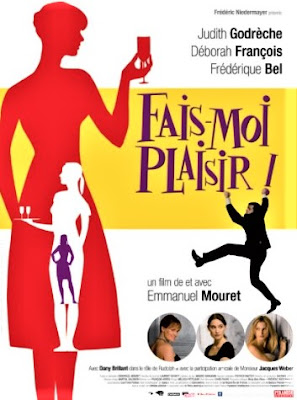
Emmanuel Mouret's Fais-moi plaisir ! | Please Please Me! (2009)

Ariane (Frédérique Bel) is the girlfriend of Jean-Jacques (Emmanuel Mouret) and sees him as fantasising about Élisabeth (Judith Godrèche), considering that the only way out of the problem is to have sex with the woman to get it out of his system.

This film is different from Vénus et Fleur in that it belongs more to the world of slapstick, and instead of having the director appearing as a Hitchcockian extra he's the main character. This last point, along with the preoccupation with sex, links it to Woody Allen films, although the improbable (indeed sometimes impossible) gags are more in the territory of Jacques Tati: the ingénu tied up in a world with which he is out of sorts leads him into absurd, even surrealistic, situations.

The key drive behind the initial action here is a the ability of a man (Frédéric Épaud) to make women fall for him by having a piece of paper given to them: this contains such charming words that they act as a kind of magic spell on the women. By accident, Jean-Jacques has come into possession of one of the papers and the spell has worked on Élizabeth.

He goes along to a function she's invited him to and the Tati element begins: he's caught up in a plush, modern world which the famous and powerful inhabit, and which is out of kilter with a man of modest means who drives a wreck of a car. First he has to find the verbal key to make the lift work; then he meets the president (Élizabeth being his daughter); his finger gets stuck in a vase and the prime minister of Japan helps him get it out; he drops a mobile phone into an ornamental toilet with a statue of a naked woman on top; he gets his flies caught in a curtain: it's a repeating helter-skelter situation in which Jean-Jacques is the dummy who can't put a foot right. But contrived as this all may sound, it's highly enjoyable because Mouret has a knack of making it work without at the same time making it appear stupid.

5 February 2022

Emmanuel Mouret's Vénus et Fleur (2004)

The very Rohmerian film director Emmanuel Mouret is concerned with the twists and turns, the understandings and the misunderstandings, of the heart. He was born in Marseille, and this – his second feature – is set in the city. The two principal characters are Vénus (Veroushka Knoge) and Fleur (Isabelle Pirès), followed by (in both senses) Dieu (Frédéric Niedermayer) and Bonheur (Julien Imbert): the name Dieu is perhaps a joke as the producer was Frédéric Niedermayer, and Bonheur may well be a prediction of the future.

Fleur's parents in Paris, where all three live, have paid for their daughter to spend her holidays in a small house in Marseille, and by chance Fleur picks up another young woman's identical bag in a café, which Vénus returns to exchange for her own. Although the two women are very different from each other – the Russian Vénus being extroverted, obsessed with young men, in general quite superficial, Vénus being introverted, shy with people and her affections and bookish (she is reading Pessoa's Le Livre de la tranquillité) – they strike a chord, and Fleur invites Vénus to stay with her.

The ill-matched pair make for the beach but Vénus's attempts to lure men by pretending to accidentally hit them with a beach ball fall flat and they return home manless. The only man interested initially is Dieu, a neighbour, but Vénus is at first uninterested, and Fleur has no interest at all. And then Bonheur – a friend of Fleur's brother – arrives for a few days and although both women are interested it's agreed that he's for Vénus, who's keen to marry a Frenchman and have dual nationality children.

One day Bonheur leaves Marseille for a few days walking, leaving Vénus in the rapacious hands of Dieu. But Bonheur returns unexpectedly and Fleur is forced to lie, saying Vénus is out for the day, saying there's no food in the house, and they go looking (fruitlessly) for an open restaurant, make do with a baguette sandwich, listen to someone playing guitar on the beach, where they innocently spend the night.

The next day Bonheur phones Fleur to tell her to meet him as he has something of vital importance to tell her: since the previous year when he met her he is obsessed with her, but (always mindful that she's 'given' him to Vénus), Fleur tells him that the feeling isn't mutual. Dieu tries it on with Fleur to no avail, Vénus comes in after being with Bonheur and it's obviously not worked out, and Dieu makes an exit, cock between his legs.

Then the next day Vénus leaves, still longing for contact, and Bonheur phones from his two-star hotel in the city to say goodbye as he's leaving. Even before Fleur rushes out and they meet up, the viewer knows that he isn't going at all.

There is bang-on improvisation in this film, which has an amazing realistic quality: time I saw some more Mouret.

4 February 2022

Jean-Pierre Melville's L'Armée des ombres | Army of Shadows (1969)

L'Armée des ombres is quite faithfully adapted from Joseph Kessel's book of the same name, and is a particular (and in some respects documentary) account of France during the Résistance. Melville was particularly pleased with the opening minute of the film, during which traffic was stopped, and in which we see an army march through L'Étoile (or the very famous Arc de Triomphe) and into the Champs-Élysées, finally revealing themselves as the occupying Nazi army. This sets the tone for the whole of the movie, and that tone is bleak.

It is pointless to regurgitate the story of this film, which many others have already done. It is enough to say that it recounts the Résistance not from a heroic angle but more from a psychological point of view: we see, for instance, the engineer Philippe Gerbier (Lino Ventura) as an escapee from a French hotel run by the Nazis (after spending a few nights in a Vichy concentration camp), and his face registers his reactions very subtly. This is not a dog-eat-dog world, but one in which not only informants of the members of the Résistance have to be killed by the Résistants, but any members of the Résistance who are at first captured by the Nazis and then freed have to be killed by their own friends: they are a danger to the Résistance cell because there are inevitably very few Jean Moulins: they will break down under torture. Particularly tragic is the necessary assassination of Mathilde (Simone Signoret), who has saved the lives of so many people, including some responsible for her own death: Lucie Aubrac is one of the models.

Édouard Molinaro's Une Ravissante idiote | A Ravishing Idiot | Agent 38-24-36 (1964)

Une Ravissante idiote is adapted from the eponymous novel by Charles Exbrayat, who produced a number of (sometimes humorous) policiers. This film is certainly of the humorous variety, and although sometimes a little too much so, this is highly engaging, not at all as bad as the film poster suggests.

Harry Compton (Tony Perkins) is English, although Perkins's French is very good, and much of this film takes place in England, where he falls for Penny Lightfeather (Brigitte Bardot) about the same time as he gets the sack from his job in a bank of Russian origin. So he decides to become a Soviet spy to avenge himself.

Penny is a creature of great beauty but appears to be hopelessly stupid. However, Harry (or whatever Russian name he chooses to call himself) is smitten and it so happens that the spying mission he's given by Bagda (Grégoire Aslan) is to steal vitally important papers from Sir Reginald Dumfrey (André Luguet), and Penny is the seemtress of his gossipy wife Lady Barbara (Denise Provence). And what do you know? Lady Barbara is so gossipy that she gives away the combination of her husband's safe (where the papers are held) to her friends (including Penny), as though Sir Reginald wanted it to be broken into. (Which he did, but that's another story.)

So Harry (assisted by Penny, who apparently also has communist sympathies) try to get the papers, and although the film tips into farce here with the perigrinations and they seem irrecoverably lost to Sir Reginald's safe, Penny seems to be so stupid (and so stupidly successful in telling the truth and getting away with it) that she can't be for real.

Of course, she's not for real and she's a major detective for Great Britain, but then she gets her real man, Harry, and they live happily ever after, of whatever the model (Hollywood) intended. But this is much better than the vast majority of Hollywood movies.

3 February 2022

François Truffaut's L'Amour en fuite | Love on the Run (1979)

Unfortunately, L'Amour en fuite is a most unsuccessful end to the five-part Antoine Doinel series, as Truffaut himself realised. After (in order) Les Quatre cents coups, Antoine et Colette, Baisers volés and Domicile conjugal, this is a very thin story of divorce, pursued love and former love held together by the past. And the past is represented in scenes from the films which preceded this. Of its kind, this is one autobiographical story too many.

Interestingly though, Jean-Pierre Jeunet seems to have taken a few cues from this for Amélie Poulain, and I can't help thinking that there's an element of autism in Doinel too.

30 January 2022

Jean Renoir's La Règle du jeu | The Rules of the Game (1939)

The beginning of La Règle du jeu shows a quotation from Beaumarchais's Le Mariage de Figaro, and although this play is undoubtedly an influence, Alfred de Musset's Les Caprices de Marianne (1833) is more so. The film was made a very short time before World War II and its depiction of an animal (particularly rabbit) cull as sport is a prediction, or a cinematic metaphor of, the atrocities to come, as are the dancing corpses in La Fête de la Colinière (Robert's country retreat in Sologne), and Saint-Saëns's Danse macabre played on the Pianola belonging to Robert, Marquis de la Chesnaye (Marcel Dalio).

Robert is the husband of Christine (Nora Gregor), who is also loved by André Jurieux (Roland Toutain) and Octave (Jean Renoir), who is also an old friend of André: obviously, Robert is unable to control humans, so he delights in clockwork treasures not only such as his Pianola, but also his mechanical fauvette (warbler), and – la pièce de résistance – his orchestrion.

This remarkable film (without the necessity to repeat what others have said so many times) concerns love (or lust), class differences,  the multidude of lies told by every conceivable source, the ability of rulers not only to triumph but to triumph over their triumphs. There is no hope, we just continue.

28 January 2022

Benoît Delépine and Gustave Kervern's Aaltra (2004)

Aaltra is the opposite of a buddie movie because the protagonists hate each other. Furthermore, it's a very different road movie because it's played out in wheelchairs. It was the directors' first feature, and has become something of a cult film.

Benoît Delépine and Gustave Kervern play the unnamed characters in this film: they are neighbours, and Delépine can't stand his agricultural worker opposite, and when he motors over to his combined harvester for an argument, they both end up under the machine and lose their legs. They decide to make a spurious complaint to the head of the agricultural firm, which is the Finnish Aaltra company.

And so, saying very little to each other, they embark on a journey from Belgium to Finland, most of the time hitching a lift in their wheelchairs. They experience a little discrimination, such as a lorry driver stopping for them, then pulling off at the last moment and calling them 'enculés' ('fuckers'), but the novelty here is that these two handicapped individuals don't at all come across sympathetically, quite the reverse: they mug people as they're begging, steal an electric wheelchair, and treat a welcoming family as their servants, for instance.

But the twist comes when they eventually reach Aaltra, where they are expecting a huge compensation for their injuries: it is a very modest factory where only the handicapped are employed, and the cherry on the cake comes when the boss (in reality the Finnish film director Aki Kaurismäki), in his wheelchair, takes them aside for a drink of vodka and gets them to agree to work in the factory. A great beginning for the directors.

27 January 2022

Alain Resnais's Nuit et brouillard | Night and Fog (1955)

Nuit et brouillard comes from the German name given to the deportees to the concentration camps, NN (Nacht und Nebel), the oblivion of night and fog. The screenplay of this short is by Jean Cayrol, who survived Mauthausen, and the footage is black and white archival, and (then) presentday colour of the remains of the Holocaust. In a sense, it's a forerunner to Claude Lanzmann's monumental nine-hour Shoah (1985), which is largely a great number of accounts of people's experiences of the Holocaust, without archival footage. Arguably, Resnais's film is more harrowing as it shows the starving Jews, the murdered Jews kicked into pits, the use of dead Jews' hair to make mats, of their skin to make a kind of paper to draw on, of their bodies to make soap, and on and on. Along with Lanzmann's film, this should be compulsory viewing, so that we never forget the atrocities perpetrated by the Nazis, so that such obscenities never happen again.

Raphaël Balboni and Ann Sirot's Une vie démente | Madly in Life (2021)


Under the circumstances, in many respects this is a strangely amusing film. Noémie (Lucie Debay) and her husband Alex (Jean Le Peltier) have decided to have a child, and are obviously anxious to ensure that all goes well. However, the odd behaviour of Alex's mother Suzanne (Jo Desure) will put the event on hold for a while, and cause a large amount of trouble, pain and general frustration for them.

The first thing Noémie and Alex notice is that when Suzanne comes to visit them she parks in the space allocated to the handicapped: nothing much to cause a fuss about there. Then when they're preparing a family meal in the kitchen and Alex asks his mother to pass the colander she ignores him: again, there doesn't seem to be any great cause for concern. But then when Alex notes that his mother, quite casually, steals a cigarette lighter from a shop, things begin to get worrying. Next, Suzanne has trouble with her credit cards when a terminal in another shop registers that she has no funds, which she 'knows' to be untrue. It's only when Alex sees what a mess she's making of her accounts, and – much more seriously – that she falsely declared herself retired two years before, although she's been working and collecting a five-figure sum under false pretences, that Alex realises that she has a real problem.

The diagnosis is the onset of Alzheimer's, and when Alex sees that she's switched off her fridge and left rotting food in it, he recognises that she'll have a home help. After a few interviews, this is found in the shape of the very knowledgeable and affable Kevin (Gills Remiche).

Meanwhile, any movement on the baby front has to be postponed, in fact left to vegetate: we see Alex and Noémie in bed with computer and a book, both with the same green, floral patern which matches the sheets, pillows, curtains, lampshade, etc. It is, of course, an image of madness, but it can only get worse because Suzanne's illness is degenerative.

In addition to this problem, Suzanne is hyperactive, makes a great deal of noise, at one point enters a stranger's house and begins having a meal at the kitchen table until she's discovered by the nonplussed occupants, so Kevin has to work hard to keep her under a kind of house arrest without actually making a prisoner of her.

Anti-psychotic drugs have the effect of turning her into a cabbage until the dosage is reduced and she regains some semblance of normality. And we finally see her in a role reversal: as she sits at a table on the lawn next to her son's baby, Noémie feeds it while Alex feeds his mother. Crazy this film certainly is, although this tragi-comedy strikes a healthy balance by treating a serious terminal illness in a mature way.

26 January 2022

Élie Wajeman's Médecin de nuit | Night Doctor (2021)

Vincent Macaigne was over forty when he had to lose 25 kilos and pass his driving test before he could take the lead role as night doctor Mickaël is this film, which he describes as a kind of homage to the New Hollywood films of the 1970s.

Mickaël's partner is Sacha (Sarah Le Picard) and they have two children in Paris, although he is also having an affair with Sofia (Sara Giraudeau), the 'fiancé' of his cousin Dimitri (Pio Marmaï), who's a pharmacist. And Dimitri relies on Mickaël to keep the pharmacy in good financial order, because Mickaël deals in the rather shady business of supplying Subutex to the many drug addicts who flock around increasingly as word gets around. But Mickaël had integrity, and in spite of his knowledge that much of this stuff ends up on the black market at hugely inflated prices, he won't in any way prescribe Fentanyl: he knows how many deaths the drug has caused, and won't listen to Dimitri or any of the addicts who ask for it.

Add to his problems he's being threatened by the medical establishment with an investigation and he wants out, he wants to get away from the addicts, maybe escape with Sofia? She'd be willing, although she knows he won't do it: he's too attached to Sacha and his family in general. As the addicts become more demanding the violence escalates, and much of it is coming from Mickaël's side: and as Dimitri increases the pressure for him to prescribe Fentanyl and tells lies about his situation, how much Mickaël and his family's life are in danger if he doesn't step up the prescriptions, Mickaël realises that he now has to carry a gun in the car.

And although Mickaël only uses the gun once as a threat, it's already too late and the doctor is the one who needs an ambulance, but it looks as if that will come too late as well.

25 January 2022

Diane Kurys's Après l'amour (1992)


If we take – and there's no reason why we shouldn't – Jean Eustache's La Maman et la putain (1973) as marking in cinema the end of the sixties, the end of the soixante-huitard mentality, in which sexual experimentation is staunchly called to question, then the title of Diane Kurys's Après l'amour fits into place, even if the only (incidental?) mention of the actual title 'après l'amour' applies to a whollly different period, to Pompeii.

Après l'amour was shot over twenty years after '68, more than twenty years after the sexual revolution, but what we have here is not the defeat of that revolution – paradoxically, far, far from it – but the continuation of the sexual revolution, a sexual revolution that never in fact died but florished under a very different ideology: a consumerist one: the world we witness in this film is very bourgeois, apart from the, er, romantic night in the run-down Eden (!) Hotel.

The film is in the present time, and was released in 1992. Gone are the revolutionary political posturings, but entrenched in the new ideology is an extension of the sexual mores of 1968: with mixed behaviour in terms of the male-female divide, where feminist attitudes appear to have eroded, become very confused. Lola (Isabelle Huppert) is the one who has ridden the wave, become her own self, is now financially and psychologically independent, or so it seems. But she's in relationships with two married men: architect David (Bernard Giraudeau) and (the unconvincing) rock musician Tim (Hyppolyte Girardot), whose wives are Marianne (Lio) and Elizabeth (Laure Killing) respectively, and both have children. Being a 'free spirit', Lola has no wish for children.

One problem with being free, of course, is that you are never free, and Lola's main problem, perhaps, is that as a novelist her emotional situation makes it impossible for her to write her next book: the white page predominates as the screwed-up pieces of paper accumulate around her.

So we are living in the aftermath, the heritage, of the sexual revolution, where now everyone is free to have who they like sexually, free to do as they please in theory, although there are two major problems: women haven't evolved equally, many of them are still tied financially to men, many of them don't accept the supposed new standards set over twenty years ago, but more importantly surely: men haven't evolved, they've always wanted double standards throughout history, and even especially now that, er, women are free. Of course, that's not saying anything about where children stand in this confusion, this whole shit, and oh, Lola's pregnant now and wants to keep it? This is evolution? To what?

Alain Resnais's On connaît la chanson | Same Old Song (1997)

This is a monster film for Alain Resnais, even if it's not his best: but then what could be this hugely important director's worst? Time, and in some respects memory, are inevitably important here, in what can (very liberally) be described as a quirky (and brilliant) musical. Resnais dedicates this to Denis Potter, who died a few years before, and is most famous for the lip-synching of such television plays as 'The Singing Detective' and 'Lipstick on your Collar'.

Here though, it's not whole songs that are heard, but snatches of them, in total thirty-six in forty-seven interventions. They represent private thoughts sung by the original performers but mimed by the actors, and can represent an emotion clearly manifested in the film but more likely represent private, secret thoughts known only to the actor or the audience. But the songs spread over a wide period of time, and it is highly unlikely that many (if any) even French viewers recognise all of the songs, which stretch over seventy-three years, ranging from Albert Préjean's 'Je m'donne' (1921) through to Michel Sardou's 'Déjà vu' (1994), passing by Édith Piaf, Charles Aznavour, Serge Gainsbourg, Léo Ferré, Sheila, Alain Bashung, Téléphone, etc. 

Certainly any French person – or any lover of Francophone popular music – will recognise a number of these songs, although the internationally known Georges Brassens, Jacques Brel or Georges Moustaki aren't represented. What they'll recognise is their own history, their own memories through the time they've lived, grafting many more personal stories onto this particular one.

For all that, the general narrative is fairly simple: Claude Lalande (Pierre Arditi) is married to Odile (Sabine Azéma) who wants to move to a new dream apartment through estate agent Marc Duveyrier (Lambert Wilson); Odile's younger sister is Camille (Agnès Jaoui), who is coming to the end of seven years studying 'Les Chevaliers paysans de l'an 1000 au lac de Paladru' for a doctorate but is also working as a tour guide; Odile's former lover hypercondriac Nicolas (Jean-Pierre Bacri), who is married and has been living in England, has just returned to Paris to find work and bring his family over; Simon (André Dussollier) works as a clerk with Marc as boss, writes radio plays more as a hobby than a source of revenue, and is secretly in love with Camille, following her tours when time permits; Marc is an egotistical womaniser who is Simon's boss, and whose latest conquest is Camille.

History is not only important via the songs or the characters' past but through other things: Camille lectures her ever-changing groups on such things as France's Nazi past, le Parc des Buttes-Chaumont with its Temple de la Sibylle and Pont des Suicidés, the house of the Marquise de Brinvilliers (on whom Simon has written a play), the Cimetière du Père Lachaise (where the famous erection of Victor Noir is scrupulously avoided, probably because too well known therefore a cliché), and so on. Obviously the sights here are off-centre, and even the sculpture near the estate agent, la Fontaine des Polypores in the 15e arrondissement, built in 1983, is hardly on the normal tourist circuit.

Through this web of relationships lie a tangle of lies, half-truths, misunderstandings, inaccuracies, etc. Nicolas is pretending not to be a humble chauffeur, Claude has a much younger lover, Simon pretends to have a profession as a playwright and not also a lowly estate agent clerk, when he meets Camille Marc goes along with the pretence that he was crying and snivelling over a relationship rather than a cold, but most of all he lied by omission because Odile and Claude's wonderful flat with its superb view will soon have the view wiped out by what looks like a horrendous HLM.

All will come out in the house-warming, but particularly Marc's lie by omission, which is not the only thing to cause electric, poisonous atmosphere by the appearance of the jellyfish, but the ending is quite cataclysmic. A superb film.

From Wikipédia, the songs:

Joséphine Baker : J'ai deux amours (Götz Burger)

Dalida et Alain Delon : Parole parole (Jean-Pierre Bacri et Sabine Azéma)

Charles Aznavour : Et moi dans mon coin (Pierre Arditi)

René Koval : C'est dégoûtant mais nécessaire (Sabine Azéma)

Simone Simon : Afin de plaire à son papa (Sabine Azéma)

Gaston Ouvrard : Je n'suis pas bien portant (Jean-Pierre Bacri)

Albert Préjean : Je m'donne (Lambert Wilson)

Jacques Dutronc : J'aime les filles (Lambert Wilson)

Michel Sardou : Déjà vu (André Dussollier)

Gilbert Bécaud : Nathalie (André Dussollier)

Maurice Chevalier : Dans la vie faut pas s'en faire (Lambert Wilson)

Arletty et Jean Aquistapace : Et le reste ? (Agnès Jaoui et Lambert Wilson)

Édith Piaf : J'm'en fous pas mal (Agnès Jaoui)

Alain Bashung : Vertige de l'amour (André Dussollier)

Sheila : L'école est finie (Sabine Azéma)

Serge Lama : Je suis malade (Jean-Pierre Bacri)

Léo Ferré : Avec le temps (Jean-Pierre Bacri)

Henry Garat : Avoir un bon copain (André Dussollier)

Jane Birkin : Quoi (Jean-Pierre Bacri et André Dussollier)

France Gall : Résiste (Sabine Azéma)

Henry Garat : Amusez-vous (Lambert Wilson)

Charles Richard : La tête qu'il faut faire (Lambert Wilson et Sabine Azéma)

Alain Souchon : Sous les jupes des filles (Sabine Azéma)

Eddy Mitchell : La Dernière Séance (Jean-Pierre Bacri)

Sylvie Vartan : La plus belle pour aller danser (Lambert Wilson, Sabine Azéma, etc)

Serge Gainsbourg : Je suis venu te dire que je m'en vais (Pierre Arditi)

Eddy Mitchell : Je vous dérange (André Dussollier)

Téléphone : Ça (c'est vraiment toi) (Pierre Arditi et autres acteurs)

Dranem : Quand on perd la tête (Sabine Azéma)

Johnny Hallyday : Ma gueule (André Dussollier)

Pierre Perret : Mon p'tit loup (Pierre Arditi)

Claude François : Le Mal-aimé (Lambert Wilson)

Michel Jonasz : J'veux pas qu'tu t'en ailles (Jean-Pierre Bacri)

Julien Clerc : Ce n'est rien (André Dussollier)

Claude François : Chanson populaire (Pierre Arditi)

Eddy Mitchell : Le Blues du blanc (Lambert Wilson)

23 January 2022

Alain Resnais's Cœurs | Private Fears in Public Places (2006)

This comedy drama is light years away from the early films which gave Resnais his hallowed name in cinema history: in fact on occasion it very nearly, but not quite, tips into farce. Still constant are some intrusive thoughts from memory, and the ending is a very long way from the traditonal comedy.

Everyone in the film is discontented with his or her current situation and strives escape from it. And if it's largely about loneliness, it's also about sex. Interestingly, and although this is in no way a sequel, Thierry (André Dussollier) is an estate agent as he was in On connaît la chanson nine years before, but Charlotte (Sabine Azéma) works there too. Thierry, who lives with his much younger sister Gaëlle (Isabelle Carré) is sexually frustrated and lusts after Charlotte: particularly after this supposedly devout woman lends Thierry two VHS tapes (yes, in 2006) she's recorded religious programmes on, but inadvertently forgotten to erase scenes of herself cavorting sexily in front of the screen in her underwear.

Then there's the couple Nicole (Laura Morante) and Dan (Lambert Wilson) who are having trouble finding a suitable flat, with Dan insisting that it has room for his office: this recalls Nicolas (Jean-Pierre Bacri) giving Dussolier's character problems in On connaît la chanson. But as we are made to probe a little deeper, the relationship between Nicole and Dan is not what it seems: he's been kicked out of the army for some unknown reason, drowns his sorrows frequently at the local bar attached to a hotel and comes home drunk. Nicole is sick of him because, whereas she has a job, Dan doesn't seem interested in getting one. In fact it irks her so much that she throws him out and he's forced to temporarily stay at the four-star hotel. The barman Lionel (Pierre Arditi) advises him to write a small ad for the paper, and quite by chance (yes, I repeat that it's 2006) also mentions the internet, although we see nothing of it here, not even a mobile phone.

Meanwhile, Gaëlle is secretly going out at night to meet potential partners, although she's not having much success with the lonely hearts columns. Surprisingly, when she meets Dan they really strike it off: not only does she like to get drunk too, but she'll meet him the following night at the bar attached to the hotel.

And so we come to Lionel, who's had a bad time with life and is now looking after his cantankerous father Arthur, who we never actually see, although we hear the voice of Claude Rich. But Lionel now needs someone else to look after his father while he works nights at the bar, and who should come along as a nursemaid but Bible-wielding Charlotte? She receives plates and food thrown at her, gets exasperated, but finds a way to soothe him by parading into the bedroom in her underwear.

The end of the film is one of the most pessimistic as possible. Nicole feels really bad about throwing Dan out, but when she comes to see Dan at the bar Gaëlle sees them and runs back to her brother. And Arthur has been sent to hospital and is telling scarcely believable tales about his homehelp. The result is that everyone is trapped inside his or her loneliness. Bleak indeed, but it appears (reading Wikidedia's synopsis of it) to adhere pretty strictly to Alan Ayckbourn's play Private Fears in Public Places (2004) on which it's based.

Claude Chabrol's Une affaire de femmes | Story of Women (1988)

Made ten years after Violette Nozière, this, along with the previous film, can be seen as a kind of diptych. Both are inspired by real-life criminal cases. The main differences lies in the historical and political backcloth within which they were set, and this is occupied France in 1943.

Class is also a difference, and here we have the barely literate Marie Latour – Isabelle Huppert again, this time representing Marie-Louise Giraud – determined to make as much money as she can for her family. She's married to Paul (François Cluzet), and although she has two young children her relationship with him is clearly sinking and she avoids sex.

One way she can earn extra money is by letting a room out to her friend the prostitute Lucie (Marie Trintignant), although her real earnings are coming from her business performing illegal abortions – she's a faiseuse d'anges – and for a time she's able to keep the knowledge of these activities from Paul.

But it's not long before Paul realises that Marie has a lover, Lucien (Nils Tavernier), and in fact she becomes not too secretive about the fact: with the result that Paul makes a letter to the authorities made out of cut-out letters from newspapers, and soon Marie is arrested. And not only that: as a measure of the gravity of her offence she's sent to Paris.

As this is Paris during the Vichy régime, and Pétain's portrait adorns one of the rooms where Marie has a talk to her lawyer, and as abortion is seen not just as a crime but a crime against the state, justice is extremely harsh with Marie: she receives the death sentence, which will never be commuted to life imprisonment. It is evident what Chabrol thinks about this gruesome farce of a verdict.

Claude Chabrol's Violette Nozière (1978)

Violette Nozière is one of Chabrol's films concerning women and is set in the early thirties at the time of increasing fascism. It is inspired by a fait divers, about an eighteen-year-old woman (Isabelle Huppert acting for Chabrol for the first time) still at school who regularly secretly leaves the petit bourgeois parental home at night to prostitute herself. When the doctor diagnoses her as having syphilis, she somehow manages to convince her parents (Jean Carmet as Baptiste and Stéphane Audran as Germaine) that she has inherited it from them.

Then she falls in love with Jean Gabin (Jean-François Garreaud), an opportunist for whom she hands over the profits from her (occasional) prostitution and money she steals from her parents. She forges doctor's prescriptions and poisons her parents, although, 'respecting' her mother, she gives her a lower dose and Germaine survives.

Violette Nozière claimed that her father has repeatedly raped her, although she was nevertheless given the death sentence. This was later commuted to a life sentence, and in August 1945 de Gaulle pardoned her, she married the prison clerk, had five children by him, and died in 1963 a fully pardoned woman.

Jean-Jacques Beineix's La Lune dans le caniveau | The Moon in the Gutter (1983)

As this was available for viewing and Beineix died just ten days ago, I thought it appropriate to watch this, which I discover is one of only six non-documentary feaures that he made. It certainly does have much of the cinéma du look about it, although I'm not sure about the 'triumph of style over content' slur that people used to make: this is addictively watchable, and not just because of the presence of the main stars.

The sister of Gérard Delmas (Gérard Depardieu) has been raped and kills herself as a result, and Gérard determines to find out who did it. Gérard is a docker living in a slum with his father and his partner Bella (Victoria Abril), although as he's on his search Loretta (Nastassja Kinski) rolls up in her flash sports car and takes a distinct liking to him: it's probably the macho working-class difference which appeals to this rich young woman, but Gérard only seems to have a passing interest. His main interest is tracing the killer of his sister Catherine.

The whole atmosphere of the film is bathed is dreams or nightmares, but although Gérard survives Bella's hitmen employed to kill him when he decides to leave and she thinks he's being unfaithful to her, by the end of the film he's still no closer to finding the murderer.

19 January 2022

Elsa Rysto's Love Hurts (2020)

Love Hurts has one of those annoying English titles that directors are increasingly giving French language films: the logic is of course that an English title attracts more people because many more people speak English than French. And certainly there's the excuse that this thirty-two minute film is inspired by American movies, the soundtrack is laden with American songs from the sixties, and 'Love Hurts' is the title of one of them, but not played in this film. Fine, but all the same...

Elsa Rysto's favourite film is Les Parapluies de Cherbourg, her second favourite is A Clockwork Orange, and although these two films are wildly different in content and style, etc, a definite logic follows from this when we watch Love Hurts: Sam (Noée Abita) is one of the two main characters, Troy (Andranic Manet) the other, and this is a movie about gratuitous violence – and love.

When the shy, easily impressionable Sam first meets Troy he takes her aside in a woodland setting and at first frightens her, then frightens her some more by asking her to hit him, but hard, as he can't feel pain. She asks if he's high on pain-killers, but no. And she gets bloody knuckles as he asks for more and shows no reaction to the hit he takes.

This, all right, is adolescence and kids have to go through everything, have to experience extremes in growing up, and hey, that's part of growing up itself. But Sam goes though various emotions, as kids do, and although the rest of the school know that Troy has been expelled for violence, and it's said that he beat a guy into a coma, she still sides with him, fights for him, is him, because that's what love's all about: no? Psychotic? What?

Patrice Leconte's Dogora : Ouvrons les yeux (2004)

During a French interview, Patrice Leconte said that the film he regrets making is Circulez, y'a rien à voir as it was one comedy too many. He likes Dogora more than any of his other films because hardly anyone has seen it. I'd not even heard of it, so set about rectifying that situation: it's available on YouTube and has been for five years, although so far the link has received less than six thousand views, and I can guess that many of those people don't hang around to watch the whole film. The reason for this is that there's no dialogue, but a large number of generally non-sequential scenes set in Cambodia only with the music of Étienne Perruchon on the soundtrack. Occasionally there are 'words' spoken as a chorus to this music, although this is in 'Dogorien', an imaginary language 'invented' by Perruchon.

Leconte's film, which is unlike anything he's ever done before, is a homage to the country and its people. It shows both urban scenes, mainly of the roads and the people and transport passing, and many scenes of the rural area, harvesting the fields, collecting the sap from trees to make rubber, etc. It is intensely poetic, and although the music blends in harmoniously with the scenes – loud and fast for busy street scenes, softer and slower for the calmer areas – I found it a little too intrusive, and I can sympathise with anyone thinking that these 'European' sounds are out of synch with what we see onscreen.