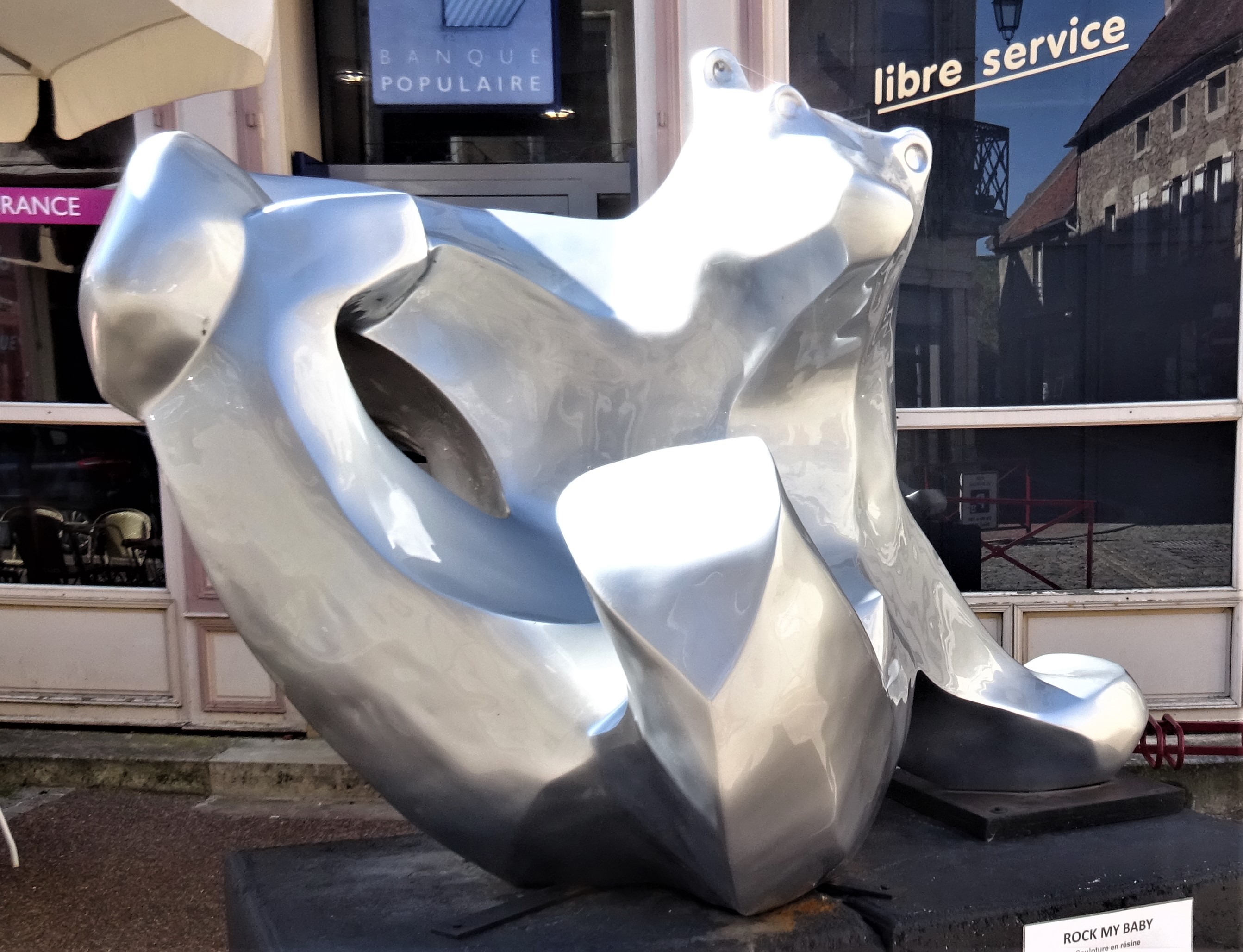
The polar bear by François Pompon in Le Jardin Darcy, Dijon, is a plastic copy of the original sculpted in 1922, and has been there since 1937. It was in fact Pompon's friend Henry Martinet who sculpted this, and he mentions how Pompon met the animal sculptor Rouillard, how Pompon sought to work against realism.
23 September 2021
François Pompon in Saulieu (21), La Côte-d'Or (21)
François Pompon (1855-1933) was a noted sculptor born in Saulieu who died in Paris. He is noted for his animal figures, particularly for the simplification of their shapes and polished surfaces. There's a museum in Saulieu partly dedicated to his work, and two reproductions of his animals (a bull and the famous polar bear) are on open display in the town: this is a copy of the original bull in Paris, which a nearby notice says is a symbol of Saulieu to travellers and 'Sédélociens' themselves; the polar bear is a plastic recreation of the original plaster version from 1928. Around the town are sculptures of animals by Pascal Masi and Cévé. Unfortunately we didn't have time for the museum.
22 September 2021
Antoinette Quarré, Dijon (21), La Côte-d'Or (21)
Antoinette Quarré (not Carré as some have written) was a seamstress in Dijon and also a poet whom Lamartine praised but Flora Tristan hated. This tomb in the Grand Cimetière de Dijon (Les Péjoces) is a remarkable praise to her, containing strong words of appreciation from Lamartine, angels holding up her book, a profile medallion of her, and a notable plaque from her friends. This stone is almost a work of art in itself.
Flora Tristan, Dijon (21), La Côte-d'Or (21)
Flora Tristan (1803-1844), as this Allée named after her says, was a writer, a feminist and a, er, revolutionary. She has her eccentricities, though, and her Le Tour de France : Journal 1843-44 has some weird things in it. She visited Dijon from 18 to 24 April 1844, was in no way interested in seeing the sights, and was more interested in meeting intelligent workers. She'd expected to find a kindred spirit in the worker and poet Antoinette Quarré after Lamartine's good words of her, a great and beautiful 'girl of the people', full of physical and mental energy. But she found Quarré ugly, deformed, grotesque, and with red hair! She continued her search for like-minded people in Dijon with mixed reactions.
Angélique du Coudray, Dijon (21), La Côte-d'Or (21)
In Dijon I was surprised to find a street named after a midwife, although this was in the hospital area near Saint-Apollinaire: Angélique du Coudray (1714 (Wikipédia claims 1712) to 1794)), who was born in Clermont-Ferrand and died in Bordeaux. She was the first person to teach midwifery, and advocated it in place of the amateur practices which had previously been used. In 1759 she published L’Abrégé de l’Art des accouchements, her teaching manual which she updated in 1769 in an illustrated edition. In Le Musée de l'homme in Paris a facsimile of her model 'Machine de Madame du Coudray' is on display.
21 September 2021
La Chouette, Dijon (21), La Côte-d'Or (21)
I won't go very far into this as it involves the 'T' word (one of my most hated: Tourism), although this is worthy of mention and is perhaps akin to such legends as the Lincoln imp: La Chouette (or the owl) of L'Église Notre-Dame de Dijon. I won't go into the many stories, but it's enough to say that the rubbing of the owl (if owl it is) is said to bring good luck if it's done with the left hand, a little like (say) rubbing Victor Noir's erection in Père-Lachaise or Montaigne's foot near the Sorbonne (with either hand, no matter, I believe). The owl, of course, is on Rue de la Chouette, and the tourist industry milks the legend by showing hundreds of owl triangles for its tourist circuit, which I obviously didn't do: you've only to see the owl tat (such as tote bags) in the souvenir shops and despair. (Oh, and it brings misfortune to rub the chouette while watching the nearby salamander, so be careful.)
La Chouette.
Dominique Labauvie, Dijon (21), La Côte-d'Or (21)
We missed a number of things on our first visit to Dijon, in our crazy rush to get photos of the glyptodon highlighted in Éric Chevillard's hilarious Démolir Nisard. Dominique Labauvie's Le Champ de feu (1992) was apparently 'Commissioned by the Ministry of Justice, France for the Courthouse of the City of Dijon'.
19 September 2021
Bernard Giroux, Rully (71), Saône-et-Loire (71)
Bernard Giroux (1950-1987) was a sports journalist noted for his Tour de France and his Grand Prix commentaries. He died just off the Isle of Wight in a high-speed boat steered by Didier Piloni.
Ernest Pinard, Rully (71), Saône-et-Loire (71)
Ernest Pinard (1822-1909) was born in Autun (Saône-et-Loire) and died in Bourg-en-Bresse (Ain). He has gone down in history as seeking the indictment of such, er, scandalous books as Flaubert's Madame Bovary and Baudeliare's Les Fleurs du mal. He even attacked Eugène Sue's Les Mystères du peuple after Sue's death by condemning his publisher and his printer. No comment.
18 September 2021
L'Art et le vélo au temps du Covid, Mâcon, Saône-et-Loire (71)
In the time of the first Covid confinement, what is there to do? One thing is turn to art, so Régis Noly painted an abandoned bicycle. And a fine specimen it is. À l'année prochaine, Régis !
16 September 2021
Marcel Yerly in Clairvaux-les-lacs, Jura (39)
Between 1945 and 1995 Marcel Yerly (1915-2000) made by hand about one hundred models in wood, between fifty and three metres in height or length. In 2006 a rather clumsily-titled Musée des machines à nourrir et courir le monde was dedicated to his work, containing his models, as well (later) as models by others: here (I think) I restrict myself only to works made by Yerly, who was also a painter. Director Claude Miller has explained that Yerly used acacia and boxwood for their durability, walnut, beech and elm for their colour. The museum, held in a large warehouse on the outskirts of the town, is a great tribute to obsession, meticulous attention to detail, and love of (mainly local) history.
Marcel Yerly's workbench.The Pacific P231 locomotive (1912) made in Le Creusot and Oullins. It had a maximum speed of 90 km per hour and the model train took Yerly 300 hours to make.
Adeline Dieudonné: La Vraie Vie | Real Life (2018)
What to do on a wet day in France? Read a book found in a boîte à lire is one possibility, and I've been meaning to read Adeline Dieudonné's first novel La Vraie Vie since it came out three years ago. A popular novel translated into numerous languages isn't normally my idea of fun, but this appeared to be somewhat stranger than the normal popular fare: and it is!
Holding a suspension of disbelief as to how an amusement park employee (the unnamed (at first ten-year-old) narrator's equally unnamed father) could find the money to go around the world and hunt game, or that the same (slightly older) girl can afford to pay an emeritus professor to give her advanced physics lessons out of what she earns through babysitting, this is still some story.
And the fact that it pays off, that the reader continues to read with great relish, is testimony to Dieudonné's writing skills. So what is this about? Well, anyone who glances at the blurb can see it's about a family who live in a house with four bedrooms: the narrator's, her younger brother Gille's, her parents', and that of 'the bodies'. We later learn that the bodies are of wild animals as the father – whose is interested mainly in hunting wild animals, watching television, drinking Glenfiddich, but above all controlling his family: he's a self-obsessed tyrant. And he's very violent towards his wife, whom the narrator calls an amoeba.
The book, however, isn't just about a dysfunctional family, but also about a highly gifted young girl growing up, how she copes with her many problems, even how she attempts to solve them by wishing to turn back history to before a specific traumatic moment in childhood. I'm not too sure what you're left with after the end, but the journey through the novel is rivetting enough.
14 September 2021
Boîte à lire in Chasselay (69), Rhône (69)
An original and well-filled example of a boîte à lire in Chasselay, and I left with a copy of Adeline Dieudonné's La Vraie Vie (2018), Emmanuelle Pagano's Les Mains Gamines (2008), and a poche edition of Romain Rolland's Colas Breugnon (1919), which I've been meaning to read for some time. (As always, we put back elsewhere what we read.) Boîtes à lire are to be treasured.
Le Tata sénégalais in Chasselay (69), Rhône (69)
Le Tata sénégalais just outside Chasselay, specifically at Vide-sac, is a cemetery containing the remains of 188 Senegalese infantrymen, six north African infantrymen and two soldiers from the Foreign Legion. They were massacred by the Nazis in June 1940. The whole cemetery is in red ochre. The name tata refers to a holy enclosure, the cemetery itself has symbols alluding to Christianity and Islam, and the wooden gates remember traditional African religions. It was built in 1942 and underwent no damage during the Occupation.
13 September 2021
Auguste Buchot in Louhans Châteaurenard (01), Ain (01)
Auguste Buchot (1851-83) is perhaps best known for his poetry books Les Ruines de Faucigny (1878) and Le Miroir indiscret (1879), although Georges Droux wrote an autobiographical booklet on him: Auguste Buchot: (avec un portrait du poète) (1889) in the Silhouettes contemporaines series. Buchot also wrote the non-fictional Histoire de Pierre Vaux, l'instituteur de Longepierre (1889), on the teacher wrongly accused of arson in Longepierre. There seems to be very little information readily available about him, although the medallion seems to belie his apparent thirty-two years.
11 September 2021
Anne Silvestre in Saint-Eusèbe (71), Saône-et-Loire (71)
Anne Sylvestre (1934-2020), or Anne-Marie Beugras, was a French singer/songwriter who was born in Lyon and died in Neuilly-sur-Seine. She was the sister of the novelist Marie Chaix, and therefore became the sister-in-law of the Oulipian Harry Mathews on her sister's marriage. I first came across her name while studying Boby Lapointe, with whom she recorded a crazy duet called 'Depuis l’temps que j’l’attends mon prince charmant', and the Youtube clip sees her incapable of keeping a straight face at Boby's antics. Much more recently, she recorded a duet with Gauvin Sers released on his second album Les Oubliés: 'Y a pas de retraite pour les artistes'.