It's worth quoting the back page of this very powerful book – the first of this Cameroon author's to be published in France – and this is my translation of that page:31 October 2020
Djaïli Amadou Amal: Les Impatientes (2017 (in Cameroon)); repr. (in France) 2020
It's worth quoting the back page of this very powerful book – the first of this Cameroon author's to be published in France – and this is my translation of that page:24 October 2020
Fanny Martin (Marie Françoise Bertrand) versus Claude Bernard
Oddly, there seems to be as much if not more information on Fanny Martin (Marie Françoise Bernard (1819-1901)) in English than there does in French. She was a militant animal rights defender in strong support of the Société Protectrice des Animaux (SPA) and in time established an anti-vivisection society. Her daughters, Marie-Claude (1849-1922) and Jeanne Henriette (1847-1923) never married and espoused the animal rights cause.
The problem: her marriage of convenience (in 1845, the same year as the foundation of SPA) was to Claude Bernard (1813-78), who would become the father of experimental medecine and whose ideas would influence Émile Zola, who wrote Le Roman expérimental in 1878. And not only did Fanny's father's money go towards Bernard's experiments on the vivisection of animals, particularly dogs, but he carried out some of his experiments in the family home. Fanny tried her best to counter this by rescuing stray dogs. The very strained marriage came to an end in 1868, and they were officially separated the following year.
Poor before his marriage, Bernard originally went to Lyon to work in a chemist's and had the idea that his vocation lay in writing. At twenty he'd written a play, Arthur de Bretagne, although it wasn't published until 1887, some years after his death. It contains a truly awful and heavily biased Preface by a certain Georges Barral, who accuses Fanny and her daughters of deserting Bernard. Needless to say, the above shows that their attempts to destroy the book were fruitless, although the latest publication appears to omit the Preface. No, I haven't read the play, and certainly never will.
It would be interesting to see what the Musée Claude Bernard in his native town of Saint-Julien-en-Beaujolais says about Fanny Martin, who has become a recent martyr to the animal rights cause.
21 October 2020
Samuel Beckett: Play (1964); repr. with Preface by S. E. Gontarski, 2009)
The heads of two women and one man each appear above 'identical grey urns about a yard high' and tell of unfaithfulness on the part of the phallocratic male. James Knowlson draws our attention to the real triangle between Beckett, Suzanne Deschevaux-Dumesnil and Barbara Bray.
Images of Ireland are here in the mention of Ash and Snodland, but Beckett also remembers his stay in London (where he was receiving psychiatric therapy under Wilfred Bion), lodging with the Frosts and drinking Lipton's tea.
Samuel Beckett: Come and Go (1967); repr. with Preface by S. E. Gontarski, 2009)
Flo, Vi and Ru are the protagonists of indeterminate age in this short play, three women sitting on a bench, each one leaving the bench for a short time in which one of the remaining women tells the other a secret about the woman's who's left, and the listener responds with shock. It isn't known if any of the women know of whatever terrible thing secret that's been mentioned is aware of it. The play has a stange mechanical, geometrical nature to it as seen by the women's behaviour.
Again, there is intertextual material, notably in the first (independently) complete sentence 'When did we three last meet?', which recalls Shakespeare's Macbeth, in which the First Witch, in the first line of the play, says 'When shall we three meet again'. And again, Ireland indirectly appears as a memory of Beckett's childhood: the mention of 'the playground at Miss Wade's recalls a former school in Dublin.
Samuel Beckett: Rockaby (1981); repr. with Preface by S. E. Gontarski, 2009)
Rockaby is another short play where a dying woman simply rocks in a chair which is moved without the woman's own effort, with a recorded voice poetically and somewhat repetitively speaking, urged on by the woman with just one word: 'More.' In the end the woman presumably dies: 'Rock her off / Rock her off' says the voice at the end.
Knowlson gives several sources in Beckett's life (including paintings) which may have inspired the play, which he wrote for Billie Whitelaw to perform.
Samuel Beckett: Footfalls (1976); repr. with Preface by S. E. Gontarski, 2009)
Footfalls is a short play centring on May, a woman in her forties almost constantly pacing up and down, and her elderly bedridden mother in darkness in the background. The first part (called the 'dying mother scene' by Beckett) is a conversation between the two; the second is the mother's voice saying that (the obviously seriously disturbed) May has not been out since she was a young girl; in the third section May speaks of herself in the third person and introduces the subject of a Mrs Winter and her daughter Amy (which of course is an anagram of May).
James Knowlson, in his Damned to Fame: The Life of Samuel Beckett, says that Footfalls 'grew out of Beckett's long-standing interest in abnormal psychology', and that May's pacing is an 'externalisation of inner anguish': Beckett had visited a psychiatric hospital in Beckenham in 1937, and two years before writing the play the daughter of a friend had told him of making similar pacing movements. But as Knowlson also says, there is more to this work than can be reduced to autobiographical instances, which of course holds for all of his works.
19 October 2020
In Memory of Samuel Paty, Teacher
Following the tragic assassination by beheading in Conflans-Sainte-Honorine (Yvelines) of the teacher Samuel Paty, who had been threatened for several days for showing a few satirical cartoons from Charlie Hebdo in a lesson about freedom of speech, a French female Protestant pastor, Sandrine Maurot, has called on people of ALL beliefs to publish satirical portraits of their belief. I really like this one, an imagined assault on a (real) religious paper by an atheist maniac, screaming 'God doesn't exist!!', 'You're insulting my beliefs!', 'I want everyone to believe that they must not believe!!!'. 'Gloire à queuedalle!!!' (a distortion of 'Gloire à que dalle!!!', meaning 'Glory to bugger all!!!') is a hopeless misunderstanding of atheism, but then this is satire, and in any case we live in a very imperfect world. France is determined to make the name of Samuel Paty live forever, and the world should support that.
17 October 2020
Samuel Beckett: Breath (1972; repr. with Preface by S. E. Gontarski, 2009)
Beckett's Breath, lasting about forty seconds and with no plot, no words and no characters, is theatrical minimalism virtually at its most minimalist, and was written as a contribution to Kenneth Tynan's Oh! Calcutta!* 'circus' (as Beckett described it). It consists of a pile of unidentified rubbish with a faint brief cry, then an intake of breath with light slowly increasing. This is followed by expiration and slowly decreasing light, ending in another brief cry. It was first performed in 1969 and first published in 1972.
As James Knowlson says, Beckett's intention was that this was an ironic comment on what followed, although someone had added 'with naked people' in the rubbish, and Beckett was very far from happy. The sequence was withdrawn from the London production of Oh! Calcutta!.
Breath is generally seen as a blurring of the difference between theatre and other art forms.
*This is a pun on Clovis Trouille's 'Oh quel cul t'as' ('Oh, what an arse you've got').
Samuel Beckett: Krapp's Last Tape (1959; repr. with Preface by S. E. Gontarski, 2009)
8 October 2020
Charles-Emmanuel Borjon de Scellery, Pont-de-Vaux, Ain (01)
Charles-Emmanuel Borjon de Scellery (1633-91) was born in Pont-de-Vaux and became a lawyer who wrote a number of books on law, although he is perhaps better known for his interest in music, particularly for his Noels Bressands pour Pontdevaux et les paroisses circonvoisines. (Painting from the Musée Antoine Chintreuil, Pont-de-Vaux.)
Benoît Textor, Pont-de-Vaux, Ain (01)
Benoît Textor (approx. 1520-56) was born in Pont-de-Vaux and was a doctor, naturalist and ornithologist and the author of several works on the plague and the canker. He was a friend of Calvin and Pierre Viret. (This is a painting from the Musée Antoine Chinteuil, Pont-de-Vaux.)
L'Abbé Pierre-Philibert Guichelet, Pont-de-Vaux, Ain (01)
7 October 2020
Silver-Washed Fritillary Butterfly, Bissy-sur-Fley, Saône-et-Loire (71)
Memories of summer. Will we be allowed to have one in another country in 2021? There is a buddleia bush in the shadow of the Château Pontus de Tyard, Bissy-sur-Fley, Saône-et-Loire, teeming this July with scarce swallowtail (flambés in French) butterflies, and also silver-washed fritillary butterflies (tabacs d'Espagne in French), so easily confused with the pearl-bordered fritillary (grand collier argenté).
Michel Déon: Un taxi mauve (1973)
Samuel Beckett: More Pricks than Kicks (1931; repr. with Preface by Cassandra Nelson, 2010)
29 September 2020
Laurent Mauvignier: Histoires de la nuit (2020)
Laurent Mauvignier's Histoires de la nuit was published earlier this month and isn't among the fifteen novels long-listed for the Prix Goncourt, although that rather surprises me. And although this is a psychological thriller, it bears the mark of Mauvignier's other books in many ways: pointilliste writing, trauma and the unspoken at the fore, and the psychology of the characters foregrounded to the actions. All the same, there is much action here, but even that is crammed into less than forty-eight hours in a 635-page novel, so this is Mauvignier's longest by far.
The hamlet La Bassée has come up as a name a few times before in Mauvignier's work, and here virtually all the action takes place in it. Patrice Bergogne, whose two brothers have left the farm after his father's death, has decided to continue the family business and lives in the hamlet with his wife Marion (found on the internet, much to his delight) and ten-year-old daughter Ida. Marion is six years younger than him, has studied printing and works for a printing company in the small (pop. 3000) town nearby and will shortly be celebrating her fortieth birthday.
There's an empty property for sale in the hamlet which the Bergognes are selling, although so far only a few Dutch and English have shown any interest, but eventually backed out. La Bassée really is almost in the middle of nowhere, which is why it has appealed to Christine, a Parisian artist of 67 who likes the anonymity of the place, and who is often driven into town by 'Bergogne' as she calls him, whom she sees almost as a son. The story – and there very certainly is one, although it is deliciously, tantalisingly drawn out in the minutest of detail – begins with a kind of Hitchcockian MacGuffin in which Bergogne once more has taken Christine to the police station to lodge a complaint about an anonymous threatening letter she's received, which (like the former ones) is increasingly menacing. But that's more or less all we hear of the letters, although they remain in the background for some time.
And then Marion's past revisits her, in the terrifying shape of a trio of brothers: by age downwards, Denis, Christophe and Bègue. In dribbles, we learn of Marion's past in a place 500 kilometres away, of the life she ran away from, of her sexual promiscuity, the drugs she took, her life with the violent Denis, her being an accomplice with him in a killing but escaping imprisonment, of her escape (pregnant with Ida) to another life while he spent ten years behind bars. Daddy Denis has come back for revenge.
As I said in the first paragraph, trauma is one of Mauvignier's preoccupations: Marion has had a miserable childhood, and her penniless, alcoholic mother slashed her wrists in the bathroom of a hotel she couldn't afford; Bergogne has been taught by his parents to be completely selfless, only to care for the interests of others, and after two rather fruitless relationships he marries a woman who wants to flee from her past and doesn't believe in love; Bègue has a history of psychiatric illness and is used by his brothers; Christine is escaping from the cultureless idiots in Paris who would rather talk about the quality of the champagne at her exhibitions than her paintings, etc.
And then there's the unspoken, which is so deafening in Mauvignier's work: Bergogne's sexless marriage and his resort to prostitutes; Marion's silence about her past; Christine's blanking out of previous married lovers to the police, which may have provided them with motives for the poison pen letters; Ida's silence to anyone because who would believe a ten-year-old?, etc.
The title Histoires de la nuit relates to the bedtimes stories Marion tells her daughter, also of course to the stories the reader learns on the night of Marion's blood-drenched birthday, and to the histories of the protagonists. This is a masterly performance by Mauvignier, although perhaps slightly overdone: the ending is full of violent horror, the baddies get their just deserts, on the plus side we're not too sure about the ultimate survival of Christine and Marion, but Ida as deus ex machina is surely a little clichéd? I loved it, but as it's so packed with suspense and blood I can't help thinking that Mauvignier is going for the money.
24 September 2020
François Bégaudeau: Dans la diagonale (2005)
Dans la diagonale is written by the writer of the novel Entre les murs (The Class), which was published the year after this novel (2006) and adapted to the cinema, for which it won director Laurent Cantet the best film award of Cannes in 2008. The film Entre les murs is even well known in England, which is relatively rare for a French film. The book Dans la diagonale, on the other hand, is little known to any French people. And after wading though it, I can quite understand why.
Dans la diagonale is written in a truncated, telegraphic fashion with verbs usually omitted, sometimes with many pages with no sentence or paragraph breaks, just strings of phrases making very little sense. In a word, it's a mess, and the lack of reviews of the novel are surely testimony to its almost total failure to engage the reader.
The story, such as it is: the narrator, who only uses the first person in the opening section to reply to a few questions, and his name appears to be Teddy. To the narrator's horror, he is hailed in the street by an old schoolmate Jacques, who invites him to a party he's having with his wife Anabelle. The narrator feels obliged to go and hitches there, subjecting the reader to the comments of the various drivers made on his way.
When the narrator arrives the scene seems to be something out of a Buñuel film, with gluttony, heavy drinking and sexual lust coming to the fore: so could this be a satire on the bourgeoisie, with added criticisms of the way people from the south of France speak in extra syllables, or others denote expressions in 'speech marks' at the side of their ears, etc? If so the joke wears thin after a while and the reader gets sick of the constant repetition. This is all played out against a backdrop of TV footage of the war on Iraq and music from Alain Bashung, The Strokes and Green Day but not (as one guest would have liked), Édith Piaf.
And the party develops into some kind of orgy and the narrator is accused of raping Annabelle, to which he won't admit. I could go on but let's just say that François Bégaudeau is very far from being James Joyce. Not a disaster novel but a disastrous one. 'Je m'en lave les mains'.*
*Alain Bashung, 'La nuit je mens'.
22 September 2020
Ancona Duck, Manor Park, Glossop, Derbyshire (UK)
A solitary ancona duck spotted in Manor Park, Glossop, Derbyshire among the many Canada geese, mallards and winter-plumaged black-headed gulls. We'd normally be in France in September, but...
16 September 2020
Auguste Rodin's Les bourgeois de Calais, Pas-de-Calais (62)
This statue, Les Bourgeois de Calais in front of the mairie in Calais, was sculpted by Auguste Rodin in bronze in 1895, and it is the first of twelve originals. The figures are Eustache de Saint Pierre, Jacques and Pierre de Wissant, Jean de Fiennes, Andrieu d'Andres and Jean d'Aire, the six city leaders who in 1347 surrendered to the English king, Edward III, in return for him saving the city during the Hundred Years' War. A very powerful creation.
Sand sculptures in Calais, Pas-de-Calais (62)
Definitely time that I finished the blog posts from our last visit to France (July to August) as I've been spending too much time looking into Marie NDiaye, Samuel Beckett and Éric Chevillard. So here goes with Calais, working back in time in general. Sand sculptor Franck De Conynck was commissioned to make sand sculptures of Calais's principal features. Barriers weren't initially put up to protect them, although they were later, and when the artist returned to complete another sculpture he'd correct the damage that the weather had done. I missed the sculpture of Les Bourgeois (the real bronze sculpture of which I'll make a post of next), and we weren't in time to see Conynck's last sculpture near the dragon.
9 September 2020
Various: Une nuit à l'hôtel (2019)
The stories:
Cécile Coulon, 'Madame Andrée' – A woman goes to a hotel to have a lesson on playing the flute from her former teacher, although everything is in her mind.
Serge Joncour, 'Une nuit, presque à l'hôtel' – A man sleeps in a deckchair by the hotel swimming pool because, well, he can't stand duvets: he's an eiderdown salesman.
Nina Bouraoui, 'Une nuit à Timinoun' – A woman with homosexual sympathies admires a young female guest in a hotel after fleeing from her husband, children, and the asphyxiating normality.
Silvain Prudhomme, 'La Femme au couteau' – A guy remembers his university back-backing days, particularly staying in a bug-ridden hotel and being greeted by a woman with a knife.
Adeline Dieudonné, 'Alika' – The hell of a child minder from the Philippines come to France to what amounts to slavery.
Franck Bouysse, 'Ma Lumière' – A clever young boy lives in hotels with his mother who perhaps works as a cleaner, but also as a prostitute.
Négar Djavani, 'Le Dernier' – After twenty-two years a cop tracks down a serial killer who has set up a new life in Buenos Aires.
Caryl Férey, 'Juste pour un jour' – The punk era by the Berlin wall, the title of course being a translation from David Bowie's 'Heroes'.
Ingrid Astier, 'Fil de soie' – A man, dumped by his girlfriend, arrives at a hotel where there's a 'telepathic' barman.
Régis Jauffret, '¡Alzheimer! ¡Que buéno! Y Macrón! ¡También!' – An insane rant from a hotel (or psychiatric hospital?) in which virtually every sentence ends in an exclamation mark!
Valérie Zénatti, 'Le Miroir de Cirta' – A young French woman traces her mother's and her grandmother's Algeria, before they were forced to emigrate to France.
6 September 2020
Jean Echenoz: Envoyée spéciale (2016)
It's pretty impossible to sum this novel up without writing a great deal, and in any case that wouldn't make a great deal of sense because of its complex nature: there are a large number of character studies here, although that's the wrong expression because we only see parts of a person. Let's say we just see certain facets of the characters' personalities.
The novel begins with the ageing General Bourgeaud of some kind of secret police telling his much younger worker Paul Objat (later named Victor for anonymity) that he needs a woman, and Paul saying he does too, but that's being facetious because Bourgeaud's reasons are professional and Paul's are sexual. Yes, Bourgeaud needs a woman to spy, but a woman who knows nothing about spying. Paul thinks he knows the woman (although he's never spoken to her) and she (the paradoxically-named Constance) is kidnapped outside the Cimetière de Passy near Trocadéro – the first part is a second nature for those familiar with Paris – where the novel will end in a kind of circle via Creuse (the second least populated département in France) and Pyongyang.
Creuse is where we have the development of both Stockholm syndrome and its opposite Lima syndrome, where the abducted (Constance) sides with her abductors (Jean-Pierre, Christian and Victor), and vice versa. And things are in part played out in South Korea, where Gang is ready to defect, but.
There is a whole, er, gang of other characters here, killings, social bondings, eccentricities and so on, but I'll leave it at that or it might risk becoming too complicated. This is a gripping book, full of twists and turns, and has to be read in a short space of time or you might lose the thread(s).
Éric Chevillard: Sans l'orang-outan (2007)
Sans l'orang-outan is in three parts, in the first of which the narrator Albert Moindre (a favourite character for Chevillard, and his surname – 'moindre', meaning 'slightest' or 'least', is a favourite word) – learns that the last two orangutans, Bagus and Mina, have died of a virus. Moindre works in the zoo and everyone is devastated by the news.
The second part goes crazy, and the narrator is plunged into a barren, meaningless, hellish violent world in which almost any hope of humanity, any hope at all in fact, is virtually non-existent. All because the orangutan has gone. This part is very similar in theme and tone to Chevillard's next novel, Choir (2010), and could very easily be viewed as a precursor to it.
The third part, as well as reminding us of the disappearing forests causing the orangutans to lose their habit for the increasing use of palm oil, plunges us into surrealism: Bagus and Mina have been stuffed, and as a reminder of what has been lost Albert Moindre has their remains displayed in a glass case for all to see. There are also very odd remarks that he makes about his sexual attraction to them, which reminds me of Joseph's behaviour in Marie Nimier's La Girafe (1987).
Sans l'orang-outan can be seen as a symbol of impending ecological catastrophe or by extension of humanity's insensitivity to anything other than profit. It is a genuine horror story.
31 August 2020
Éric Chevillard: Choir (2010)
The inhabitants of the island of the same name all want to leave the hell they're in: a place that can be freezing, where food (such as it is, and often they rely on root crops, animals they catch, or even eating themselves – at one time when people had died, or there's a suggestion of parents eating their young). The land is covered in guano or infertile sand, sometimes quicksand in which they're buried alive. Not only is the land itself hostile, but they're prey to savage animals or even themselves as there's frequent infighting.
This is not a timeless environment because planes often arrive there: forced to land for whatever reason, the planes crash, are forced by necessity to land on Choir, or are drawn to the island as if by some kind of magnetism – there's a suggestion of a kind of Bermuda triangle. Whatever the reason, any survivors are unable to make contact with any outside civilisation and must join with the others in fruitlessly wanting to leave. Inevitably, this seems (as in Beckett) to be a description of the human condition.
Contradictions abound, the hunters become the hunted, sleep is avoided for fear of dreaming of Choir only to wake up to the living nightmare, misfortunes are counted off as if prayers on a rosary, and sex is generally avoided because it can only result in producing more despairing life. And yet one game consists in causing the opponent as much harm as possible without killing him, as if misery must paradoxically be prolonged.
But there's hope of a kind. In the centre of the island is a statue to the one person who has succeeded in escaping from the island – Ilinuk, who built a machine from the wreckage of the planes: he is worshipped as a god, and the main essential thread in this story is the aged Yoakam's tales of his relationship with Ilinuk and of how he awaits his promised return, like a saviour coming back to free his people from their servitude. Or could he be rambling, is Ilinuk dead or did he in fact exist? Chevillard piles on the misery, emphasizing one of his obsessive themes: the impossibility of survival.
30 August 2020
Alexis Piron in Dijon, (Côte-d'Or (21))
27 August 2020
Aloysius Bertrand in Dijon, (Côte-d'Or (21))
Éric Chevillard: Monotobio (2020)
There's a catch of course, but then what do you expect from a Minuit writer, especially of Chevillard's nature? Chevillard hates narrative conventions, hates writing that follows on, so this is not the story of the novelist's life, or rather not a conventional story. Here we have memories, floods of them, apparently totally insignificant incidents such as (accidentally) scalding an earwig, drowning an ant, deliberately truncating a lizard's tail to watch the cut part wriggle for a few seconds but slowly grow back on the reptile again as a (surely misconceived?) lesson to his daughters; but then Chevillard, who bizarrely sees himself as a variety of vegetarian (is that a joke?), in spite of his obvious love of the animal kingdom, in spite of his sympathy for the exotic spider who briefly shares his room, loves eating animals. But I digress.
Monotobio is a book in which we learn by installments, in no obvious chronological order, of Chevillard's life as if through stream of consciousness or internal monologue, although of course there are many omissions he chooses to make, although you'll no doubt never know which. But you will learn of his marriage to Cécile, of his daughters Agathe (first) and then (around the same time of his father Bernard's death) of the birth of Suzie, his siblings and his friends. His parents have/had a holiday home on L'Île d'Yeu just off the Vendée coast, where the family go every summer, and here we learn of lot of the island.
We are told of course of many of Chevillard's books being published or in preparation, and it's in the cemetery of Port-Joinville that we learn that the imaginary character Dino Egger of the book of the same name was born from the real people Dina Egger et Nino Egger, whose names Chevillard found on a gravestone. He later received a letter from a person who had known Dina Egger, who had died tragically: from fiction, reality.
For someone who seems asocial (can't drive, doesn't have a mobile phone and turns down many invitations) Chevillard seems to get about a great deal, has visited many places and appears to be more 'normal' than one might imagine, has had couscous with Marie NDiaye and her partner Jean-Yves Cendrey in Berlin, etc. He sends his daughters up the Tour Eiffel (but backs out himself as he's scared of heights) and goes on a bateau-mouche (the horror of many French people!) with them, and even states that tourist features are comforting, like a local form of universal gravitation!
Warning: Monotobio is full of delights, far too many to mention. Enjoy this fascinating book, but don't expect anything sequential, logical or even much which on the surface makes a great deal of sense: this is a book for those already converted by Chevillard's absurdities, and for those who will recognise things already mentioned in previous books. This is Chevillard at his best (not that there's ever a worst), but if you aren't already acquainted with him there is very little for you, apart perhaps from almost total incomprehension.
20 August 2020
Le Dragon de Calais in Calais, Pas-de-Calais (62)
A juvenile seagull, no doubt on the lookout for tourist crumbs, waits patiently (but fruitlessly: a wise sign signals that it is forbidden to feed them).
18 August 2020
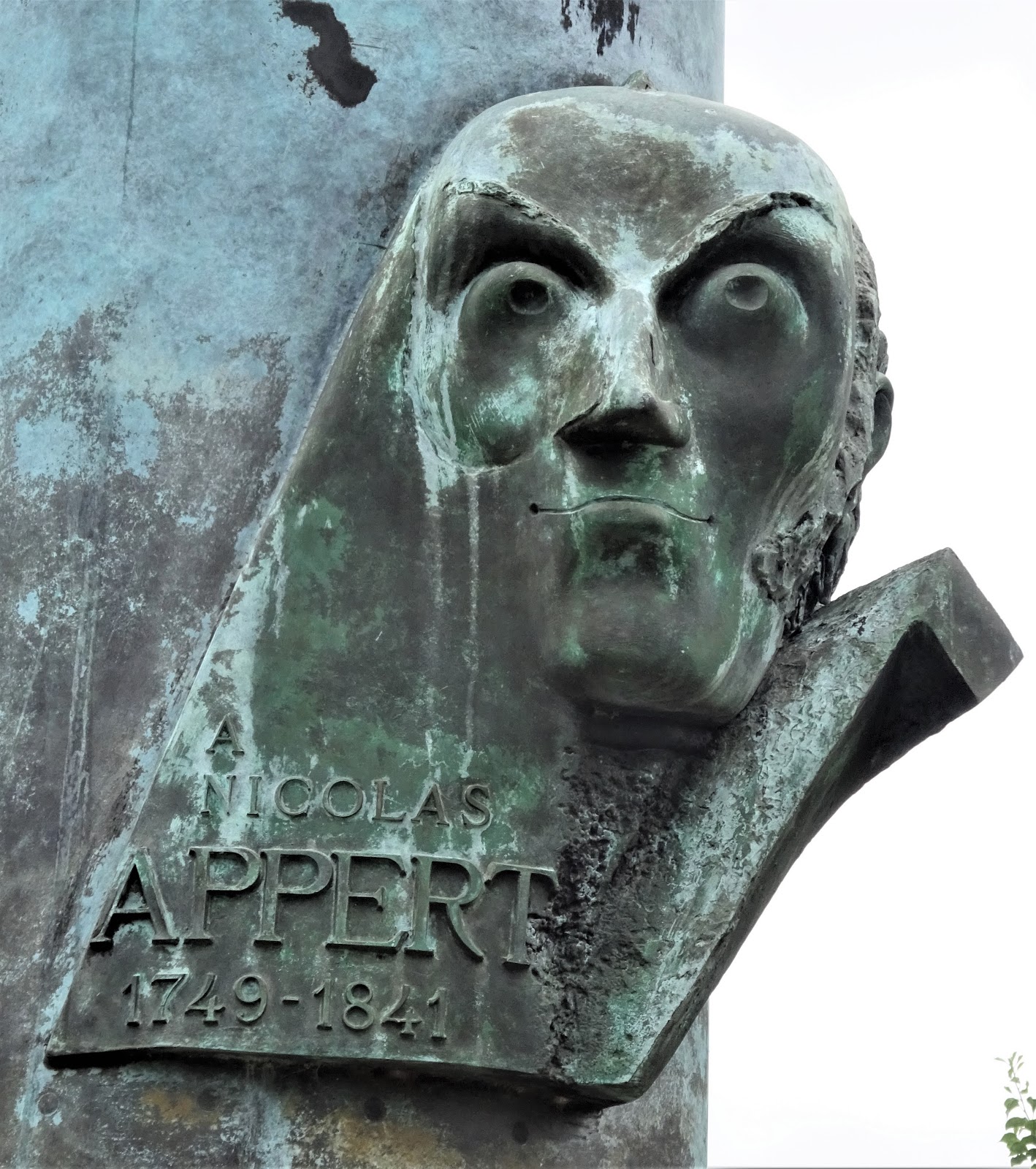
Nicolas Appert in Châlons-en-Champagne, Marne (51)
Continuing his experiments he from 1815 became the initiator of techniques for conserving wines and milk, later perfected by fermentation by Louis Pasteur. Several times Appert was acknowledged by the Société d'Encouragement pour l'Industrie nationale, although his techniques were advanced by English developers of his technique without any compensation/recognition for Appert and he was buried in an ossuary in 1841.
This monument was erected in 2009.