12 August 2020

Boîtes à lire in Dijon, (Côte-d'Or (21))

Three Boîtes à lire (of 49!) here in Dijon (called Boîtes à livres in both French and Braille!). Disappointingly, both the first (in a way out-of-the-way spot in the Jardin de l'Arquebuse) and the second (in the bustling Place de République) had almost no books: people collecting, or lack of interest? Who can tell, but the third had a quite a number. I was devastated that neither Gibert Joseph nor Fnac in the town had a copy of the brilliant Éric Chevillard's latest Minuit novel Monotobio, I mean, the guy lives here: very quietly, almost in secret, but everyone knows! Or not. I digress.

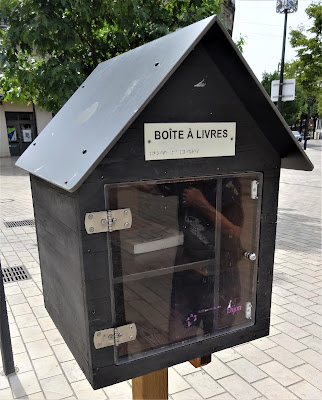

So, Dijon encourages reading, and to prove it this Boîte à lire is just one of the 49 in the town itself and the outskirts. OK, I'd come across one weird one which was locked up (Varennes-le-Grand) due to Covid-19, but this is the first one with a warning I'd encountered. It advises taking all precautionary measures: the wearing of gloves and the washing of hands when books are either left or taken, and to put any books taken 'in quarantine' between five and eight days. No comment.

Glyptodon in Dijon, (Côte-d'Or (21))

The glyptodon (same word in French) is no longer extant, although it was a herbivorous mammal which appeared in South America about 1.8 million years ago, and became extinct about 11,500 years ago. Its carapace consisted of thousands of bony plates, obviously important to its protection. Its head and tail also consisted of bony substances. It weighed more than a tonne and its closest existing neighbour is the armadillo.

This specimen is in fact the star of Dijon's Muséum d'histoire naturelle. It was Léonard Nodot (1802-59) who founded the museum and was its first director. Vice-admiral Dupotet had brought back 2000 skeletal fragments of the animal from South America, left them to the town of Dijon, and Nodot patiently reconstructed the glyptodon from what there was. This was at a time when very little was known of the glyptodon by naturalists and Nodot's work was to be of great help to researchers.

Éric Chevillard is much concerned with self-protection, particularly in the non-human animal kingdom (analogies, of course), and his novel Démolir Nisard | Demolishing Nisard (2006) is where I first learned of the (former) existence of the glyptodon. In this novel the narrator's hatred for Désiré Nisard slightly gives way to his appreciation of Nodot. As I say in that post:

'There is a positive to the negative, and as Nisard is 'demolished', then the narrator suggests that Léonard Nodot, the founder of the Muséum d'histoire naturelle in Dijon (where Chevillard lives) should be 'resurrected'. The narrator particularly enjoys visiting the museum to see the 'resurrection' of the prehistoric gigantic armadillo there, the glyptodon.'


11 August 2020

Désiré Nisard in Châtillon-sur-Seine (Côte-d'Or (21))

The bronze bust of the writer and critic Désiré Nisard (1806-88) in Châtillon-sur-Seine (where he was born) is by Pech, and the medallions of his brothers Charles (a philologist, publisher and translator (1808-89)) and Auguste (an academic (1809-92)) are by Pech and Drouet. Désiré also has a street named after him, although he figures in none of the usual information by the Bureau de tourisme. (As I've not mentioned anything about Désiré, see my post on Éric Chevillard's novel Démolir Nisard!). Paradoxically, Nisard had been long forgotten until Chevillard came along.


Black Redstart, Montbard, (Côte-d'Or (21))

A slightly blurred black redstart at Montbard, close to where Buffon is buried.

6 August 2020

Ancient house in Bâgé-le-Châtel, Ain (01))

This ancient house in Rue Ratelet has undergone many transformations throughout the centuries, although its impressiveness is indisputable. The blanched appearance is due to the fact that I took this photo at a withering temperature of well over forty degrees, with the sun pouring its light over the house.

Murals in Bâgé-le-Châtel, Ain (01))


Apparently anonymous murals at the corner of Rue Ratelat and Rue Marsale.

Boîte à Lire in Bâgé-le-Châtel, Ain (01))

This Boîte à lire in Bâgé-le-Châtel (actually called a Cabane à livres) didn't prove fruitful for me in any way,  but I applaud the existence of these wonderful structures, which have introduced me to so many books (and some authors) I'd not heard of. If only these tiny free bookshops could exist elsewhere and spread knowledge without mindless commerce.

Boîte à Lire in Sornay (Saône-et-Loire (71))

A rather stylish Boîte à lire (here called a Boîte à Livres) in rather unstylish surroundings: at the side of the public toilets. But anywhere is better than nowhere!

5 August 2020

Ferdinand Berthier in Louhans Châteaurenard (Saône-et-Loire (71))

Ferdinand Berthier (1803-86), born in Louhans, was (surely very oddly) nicknamed 'The Napoleon of the deaf-mutes', and became deaf at the age of four. He was the first deaf member of the Chevalier de la Légion d'honneur, the founder of the Association de sourds et muets, and became teacher at the Institut national des Sourds et muets in Paris. All his life was devoted to promoting the use of sign language and the civil rights of deaf people.


L'Abbé Guichelet in Pont-de-Vaux (Ain (01))

L'Abbé Guichelet (1736-1823) was born and died in Pont-de-Vaux and is famed for the collection of fables in verse that he wrote.

Léonard Racle in Pont-de-Vaux (Ain (01))

Léonard Racle (1736-1791) is listed in his French Wikipédia entry as an engineer, architect and potter, although the present exhibition leaflet of him at Pont-de-Vaux, where he died, also says that he was a cartographer, entrepreneur, mathematician, geometrician and tiler. He is most well known as an architect, in particular for adding two wings to Voltaire's château in 1765 in what is now Ferney-Voltaire. He also paved the streets of Ferney. Later, after Voltaire's death in 1778, he set about constructing the Canal de Pont-de-Vaux. He built this house, now a Monument Historique, in 1785.


4 August 2020

Antoine Chintreuil in Pont-de-Vaux (Ain (01))

Antoine Chintreuil (1814-73) was born in Pont-de-Vaux and died in Septeuil. He was a landscape artist from a father (Georges) who was a hat maker and haberdasher and a mother (Suzanne) who opened a small girls's school in Pont-de-Vaux and who gave Antoine his early education before he joined the Collège de Pont-de-Vaux. An old friend of the family gave him art lessons.

Chintreuil has been called one of the precursors to the Impressionists and a museum which bears his name is in Pont-de-Vaux.


Tonino Benacquista and the sense of smell, Chalon-sur-Saône (Saône-et-Loire (71))

 
In a shop selling spices in Chalon-sur-Saône is a quotation from novelist Tonino Benacquista, in which he states that the sense of smell has much more memory than any of the other senses, having the power to bring back the past in a truly remarkable way. It's a perceptive comment of course, although it forgets or is unaware of the fact that many people don't have a sense of smell.

3 August 2020

François Chabas, Chalon-sur-Saône (Saône-et-Loire (71))

François Joseph Chabas (1817-82) was, as should be clear from this photo, an Egyptologist. He was from modest origins and taught himself Latin and Greek among other languages, in particular ancient Egyptian. He published about fifty scientific works during his life, and was the first person to decipher the Prisse papyrus. From 1876 to 1880 he published the journal L'Égyptologie.

2 August 2020

Nicéphore Niépce, Chalon-sur-Saône (Saône-et-Loire (71))

The statue by Eugène Guillaume in 1885, in Chalon-sur-Saône, in memory of Nicéphore Niépce (1765-1833), the inventor of photography, in the town where he was born. Also the plaque on Niépce's nearby birthplace, in 15 rue de l'Oratoire just off rue au Change. The photography museum Nicéphore Niépce is in the former Hôtel des messageries.


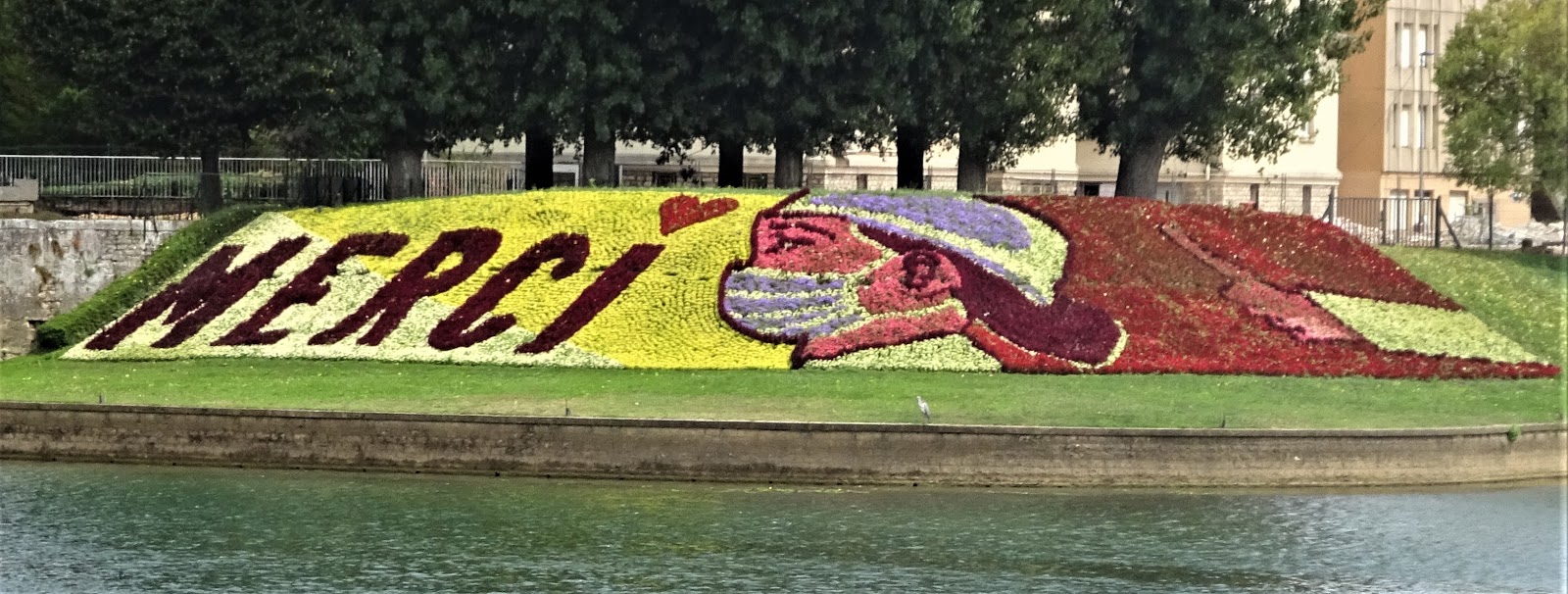
Floral tribute, Chalon-sur-Saône (Saône-et-Loire (71))

The floral tribute in Chalon-sur-Saône to those who respect the wearing of the mask.

Frère Roger (Roger Schultz) in Taizé (Saône-et-Loire (71))

Frère Roger (1915-2005), Roger Schultz by his full name, was born in Switzerland. In 1940, when he was 25, he decided to go to occupied France: from Geneva on a bicycle. He was warmly welcomed in tiny Taizé, where he stayed. At the beginning of the war, he welcomed dozens of Jews with his sister Geneviève. Returning to Switzerland in 1942, he learned that he had been denounced: return to Taizé wasn't possible. On Liberation in 1944 he returned and helped German POWs. Over the years he developed a community in Taizé, vowed to a life of chastity. Originally Protestant but increasingly turning towards Catholicism, Frère Roger is buried in the Église Saint-Marie-Madeleine in Taizé, along with other members of the church.


1 August 2020

Charles Dorel in Sennecé-lès-Mâcon (Saône-et-Loire (71))


The peasant Charles Dorel is said to have been imprisoned here in the tower at Sennecé-lès-Mâcon by the Marquis de Gorge in 1788 at the time of the French revolution. This is the only remaining part of the château in the village. Serge Renoud-Lyat has the manuscript of the story, has met the director Guillaume Main and the novelists Albine Novarino-Pothier and Béatrice Mandopoulos. In January a novel and a film were being prepared, along with a theatrical project.

These ideas were being made at the beginning of the year, although on 30 July this year the Journal de Saône-et-Loire announced that the Théâtre pour l'espoir envisage putting on a five-act play based on the original manuscript in 2021. It is seeking support and its ideal would be to put on the play in front of the tower: from there, who knows? The organisation encourages handicapped players or those working behind the scenes.

31 July 2020

Cuisery, the Book Village (Saône-et-Loire (71))


In 1999 Cuisery became the fourth Village du Livre in France: the idea was to bring fresh life back to the village and revive the number of shops in the centre which had been closed. The central street is La Grande Rue, which now boasts a number of bookshops, and every first Sunday in the month the village boasts a book fair. Coming in from Tournus, the visitor is greeted by a floral display which enhances the poem written by an anonymous member of the village. At the beginning of La Grande Rue stand two enormous books: Hugo's La Légende des siècles and the imaginary Aux portes de l'an 2000.

Désiré Barodet in Cuisery (Saône-et-Loire (71))


In this building the teacher Désiré Barodet (1823-1906) created the first non-religious school in 1849, and Jules Ferry's laws were inspired by Barodet. He was a free thinker with progressive ideas and became the mayor of Lyon, député in 1873 and sénateur in 1896. He retired first to Cuisery and then the Jura, where he died.

30 July 2020

Oven and Well, La Planche (Saône-et-Loire (71))


Laizé-Blany communal oven (now working) and its well covered, this represents two years work and 2200 hours put in by the 'Laizé-Blany culturelle et patrimoine' association.