24 July 2020
La Roche de Solutré, Solutré-Pouilly (Saône-et-Loire (71))
On the calcareous slopes of Solutré-Pouilly, just above the vineyards, is La Roche de Solutré, one of the most well-known sights in Saône-et-Loire. Wines produced in this area include Pouilly-Fuissé, Saint-Véran et Mâcon-villages. In 1866 the geologists Henry Testot-Ferry and Adrien Arcelin found thousands of bones of horses, bison and mamouths at the foot of the Roche. Today, understandably, this is quite an attraction, if not the easiest of places to negotiate.
23 July 2020
Danielle Mitterrand in Cluny (Saône-et-Loire (71))
Danielle Mitterrand (1924-2011), née Gouze, was the wife of François Mitterrand, President of France from 1981 to 1995. She established the Fondation Danielle-Mitterrand - France Libertés for the defence of human rights in 1985. She wrote several books, of which her autobiographical Le Livre de ma mémoire (2007) is the most well known, and she is buried with elder sister Christine Gouze-Rénal in Cluny cemetery.
Georgette Gauthier in Cluny (Saône-et-Loire (71))
Libellés :
Cluny (71),
Gauthier (Georgette),
Saône-et-Loire (71)
Georgette Gauthier (1902-75) was from Cluny, and the plaque on her house gives a quotation from what is obviously a poem of hers. But neither the BNP nor BookFinder list any books of hers. In fact the only information I can find about her comes from AMAAC (Amis du musée d’art et d’archéologie de Cluny), which – to celebrate the twenty-fifth anniversary of its existence last year – organised an exhibition of information on twenty-five people associated with Cluny, and of course Gauthier is one of them. From the information given, we learn that Gauthier's father was a well-known plasterer in the town, that the family lived on rue Filaterie, in the house where Georgette would spend her whole life. She was very interested in literature, particularly in poetry, and Léon Declin – a friend of her father's – encouraged her in this pursuit.
Lamartine's poetry was constantly with her, and she spent whole nights reciting his poetry. Her grandmother told her stories from her own grandmother, in which it was said that Lamartine came to shoe his horse in Cluny and stopped off at the Café de la Paix. We also learn that she wrote for the paper La Bourgogne d'Or, and that her poetry was often humorous.
For most of her life she kept a journal, which contained her thoughts and comments on local activities. She had a great unknown love, although she merely calls him 'Jean'. She was also close to the Gadzarts, who apparently published a collection of her poems: 'Chants inutiles'. She died of flu in a convalescent home at the age of 73.
Roger Vailland in Meillonnas (Ain (01))
Libellés :
Ain (01),
Meillonnas (01),
Vailland (Roger)
Roger Vailland (1907-65), who won the Goncourt with La Loi in 1957, lived in Meillonnas with his wife Elisabeth from 1954 to 1965. The notice outside his house calls him one of the important figures of surrealism, the Resistance, communism and literature. The house they lived in is now called 'Rue Roger Vailland'. His grave is in the local cemetery and is almost anonymous, inundated by vegetation.
Guétali in Meillonnas (Ain (01))
Libellés :
Ain (01),
Guétali,
Meillonnas (01)
This pavilion is usually found not in France but on the island of Réunion in the Pacific. It's a guétali, which in creole means 'Regarde-le' ('Look at it' (or him)). It used to stand elsewhere in the village but was moved as it was disturbing traffic. What seems to be missing here is what this structure, which allows people to see out without others seeing in, is doing in Meillonnas.
22 July 2020
Frescoes in Meillonnas (Ain (01))
Libellés :
Ain (01),
Meillonnas (01)
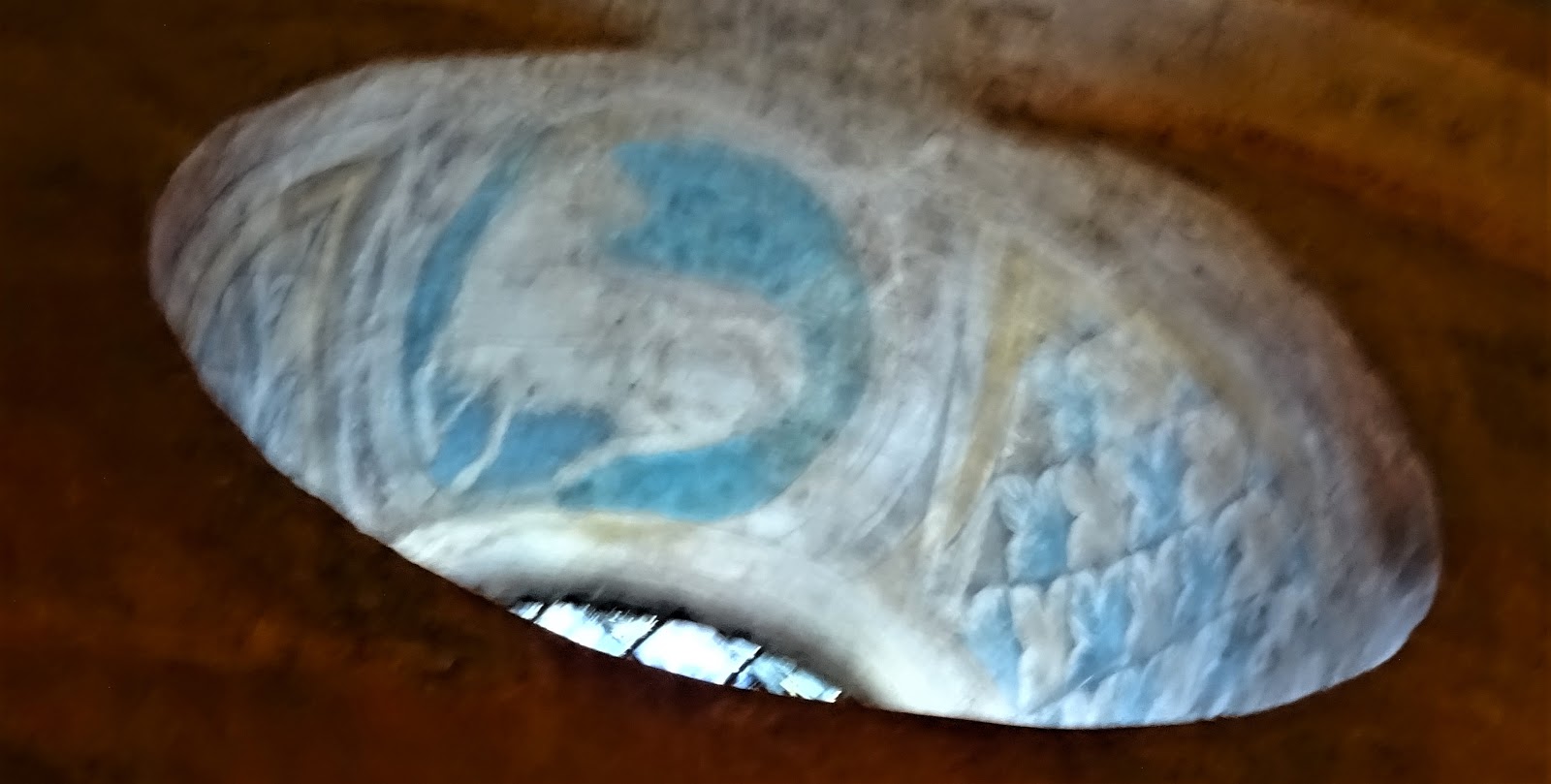
With the Chapelle Saint-Esprit, the Chapelle Notre-Dame is the oldest part of L'Église St Oyen, dating from the 13th and 14th centuries. The curé Charvet discovered the frescoes in the chapels on 1897, whose style, themes and techniques evoke the Italian Renaissance. The Chapelle Notre-Dame has by far the most well preserved frescoes, photos of which I show below.
Frédéric Dard/San-Antonio in Bourgoin-Jallieu (Isère (38))
Libellés :
Bourgoin-Jallieu (38),
Dard (Frédéric),
Isère (38),
San-Antonio
75 rue de la Liberation, where Frédéric Dard was born.
And, shut up at the time of our visit, the San Antonio café close to the house of Dard's birth, which opened in Dard's lifetime.
And finally the wonderful (and wonderfully named) sculpture Objet Dard (2003) by Bertrand Lavier, which is in the centre of town at the end of avenue Frédéric Dard. On the monument the 175 San Antonio books by Dard are named.
Frédéric Dard/San-Antonio in Saint-Chef (Isère (38))
Libellés :
Dard (Frédéric),
Isère (38),
Saint-Chef (38),
San-Antonio
Frédéric Dard (1921-2000), the writer of many gloriously far-fetched policiers crammed full of slang (some words invented by Dard himself) spent part of his childhood in Saint-Chef in the département of Isère, a place near to his heart and where he is buried. He was also known as San-Antonio after the cop he created.
The school where Dard was a pupil is now private premises, but this plaque remembers him today in what is now Place Frédéric Dard.
A part of the village museum is also dedicated to the writer.
The school where Dard was a pupil is now private premises, but this plaque remembers him today in what is now Place Frédéric Dard.
A part of the village museum is also dedicated to the writer.
'FRÉDÉRIC DARD
DIT SAN-ANTONIO
1921 - 2000'
21 July 2020
Marius Riolet in Saint-Chef (Isère (38))
Libellés :
Isère (38),
Riollet (Marius),
Saint-Chef (38)
Yes, Saint-Chef has another writer, although nowhere near as well-known as the village's very famous son (posts to come shortly). Marius Riolet (1889-62) was a novelist, playwright and historian who was born in Saint-Chef and died in Geneva. His novel La fin du monde won the Prix Émile-Augier in 1961.
Boîte à lire, Bissy-sur-Fley (71), Saône-et-Loire (71)
Libellés :
Bissy-sur-Fley (71),
Boîte à lire,
Saône-et-Loire (71)
Tucked away in a corner of Bissy is this this rather cute Boîte à lire next to the letter box, where I got rid of the French books I'd read and didn't want to keep, and picked up a book by the fascinating sculptor and author Roland Topor, most known for his eerie Le Locataire chimère (translated as The Chimerical Lodger).
20 July 2020
Pontus de Tyard in Bissy-sur-Fley (Saône-et-Loire (71))
Libellés :
Bissy-sur-Fley (71),
Pontus de Tyard,
Saône-et-Loire (71)
Pontus de Tyard (1521-1605) was a poet, musician, philosopher, theologian and bishop of Chalons-sur-Saône during the wars of religion. As a poet he was one of the Lyon school encouraged of Maurice Scève, and also a member of Ronsard's Pléiade: Ronsard sang his praises in his verses.
The works of Pontus de Tyard.
From the vineyard, the Château de Pontus de Tyard. The Château itself:
Subscribe to:
Posts (Atom)