
16 March 2020
Promenade Littéraire #10: George Limbour, Le Havre, Seine-Maritime (76)
Libellés :
Le Havre (76),
Limbour (Georges),
Seine-Maritime (76)


Promenade Littéraire #9: Various Writers, Le Havre, Seine-Maritime (76)
Libellés :
Le Havre (76),
Seine-Maritime (76)

#9, various writers, Rue de Paris. This is one of the principal streets in Le Havre, and is mentioned by a number of writers, among them Maupassant in Pierre et Jean (1888), Céline in Voyou Paul. Brave Virginie (1959), Georges Simenon in Le Bilan Malétras (1948).
Promenade Littéraire #7: Stendhal, Le Havre, Seine-Maritime (76)
Libellés :
Le Havre (76),
Seine-Maritime (76),
Stendhal

15 March 2020
Promenade Littéraire #6: Louis-Ferdinard Céline, Le Havre, Seine-Maritime (76)
Libellés :
Céline (Louis-Ferdinand),
Le Havre (76),
Seine-Maritime (76)

#6, Louis-Ferdinard Céline (1894-1961), Boulevard Clemenceau. Céline wrote a part of his novel Mort à crédit in the former Hôtel Frascati. In this book Auguste, inspired by Céline's father, comes from Le Havre and has a passion for boats.
We couldn't find the fifth bench on Boulevard Clemenceau, dedicated to Guy de Maupassant (1850-1893) who set his novel Pierre et Jean in Le Havre.
12 March 2020
Promenade Littéraire #4: Jean-Paul Sartre, Le Havre, Seine-Maritime (76)
Libellés :
Le Havre (76),
Sartre (Jean-Paul),
Seine-Maritime (76)

Promenade Littéraire #3: Benoît Duteurtre, Le Havre, Seine-Maritime (76)
Libellés :
Duteurtre (Benoît),
Le Havre (76),
Seine-Maritime (76)

Promenade Littéraire #2: Gustave Flaubert, Le Havre, Seine-Maritime (76)
Libellés :
Flaubert (Gustave),
Le Havre (76),
Seine-Maritime (76)

Promenade Littéraire #1: Armand Salacrou, Le Havre, Seine-Maritime (76)
Libellés :
Le Havre (76),
Salacrou (Armand),
Seine-Maritime (76)
Throughout Le Havre there are twenty benches, part of the Promenade Littéraire (an expression displayed on the top left of each bench). Each bench has its number, and in the central area between the two seats are the details of a writer (occasionally number of writers) associated with the area, including a quotation. We found nineteen of these benches: on two occasions we tried to find the bench of Guy de Maupassant (#5) on the Boulevard Clemenceau, but with no success. We begin the literary walk with #1, on Boulevard Albert 1er.

 I took this rather eccentric shot of #1, the dramatist Armand Salacrou (1899-1989), to avoid the ugliness of the car behind the bench. This is opposite Salacrou's Villa Maritime, built by George Dufayel. The quotation given is from Salacrou's Dans la salle des pas perdus (1974). Many writers have mentioned the villa.


11 March 2020
L'Église St Joseph and Auguste Perret, Le Havre, Seine-Maritime (76)
Libellés :
Le Havre (76),
Perret (Auguste),
Seine-Maritime (76)
L'Église St Joseph was built after the destruction of the third church of the same name after the bombardments of the Second World War by the rebuilder of Le Havre, Auguste Perret. Perret wanted this to be not just a reconstruction but a spiritual lighthouse, a monument to the memory of those who died in the war. The concrete church took from October 1951 to October 1957 to be built, and Perret needed a woman to be responsible for designing the immense number of glass lights: that woman was Marguerite Huré, and L'Église St Joseph is a splendour to see. The actual ground space is small, but the height is dizzying.


Robert (Le Minihy) de La Villehervé, Le Havre, Seine-Maritime (76)

9 March 2020
Le Cimetière de Sainte-Marie, Le Havre, Seine-Maritime (76): #3: Émile Renouf
Libellés :
Le Havre (76),
Renouf (Émile),
Seine-Maritime (76)
Émile Renouf (1845-94), although born in Paris and spending some years in Honfleur, made Le Havre the centre of his studies as an artist and his work there. His grave has suffered much, and used to have a bust of the painter by G. Bénard.


Le Cimetière de Sainte-Marie, Le Havre, Seine-Maritime (76): #2: Adolphe d'Houdetot
Libellés :
Houdetot (d'Adolphe),
Le Havre (76),
Seine-Maritime (76)
Adolphe d'Houdetot (1799-1869) is mainly an author of works on hunting. Enough said.


Le Cimetière de Sainte-Marie, Le Havre, Seine-Maritime (76): #1: Octave Crémazie
Libellés :
Crémazie (Octave),
Le Havre (76),
Seine-Maritime (76)
Octave Crémazie (1827-79) is undoubtedly an important poet from the Canadian province of Québec. The bookshop his brother Joseph founded in 1833 was much enhanced by Octave's literary knowledge, and was for a time very notable in Québec city. On the note by his cenotaph in le cimetière Sainte-Marie we don't exactly get the full story: it says that the bookshop failed, that Crémazie went to France in exile in 1862 under the assumed name Jules Fontaine, but not that the bookshop failed largely due to Crémazie's wild extravangances, nor that he fled from Canada due to his fraudulent activities. In France he lived in poverty and died in Le Havre but was buried in obscure Ingouville with just a wooden cross as a grave. This cenotaph is the real tribute to his work.


L'Escalier de Montmorency, Le Havre, Seine-Maritime (76)
Libellés :
Le Havre (76),
Seine-Maritime (76)
L'Escalier de Montmorency (which has 266 steps) is probably one of the best known sets of steps linking the upper part of the town to the lower: one of the ninety stairways in Le Havre. Near the top of the stairs is a bus stop named 'Escalier Roulant' after the lift that was once there. The moving staircase became financially unworkable and was closed down in 1987. Just over a year ago colour was added to it by the locals.

 About halfway up I couldn't resist taking a shot of this piece of graffiti: 'MACRON CASSE TOI PAUVRE CON'. This in fact refers, famously, to Nicolas Sarkovsky using exactly the same phrase ('Casse-toi pauvre con') to someone who refused to shake his hand, and roughly means something like 'Macron, piss off you sad prat.' But then, I think that says far more about Sarko than the guy who merely refused to shake his hand.


La Colline aux oiseaux, La Folie Couvrechef, Caen, Calvados (14)
La Colline aux oiseaux is a park in La Folie Couvrechef in Caen created in the 1990s from what began as a refuse tip in the 1920s, and has some quite remarkable features, including a panoramic view of Caen.


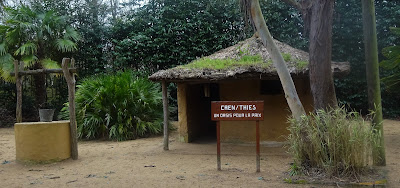


The bird was constructed in 2017 by Claude Yann after a design by Yvonne Guégan.
Boîte à lire, La Folie Couvrechef, Caen, Calvados (14)

Boîtes à lire:
––––––––––––––––––––––––––––––––––––
Boîte à Lire, Dicy, Nièvre
Boîte à lire, Maisons-Laffitte, Yvelines
Boîte à lire, Sorigny, Indre-et-Loire
Boîte à Lire, Jonzac, Charente-Maritime
Boîte à lire, La Roque-d'Anthéron, Bouches-du-Rhône
Boîte à Lire, Épineuil-le-Fleuriel, Cher
Boîte à lire, Marseille, Bouches-du-Rhône
Boîte à lire, East Markham, UK
Boîte à lire, La Folie Couvrechef, Caen, Calvados
Boîte à lire, Bergues, Nord
Boîte à lire, Le Havre, Seine-Maritime
Boîte à lire, Villerville, Calvados
Boîte à lire, Saint-Servan, Saint-Malo, Ille-et-Vilaine
Boîte à lire in Caen, Calvados
Boîte à Lire, Noyant d'Allier, Allier
Boîte à lire, Dampierre-en-Burly, Loiret
Boîte à lire, Illiers-Combray, Eure-et-Loir
Boîte à lire, Chartres, Eure-et-Loir
Boîte à lire, Saint-Romain-au-Mont-d'Or, Rhône
8 March 2020
Musée de la Luna Rossa (revisited), Caen, Calvados (14)
Libellés :
Art brut,
Caen (14),
Calvados (14)
Last September I took a few shots of the Musée de la Luna Rossa, although because it's only open at limited times (on Sundays from 1 April) I had to aim my camera high and hope for the best. Unfortunately there was very little to see because of the abundant foliage. It isn't open at the moment either, but because of the time of year I was able to get better pictures:


 And a magnificent cockerel kept turning up, obviously interested in what I was doing.
Art brut (Outsider Art) and associated:
––––––––––––––––––––––––––––––––––––
Rémy Callot, Carvin (Nord)
Carine Fol (ed.): L'Art brut en question | Outsider Art in Question
Kevin Duffy, Ashton-in-Makerfield
The Art Brut of Léopold Truc, Cabrières d'Avignon (34)
Le Musée Extraordinaire de Georges Mazoyer, Ansouis (34)
Le Facteur Cheval's Palais Idéal, Hauterives (26)
The Little Chapel, Guernsey
Museum of Appalachia, Norris, Clinton, Tennessee
Ed Leedskalnin in Homestead, Florida
La Fabuloserie, Dicy, Yonne (89)
Street Art City, Lurcy-Lévis, Allier (03)
The Outsider Art of Jean Linard, Neuvy-deux-Clochers (18)
Jean Bertholle, La Fabuloserie, Yonne (89)
Jean-Pierre Schetz, La Fabuloserie, Yonne (89)
Jules Damloup, La Fabuloserie, Yonne (89)
Camille Vidal, La Fabuloserie, Yonne (89)
Pascal Verbena, La Fabuloserie, Yonne (89)
The Art of Theodore Major
Edward Gorey's Yarmouth Port, Cape Cod, MA
Marcel Vinsard in Pontcharra, Isère (38)
Vincent Capt: Écrivainer : La langue morcelée de Samuel Daiber
The Amazing World of Danielle Jacqui, Roquevaire (13)
Alphonse Gurlie, Maisonneuve (07)
Univers du poète ferrailleur, Lizio, Morbihan
Les Rochers sculptés de L'Abbé Fouré, Rothéneuf, Saint-Malo
Robert Tatin in Cossé-le-Vivien, Mayenne
René Raoul's Jardin de pierre in Pléhédel, Côtes d'Armor
La Demeure du Chaos, Saint-Romain-au-Mont-d'Or, Rhône (69)
Emmanuel Arredondo in Varennes Vauzelles, Nièvre (58)
Musée de la Luna Rossa (revisited), Caen, Calvados (14)
La Fontaine de Château-Chinon, Nièvre (58)


Art brut (Outsider Art) and associated:
––––––––––––––––––––––––––––––––––––
Rémy Callot, Carvin (Nord)
Carine Fol (ed.): L'Art brut en question | Outsider Art in Question
Kevin Duffy, Ashton-in-Makerfield
The Art Brut of Léopold Truc, Cabrières d'Avignon (34)
Le Musée Extraordinaire de Georges Mazoyer, Ansouis (34)
Le Facteur Cheval's Palais Idéal, Hauterives (26)
The Little Chapel, Guernsey
Museum of Appalachia, Norris, Clinton, Tennessee
Ed Leedskalnin in Homestead, Florida
La Fabuloserie, Dicy, Yonne (89)
Street Art City, Lurcy-Lévis, Allier (03)
The Outsider Art of Jean Linard, Neuvy-deux-Clochers (18)
Jean Bertholle, La Fabuloserie, Yonne (89)
Jean-Pierre Schetz, La Fabuloserie, Yonne (89)
Jules Damloup, La Fabuloserie, Yonne (89)
Camille Vidal, La Fabuloserie, Yonne (89)
Pascal Verbena, La Fabuloserie, Yonne (89)
The Art of Theodore Major
Edward Gorey's Yarmouth Port, Cape Cod, MA
Marcel Vinsard in Pontcharra, Isère (38)
Vincent Capt: Écrivainer : La langue morcelée de Samuel Daiber
The Amazing World of Danielle Jacqui, Roquevaire (13)
Alphonse Gurlie, Maisonneuve (07)
Univers du poète ferrailleur, Lizio, Morbihan
Les Rochers sculptés de L'Abbé Fouré, Rothéneuf, Saint-Malo
Robert Tatin in Cossé-le-Vivien, Mayenne
René Raoul's Jardin de pierre in Pléhédel, Côtes d'Armor
La Demeure du Chaos, Saint-Romain-au-Mont-d'Or, Rhône (69)
Emmanuel Arredondo in Varennes Vauzelles, Nièvre (58)
Musée de la Luna Rossa (revisited), Caen, Calvados (14)
La Fontaine de Château-Chinon, Nièvre (58)
7 March 2020
Joep Van Lieshout's La Caravane in Caen, Calvados (14)
Libellés :
Caen (14),
Calvados (14),
Van Lieshout (Joep)
La Caravane, by Dutch sculptor Joep Van Lieshout, caused some negative reactions on its installation in La Place Saint-Sauveur in Caen. It cost 204,000 euros (two thirds financed by the town) and some people found it not to their taste, although this of course is art, and as Van Lieshout noted: 'The worse thing would be indifference.' Quite. Emotion in time of crisis is the representation, the Great War, D Day. Mayor Philippe Duron saw the scultures as a comment from the people in front of the huge statue of Louis XIV, touchable sculptures, far removed from the aristocratic representation.


6 March 2020
Un singe en hiver, Villerville, Calvados (14)
Libellés :
Calvados (14),
Villerville (14)
As Sainte-Sévère-sur-Indre is in many ways synonymous with Jacques Tati's film Jour de Fête, or Bergues is with Dany Boon's Bienvenue chez les Ch'tis, so Villerville is with Henri Verneuil's Un singe en hiver. The unforgettable (and only) pairing of Jean-Paul Belmondo with Jean Gabin is electric, and even today (a cold one) there were people here looking for the obvious spots where the film took place, made easier by posts bearing photos of the film and quotations from the screenplay by Michel Audiard. This is such an enormous cult movie that a huge number of people remember the whole script by heart.


Just as you enter Villerville, this movie still greets you.

Obviously the 'bull-fighting' scenes by Belmondo, echoing the games played with cars by Antoine Blondin on the Boulevard Saint-Germain, are more of less impossible to pinpoint geographically.


The scene on the steps of the Gendarmerie Nationale.
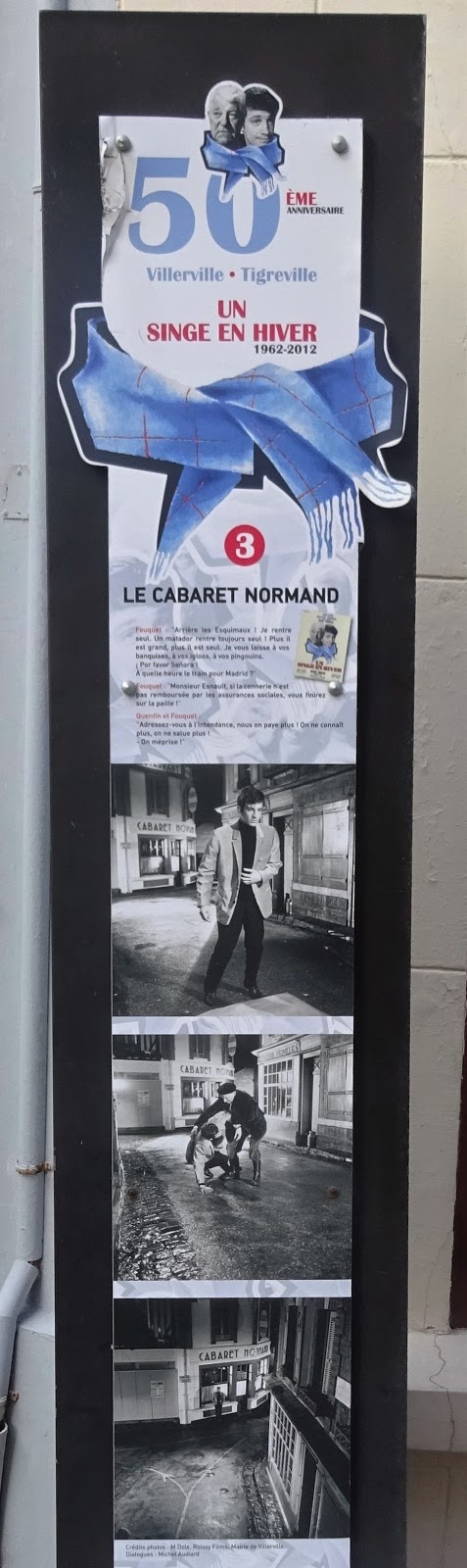

The (at the moment closed) Cabaret Normand, where Belmondo famously got pissed on Picon beer, danced a flamenco (with a real flamenco dancer posing as his legs), told the customers to get to their igloos, etc, and was thrown onto the street. This bar is obviously the main point of interest.


Well, your husband may still be obsessed with China, but with me it's Spain.
Subscribe to:
Posts (Atom)


 Posts
All Comments
Posts
All Comments