30 April 2017

Victor Hugo's Hauteville House, St Peter Port, Guernsey

Hauteville House, St Peter Port, Guernsey, the Channel Island where Victor Hugo lived in exile between 1855 and 1870. Exile is written throughout the house, where Hugo installed a collection of his findings, making this a treasure trove, indeed a museum, where he wrote and drew, carved out the names of great authors, welcomed the poor and fed them, and above all wrote many of his great works from his 'look-out'. It has belonged to the city of Paris since 1927.

Hauteville House from the back garden.


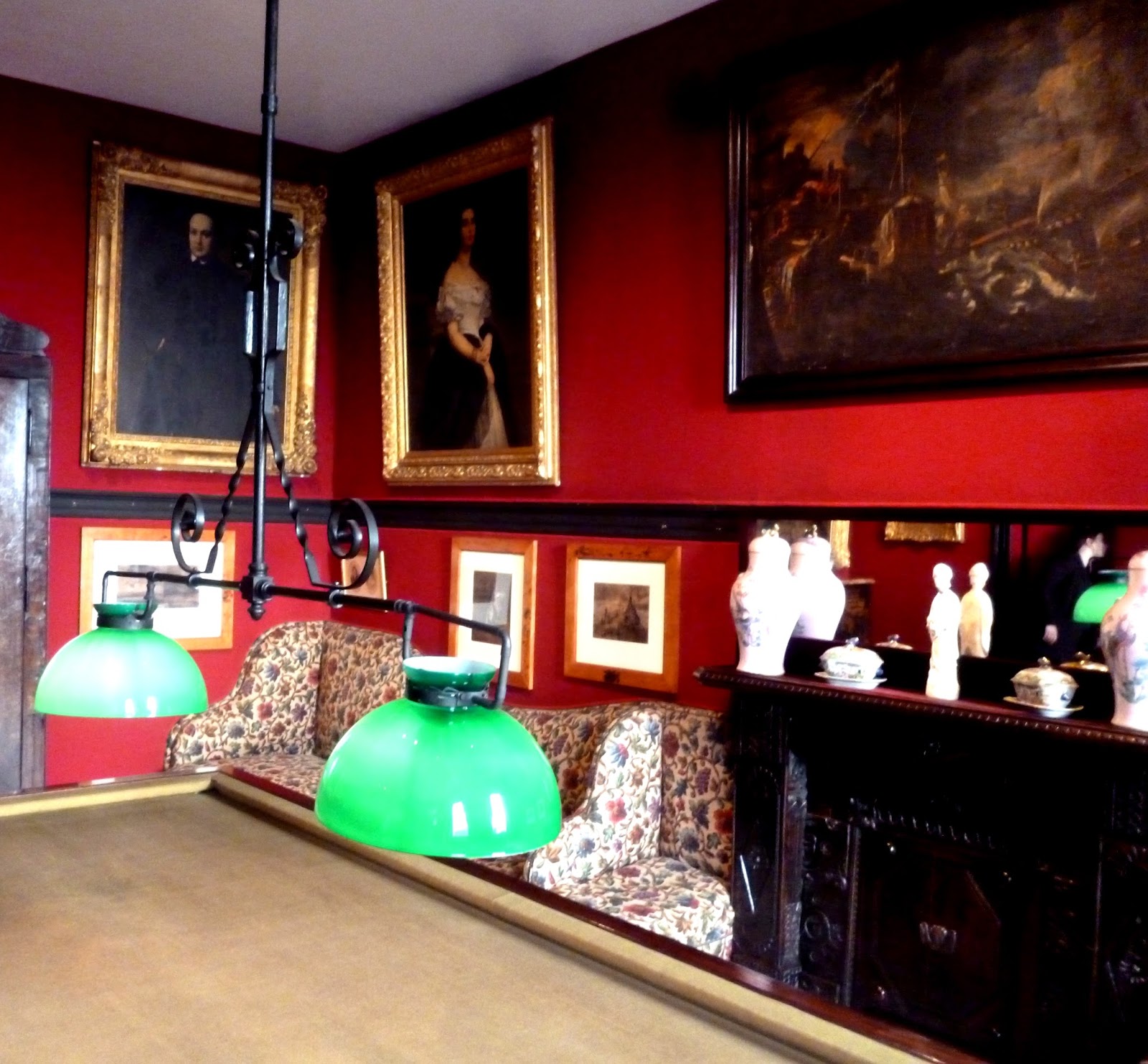
The billards room.

Shakespeare's name is misspelt.


Hugo's dark room.


The red room.


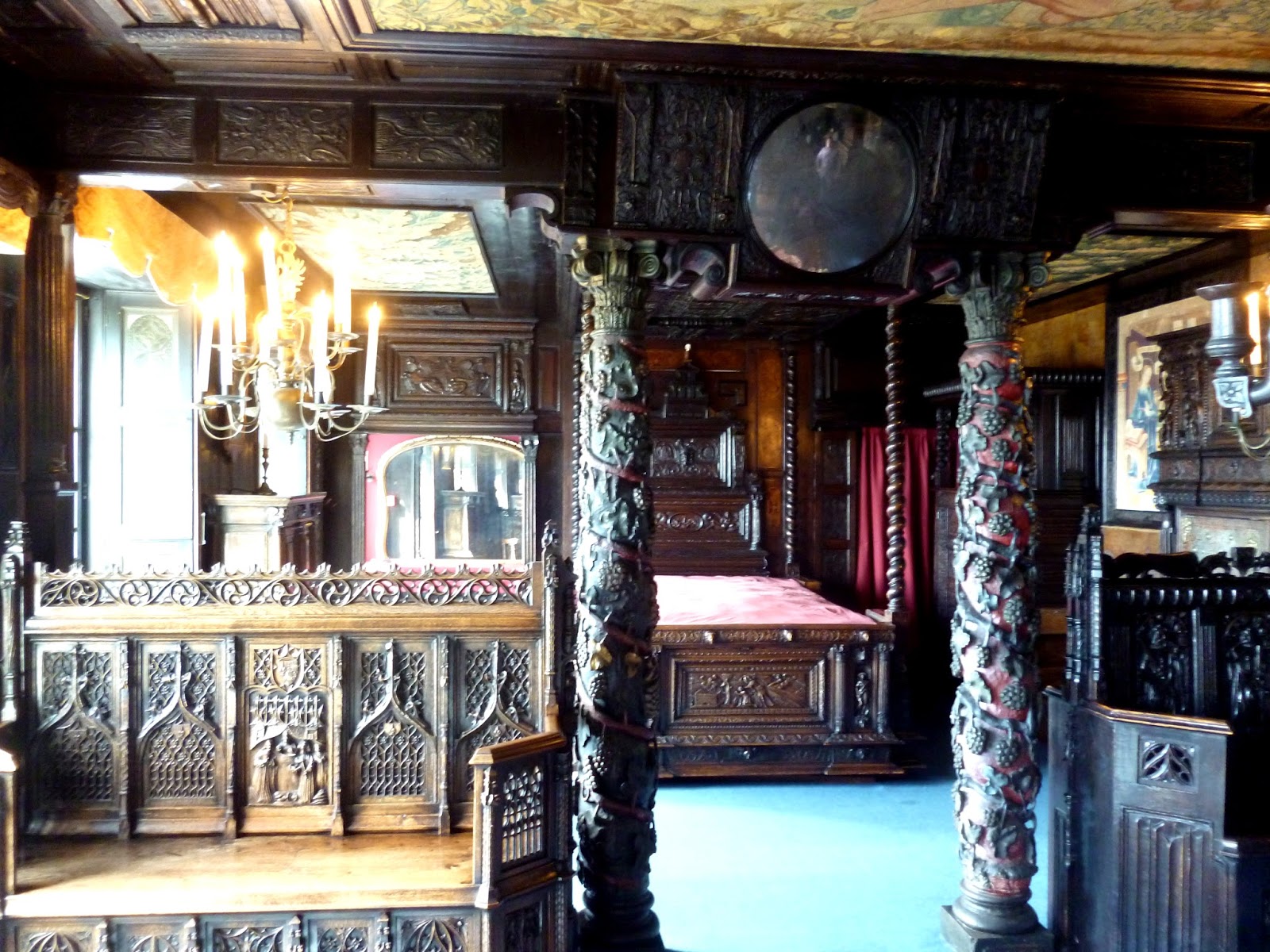
Hugo's bedroom.


'The Look-Out'.


'"Hauteville Fairy"
Première maison
de Victor Hugo à Guernesey
de 1855 à 1856
et demeure de Juliette Drouet
à partir de 1864'

Hugo's mistress lived just a few houses down from the Hugo household.

My Victor Hugo posts:
–––––––––––––––––––––––––––––––––––
Victor Hugo's Hauteville House, Guernsey
Victor Hugo, Place des Vosges
Victor Hugo in Bièvres
Victor Hugo in Candie Gardens, St Peter Port, Guernsey
Émilie de Putron in Foulon Cemetery, Guernsey

29 April 2017

Pierre Desproges: Fonds de tiroir (1990)

Fonds de tiroir is a posthumous publication, findings of his humorous writings collected and put into a vague alphabetical order. The quotation on the back cover illustrates the nature of the content: 'Il n'est pas vrai que je ne respecte rien : j'ai le plus profond respect pour le mépris que j'ai des hommes': ('It's untrue that I have no respect for anything: I've the deepest respect for the contempt that I have for men.')

There's some funny material here, some mediocre, and unfortunately some that seems to be merely filling space, sort of, er, scraping the barrel. Ironically, though, the best part of this book I found in the Preface, in which his friend Renaud says that he initiated the comedian into fishing, whereas the comedian initiated the singer into golf – although he's not about to write anything like 'I was a mate of Desproges, blablabla, and the proof: we shared the same holes!'

In Père-Lachaise, the tomb of Pierre Desproges (1939–88).

28 April 2017

Pierre Combescot: Les Filles du Calvaire (1991)

Pierre Combesot's Les Filles du Calvaire (winner of the Prix Goncourt in 1991, the year of publication) weighs in at four or five hundred pages, depending on the edition. It's in a sense a modern re-working of a nineteenth century novel, filled with many characters, impossible to sum up in terms of plot in a few paragraphs, more Zola than Balzac, although with many digressions, leaps back into time, covering around fifty years of the first part of the twentieth century.

Les Filles du Calvaire is the name of a (real and still extant) métro station opposite the Cirque d'hiver, and close by there's an imaginary café, les Trapézistes, where the central character Madame Maud (formerly the Jewish Rachel Aboulafia, with great exotically-stockinged legs) presides over a group of circus performing clients, freaks (if I can still use that word without being condemned for political incorrectness), pimps, prostitutes (both male and female), crooks, nude dancers, etc.

We whizz back to Rachel's parents and grandparents, from Tunisia to PACA, then onto Nazi Paris and after, all of this in a slang which many might find difficult to cope with, hence the paucity of reviews of the book. The Jewish mythological figure Litith? Certainly she's there in prominence. Translation of this book into English? I can't see one, although that might in many respects be a positive because I hate to think of the mess that could be made of this amazing book.

20 April 2017

Simone de Beauvoir: Les Mandarins II (1954)

Simone de Beauvoir's Les Mandarins (a title referring to the fame and intellectual status of the characters) scooped the Goncourt in 1954, its year of publication. The second part of it here begins at Chapter VI, following on from Les Mandarins I: the first edition was published (unlike these two paperback Folio volumes (also belonging to the original publisher)) in a single Gallimard edition.

Roman à clef is an expression often used of this 1000-page book, although it's not entirely easy to fit the characters neatly into the place of real characters. On the other hand, there are clear autobiographical elements, such as Anne Dubreuilh and her husband the intellectual writer character Robert Dubreuilh resembling the (unmarried) Beauvoir and her long-term companion Jean-Paul Sartre in an apparently open relationship.

There are strong similarities between Anne's relationship with the American author Lewis Brogan from Chicago and Beauvoir's relationship with the author Nelson Algren, who fall in love, visit the States and Mexico, meet for some weeks on three occasions and then part after Lewis goes somewhat cold on Anne on her final visit to Chicago.

Robert Dubreuilh's relationship with Henri Perron, particularly their ideological split, very clearly recalls Camus's split with Sartre, and there are several other characters in the book who can be said to share similarities with people who existed. A settling of accounts? A kind of guessing game? Maybe both, but also a highly rivetting novel about those whose peopled Beauvoir's life during the immediate post-war years.

11 April 2017

Marc Robine: Grand Jacques : Le Roman de Jacques Brel (1998)

I could write reams on the brilliance of Jacques Brel (1929–78), but there's no point. Bob Dylan (another of my songwriter loves) snagged the Nobel prize for Literature, and so rightly, in spite of what so many self-dubbed enthusiasts (for which read clueless enemies) may have thought of him. There's a division between literature and song-writing which sometimes gets blurred, and certainly Dylan and Brel (also Brassens, Cohen, Renaud, Morrissey, Pete Doherty, oh the list is endless) belong to a higher culture way beyond the mere writing of songs to entertain.

Marc Robine's Grand Jacques : Le Roman de jacques Brel is close to 700 pages, including interviews, discographies, etc. I've not yet read any other works on Brel, although I think I can firmly say that this exhaustive (and wonderfully exhausting) work is among the (if not the) best of all time.

This is no hagiography, and I'm sure Brel himself wouldn't have welcomed one: he was mildly homophobic for the time (David Bowie being dubbed as a 'queer'), more than mildly (I'm not too sure, as he was a pop god of a long gone era, so kind of untouchable) phallocratic in that he wasn't content with one woman, but on the plus side I didn't detect a single sniff of racism about him. As for champion of the underclasses?

Depends on what is meant by underclasses. Brel was generous with money and time, a kind of hero, and we have only to listen to his songs, performed with such showmanship, such theatricality, to understand his sympathy for outsiders, shy people, those stricken by alcoholism, by age or unrequited love, to realise that Jacques Brel was a master of many arts he attempted: singing, acting, writing, etc. This book is an immense tribute to the huge talent that was Brel. Chapeau bas, as Barbara would certainly have said.

Jérôme Garcin: Olivier (2011)

I learned a new word in Jérôme Garcin's  Olivier, both in French and in English: gemellologue, meaning 'gemellologist': gemellology is the study of twins. Jérôme Garcin was born on the stroke of midnight on 4 October 1956, and his brother Olivier just after. Only Jérôme is still alive, but his brother Olivier was killed in a traffic accident before his sixth birthday. Olivier the book is very much a gemellological study in itself, although of course from a very emotional as well as learned viewpoint.

Much of Olivier is addressed in the second person singular – tu – to the dead Olivier. The book is filled with recollections of Oliver (or as much as Jérôme Garcin can remember), with speculations as to what might have been, very much with a sense of loss, as if an appendage is missing from the author: one particularly poignant expression is 'looking for his vanished double in the broken mirror.' The remaining half of a severed twin may well seek his missing half in a surrogate, perhaps in the form of a platonic relationship with another person or with a sexual partner.

This then is a scholarly as well as an emotional work, detailing instances of twins in history as well as in literature. This is a fascinating book which possibly makes a few rather unusual digressions, but which I found particularly interesting in its mention of Irène Lézine's findings on two usages of language by twins: the everyday public talk to third persons, and the idiolect used by the twins and comprehensible only by them.

Very interesting indeed is Jérôme Garcin meeting Michel Tournier, of whose Les Météores I was unaware, but whose main concern is about twins. To read in the near future of course, but Olivier itself is so interesting and original that it demands to be read.

2 April 2017

Marjorie Ozanne, Vale, Guernsey

'MARJORIE EDITH
OZANNE
1897 – 1973.'

Marjorie Ozanne was born in Vale and wrote stories and poems in Guernesiaise, particularly for La Gazette de Guernesey in the 1920s, and the Guernsey Evening Press between 1949 and 1965. She was the daughter of a verger of Vale Church, and when he was ill took on his duties there. She founded the world's first bird hospital in Les Cordeliers, Guernsey, where she lived with her companion Nell Littlefield. Ken Hill translated her works, although he had the knowledge to realise the problems of translation and included Ozanne's work simultaneously with his own. She was buried in an unmarked grave until the Société Guernesiaise discovered it in 1988 and gave it this headstone.

Émilie de Putron in Foulon Cemetery, Guernsey

la mémoire
de
ÉMILIE,
FILLE DE
MATTHIEU DE PUTRON,
ET DE MARTHE BOURGAIZE
SA FEMME.
DÉCÉDÉ LE 14 JANVIER 1803,
AGÉE DE TRENTE ANS.'

The importance of this grave is not only that Émilie de Putron was the fiancée of Victor Hugo's son François-Victor, but also that Victor Hugo wrote the inscription, which is unfortunately now virtually illegible. I found most of the inscription in a large and very informative fold-out leaflet at Hugo's Hauteville House, St Peter Port, Guernsey: 'Victor Hugo's Guernsey' by Gérard Pouchain and The Victor Hugo in Guernsey Society, and although some of that too is illegible, very kindly Dinah Bott, chairman of the society, has made a comment below, including a link to the content of Hugo's original words about Émilie. These words I include below, and interestingly they show that the inscription on the grave is a somewhat abbreviated version of what Hugo in fact wrote. Also interesting is that Hugo wrote the girl's forename in the English form 'Emily' as opposed to the French 'Émilie':

'Emily de Putron était le doux orgueil d’une respectable et patriarcale famille. Ses amis et ses proches avaient pour enchantement sa grâce, et pour fête son sourire. Elle était comme une fleur de joie épanouie dans la maison. Depuis le berceau, toutes les tendresses l’environnaient ; elle avait grandi heureuse, et, recevant du bonheur, elle en donnait ; aimée, elle aimait. Elle vient de s’en aller !

'Où s’en est-elle allée ? Dans l’ombre ? Non. C’est nous qui sommes dans l’ombre. Elle, elle est dans l’aurore.

'Elle est dans le rayonnement, dans la vérité, dans la réalité, dans la récompense. Ces jeunes mortes qui n’ont fait aucun mal dans la vie sont les bienvenues du tombeau, et leur tête monte doucement hors de la fosse vers une mystérieuse couronne. Emily de Putron est allée chercher là-haut la sérénité suprême, complément des existences innocentes. Elle s’en est allée, jeunesse, vers l’éternité ; beauté, vers l’idéal ; espérance, vers la certitude ; amour, vers l’infini ; perle, vers l’océan ; esprit, vers Dieu.

'Va, âme !'

Dinah Bott mentions that the founder of The Victor Hugo in Guernsey Society, Dr Gregory Stevens Cox, states that Victor Hugo's son François-Victor – whose project was to translate Shakespeare – arrived in Guernsey in 1855, found Emily de Putron to help him, and fell in love with her. They were engaged, although in January 1865, on near completion of the project, Emily died from tuberculosis.

Hugo's full text is here .

My Victor Hugo posts:
–––––––––––––––––––––––––––––––––––
Victor Hugo's Hauteville House, Guernsey
Victor Hugo, Place des Vosges
Victor Hugo in Bièvres
Victor Hugo in Candie Gardens, St Peter Port, Guernsey
Émilie de Putron in Foulon Cemetery, Guernsey

31 March 2017

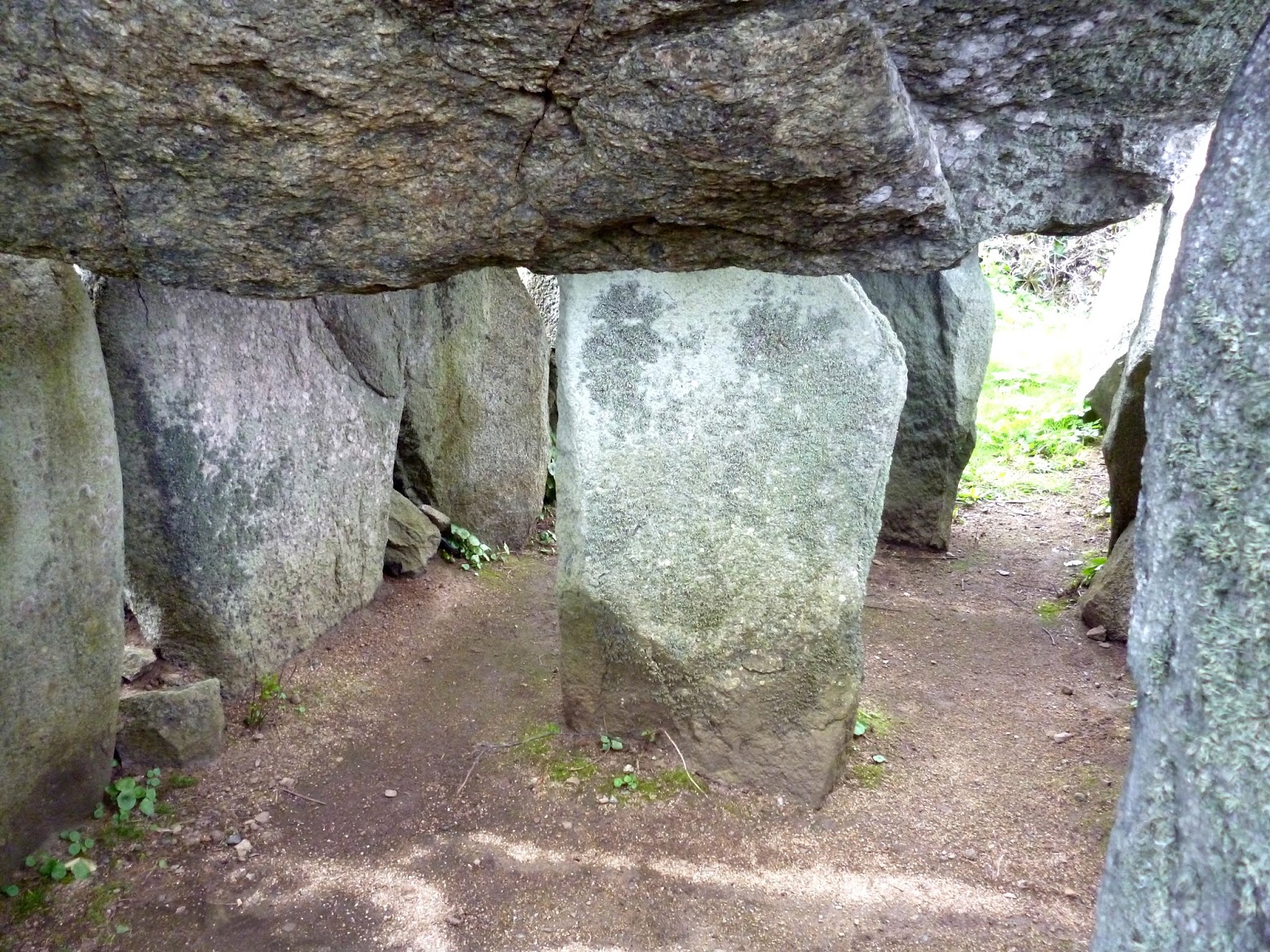
Le Trepied Dolmen, Perelle Bay, Guernsey

A prehistoric passage grave built between around 4000 and 2500 BC, and in use until about 1000 BC. Excavations by F. C. Lukis began in 1840. The site is frequently mentioned in seventeenth century witch trials.

Inside the dolmen.

Close to the dolmen, the Mont Chinchon Battery, one of over sixty, was built as a defence against possible invasion by France. The cannons were cast between 1760 and 1820. It was also known as the Druids Altar Battery due to its closeness to the Trepied dolmen.

Thomas de la Rue in Forest and St Peter Port, Guernsey

The pub in St Peter Port, Guernsey, named after the printer.

'THOMAS de la RUE
Founder of the House of De La Rue
1793 – 1866'

De la Rue co-founded Le Publiciste, and shortly afterwards his own publication Le Miroir politique. His was the first business to be granted the right to publish playing cards.


'Thomas
de la Rue
1793 – 1866
Printer
Born at
Le Bourg'

Lihou Island, Guernsey

Lihou Island, the most western of the Channel Islands, seen from Guernsey.

Lihou Island, which is about a half of a mile from Guernsey, can be reached on foot during low tide periods: a causeway links it to the mainland. There's a lot of nonsense about stout footwear being needed to make the crossing, although anyone making the twenty-minute effort, while not needing wellingtons, should be prepared for wet feet: the causeway isn't entirely continuous, and the (slightly) adventurous have to contend with rather slippery seaweed (once a part here of the iodine industry). Apart from Victor Hugo's Hauteville house and the Little Chapel, this must rank as the third Guernsey must: and it's free! (In The Book of Ebenezer le Page (1981), G. B. Edwards mentions the childhood days of Ebenezer and his friend Jim, who get stranded on the island and spend the night there.)

Part of the remains of the twelfth century Benedictine Priory here.

Lihou farmhouse, now a hostel.

29 March 2017

Denys Corbet in Forest, Guernsey

The grave of Denys Corbet (1826 – 1909), poet and painter. He wrote in English, French and Guernsey French and patois, and his noted works are L'Touar de Guernsey, Les Fueilles de la forêt and Les Chants du Drain rimeux (translated as The Songs of the Last Rhymster). He was the editor of Le Baillage and lived at La Roberge. 

G. B. Edwards in St Sampson, Guernsey

Hawkesbury House, Braye Road, St Sampson, Guernsey.

'G. B. Edwards
1899 – 1976
author of
The Book of
Ebenezer Le Page
lived here'

28 March 2017

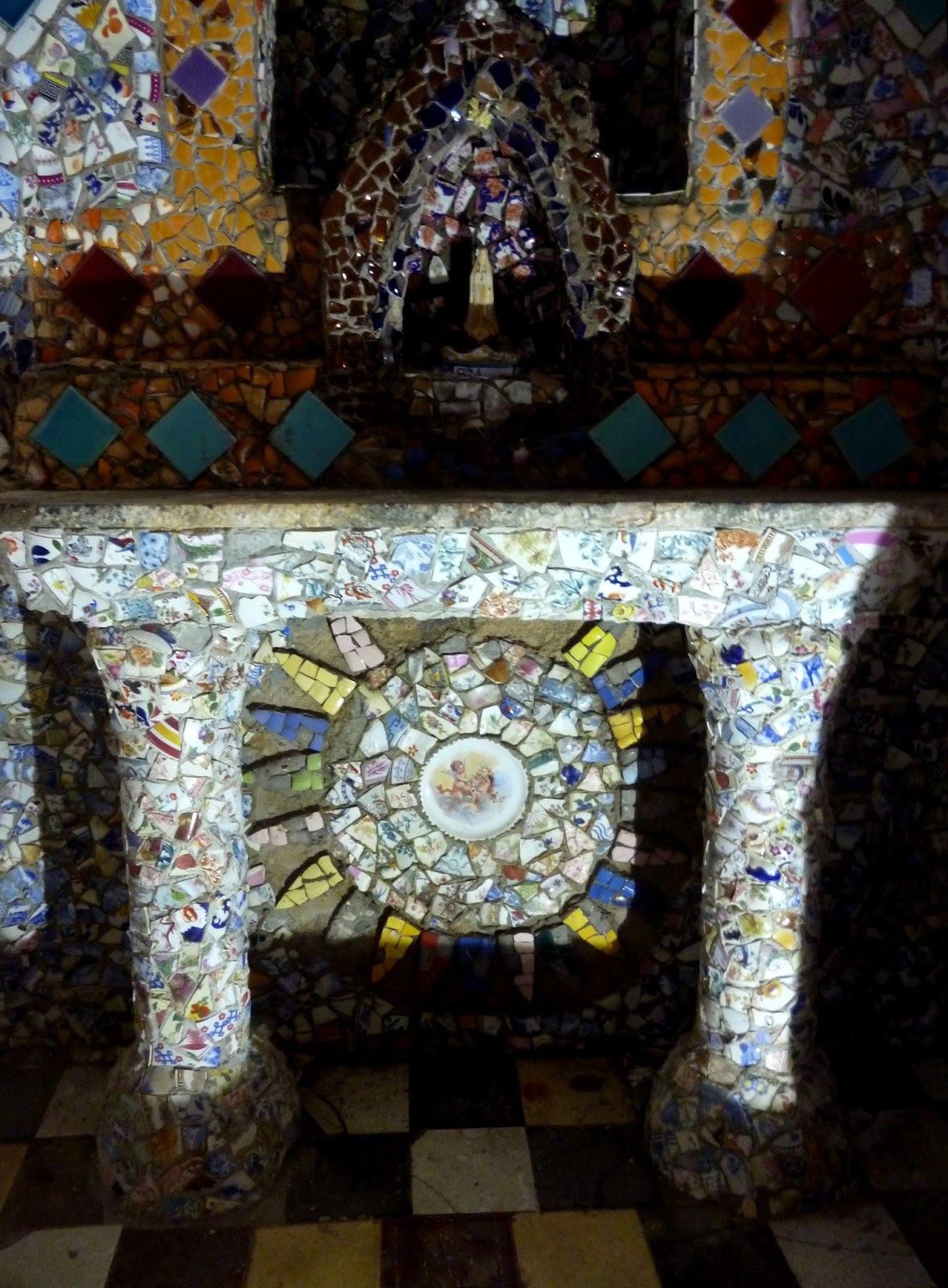
The Little Chapel, Les Vauxbelets, St Lawrence, Guernsey

In 1914 Brother Déodat, inspired by the shrine in Lourdes, began constructing a small chapel in Les Vauxbelets, St Lawrence, Guernsey. What are now on view are the surviving elements of his third attempt, begun in 1923 and completed a few years later. The materials are pieces of china, pebbles, etc, which are normally associated with outsider art. In 2015 the site was closed because of possible damage due to collapse, and scaffolding has now saved the structure from complete collapse. The restoration continues, and although most of the exterior is at present unseeable, the highly impressive interior can still be viewed. I let the images below speak for themselves.


Art brut (Outsider Art) and associated:
––––––––––––––––––––––––––––––––––––
Rémy Callot, Carvin (Nord)
Carine Fol (ed.): L'Art brut en question | Outsider Art in Question
Kevin Duffy, Ashton-in-Makerfield
The Art Brut of Léopold Truc, Cabrières d'Avignon (34)
Le Musée Extraordinaire de Georges Mazoyer, Ansouis (34)
Le Facteur Cheval's Palais Idéal, Hauterives (26)
The Little Chapel, Guernsey
Museum of Appalachia, Norris, Clinton, Tennessee
Ed Leedskalnin in Homestead, Florida
La Fabuloserie, Dicy, Yonne (89)
Street Art City, Lurcy-Lévis, Allier (03)
The Outsider Art of Jean Linard, Neuvy-deux-Clochers (18)
Jean Bertholle, La Fabuloserie, Yonne (89)
Jean-Pierre Schetz, La Fabuloserie, Yonne (89)
Jules Damloup, La Fabuloserie, Yonne (89)
Camille Vidal, La Fabuloserie, Yonne (89)
Pascal Verbena, La Fabuloserie, Yonne (89)
The Art of Theodore Major
Edward Gorey's Yarmouth Port, Cape Cod, MA
Marcel Vinsard in Pontcharra, Isère (38)
Vincent Capt: Écrivainer : La langue morcelée de Samuel Daiber
The Amazing World of Danielle Jacqui, Roquevaire (13)
Alphonse Gurlie, Maisonneuve (07)
Univers du poète ferrailleur, Lizio, Morbihan
Les Rochers sculptés de L'Abbé Fouré, Rothéneuf, Saint-Malo
Robert Tatin in Cossé-le-Vivien, Mayenne
René Raoul's Jardin de pierre in Pléhédel, Côtes d'Armor
La Demeure du Chaos, Saint-Romain-au-Mont-d'Or, Rhône (69)
Emmanuel Arredondo in Varennes Vauzelles, Nièvre (58)
Musée de la Luna Rossa (revisited), Caen, Calvados (14)
La Fontaine de Château-Chinon, Nièvre (58)